
Taboola is not a channel you hand to a generalist and check once a month. A Taboola media buying agency needs to manage a fast-moving system of audience signals, editorially native creative, landing-page performance, and budget decisions. When one part slows down, the account loses momentum. When those parts operate together, Taboola can become a scalable acquisition channel rather than a source of unpredictable spend.
The difference is operational. Strong results do not come from finding one headline that works or pushing budgets after a short-term spike. They come from a repeatable process that launches enough creative, isolates real winners, controls quality, and gives the business a clear view of profitability.
What Taboola Media Buying Actually Requires
Taboola reaches people while they are consuming publisher content, not while they are actively searching for a product. That changes the job of media buying. Your ads must earn attention in a competitive editorial environment, then carry users to a page that delivers on the promise without creating friction.
This is why native acquisition is rarely solved by targeting alone. The account needs a constant supply of creative angles, images, videos, headlines, and landing-page variants. A media buyer can optimize bids and placements, but a thin creative pipeline will eventually cap performance. The same is true in reverse: high-volume creative without structured campaign management produces noise instead of insight.
For growth teams, the real question is not whether an agency can launch Taboola campaigns. It is whether it can run the complete feedback loop:
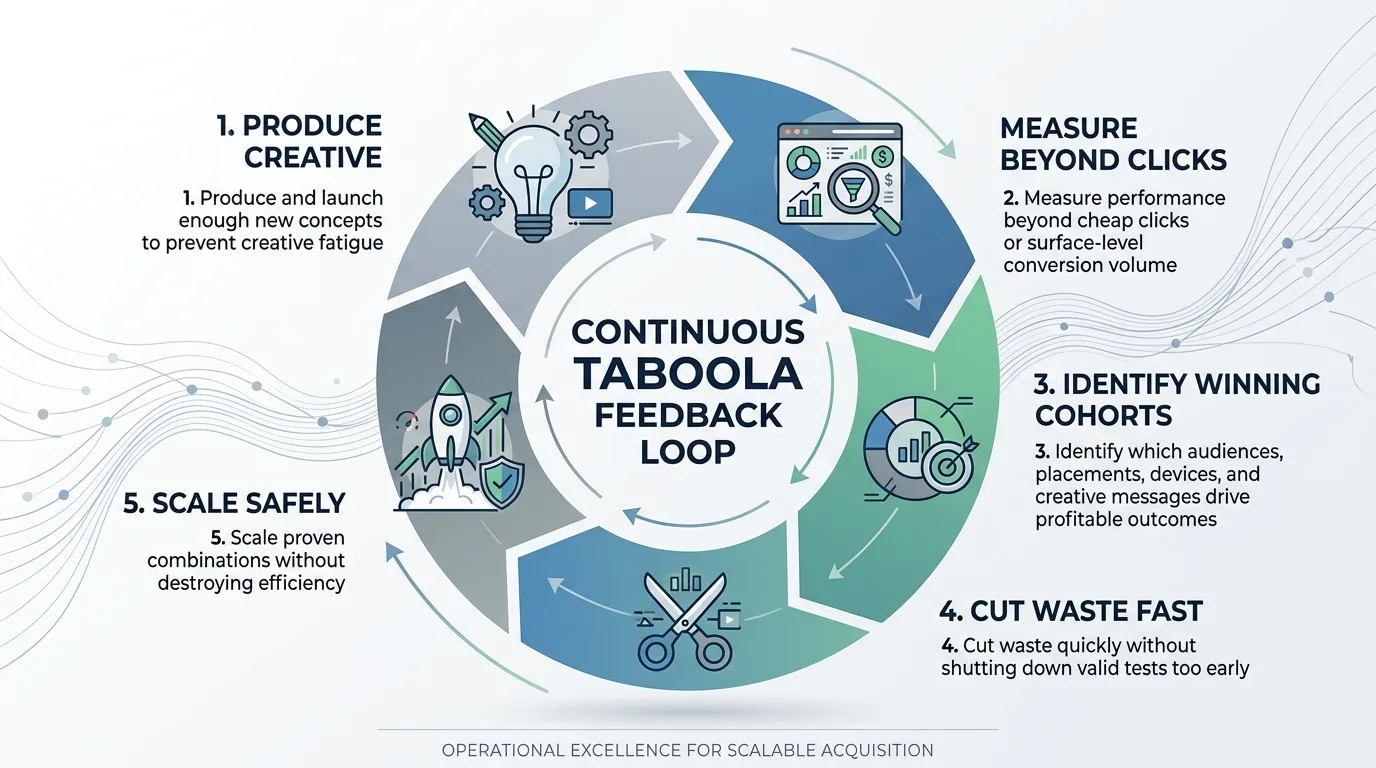
- Produce and launch enough new concepts to prevent creative fatigue
- Measure performance beyond cheap clicks or surface-level conversion volume
- Identify which audiences, placements, devices, and creative messages drive profitable outcomes
- Cut waste quickly without shutting down valid tests too early
- Scale proven combinations without destroying efficiency
That loop needs to run every week, and often every day when spend is material.
The Operating Model Behind Profitable Scale
A capable Taboola media buying agency brings order to a channel that can become messy fast. Campaigns multiply, creative versions pile up, and performance shifts by publisher, device, geography, and daypart. Without a clear naming structure, testing framework, and reporting layer, teams spend more time hunting for answers than acting on them.
Creative Is the Main Growth Lever
On Taboola, the ad has to interrupt a content session without feeling disconnected from it. That does not mean writing vague clickbait. It means translating a real customer pain point, product mechanism, offer, or proof point into a message people want to investigate.
The strongest creative programs test distinct concepts, not just cosmetic changes. A new image paired with the same claim is useful, but it is not a complete test of market response. Agencies should build variations around different reasons to care: price relief, speed, transformation, social proof, problem awareness, comparison, authority, and product demonstration.
For example, a subscription brand may test a founder-led angle, a customer-results angle, an educational angle, and a direct offer. An ecommerce brand may test the product in use, a problem-first story, a before-and-after visual, and a category comparison. The purpose is to find a message with enough pull to support scaling, not simply win a low-cost click.
Creative velocity matters because winners decay. Publisher audiences see ads repeatedly, competitors copy visible angles, and performance changes as inventory mix shifts. A partner that delivers a few assets per month cannot respond at the speed native media requires. The creative pipeline should stay ahead of fatigue, with clear rules for launching, learning, refreshing, and retiring assets.
Testing Must Be Structured, Not Random
A campaign full of unrelated ads and broad optimization changes will generate activity, but not reliable learning. Good testing isolates variables. It gives a concept enough spend to show a pattern while protecting the account from unnecessary loss.
The exact threshold depends on conversion volume, purchase cycle, target CPA, and the reliability of the conversion signal. A lead-generation advertiser with same-day call data can make decisions faster than a high-ticket brand that needs weeks to validate booked appointments or closed revenue. The agency should adapt the testing cadence to the business model instead of applying one rigid rule to every account.
Testing also needs a hierarchy. Start with the largest sources of upside: angle, offer, landing page, and audience approach. Then refine execution through headlines, thumbnails, calls to action, bid strategy, and placement-level controls. Teams often waste time optimizing small details while running an offer or landing page that cannot convert cold traffic efficiently.
Optimization Should Protect Revenue Quality
Taboola can produce scale, but volume is not the same as value. Cheap traffic can look attractive in platform reporting and still create poor downstream outcomes. For lead generation, that may mean low contact rates, weak qualification, or low sales conversion. For ecommerce, it may mean low average order value, excessive returns, or weak repeat purchase behavior. For apps, it may mean installs without activation or retention.
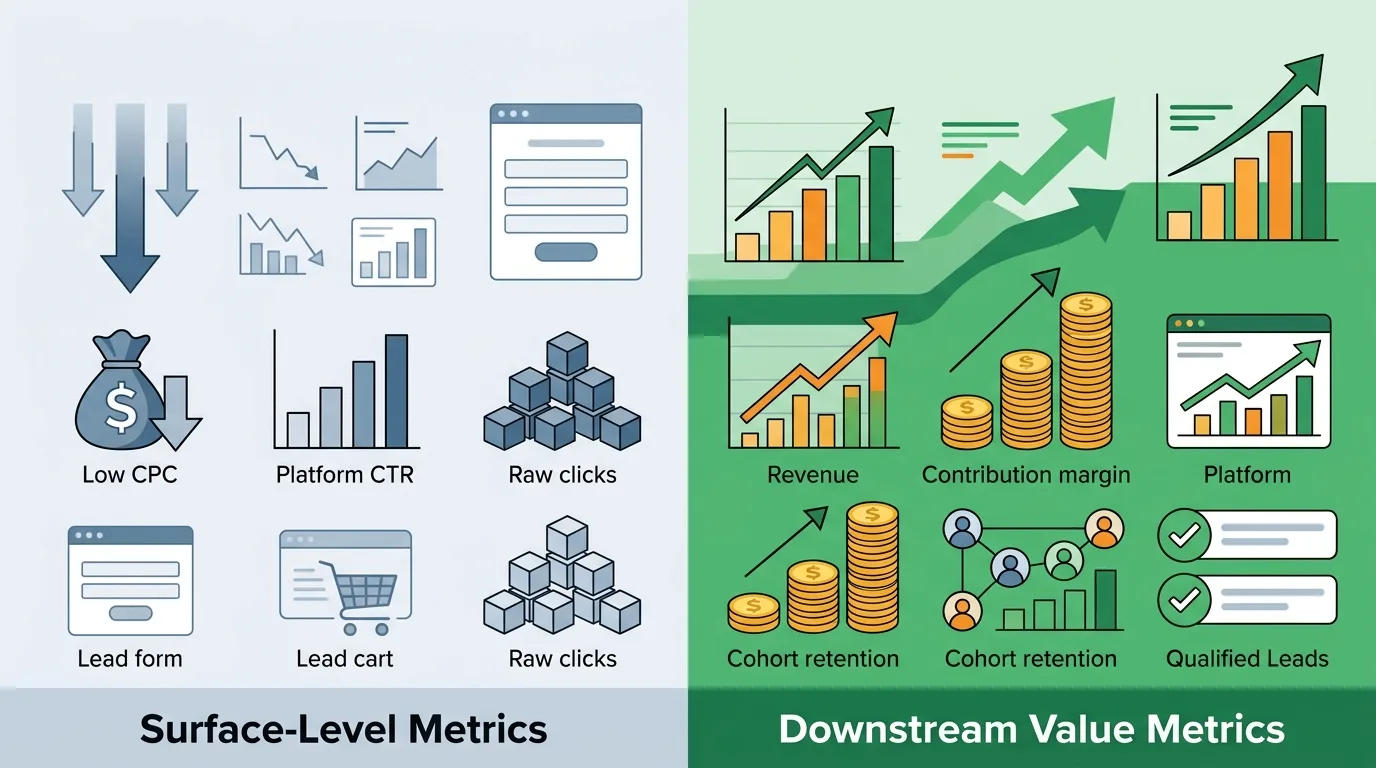
A serious agency connects optimization to the metric that matters. That can include qualified leads, approved applications, first purchases, contribution margin, activated users, or revenue. Platform conversion data is useful, but it should not be the only source of truth when it differs from the business outcome.
This is where reporting becomes a decision tool rather than a status update. Leadership should be able to see what is scaling, what is being tested, what is losing efficiency, and what action is being taken. If reporting cannot explain why spend moved, it is not providing operational control.
What to Look for in a Taboola Partner
Agency selection should focus less on presentation polish and more on how the team works when performance changes. Ask how creative requests become live tests, how frequently campaigns are reviewed, and what triggers a budget increase or cut. Ask who owns landing-page feedback, whether the team can work with offline conversion data, and how it separates a temporary fluctuation from a genuine performance shift.
You should also look for media and creative under one operating system. When one partner buys traffic and another produces assets, feedback slows down. The media team sees fatigue but waits for a creative brief. The creative team produces work without enough performance context. Valuable learnings get lost between meetings.
Conversion Collective is built around the opposite model: high-velocity creative and cross-platform media buying operating as one managed growth function. For Taboola, that means creative feedback can become new tests quickly, while centralized campaign systems keep execution consistent as the account expands.
The right partner should be comfortable with accountability. That includes clear measurement definitions, access to the data needed for decisions, and direct conversations about constraints. Sometimes the issue is not media buying. It may be an offer with weak market pull, a slow landing page, limited creative approvals, inconsistent sales follow-up, or a conversion event that does not reflect revenue quality. A performance partner should identify the constraint early instead of disguising it with more spend.
The Common Reasons Taboola Programs Stall
Most stalled accounts have a predictable pattern. Creative production is too slow, so fatigued ads stay active longer than they should. Tests are launched without a clear hypothesis, so results do not translate into the next round of action. Budgets are scaled before conversion quality is validated. Or reporting stops at clicks and platform CPA while the business sees weaker economics downstream.
Another common issue is over-fragmentation. Splitting modest budgets across too many campaigns, audience segments, and creative variants can prevent the platform from gathering meaningful signals. More structure is not always better. The account needs enough organization to reveal performance drivers, but enough concentration for winning campaigns to earn scale.
There is also a trade-off between control and exploration. Placement exclusions, bid caps, and tight targeting can protect efficiency, especially in mature accounts. Applied too early, they can restrict delivery and prevent the team from finding new pockets of volume. A disciplined agency knows when to constrain the account and when to let a controlled test explore.
Build a System That Can Keep Up
Taboola rewards businesses that treat paid acquisition as an operating system, not a collection of ad buys. The channel needs a consistent rhythm: new creative entering the account, performance signals being reviewed, winners receiving budget, weak combinations being removed, and landing-page insights feeding the next launch cycle.
That rhythm creates compounding advantage. Each test produces more than a result. It reveals what message earns attention, what promise converts, which customer segment responds, and where the economics hold. Over time, those insights make launches faster and scaling decisions more confident.
The best time to evaluate your Taboola program is before spend becomes the problem. Build the creative capacity, measurement discipline, and campaign control required to act quickly when a winner appears. Then growth is not dependent on a lucky ad. It is supported by a system built to find the next one.