
Most paid acquisition teams do not have a creative shortage. They have a decision shortage. Ads launch, spend accumulates, and reporting fills up with disconnected observations that never become a repeatable next move. A structured creative testing framework fixes that problem by turning creative production, media buying, and analysis into one operating system.
The objective is not to find one winning ad. It is to build a reliable process for identifying which messages, hooks, formats, offers, and audience angles produce profitable demand - then producing the next round faster and with more confidence.
Why creative testing breaks at scale
Creative testing usually fails before the data arrives. Teams launch too many variables in a single ad, change targeting and creative at the same time, or judge results before the platform has enough signal. When performance moves, no one can explain why.
The opposite problem is just as costly: testing too cautiously. A team may make one new video per week, wait for a perfect result, then attempt to scale it across every audience and channel. That pace cannot keep up with ad fatigue, changing inventory, or competitor pressure.
A productive system sits between random volume and slow perfectionism. It creates enough controlled variation to surface patterns while maintaining the discipline needed to trust the result. That is how creative becomes a scalable acquisition lever rather than a stream of opinions.
The structured creative testing framework
A framework needs four connected parts: a clear testing thesis, modular creative production, disciplined campaign design, and a decision process that turns results into the next set of tests. If any part is missing, testing becomes harder to scale.
Start with a testable hypothesis
Every creative batch should answer a specific business question. “Make new ads” is a production request, not a testing plan. A useful hypothesis identifies the variable, the audience problem it addresses, and the expected outcome.
For example, an ecommerce brand could test whether urgency around limited inventory outperforms a product-demonstration hook for first-time buyers. A subscription business could test whether emphasizing a low entry price beats a message built around long-term value. A lead generation advertiser might compare pain-led copy against outcome-led copy.
The hypothesis does not need to be academic. It needs to be clear enough that the team knows what changed and what a positive result would mean. This prevents creative feedback from collapsing into subjective comments about whether an ad “feels stronger.”
Build a creative matrix, not isolated concepts
High-velocity testing works when creative is built in modules. The team should be able to vary one component without rebuilding the entire asset from scratch.
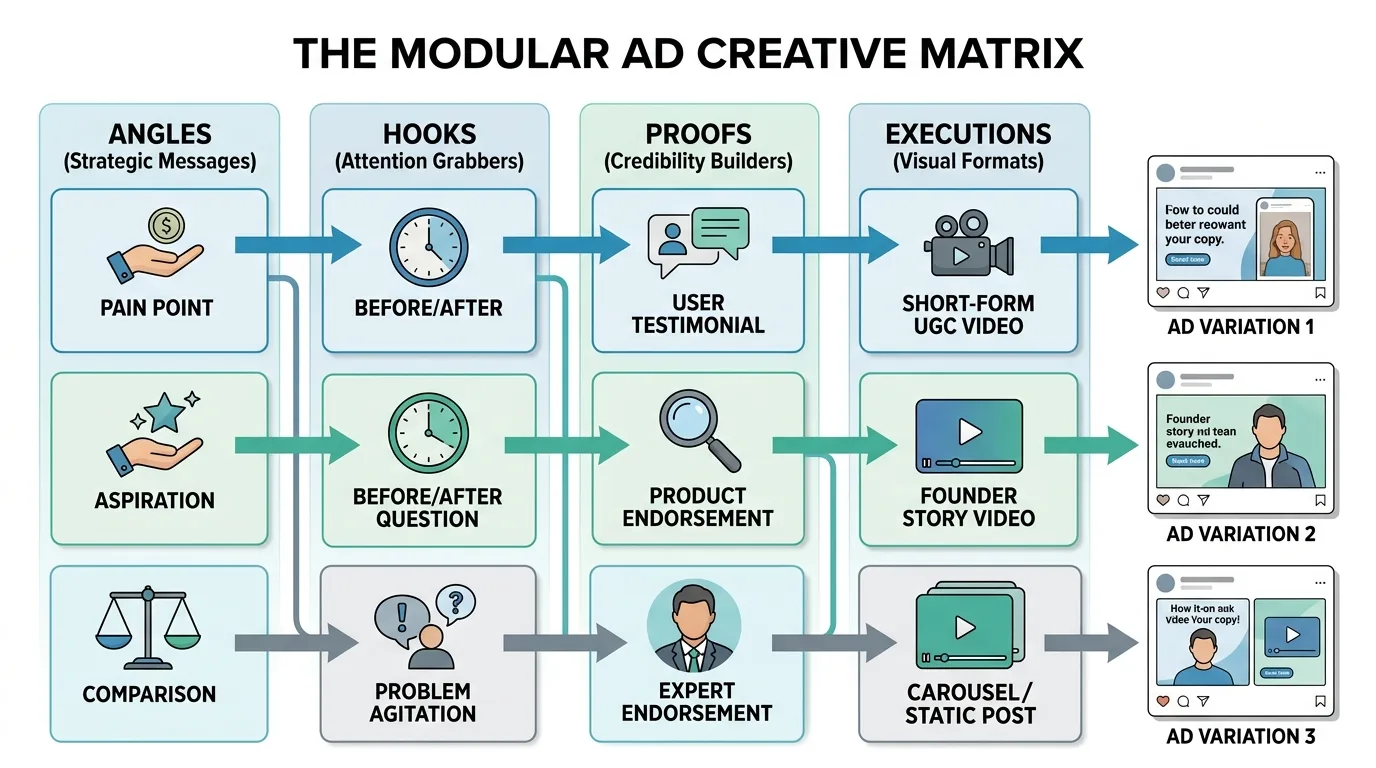
A practical creative matrix includes four major dimensions:
- The angle: pain point, aspiration, proof, comparison, urgency, education, or objection handling.
- The hook: the first visual, opening line, headline, or pattern interrupt that earns attention.
- The proof: testimonial, product demo, expert endorsement, statistics, before-and-after evidence, or editorial-style validation.
- The execution: static, UGC-style video, founder-led video, motion graphic, carousel, native-style unit, or longer-form demonstration.
This structure makes production more efficient because one validated idea can generate multiple executions. It also makes analysis sharper. If a proof-led angle wins across three formats, that is a stronger signal than one isolated ad with a strong click-through rate.
The right volume depends on spend, conversion cycle, and available production capacity. A brand spending $5,000 per day can create meaningful signals more quickly than one spending $500 per day. Smaller accounts should test fewer variables per cycle and prioritize large strategic differences. Larger accounts can support more granular testing across hooks, edit styles, and claims.
Separate concept testing from iteration
Concept testing asks, “What should we say?” Iteration asks, “What is the best way to say it?” Treating these as the same stage wastes budget.
| Testing Stage | Core Question | Focus Area | Goal |
|---|---|---|---|
| Concept Testing | ”What should we say?” | Materially different messages and angles (e.g., convenience vs. savings) | Identify the message territory that produces qualified action |
| Iteration Testing | ”What is the best way to say it?” | Specific execution mechanics (e.g., hooks, pacing, CTA, headlines) | Improve delivery efficiency without changing the core winning message |
At the concept stage, test materially different messages. A mobile app might compare convenience, cost savings, and social proof. A publisher might compare curiosity-driven headlines with expertise-driven value propositions. The goal is to identify the message territory that produces qualified action.
Once a concept proves itself, iterate on its mechanics. Test the opening three seconds, the visual pacing, the headline, call to action, length, or proof placement. This is where teams improve efficiency without losing the core message that made the ad work.
A common mistake is iterating on a weak concept because the team has already invested in production. If the underlying angle does not create demand, better editing will not rescue it. Cut losses quickly and move resources toward stronger message territories.
Campaign structure must protect the signal
Creative results are only useful if the campaign setup allows for clean interpretation. When an account has overlapping audiences, inconsistent optimization events, frequent budget edits, and dozens of ads competing for minimal delivery, performance data becomes noisy.
The campaign architecture should match the question being tested. Early-stage concept tests often need controlled environments where spend can reach each asset. Scaling campaigns need broader delivery and enough creative rotation to prevent concentration on a single aging winner.
This does not mean every test requires a rigid one-ad-set experiment. Platform behavior matters. Meta, TikTok, Google, Taboola, and custom channels distribute spend differently, and each platform has its own learning dynamics. The principle is consistent: avoid changing so many variables at once that a result cannot be acted on.
Media buyers and creative teams also need shared naming conventions. Each asset should be traceable to its angle, hook, format, offer, and production batch. Without that operational detail, the team cannot reliably aggregate results across hundreds of ads or identify whether a winner is truly repeatable.
Decide with business metrics, not vanity metrics
A strong thumb-stop rate or click-through rate can indicate that an ad is earning attention. It does not prove that the ad produces profitable customers. Likewise, a creative with an average click-through rate may drive stronger conversion quality because it sets more accurate expectations.
The decision hierarchy should reflect the business model. For many advertisers, cost per acquisition, return on ad spend, contribution margin, lead quality, or subscription retention matters most. Engagement metrics are diagnostic inputs, not the final score.
Use performance windows that match the conversion cycle. An impulse-purchase offer may show enough direction within days. A high-consideration lead funnel may require more time for qualification and sales follow-up. Killing ads too early can eliminate viable winners; waiting too long burns spend on concepts that are clearly underperforming.
Define the decision rules before launch. For example, an asset may be paused if it spends a set multiple of target CPA without downstream conversion evidence. An asset may move to an iteration queue when it has strong engagement but weak conversion. A proven asset may enter scale when it clears profitability thresholds across enough spend to reduce the risk of a false positive.
Turn winners into a compounding system
The value of testing is not the weekly report. It is the institutional knowledge that accumulates over time.
Every winning or losing batch should produce a concise readout: what was tested, what changed, where it ran, how it performed, and what should happen next. The best insight statements are specific. “UGC works” is not useful. “First-person product demonstrations that show the result in the opening two seconds outperform lifestyle intros for prospecting audiences” is actionable.
That insight should affect the next production brief, campaign launch, and budget allocation. Winning hooks can be adapted into new formats. Strong proof points can be carried into landing pages and email. Losing angles can be deprioritized until the offer, season, or audience changes.
Creative fatigue also belongs in the system. A winner is not permanently evergreen just because it once scaled. Track spend concentration, frequency, efficiency trends, and the performance gap between established ads and new challengers. The goal is not to replace every winner immediately. It is to maintain a pipeline that prevents performance from depending on a handful of aging assets.
What operational maturity looks like
A mature creative testing operation does not confuse speed with chaos. It has a visible backlog of hypotheses, defined production lanes, clear launch standards, centralized reporting, and a regular cadence for decisions. Teams know which assets are in concept testing, which are being iterated, which are ready to scale, and which have been retired.
This is where integrated creative and media management matters. When production operates separately from buying, feedback arrives late and often lacks context. When the same growth function owns both, creative feedback is grounded in delivery, conversion quality, spend thresholds, and the realities of each channel.
The payoff is not merely more ads. It is faster learning per dollar spent. A structured creative testing framework gives growth teams the control to move quickly, protect profitable spend, and keep creating new paths to scale before the current winners fade.