
Most paid acquisition problems are not caused by a lack of traffic. They come from a disconnected system: prospecting campaigns chase cheap clicks, retargeting carries too much revenue pressure, creative testing happens too slowly, and reporting makes every channel look like it worked alone. Full funnel media buying fixes that operating problem by managing demand creation, demand capture, and conversion as one performance system.
For growth teams spending meaningful budget across Meta, Google, TikTok, Taboola, and other channels, the goal is not to be present everywhere. The goal is to understand what each channel, audience, and creative asset contributes to profitable growth - then move faster on what the data proves.
What Full Funnel Media Buying Actually Means
Full funnel media buying is the coordinated management of paid media across every stage of the buyer journey. It connects upper-funnel reach and demand generation with mid-funnel consideration, lower-funnel conversion activity, and post-conversion retention or expansion where applicable.
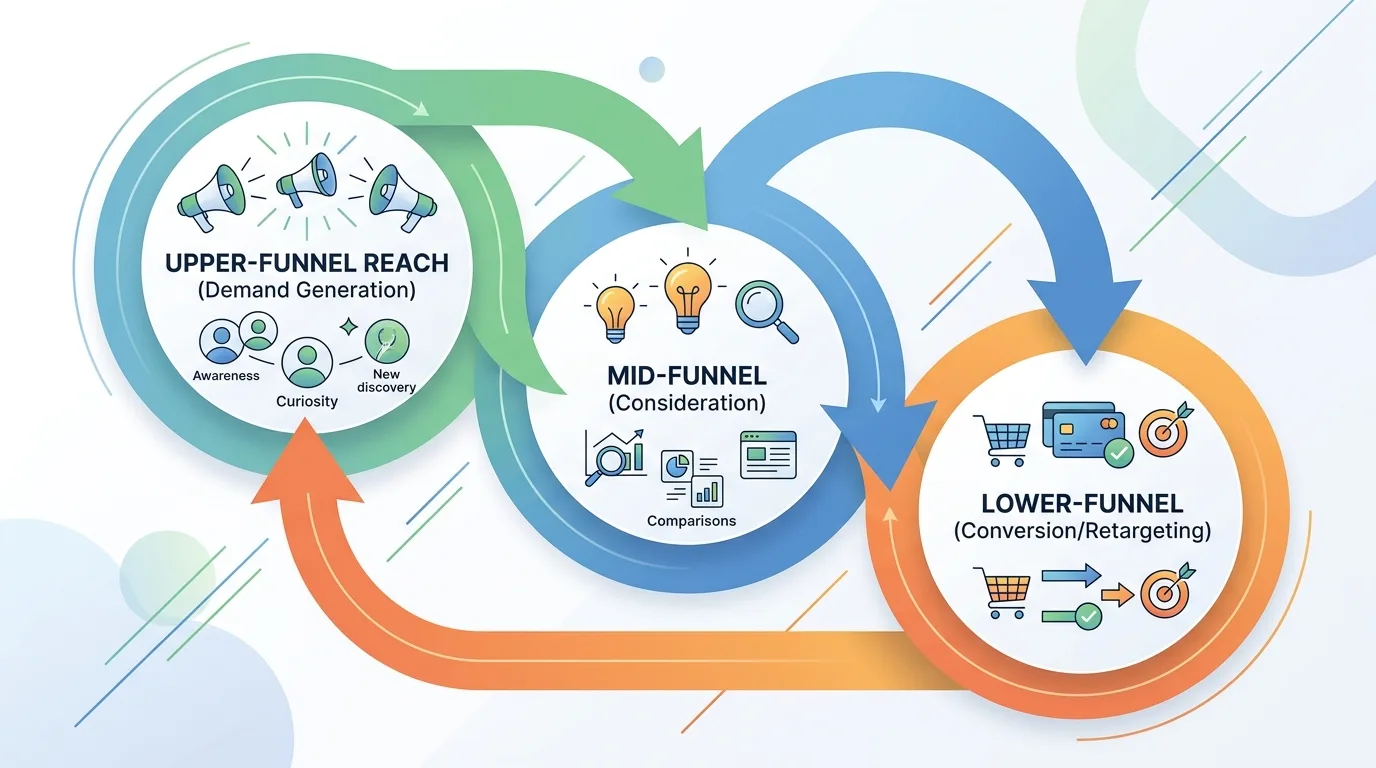
That definition sounds straightforward. Execution is not. A full-funnel program must decide where incremental demand is coming from, which messages move a cold audience toward action, when users need another touch, and how much credit each interaction deserves. It also has to do that while protecting margin, controlling frequency, and responding quickly when performance shifts.
A narrow media buying model often optimizes only for platform-reported cost per acquisition. That can produce short-term gains, particularly when branded search volume is high or retargeting pools are large. But it can also create a false picture of scale. If conversion campaigns capture users generated elsewhere, the account may look efficient while the business stops creating new demand.
The full-funnel approach asks a more useful question: what combination of spend, creative, and channel mix produces profitable customer growth over time?
The Funnel Is a System, Not a Campaign Naming Convention
Many accounts have campaigns labeled awareness, consideration, and conversion. That alone does not make them full funnel. The system only works when the stages are connected through a shared measurement plan, a consistent creative strategy, and budget decisions based on business outcomes.
At the top of the funnel, paid media introduces a problem, desire, product, or offer to people who are not actively searching for it. Success here is not always an immediate purchase. Depending on the business, useful signals can include qualified site visits, video engagement, content consumption, new-user conversion rate, lift in branded search, or downstream revenue from newly acquired cohorts.
In the middle of the funnel, the job changes. The audience may know the brand but still need proof, differentiation, education, or a clearer reason to act. Product demonstrations, comparison angles, testimonials, advertorials, lead magnets, and creator-style videos often perform well here because they reduce uncertainty rather than simply repeating the initial message.
At the bottom of the funnel, media buying should remove friction. That may mean a direct offer, urgency, abandoned-cart messaging, high-intent search coverage, or a retargeting sequence built around the objections that stopped the first conversion. The mistake is treating bottom-funnel campaigns as a rescue plan for weak demand generation. Retargeting is valuable, but it cannot scale indefinitely when the top of the funnel is underfed.
Creative Is the Control Lever
Media buyers can adjust bids, audiences, placements, and budgets. Those levers matter, but creative usually determines whether an account can find new scale without paying more for the same people.
A full-funnel creative system uses different messages for different levels of awareness. Cold audiences may respond to a sharp problem statement, a surprising outcome, or a category-level insight. Warm audiences need evidence that the solution is credible. High-intent users need a reason to choose now rather than later.
This is why one winning ad should not be copied into every campaign with minor edits. The core angle may be strong, but the execution must match the audience’s context. A founder testimonial that drives efficient first-touch engagement may need product proof and a specific call to action when used in retargeting. A search ad built for purchase intent may be too transactional for a user seeing the brand for the first time on TikTok.
Testing velocity matters as much as creative quality. If a team launches only a few new ads per month, it learns too slowly to keep pace with fatigue, competitor activity, changing offers, and platform volatility. High-volume testing does not mean producing random variations. It means building a repeatable pipeline of hypotheses across hooks, formats, offers, proof points, visual treatments, and landing-page messages.
Build Measurement Around Decisions, Not Dashboards
A full-funnel program does not need perfect attribution to make better decisions. Perfect attribution does not exist, especially across multiple devices, privacy constraints, long consideration cycles, and platforms that all claim credit. What matters is having enough directional clarity to allocate budget with discipline.
Start with the business metric that matters most: contribution margin, qualified pipeline, subscription revenue, approved leads, or another outcome tied to real value. Then define the supporting metrics that explain movement at each stage of the funnel.
Platform reporting is useful for daily optimization, but it should not be the only source of truth. Compare it with first-party conversion data, CRM outcomes, cohort performance, blended acquisition cost, and revenue trends. When possible, use controlled tests to evaluate incremental impact. Geo tests, holdouts, creative tests, and spend experiments can reveal whether a channel is creating demand or simply receiving credit for it.
The right reporting cadence separates urgent operational decisions from strategic ones. Daily views should identify broken tracking, spend anomalies, creative fatigue, and delivery changes. Weekly reviews should focus on active tests, budget reallocations, and channel-level efficiency. Monthly or quarterly reviews should evaluate incrementality, customer quality, and whether the funnel mix supports the company’s growth target.
How to Operate a Full Funnel Media Buying Program
The strongest programs run on a consistent operating rhythm. Strategy without execution speed is a planning document. Execution without structure creates noise.
A practical system has four connected disciplines:
- Audience and channel mapping: Define who each channel can reach, what level of intent it captures, and the role it should play in the acquisition path.
- Creative production and testing: Launch enough purposeful static and video variations to identify winning messages before fatigue erodes performance.
- Campaign architecture and optimization: Keep prospecting, consideration, conversion, and retention objectives organized without over-segmenting budgets into campaigns that cannot learn.
- Unified performance reporting: Connect platform-level signals to blended efficiency and downstream business outcomes so budget decisions are accountable.
The details depend on the business model. An ecommerce brand with a short buying cycle can often move users from discovery to purchase in days. A B2B lead generation company may need weeks or months of nurturing before it can judge lead quality. A subscription app may accept a higher initial acquisition cost if retention and lifetime value justify it. Full funnel does not mean every company needs the same campaign structure. It means every company needs a clear view of how paid media produces value across time.
Common Failure Points That Limit Scale
The first failure point is treating channels as separate vendors. When Meta, Google, TikTok, and native media are managed in silos, each team optimizes for its local metric. No one owns the combined result. A channel can look less efficient in isolation while improving total customer acquisition by expanding the retargeting pool, increasing branded demand, or reaching an audience search cannot capture.
The second is over-relying on retargeting and branded search. These campaigns often show attractive numbers because they target people already close to converting. They should be protected, but they should not be mistaken for a growth strategy. Watch audience size, frequency, new-customer share, and blended acquisition cost to avoid spending more to harvest the same demand.
The third is mistaking activity for testing. Launching many ads is not useful if every ad repeats the same message. A good test changes a meaningful variable and records what was learned. The output is not just a winner. It is a clearer understanding of which claims, audiences, and formats create demand.
Finally, slow operations create hidden media waste. Delayed creative approvals, inconsistent tracking, manual campaign builds, and fragmented reporting all extend the time between signal and action. Teams need systems that make rapid launches and clean analysis routine, particularly when managing hundreds or thousands of campaigns.
Scale the Evidence, Not the Spend
Profitable scaling happens when a business can identify repeatable evidence and act on it quickly. That evidence may be a creative angle that converts new audiences, a channel that improves blended results at higher spend, a landing page that raises qualified conversion rate, or a retargeting sequence that recovers more value without inflating frequency.
Conversion Collective approaches media buying as an integrated operating function because creative, targeting, campaign execution, and measurement cannot be separated without losing speed and context. The practical advantage is simple: fewer handoffs, faster testing, and clearer decisions about where the next dollar should go.
The next time a channel misses its target, do not start by asking whether to cut it. Ask what role it is meant to play, what creative it has been given, what downstream effect it produces, and whether the measurement framework can see that effect. That is where profitable growth decisions get made.