
Most ecommerce brands do not hit a paid media ceiling because they lack another campaign setting to tweak. They hit it because their creative pipeline, testing process, channel strategy, and reporting cadence cannot keep pace with spend. A paid acquisition agency for ecommerce should solve that operating problem, not simply log into an ad account and send a monthly slide deck.
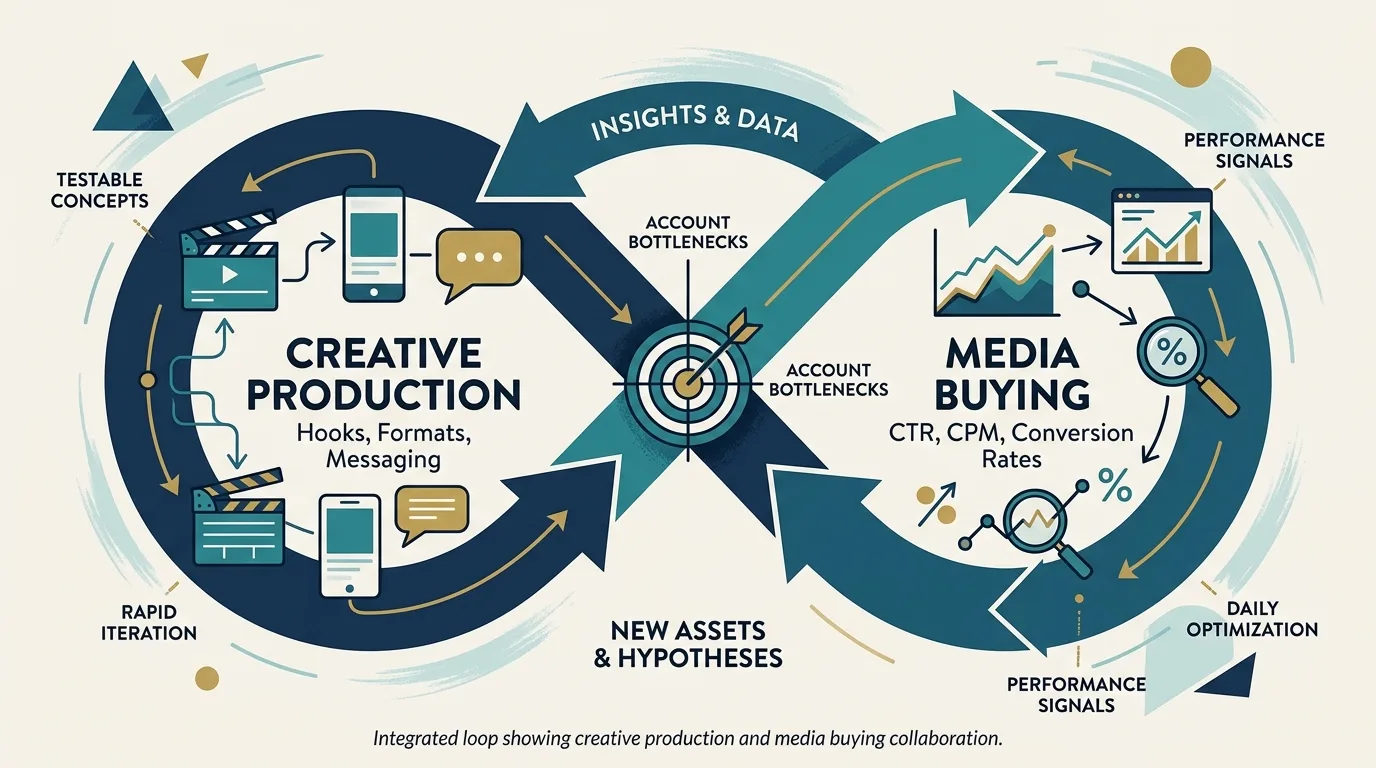
The right partner gives your team a controlled way to test faster, identify winners with confidence, and increase investment without losing sight of contribution margin. That requires more than platform expertise. It requires an integrated system where creative production and media buying inform each other every day.
What a paid acquisition agency for ecommerce should own
Ecommerce growth becomes fragmented quickly. One team produces assets, another manages Meta, a freelancer handles Google, and leadership receives reports after the decisions have already been made. The result is slow feedback, recycled creative, and budget changes based on incomplete signals.
A serious paid acquisition partner closes those gaps. It should take ownership of the work that determines whether spend can scale: creative concepts and production, campaign architecture, launch execution, daily optimization, measurement, and clear performance insight. Strategy matters, but the value is in turning strategy into a repeatable weekly operating rhythm.
That does not mean an agency replaces internal leadership. Your team still defines product truth, margin constraints, inventory realities, brand boundaries, and growth targets. The agency should turn those inputs into a structured acquisition program that can move quickly without creating chaos.
Creative is the growth input, not an afterthought
For many ecommerce accounts, the biggest constraint is not audience size. It is the supply of ads worth showing to that audience. A strong offer can fatigue. A winning angle can stop working when competitors copy it. Platform delivery changes. Seasonal demand shifts.
That is why creative volume alone is not enough. You need useful volume: multiple hooks, formats, claims, product demonstrations, offers, landing-page narratives, and customer objections addressed in distinct ways. Each asset should have a testable job. A static image may validate a price objection. A creator-style video may test social proof. A product demonstration may improve conversion quality for a higher-consideration purchase.
When creative and media teams operate separately, this learning loop breaks. Media buyers ask for more assets without enough direction, while creative teams produce variations that do not isolate a meaningful hypothesis. An integrated team can see where delivery is improving, where click-through rate is weak, and where post-click conversion is deteriorating. It can then build the next batch around the actual constraint.
The operating system behind profitable scale
Scaling spend is not the same as spending more. A brand can double daily budget and acquire twice as many customers while quietly eroding profit, cash flow, or customer quality. The job is to find the spend level and channel mix that support profitable growth under your real business constraints.
That starts with a measurement framework everyone accepts. Depending on the business, the primary decision metric may be new-customer acquisition cost, contribution-margin return, blended customer acquisition cost, first-order profitability, payback period, or predicted lifetime value. The right metric depends on your margin structure, repeat purchase behavior, fulfillment cost, and financing model.
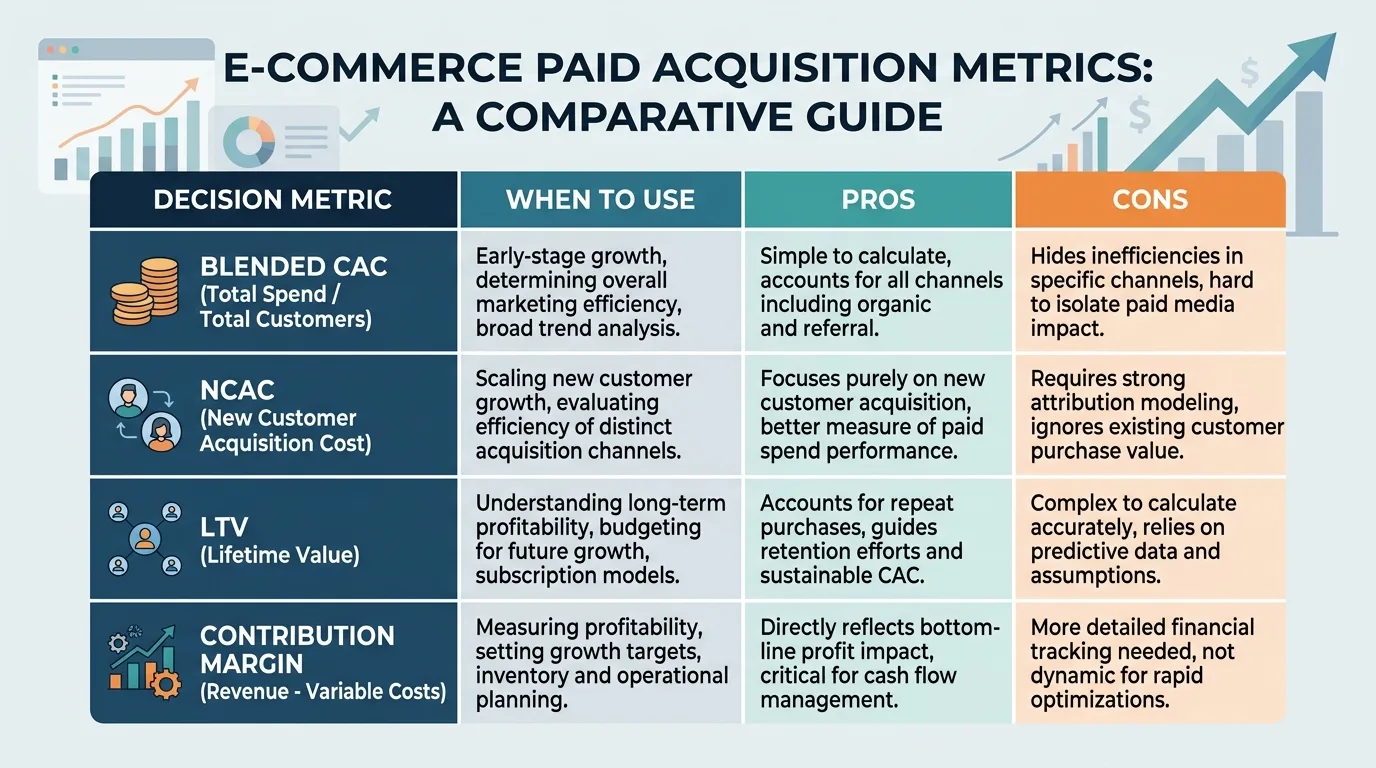
A low front-end return can be acceptable for a subscription or replenishment brand with reliable retention. It is far less acceptable for a low-margin product with one-time purchase behavior. A paid acquisition agency should understand that distinction before recommending aggressive scale.
Testing needs rules, not random activity
Activity can look like progress when an account contains dozens of campaigns and hundreds of ads. But without a test plan, all that activity creates noise.
A disciplined testing system defines what is being tested, the spend or impression threshold required to assess it, the success metric, and the next action. That makes it easier to separate a real winner from a lucky result.
For example, testing a new product angle requires enough creative consistency to evaluate the angle itself. Testing a new editing style requires keeping the offer and message relatively stable. If the hook, visual treatment, landing page, audience, and promotion all change at once, no one can explain why performance moved.
The goal is not to make every test statistically perfect. Paid media moves too fast for that standard in many accounts. The goal is to make decisions with enough discipline that budget shifts are based on repeatable signals rather than instinct.
Campaign structure should serve learning and scale
Overbuilt account structures are a common drag on ecommerce performance. Too many campaigns split data, restrict delivery, and make it harder to see which creative is genuinely earning spend. On the other side, an account that is too consolidated can hide important differences between prospecting, retention, product lines, or market segments.
There is no universal structure that works for every brand. The right setup depends on spend level, product catalog complexity, geography, feed quality, creative volume, and platform. The important question is whether the structure helps the team make faster, more accurate decisions.
A capable agency will simplify where possible, preserve separation where it creates useful insight, and use naming conventions and launch processes that keep the account clean as volume increases. Internal tools such as Conversion Collective’s LaunchBox can help standardize this work across thousands of campaigns, reducing the manual errors that appear when execution scales faster than operations.
What to evaluate before hiring an agency
Most agencies can show a platform certification or a case study. Neither tells you whether they can run your growth engine. Evaluate the operating model behind the pitch.
Agency Evaluation Checklist
Use this checklist to evaluate an agency’s operating model during the vetting process:
- Creative Production & Testing: Ask how creative is produced and tested. Avoid partners that outsource creative or deliver in small monthly batches, as you need rapid, data-to-concept iteration.
- Success Metrics & Incentives: Ask how success is defined. Look for models with incentives tied to efficient growth, clear targets, and transparent reporting rather than a pure percentage of ad spend.
- Operational Recovery Plan: Ask what happens when performance drops. Ensure they have a clear response plan to diagnose issues like creative fatigue, tracking problems, landing-page friction, or auction pressure.
- Communication & Reporting: Examine their communication quality. Reporting should reduce decision time with actionable insights—what changed, why, and what is next—rather than overwhelm you with complex dashboards.
First, ask how creative is produced and tested. If creative is outsourced, delivered in small monthly batches, or treated as a separate add-on, expect slower iteration. You want a partner that can translate performance data into new concepts quickly and produce enough assets to keep learning.
Second, ask how they define success. An agency compensated only on ad spend has a built-in incentive to increase budgets. That does not automatically make the model wrong, but it does require stronger oversight. Look for incentives tied to efficient growth, clear targets, and transparent reporting.
Third, ask what happens when performance drops. The answer should be operational, not vague. You should hear how they diagnose creative fatigue, offer weakness, tracking issues, landing-page friction, channel shifts, and auction pressure. A good partner has a response plan before the account enters a rough week.
Finally, examine communication quality. You do not need more dashboards. You need answers: what changed, why it changed, what the team learned, what will happen next, and what decision is required from your side. Reporting should reduce decision time, not create another meeting to interpret it.
Channel expansion should follow evidence
Meta and Google are often the foundation of ecommerce acquisition because they capture both demand creation and demand capture. TikTok can create efficient reach and fresh creative signals. Taboola and other native placements can work when the advertorial, offer, and landing experience fit the channel. Custom channels may become attractive as a brand matures or inventory becomes more competitive.
Expansion should not be automatic. Adding channels creates new creative requirements, attribution questions, operational complexity, and budget fragmentation. A brand with an underdeveloped Meta creative engine may get more value from fixing that engine than launching three additional platforms.
The right time to expand is when the core program has enough stability to establish a baseline, the brand has assets suited to the new environment, and the team can measure incremental value rather than just claiming platform-level conversions. Channel diversification is valuable when it increases profitable customer volume, not when it makes the reporting look more sophisticated.
The real outcome is control
The best agency relationship makes paid acquisition easier to manage as it grows. Your team knows which messages are winning, which channels are producing quality customers, where marginal efficiency begins to fall, and what the next set of tests is designed to prove.
That clarity changes how a business scales. Instead of reacting to volatile daily results, you build a system that produces creative, turns data into decisions, and directs budget toward the opportunities that can support profitable growth.