
A lead generation media buying agency is not hired to make a dashboard look busy. It is hired to produce a reliable volume of qualified leads at an acquisition cost the business can support. That requires more than choosing audiences, raising budgets, and reporting on form fills. It requires a system that connects creative, media buying, lead quality, sales outcomes, and fast decisions.
For businesses spending serious money on paid acquisition, the problem is rarely a lack of channels. Meta, Google, TikTok, Taboola, and native placements can all create volume. The problem is operational control. Without it, campaigns multiply, creative gets stale, sales teams reject leads, and spend keeps flowing toward activity rather than profit.
What a Lead Generation Media Buying Agency Should Own
A capable partner owns the full path from market signal to scalable campaign execution. Media buying is one part of that job. The larger responsibility is building a repeatable acquisition engine that can test quickly, identify winners, and cut waste before it compounds.
That begins with a clear definition of a qualified lead. A cheap lead that never answers the phone, cannot afford the offer, or fails compliance checks is not a win. The agency needs visibility beyond the ad platform’s cost per lead. Depending on the business, the real optimization event may be a completed application, booked appointment, verified lead, sales-qualified lead, approved customer, or first payment.
This does not mean every campaign must wait for perfect downstream data. Some businesses have long sales cycles or incomplete CRM tracking. In those cases, the right approach is to use the best available leading indicators while improving feedback loops over time. The key is being honest about what the numbers do and do not prove.
A lead generation media buying agency should also bring creative production into the operating model. Creative is the targeting layer on most modern platforms. Different hooks, offers, proof points, landing-page angles, and formats attract different prospects. If creative production sits in a separate queue from media buying, the team learns too slowly to scale efficiently.
The Operating System Behind Profitable Lead Growth
Paid lead generation becomes predictable when there is a disciplined cadence for launching, learning, and reallocating budget. The specifics vary by vertical, traffic source, and conversion path, but the underlying system stays consistent.
Start with economics, not platform metrics
Before campaigns launch, establish the financial boundaries. What is an acceptable cost per qualified lead? What percentage of leads should become sales opportunities? What is the expected close rate, revenue per customer, margin, refund rate, and payback window?
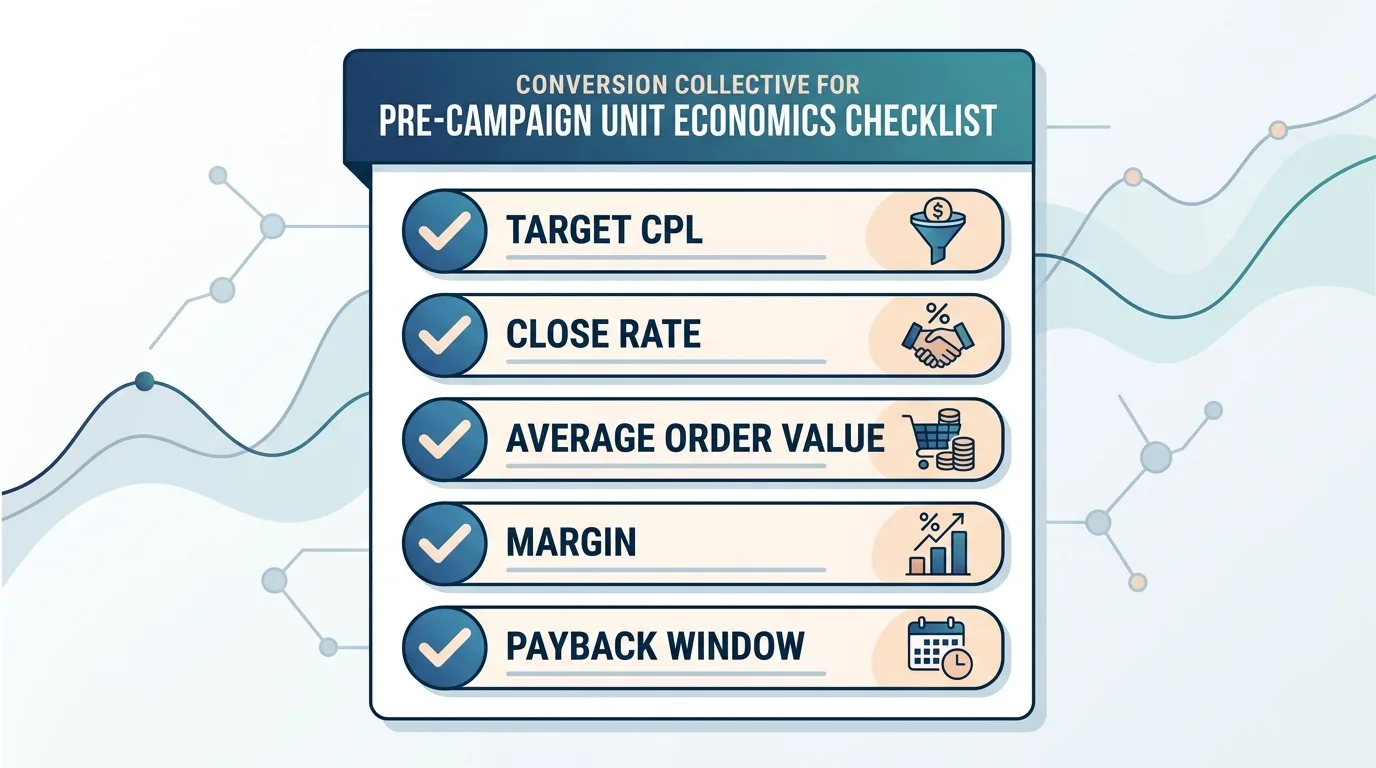
These numbers prevent a common mistake: optimizing to the cheapest possible lead. A campaign with a higher front-end cost can be materially more profitable if it produces prospects with stronger intent. Conversely, an inexpensive source can quietly damage sales efficiency by flooding the team with low-quality submissions.
The target should be a profitable cost of acquisition, with interim metrics that tell the team whether it is moving in the right direction. That creates a shared standard for marketing, sales, and finance.
Build a creative testing pipeline
High-performing lead programs do not depend on one polished ad concept. They build a pipeline of hypotheses and test them at volume. The best concepts are rarely predictable from a brainstorming session. They emerge from structured testing against real market behavior.
Test the major variables deliberately: the problem named in the opening, the audience context, the offer, the proof, the call to action, the visual format, and the landing-page message. A testimonial-style video may outperform a founder-led pitch on Meta, while a direct comparison angle may work better on native traffic. The lesson is not that one format is universally better. It is that every channel and audience segment needs evidence.
Testing velocity matters because creative fatigue is a business issue, not a design issue. When a program cannot generate and launch enough fresh concepts, frequency rises, response falls, and costs increase. Media buyers then try to solve a creative problem with bidding adjustments. That usually delays the real fix.
Launch with structure that preserves signal
A clean campaign structure makes optimization possible. Naming conventions, consistent tracking, controlled budgets, and clear test groups help the team understand what caused a performance change. When dozens of uncontrolled edits happen at once, the account produces noise instead of insight.
This is particularly important across multiple channels. Meta may provide efficient scale through broad delivery and creative variety. Google can capture high-intent demand but may be constrained by search volume. TikTok can expose new audiences quickly, though lead quality can vary sharply by offer and funnel. Native platforms can add reach when advertorial or content-led approaches fit the buyer journey.
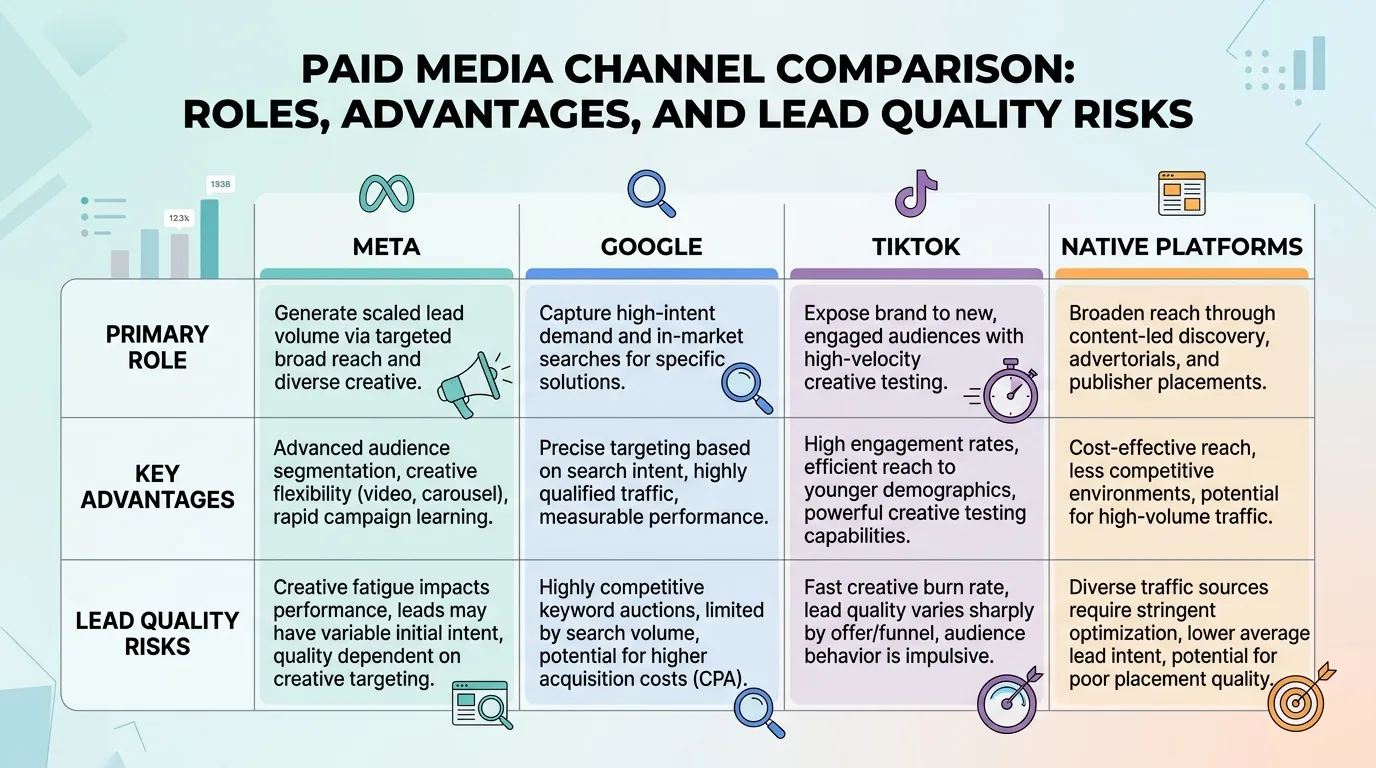
Channel diversification is valuable, but only after each channel has a clear role. Spreading a modest budget across five platforms often creates five underpowered tests. Concentrate spend where signals can form, then expand when the economics justify it.
Optimize against lead quality quickly
The handoff from marketing to sales should not be a monthly reporting ritual. It should be a fast feedback loop. If one creative angle drives lower answer rates or weak qualification, that information needs to reach the media team while the test is still active.
Track practical quality signals such as contact rate, appointment set rate, show rate, sales qualification rate, approval rate, and closed revenue. The right set depends on the business model, but it should be consistent enough to compare traffic sources, campaigns, audiences, and creative concepts.
When quality declines, do not assume the platform is the problem. Review the entire path. The ad may be overpromising. The form may be too easy to complete. The landing page may create confusion. Sales follow-up may be slow. A performance partner should diagnose the system rather than protect one channel’s metrics.
What to Expect From the Agency Relationship
The strongest agency relationships are built around execution standards, not vague promises of scale. You should expect frequent campaign launches, a visible testing roadmap, direct reporting on performance drivers, and an explanation of what will change next.
Reporting should make decisions easier. A useful report shows where spend went, which creative and channels generated qualified outcomes, what is fading, and where the next budget increase should come from. It should not bury the team in screenshots or platform-specific vanity metrics.
Compensation structure also matters. Fees tied only to media spend can create the wrong incentives when efficiency is the actual objective. A serious partner should be comfortable discussing profit, lead quality, and marginal returns as budgets increase. Scaling is not simply spending more. It is increasing spend while preserving acceptable economics.
At Conversion Collective, that operating discipline combines high-velocity creative with centralized campaign management, so teams can launch at scale without losing control of the details. The goal is not more campaigns for their own sake. It is faster evidence on what deserves more budget.
Questions to Ask Before You Hire
Ask how the agency defines a qualified lead and what downstream data it uses to optimize. Ask who produces creative, how many concepts can be tested in a typical month, and how quickly new ads can move from idea to launch. Ask how it handles creative fatigue, what reporting cadence it follows, and who owns the data and accounts.
Also ask for an example of a campaign that looked efficient at the platform level but failed on lead quality. The answer reveals whether the team understands the difference between cheap volume and profitable acquisition.
Be cautious of partners that promise a fixed cost per lead without understanding your sales process, offer, geography, compliance requirements, or lead definition. Benchmarks can guide planning, but they are not guarantees. A complex, high-consideration offer should not be evaluated by the same front-end metrics as a low-friction consumer quote form.
Scale Only What the Business Can Absorb
Media buying can create demand faster than an organization can handle it. If call centers miss speed-to-lead targets, appointment inventory is full, or onboarding capacity is constrained, forcing additional spend can lower conversion rates and make a good acquisition channel appear broken.
The right growth plan accounts for those constraints. Scale budgets in measured increments, monitor marginal lead quality, and keep enough creative in production to support the next level of spend. When performance changes, respond with evidence rather than panic edits.
The best time to build this discipline is before the account becomes unmanageable. A clear lead definition, a steady creative pipeline, and fast sales feedback turn paid media from a source of unpredictable lead volume into a controllable growth function.