
A creative brief that says “make three new videos” is not a brief. It is a production request with no test logic, no definition of success, and no useful path from result to next action. The cost shows up later: a pile of ads launches, spend disperses, and nobody can explain whether the winner worked because of the hook, the offer, the audience, or simple delivery variance.
This performance creative briefing guide is built for teams that need creative to function as part of the paid acquisition engine. The goal is not to make a document more polished. The goal is to produce clearer hypotheses, faster launches, cleaner learnings, and more ads worth scaling.
Treat the Brief as a Test Plan
Brand creative briefs often start with a message, visual direction, and a list of deliverables. Performance briefs need those inputs, but they also need to answer a harder question: what are we trying to learn from this batch?
Every asset that enters a paid campaign consumes budget and creates data. If the variables are unclear, the data is weak. If the creative team receives only broad direction, they will naturally produce broad variations. The media team then has to interpret noisy results after the fact.
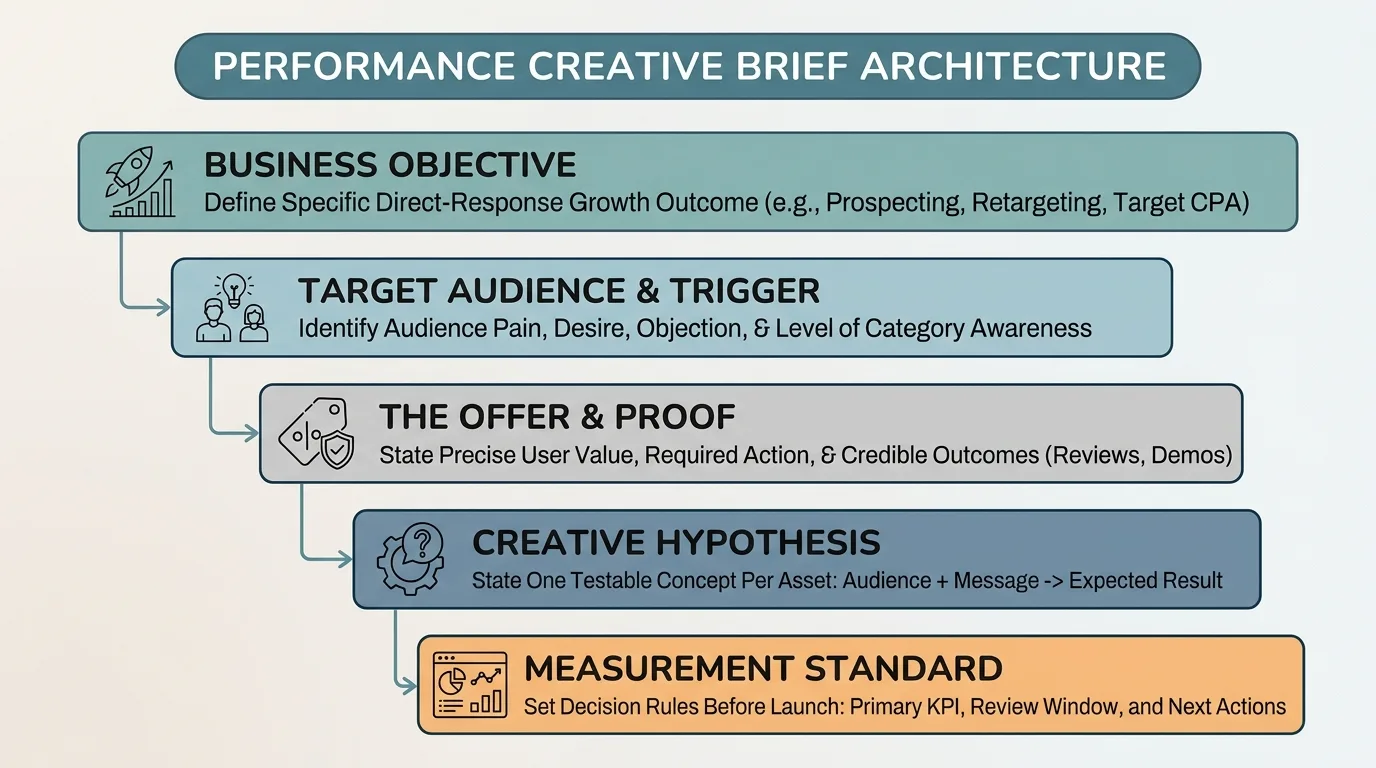
A strong brief connects five things before production starts: the business objective, the target audience, the offer, the creative hypothesis, and the measurement standard. That connection gives writers, designers, editors, and buyers a common operating model.
For example, “create UGC ads for our subscription offer” is not testable. “Test whether first-person stories about saving time outperform price-led messaging for new customers on TikTok” is testable. The first request produces content. The second produces a decision.
Start With the Economics, Not the Format
Do not begin by selecting static ads, short-form video, carousels, or creator-style content. Begin with the acquisition economics that the creative must support.
State the conversion event, target cost per acquisition, expected conversion rate, average order value or projected customer value, and the audience stage being addressed. A prospecting creative built to generate qualified leads at $40 should not be judged by the same standard as a retargeting ad designed to recover high-intent cart abandoners.
The brief should also identify the optimization event being used on each platform. Meta may optimize toward purchases, Google toward qualified form submissions, and TikTok toward registrations or installs. That distinction affects what the platform learns and what the creative needs to communicate.
This does not mean every creative producer needs a finance model. It means the team needs enough commercial context to understand the job. If a lower conversion rate is acceptable because the offer attracts higher-value customers, say so. If margins are thin and the ad must qualify aggressively, say that too.
Define One Primary Hypothesis Per Concept
High-volume testing does not require random volume. It requires a system for generating distinct, comparable ideas.
Each concept should have one primary hypothesis. That hypothesis can test a pain point, angle, audience belief, proof mechanism, offer framing, or format. Avoid testing all of them at once. When a video changes the hook, spokesperson, claim, offer, landing-page path, and edit style, a positive result tells you very little about what to repeat.
A useful hypothesis has a clear structure: for a defined audience, a specific message or mechanism should improve a defined performance signal because it addresses a known objection or motivation.
For a B2B lead generation campaign, the hypothesis might be that operations leaders respond better to a “reduce reporting chaos” angle than a generic “save time” angle because fragmented data is the more immediate pain. For ecommerce, the hypothesis might be that product demonstration drives stronger purchase intent than lifestyle imagery because the product benefit is difficult to understand in a static frame.
Not every test will win. That is expected. A disciplined brief makes losses valuable because it records what the team intended to test and why.
What Every Performance Creative Brief Needs
The Objective and Conversion Context
Open with the campaign objective, conversion event, target KPI, and funnel stage. Include whether the work is designed for prospecting, retargeting, retention, or a specific expansion audience. This prevents a common mistake: judging awareness-oriented creative against direct-response benchmarks, or using hard-sell retargeting language for cold audiences.
Briefing Context Checklist
- Campaign Objective: Define specific direct-response growth outcome
- Conversion Event: Align optimization event across ad platforms
- Target KPI: Establish baseline CPA, ROAS, or CAC target
- Funnel Stage: Identify audience warmth (Prospecting, Retargeting, Retention)
- Expansion Segment: Note regional or customer-tier parameters
The Audience and Its Trigger
Define more than age, interest, or job title. Identify what is happening when the audience sees the ad. Are they actively comparing solutions? Frustrated with a manual process? Trying to solve an urgent problem? Looking for a better value proposition?
The best performance ads usually meet a live demand signal. The brief should name the pain, desire, objection, and level of category awareness. A buyer who understands the category needs proof that your option is better. A buyer who does not understand the category may need the problem made visible first.
The Offer and Proof
Be precise about what the user gets, what action they should take, and what makes the claim credible. The offer may be a discount, free trial, consultation, product bundle, lead magnet, or core product proposition. Include the exact terms and expiration details where relevant.
Proof is often the difference between a promising concept and a scalable one. Specify approved proof points such as customer outcomes, reviews, demonstrations, credentials, before-and-after evidence, product details, or quantified results. Do not ask creative teams to invent proof on the fly. It creates compliance risk and slows approvals.
The Message Hierarchy
Rank the information the ad must communicate. In many direct-response ads, the order is hook, problem or desire, solution, proof, offer, and call to action. But the order depends on the audience and channel.
For a highly aware retargeting audience, lead with the offer. For a cold audience on TikTok, lead with a recognizable problem or visual disruption. For a search-adjacent environment, direct product relevance may matter more than an elaborate story. The brief should provide the hierarchy without scripting every word unless the test requires controlled copy.
Deliverables and Production Constraints
Specify required formats, aspect ratios, durations, platform placements, brand assets, legal language, claim restrictions, and deadlines. Include the number of concepts and the number of variants per concept.
The distinction matters. Five concepts with two hook variants each are not the same as 10 minor edits of one idea. Label assets consistently so the media team can identify concepts, hooks, offers, and iterations once campaigns are live.
Build Variations That Preserve the Learning
A productive creative batch has both exploration and iteration. Exploration tests materially different ideas. Iteration takes a signal from an existing winner and pushes one variable at a time.
If a creator-led testimonial wins, the next batch might hold the core story steady while testing three opening hooks. If a product demo wins, test alternative demonstrations, proof points, or use cases. Do not immediately replace the entire concept just because the first version worked. The fastest route to scale is often finding the range of a winning mechanism before moving on.
At the same time, avoid over-iterating a tired winner. Frequency, audience saturation, and competitor behavior can erode performance even when the original insight remains sound. A healthy testing roadmap includes new angles alongside controlled variations of proven ads.
Adapt the Brief to the Channel
The central hypothesis can travel across platforms. The execution should not be copied blindly.
Meta often rewards creative that earns attention quickly while communicating a clear commercial message. TikTok requires native pacing and a strong first second, but “native” does not mean unstructured. Google and native placements frequently need sharper relevance to user intent and tighter alignment between ad promise and landing page. Taboola may reward curiosity, but curiosity that fails to qualify the click can destroy economics.
Brief platform-specific requirements alongside the shared core message. That gives the team room to adapt pacing, visual grammar, text density, and calls to action without losing the test itself.
Set Decision Rules Before Launch
A briefing system is incomplete without a plan for what happens after the ads go live. Define the review window, minimum spend or impression threshold, primary KPI, and secondary diagnostics. The winning ad is not always the one with the lowest early CPA. It may have stronger conversion quality, better downstream revenue, or more room to scale.
Set rules for cutting weak assets, iterating promising ones, and moving winners into broader budgets. Consider attribution lag, learning-phase volatility, and small sample sizes. A lead-generation team may need to wait for qualification data before calling a creative a winner. An ecommerce team with high purchase volume can make decisions faster.
The brief should also name the owner of the next action. Creative insight without a production owner becomes a slide in a report. Media insight without a campaign owner becomes stalled spend.
A Better Brief Produces a Faster Feedback Loop
The value of a performance creative briefing guide is not that every ad wins. It is that every launch produces a useful signal. When creative and media operate from the same hypotheses, production gets faster, analysis gets clearer, and budget moves toward the work that actually drives profitable growth.
Make the brief short enough that teams use it, but specific enough that nobody has to guess what is being tested. That operating discipline is what turns creative volume into compounding performance insight.