
Most paid media teams do not have a testing problem. They have a decision-making problem. They launch new ads, see uneven results, then change targeting, budgets, creative, landing pages, and campaign settings at the same time. The result is activity without insight. Knowing how to structure ad testing means building a system that isolates meaningful variables, generates enough signal to act, and moves proven winners into scale without contaminating the data.
For growth teams spending serious money across Meta, Google, TikTok, Taboola, or custom channels, testing is not a side project. It is the operating system for profitable acquisition. The goal is not to find one breakout ad. The goal is to create a repeatable process that produces winners consistently, identifies why they work, and cuts spend on everything else quickly.
Start With a Testing Architecture, Not a Batch of Ads
A strong testing program begins before creative production. Define the business outcome, the testing unit, the success metric, and the decision rule. If those four pieces are unclear, your reports may look detailed while your team remains unable to explain what actually drove performance.
The business outcome should reflect the economics of the channel. For ecommerce, that may be contribution-margin-adjusted CAC or new customer ROAS. For lead generation, it may be qualified cost per lead and downstream close rate. For subscriptions and apps, it may be trial-to-paid conversion, retained subscriber CAC, or early cohort value. A low front-end CPA is not a winner if the customers it brings in do not monetize or retain.
Next, decide what you are testing. In most creative-led acquisition programs, the primary unit should be the creative concept, not an individual asset variation. A concept is the underlying sales argument: a customer pain point, an offer framing, a testimonial angle, a comparison, a product demonstration, or a contrarian claim. Headlines, hooks, thumbnails, formats, and edits are executions of that concept.
This distinction matters. If a testimonial-style ad works, you need to know whether social proof was the driver, whether the opening hook was the driver, or whether the offer simply had better product-market fit. Testing one variable at a time early in the process gives you usable answers. Once a concept proves itself, you can expand into more variations to improve delivery and combat fatigue.
Build a Clear Hypothesis for Every Test
Every ad entering the account should have a stated reason to exist. A useful hypothesis is specific enough to prove or disprove: “First-person founder videos will lower qualified lead cost for this audience because they make a complex financial product feel more credible and understandable.”
That statement gives the team direction on creative, audience, and evaluation. It also prevents random production. A batch of 20 ads that all use the same broad promise is not high testing velocity. It is 20 versions of the same bet.
Your test matrix should balance proven angles with new learning. A practical mix is to reserve most production for iterations on established winners while dedicating a meaningful portion to net-new concepts. The exact split depends on spend and creative fatigue. A mature account with stable performance may lean harder into iteration. An account that has plateaued or entered a new market needs more exploration.
Organize hypotheses into a small number of strategic territories, such as pain, aspiration, proof, mechanism, offer, objection, and urgency. This creates a visible record of what has been tested and what has not. It also makes reporting more useful. Instead of saying, “Video 14 lost,” you can say, “Price-objection messaging is not converting cold traffic at our current offer, while customer-proof messaging is producing qualified volume.”
Separate Discovery, Validation, and Scale
The fastest way to create chaos is to run every ad under one campaign structure. Discovery, validation, and scale have different jobs. Combining them makes it harder to protect spend, compare results, and know whether performance is real.
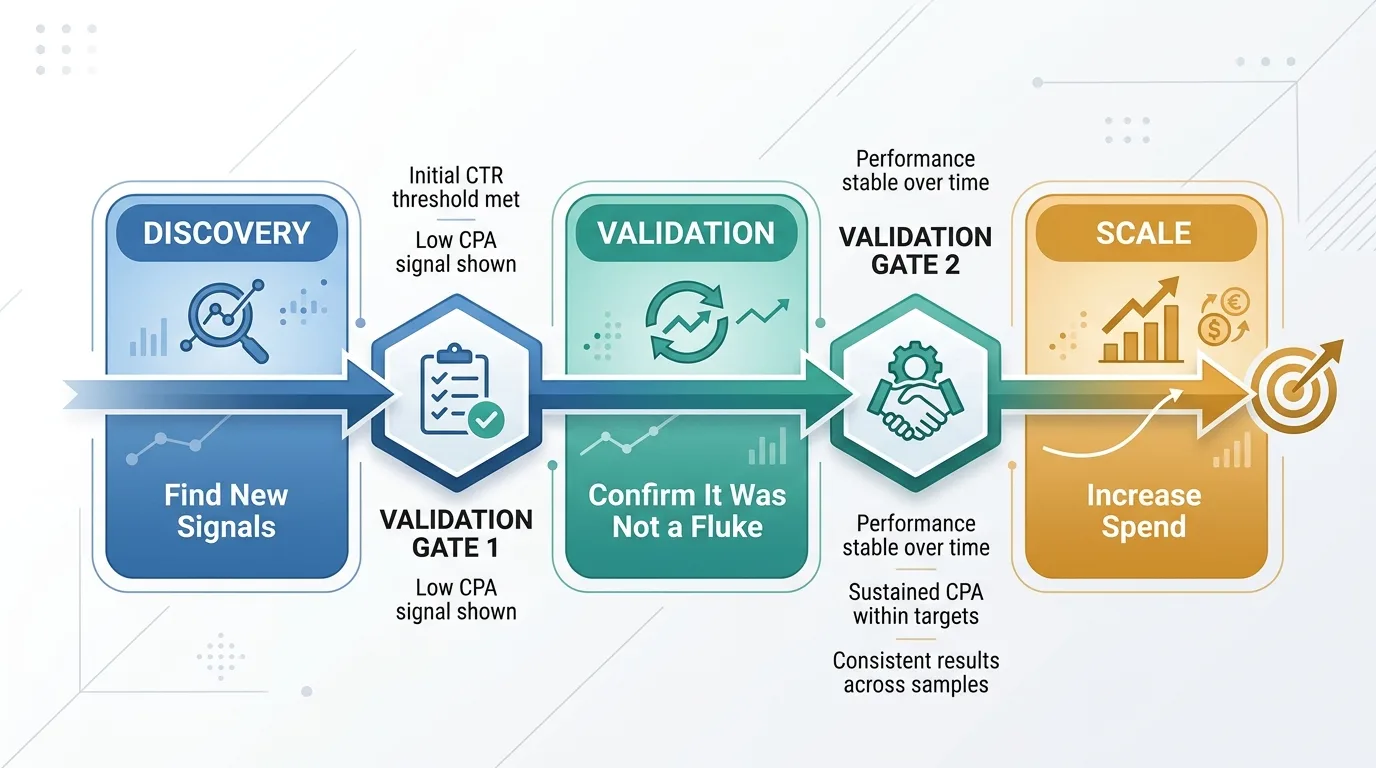
Comparison of Ad Testing Phases
| Testing Phase | Core Purpose | Budget Strategy | Target Audiences | Key Decision Rule |
|---|---|---|---|---|
| Discovery | Identify early creative concept signals | Controlled, minimum spend to get signal | Consistent broad or test audiences | Kill if CPA threshold exceeded; advance if signal shown |
| Validation | Verify performance stability and audience fit | Moderate, sustained spend over validation window | Expanded or alternative segments | Advance to scale if CPA remains stable and profitable |
| Scale | Maximize conversion volume and efficiency | High budget, incremental scaling | Proven scaling audiences / broad | Monitor marginal CPA; scale in measured increments |
Discovery: Find New Signals
Discovery campaigns are where new concepts earn attention. Their purpose is not maximum efficiency on day one. Their purpose is to identify ads that show enough early signal to warrant more budget.
Keep discovery structures simple. Use consistent audiences, placements, optimization events, and attribution settings wherever possible. If every new creative is launched into a different audience or campaign, you are testing creative and media conditions simultaneously.
Budget discovery based on the cost of a meaningful result. If your target CPA is $80, a $20 test budget will not tell you much. The right amount depends on conversion volume, purchase cycle, and platform volatility, but the principle is fixed: spend enough to make a decision, not enough to turn every unproven asset into an expensive experiment.
Validation: Confirm It Was Not a Fluke
A promising creative should not immediately receive unlimited budget. It should enter validation, where you test whether the result holds under slightly more sustained spend and, where relevant, across another audience segment or placement set.
Validation answers questions discovery cannot. Does the ad still work after the initial delivery pocket is exhausted? Does it generate the same quality of customer? Is performance stable enough to survive normal day-to-day variance? Can multiple executions of the same concept perform, or was one asset an outlier?
This stage is especially important when conversion volume is low. A creative that generates two efficient purchases may be encouraging, but it is not yet a scaling decision. Give it a defined validation window and a clear threshold tied to your target economics.
Scale: Increase Spend Without Erasing the Signal
Once an ad clears validation, move it into a controlled scaling environment. This can be a dedicated campaign, an established scaling ad set, or a channel-specific structure built to give proven creative access to budget. The right setup depends on the platform and account history.
The key is to avoid constantly rebuilding winners. Major edits to budgets, audience settings, bidding, placement controls, and creative all at once make it impossible to diagnose changes in performance. Scale in measured increments, monitor marginal efficiency, and keep proven assets live long enough to capture their full value.
Set Decision Rules Before Spend Goes Live
Teams often waste budget because nobody has authority to call a test. Solve that with predefined rules. Each test should have a launch date, spend cap, primary metric, secondary quality check, and one of three outcomes: kill, iterate, or advance.
A kill rule does not mean every ad must hit a target instantly. Some products have delayed conversion behavior, and platforms need time to learn. But you should know when poor performance has crossed from normal variance into wasted spend. For example, an ad may be paused after spending a defined multiple of target CPA with no conversion, or after generating enough conversions to demonstrate it is materially outside the acceptable range.
An iterate decision applies when the concept has promise but the execution is weak. Maybe the hook earns clicks but the offer is unclear. Maybe video retention is strong while conversion rate is poor. Do not discard the learning. Create the next version around the specific failure point.
An advance decision means the ad met the threshold for validation or scale. Record why. Was it the message, format, opening, audience fit, or offer? The answer will not always be certain, but documenting the best explanation compounds learning over time.
Evaluate Creative With a Full-Funnel View
Platform CPA alone is not enough to diagnose creative. Break performance into the steps that explain where an ad is winning or losing: impression-to-click rate, landing page view rate, conversion rate, cost per acquisition, and downstream revenue or quality indicators.
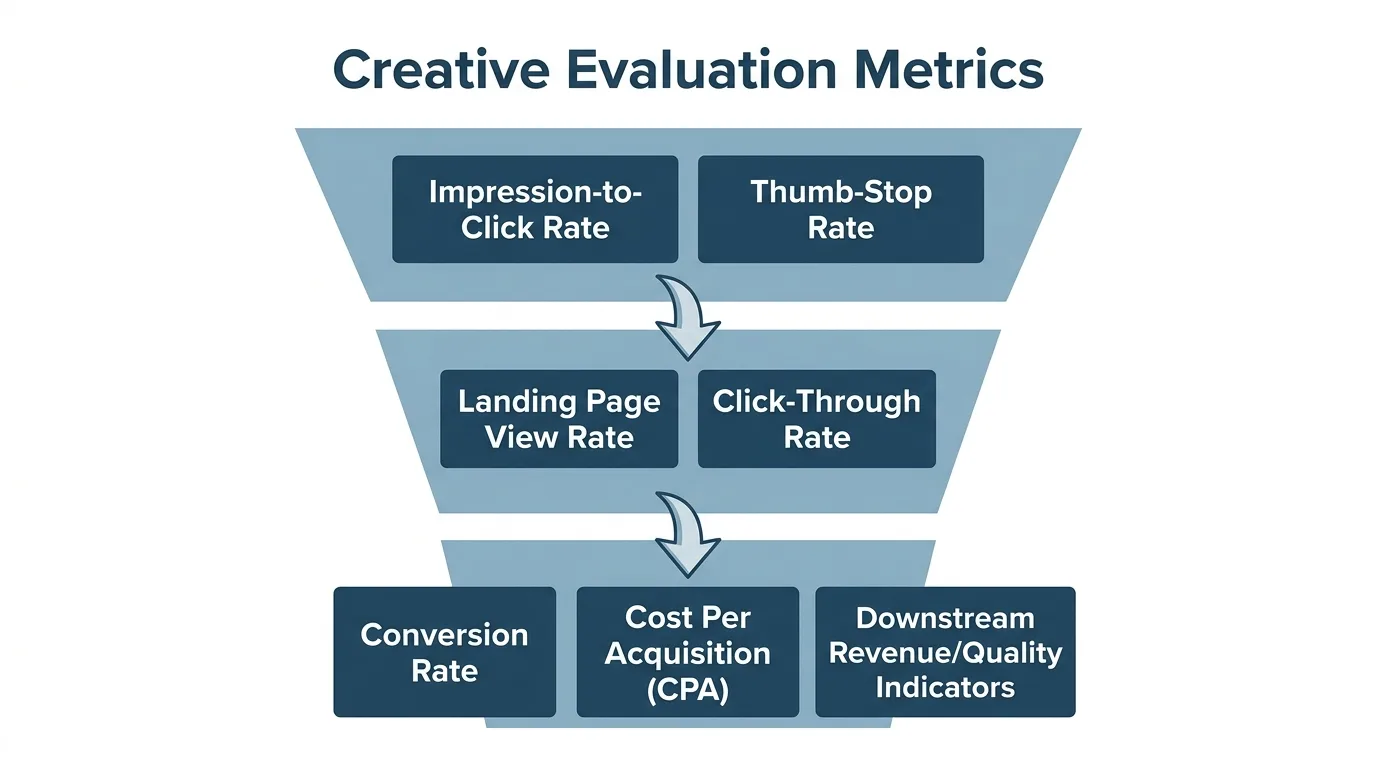
A high click-through rate can be a warning sign if the ad overpromises and sends low-intent traffic. A lower-clicking ad may be more profitable because it qualifies users before the click. This is why sensational hooks can look strong in ad reporting while damaging blended efficiency.
For video, review hold rate, early retention, average watch time, and click behavior. For statics, compare thumb-stop performance, click-through rate, and conversion quality. These metrics are diagnostic inputs, not final scorecards. The final decision should still connect to the business outcome.
Create a Testing Cadence Your Team Can Sustain
Testing velocity only matters when the operational system can absorb it. High-volume creative without naming conventions, launch checklists, centralized reporting, and clear ownership produces more noise than learning.
Set a recurring cadence. Each week, review active tests, decide which assets move forward, identify failure patterns, and assign the next production brief. Each month, assess concept-level performance and decide which territories deserve more investment. This rhythm turns reporting into an input for production rather than a backward-looking status meeting.
Use a consistent naming framework that captures channel, audience, concept, format, hook, version, and launch date. The label should tell an operator what the asset is without opening it. At scale, this is not administrative overhead. It is what allows a team to manage hundreds or thousands of campaigns without losing the thread.
Centralized systems also matter when multiple channels are active. A winning Meta concept may need a different execution for TikTok, Google Demand Gen, or native placements, but the underlying customer insight can transfer. The media team and creative team need one shared view of that insight, not separate dashboards and disconnected handoffs.
Protect the System From Common Testing Failures
The most common failure is changing too many variables at once. The second is declaring winners based on too little data. The third is treating every creative loss as useless. A failed ad can still reveal that a pain point lacks urgency, an offer is unclear, or an audience responds better to proof than promises.
Another failure is optimizing only for platform-reported results. Attribution windows, delayed conversions, repeat purchases, and lead quality can all change the true picture. Use platform data for fast operating decisions, then reconcile it against your broader business data often enough to prevent false confidence.
Finally, do not confuse campaign complexity with control. More ad sets, exclusions, and micro-segments do not automatically create better testing conditions. The best structure is usually the simplest one that gives each test a fair opportunity to generate signal and gives the team a clean read on what happened.
A disciplined ad testing system makes creative production sharper, media buying faster, and budget decisions easier to defend. Build the process so every dollar buys either a profitable conversion or a useful lesson. That is how testing becomes a growth engine instead of a recurring expense.