
A paid acquisition account rarely fails because the team does not know how to launch an ad. It fails because 40 ads go live with no clear test logic, winners are buried in platform noise, budget changes happen by instinct, and reporting arrives after the decision window has closed. This media buying system example shows what a controlled operating model looks like when creative volume, campaign execution, and budget allocation must work together.
The goal is not to build the most complicated account possible. It is to create a repeatable way to launch quickly, learn quickly, and put more spend behind proven demand without letting inefficiency spread across the account.
What a media buying system needs to control
A media buying system is the process, campaign architecture, data flow, and decision rules used to turn paid media into a scalable growth channel. It should answer four practical questions every day: What launched? What is working? What is losing money? What gets more budget next?
For a growth-stage brand spending across Meta, Google, TikTok, or native channels, the system has to connect functions that are often managed separately. Creative production cannot operate on a monthly calendar if media buyers need fresh angles every week. Media buyers cannot make sound scaling decisions if they do not know which hook, offer, audience, or landing page produced the result. And leadership cannot evaluate performance from disconnected channel reports.
The system should make the path from a creative idea to a budget decision visible. That is the standard. Anything that adds activity but does not improve that path is operational overhead.
A media buying system example: scaling a subscription offer
Consider a subscription business acquiring customers through Meta and Google. Its target is a customer acquisition cost of $90 or less, with a 60-day payback period that supports profitable growth. The company has enough demand to scale, but it has stalled at $80,000 per month in spend because performance drops whenever it pushes harder.
The initial diagnosis is familiar: too few creatives, broad campaigns carrying unrelated ads, inconsistent naming, and no agreed rule for when an ad becomes a winner. The team is not short on effort. It is short on a system.
1. Start with a measurable testing backlog
The first layer is a creative testing backlog organized around hypotheses, not vague requests for more ads. Each concept has a defined variable to test: a problem-led hook, a new customer proof point, a different product demonstration, a price objection, or a revised offer framing.
For example, the team may develop three distinct angles: save time, reduce a costly frustration, and get a better result than the existing solution. Each angle then receives multiple executions, such as founder-led video, customer testimonial, static comparison, and short-form demonstration. This creates enough variation to identify whether the message or the execution is driving performance.
Creative requests are tagged before launch by angle, format, offer, audience intent, and production batch. That tagging matters later. Without it, a report can tell you that one ad won, but not what to make next.
2. Build campaign structure around decisions
The account structure should make testing and scaling easier, not simply mirror every possible audience or product variation. In this example, Meta has a dedicated testing campaign with controlled budgets and a separate scaling campaign for validated ads. Google is structured by intent level and product category, with search terms and landing-page performance reviewed separately.
The testing campaign is designed to produce signal. It limits the number of variables changing at once and gives new creatives a fair path to spend. The scaling campaign is designed to capture volume. It contains only ads that have met the business’s threshold for efficiency and have shown enough spend to make the result credible.
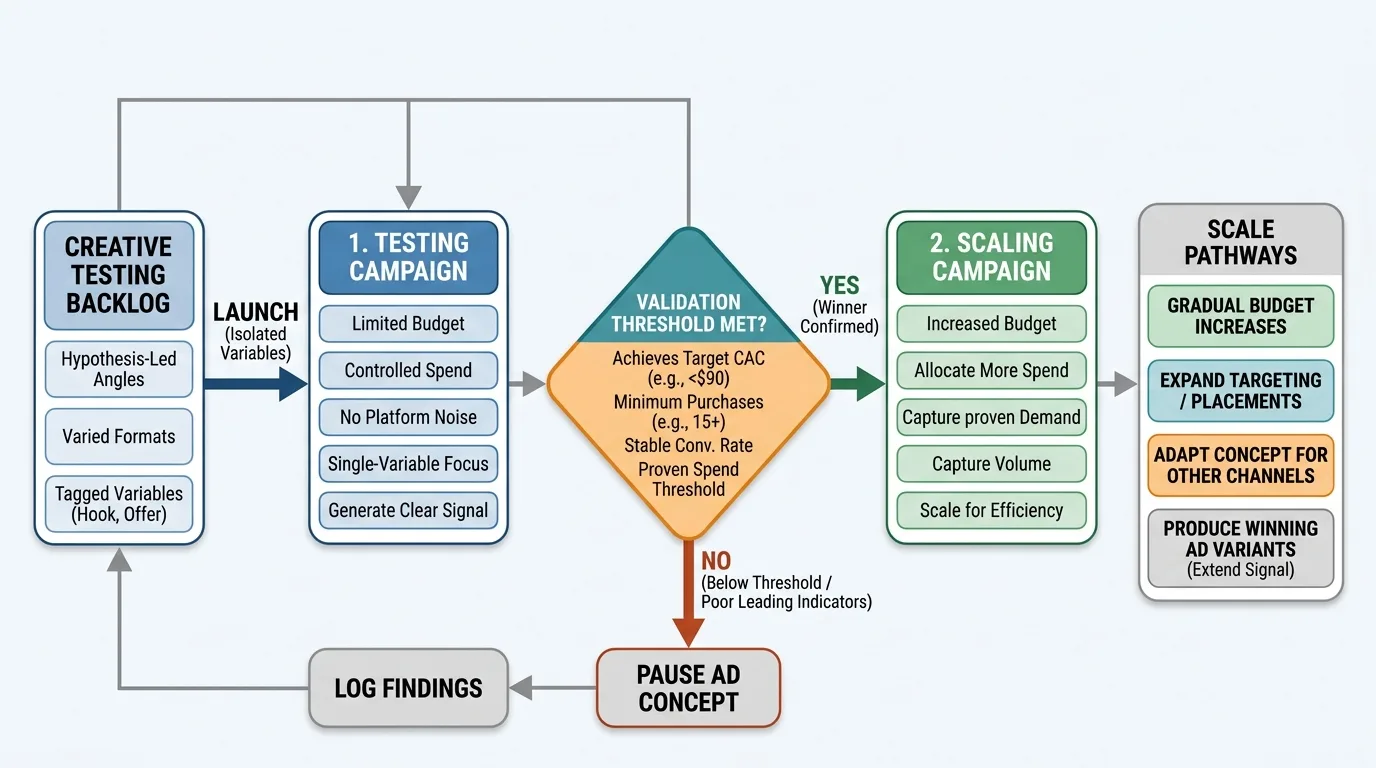
This separation prevents a common problem: a strong new ad gets trapped in a crowded campaign beside dozens of inconsistent assets, while a weak ad continues spending because nobody has a clean rule for removal. It also makes reporting more honest. Testing spend is an investment in learning. Scaling spend is an investment in known performance. Both matter, but they should not be confused.
3. Define winner and loser rules before launch
A system needs predetermined decision rules. Otherwise, teams start protecting ads based on personal preference or reacting to one good day of data.
For this subscription brand, a creative may be marked as a potential winner after it generates at least 15 purchases at or below the $90 CAC target, while maintaining conversion-rate and refund-quality signals within range. It becomes scale-ready after it repeats that performance across a larger spend threshold and does not rely on a single narrow audience.
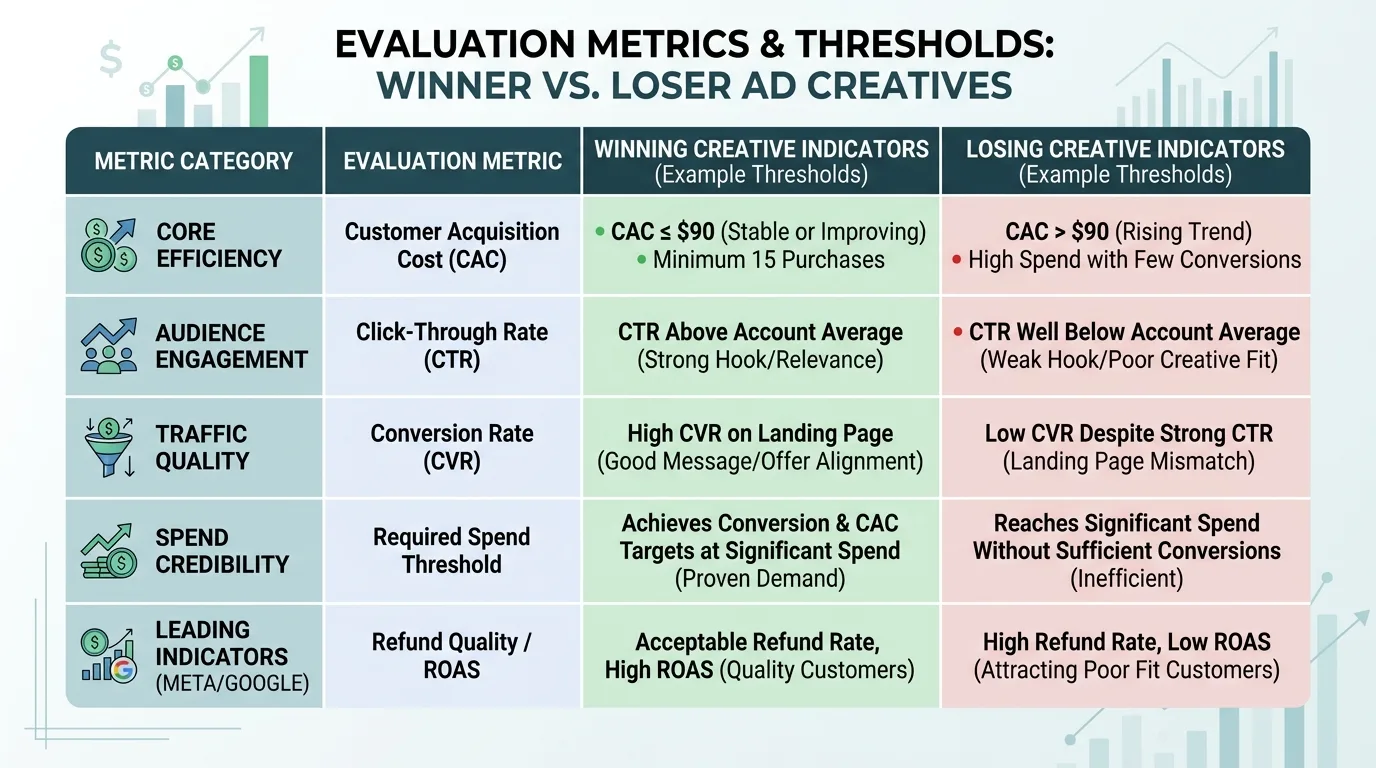
A losing ad is not necessarily paused after its first few clicks. The required spend threshold depends on conversion rate, average order value, traffic quality, and channel. A high-ticket lead generation campaign needs more patience than a low-cost ecommerce offer with frequent transactions. But the threshold must exist, and it must be followed.
The team also watches leading indicators. A low click-through rate can point to a weak hook. A strong click-through rate with poor conversion can point to an offer or landing-page mismatch. High conversion with rising CAC may indicate auction pressure or audience fatigue. These signals guide the next action, but they do not replace the final business metric.
4. Move winning ads through a controlled scale path
When an ad qualifies, it moves from test to scale with its context intact. The media buyer knows the angle, format, landing page, and audience conditions that created the result. The next decision is whether to increase budget, expand placement, add audiences, adapt the creative for another channel, or produce new variants of the same concept.
Budget increases should be deliberate. A team can raise spend gradually when the platform is stable, or use a more aggressive increase when the offer has deep conversion history and capacity is not a constraint. The correct pace depends on volatility, margin, and how quickly the platform responds to change.
The most reliable scaling move is often not putting ten times more budget behind one ad. It is creating a family of proven creative. If a testimonial built around a specific objection wins, produce new testimonials, new visual openings, and new cuts that preserve the core message. That extends the signal instead of betting the account on one asset that will eventually fatigue.
Reporting should create actions, not a monthly recap
A useful reporting layer connects channel data to the decisions made in the account. It shows spend, revenue, CAC, conversion rate, and return by platform, campaign type, creative angle, and production batch. It should also show what changed: new launches, ads promoted to scale, ads paused, budget shifts, and material performance movement.
For the subscription brand, a weekly review might reveal that problem-led static ads are generating cheaper first purchases on Meta, while customer-story videos are producing stronger 60-day retention. That is not a reason to declare one format superior. It is a reason to allocate spend according to the business goal and test whether the retention signal holds at more volume.
The best reports also expose wasted spend quickly. If a campaign has consumed budget without producing a viable signal, the team should be able to see whether the issue is creative quality, targeting, landing-page conversion, tracking, or a mismatched channel. A dashboard alone cannot solve that problem. The operating cadence around the dashboard does.
Where this system breaks down
Even a well-designed system can underperform when inputs are constrained. If creative production is slow, testing velocity falls and the account becomes dependent on aging winners. If the landing page cannot convert qualified traffic, stronger ads may only accelerate wasted spend. If tracking is unreliable, teams optimize toward incomplete data and lose confidence in every decision.
There is also a trade-off between control and speed. Overly rigid approval processes can delay launches and make the system less responsive. Too little structure creates duplicate tests, inconsistent naming, and chaotic budget changes. The right balance is standardized execution with enough room for a buyer to act when performance moves.
This is why integrated creative and media teams outperform fragmented setups. When the people reading the performance data can immediately brief the next batch of ads, learning compounds. Conversion Collective uses this operating model to connect high-velocity creative production, structured testing, and centralized campaign management rather than treating them as separate services.
The operating standard to aim for
A good media buying system does not promise that every ad will win. It makes losses cheaper, winners clearer, and decisions faster. Your team should be able to trace every major budget increase back to a result, every new creative batch back to a hypothesis, and every performance shift back to an action plan.
That level of control is what turns paid acquisition from a collection of platform tactics into a growth engine that can handle more spend without creating more chaos.