A campaign can show a weak CPA while the media team says the audience is saturated and the creative team says production delivered on brief. Neither answer helps you scale. The real question is whether the message, format, audience, placement, and bid strategy were tested as one system. That is how to unify media and creative: make every ad outcome a shared operating signal, not a handoff between separate teams.
For performance-driven brands, fragmentation is expensive. Media buyers can only optimize what they are given. Creative teams can only improve what they can see. When those functions run on separate calendars, dashboards, and success metrics, weak concepts stay live too long, winning angles are not expanded fast enough, and spend rises before learning does.
Why media and creative split apart
Most organizations do not deliberately create a divide. It develops through workflow. Creative is often treated as a production function measured by volume, approvals, and brand fit. Media is treated as a buying function measured by CPA, ROAS, pacing, and platform performance. Each team has valid responsibilities, but the split creates blind spots.
A media buyer may see that a video has a high CPM and shut it down. The creative team may never learn whether the issue was the opening hook, the first-frame visual, the audience match, or a placement where the asset did not translate. Meanwhile, a strong ad may be labeled a winner based on blended performance, even though it only works with one audience or at one stage of spend.
Unified teams use a different standard. They ask what combination produced the result and what the next test should isolate. Creative performance is not a post-launch report. It is an input to campaign structure, budget allocation, and the next production queue.
Build one shared performance system
Unifying media and creative does not require everyone to do the same job. It requires one source of truth, one testing cadence, and shared accountability for profitable growth.
Start by agreeing on the decision metrics. CPA and ROAS matter, but they are lagging indicators when a campaign is still gathering data. Your operating view should also show creative-level signals that explain why an ad is moving: thumb-stop rate, hold rate, click-through rate, conversion rate, frequency, CPM, and spend by concept.
The point is not to overload the team with metrics. It is to connect them. A low click-through rate may indicate a weak hook or a poor audience-message match. A strong click-through rate with poor conversion can signal misaligned claims, landing-page friction, or low-intent traffic. High CPM may reflect a narrow audience, but it may also mean the creative is failing to earn delivery in a competitive auction.
Every asset should carry a clear naming structure that identifies its angle, format, hook, creator or production style, offer, audience intent, and version. Without this discipline, reporting becomes a gallery of filenames and opinions. With it, teams can identify patterns across hundreds of ads rather than debating one-off results.
A useful operating system tracks four things for every launch:
- The hypothesis: what belief about the customer or market is being tested.
- The creative variable: the hook, angle, proof point, visual treatment, offer, or CTA being changed.
- The media variable: the audience, placement, optimization event, budget level, or platform context.
- The decision rule: how much spend or how many conversions are required before the team iterates, expands, or cuts the test.
This structure gives creative a direct line to commercial outcomes and gives media a dependable supply of purposeful test inputs.
Create a testing backlog, not a content calendar
A conventional content calendar asks what assets need to be produced this month. A performance testing backlog asks what uncertainty is worth resolving next.
That difference matters. If a brand needs scale, it should not simply make more versions of its best-looking ad. It should prioritize the largest opportunities in the account: a proven angle that has not been adapted to video, a high-spend audience that lacks tailored messaging, a strong hook that has not been tested with different proof, or a winning Meta concept that needs to be rebuilt for TikTok, Google, or native placements.
Each backlog item should state the expected learning. For example: “Price-sensitive shoppers will respond better to a cost-per-use proof point than a percentage-off offer.” That is stronger than “make three discount ads” because it gives the media team a specific pattern to evaluate and gives the creative team room to execute multiple treatments.
Prioritize tests by potential impact, not by who requests them most loudly. A small copy change can be worth testing, but it should not displace a new customer insight, a fresh format, or an angle with enough headroom to materially improve acquisition economics.
Make launch speed part of the strategy
A good test that takes three weeks to launch loses value. Markets change, competitors refresh, and audiences fatigue. Speed is not about rushing assets out without quality control. It is about removing operational delays between insight, production, launch, and decision.
That means establishing clear service-level expectations. Media should communicate upcoming needs early, including platform requirements, budget availability, audience context, and known fatigue risks. Creative should deliver assets in testable batches, with variations designed around a stated hypothesis rather than cosmetic edits. Both teams should know who approves claims, offers, and brand-sensitive messages before production begins.
Campaign setup also needs consistency. Standardized naming, QA checklists, tracking verification, and launch templates reduce preventable errors. When an account manages hundreds or thousands of campaigns, these details determine whether testing velocity creates insight or chaos.
At Conversion Collective, this is the purpose of treating campaign management and creative production as one managed growth function. The objective is not more activity. It is a faster path from performance signal to the next profitable action.
Read performance in layers
The fastest way to waste budget is to declare winners and losers too early. The second-fastest is to wait so long for certainty that the market has already moved on. The right decision depends on spend, conversion volume, sales cycle, attribution quality, and how large the expected performance difference is.
Read results in layers. First, assess delivery: did the platform spend, where did it spend, and did the asset receive enough exposure to be evaluated? Next, assess attention and engagement: did the ad earn the click or view behavior expected for that format? Then assess conversion quality: did the traffic produce the action that matters, at an acceptable cost?
This layered view prevents bad conclusions. A creative can have a weak blended CPA because it was pushed into a cold audience, yet still be the best prospecting message in the account. Another asset can generate cheap clicks while attracting customers who do not convert. Neither should be judged by a single dashboard column.
Keep tests controlled where possible, but do not become rigid. On platforms with automated delivery, perfect experimental conditions are not always available. The practical standard is directional confidence plus repeatability. If an angle wins across multiple executions, audiences, or spend levels, it is more valuable than a single ad that briefly spikes.
Turn winners into a scaling plan
A winning creative is not the finish line. It is evidence. The next step is to identify what actually won: the problem framing, the first three seconds, the product demonstration, the creator style, the offer, or the audience context.
Then expand the underlying mechanism. If a testimonial format works, test new customer stories, stronger proof, different objections, and alternate openings. If a specific angle converts, adapt it into statics, short-form video, longer demonstrations, landing-page copy, and channel-native versions. This is how an account compounds learning instead of burning through isolated ads.
Media and creative should jointly decide when to scale. Increasing budget on a proven asset may be the right move when efficiency holds and frequency remains manageable. In other cases, horizontal scaling is safer: take the message into adjacent audiences, placements, or platforms before pushing more spend through one campaign. The right path depends on account maturity, creative depth, and how quickly the audience is saturating.
The operating habit that keeps the system unified
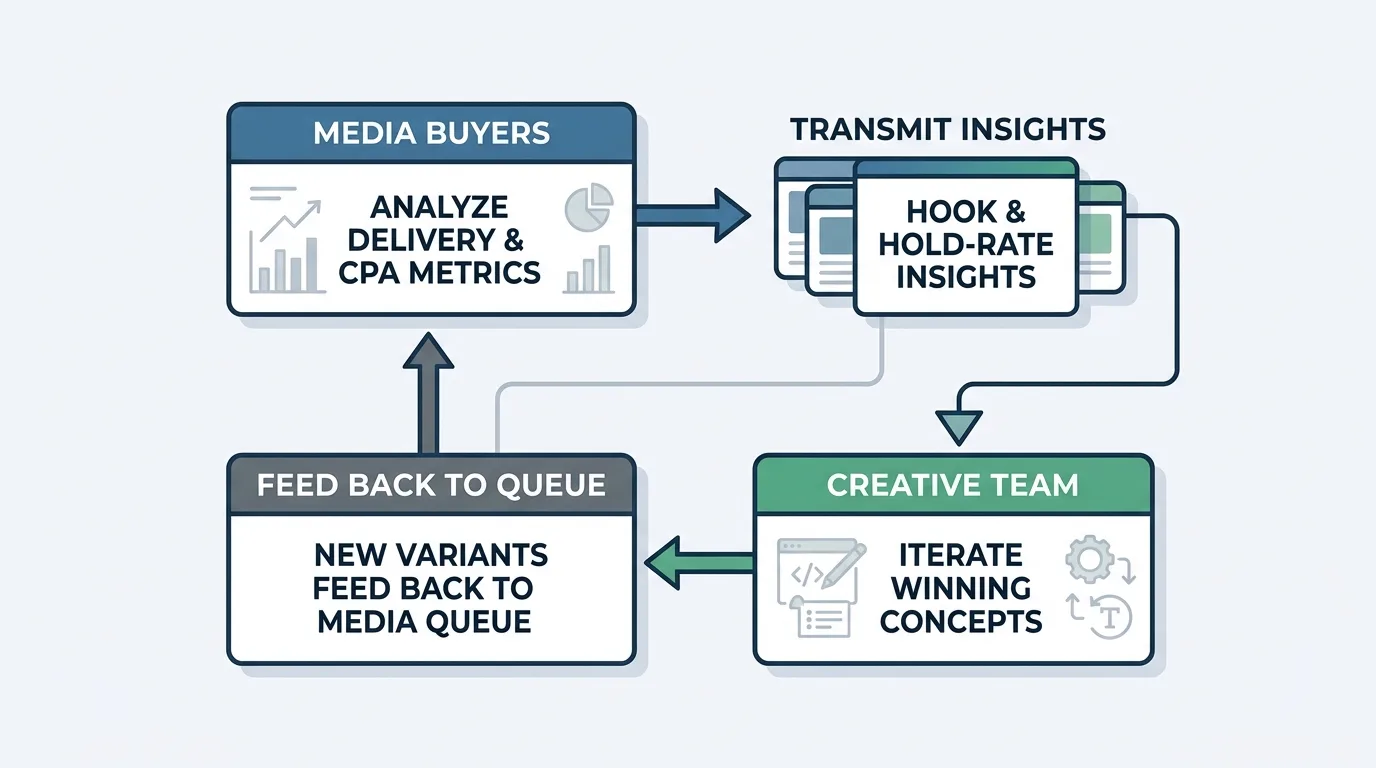
Run a recurring performance review that ends with decisions, not observations. The team should leave knowing which ads are being cut, which concepts are being iterated, which winners are being expanded, and what must launch next. If a report does not change the production queue or media plan, it is reporting theater.
The strongest paid acquisition programs are built on this habit: media reveals where demand is responding, creative explains and extends that response, and both functions move quickly enough to capitalize on it. Keep the feedback loop tight, make every test intentional, and let profitable signals set the pace for the next round of work.