
A campaign can look exceptional in-platform and still produce little to no net-new revenue. That is the central problem this incrementality testing guide is built to solve. Attribution reports tell you where conversions were credited. Incrementality tells you whether your advertising caused conversions that would not have happened otherwise.
For growth teams spending aggressively across Meta, Google, TikTok, Taboola, and other channels, that distinction is not academic. It determines whether you scale a real growth lever or keep funding demand your brand was already going to capture.
What incrementality testing actually measures
Incrementality is the additional business outcome created by a marketing activity compared with what would have happened without it. The outcome could be purchases, qualified leads, subscriptions, installs, revenue, or profit. The key is the counterfactual: what would this same audience have done if they had not been exposed to the campaign?
Standard platform attribution cannot answer that question on its own. Platforms see impressions, clicks, and tracked conversions within their own reporting windows. They are designed to assign credit, not to build a clean no-ad scenario. A branded search campaign may receive credit for a customer who was already searching for your company. Retargeting may claim a purchase from someone who had already decided to buy. Prospecting may be undervalued if its impact appears later through direct traffic, branded search, or another channel.
Incrementality testing creates a control group that does not receive the treatment. When the test is designed correctly, the difference in performance between exposed and unexposed groups is your estimated causal lift.
That is the number a performance team can operate from.
Why attribution alone creates expensive decisions
Attribution is useful. It helps media buyers optimize day to day, identify creative patterns, monitor funnel health, and move budget quickly. The mistake is treating attributed return as proof of causality.
This becomes especially costly when spend scales. A channel can report a 3x return while mostly harvesting existing demand. Another channel can report a weaker return while creating new customers who convert days or weeks later through a different touchpoint. If you only follow last-click, view-through, or platform-reported return, you are likely to overfund capture and underfund creation.
The result is familiar: reported efficiency looks stable, spend climbs, and blended revenue fails to move in proportion. Teams respond by changing bids, audiences, landing pages, and creative all at once. The account gets busier, but the actual signal gets harder to see.
Incrementality brings operational control back to the system. It gives you a disciplined way to answer questions such as whether branded search needs its current budget, whether retargeting is genuinely additive, whether a new prospecting creative is expanding reach, and whether a platform deserves more spend.
The incrementality testing guide: choose the right test design
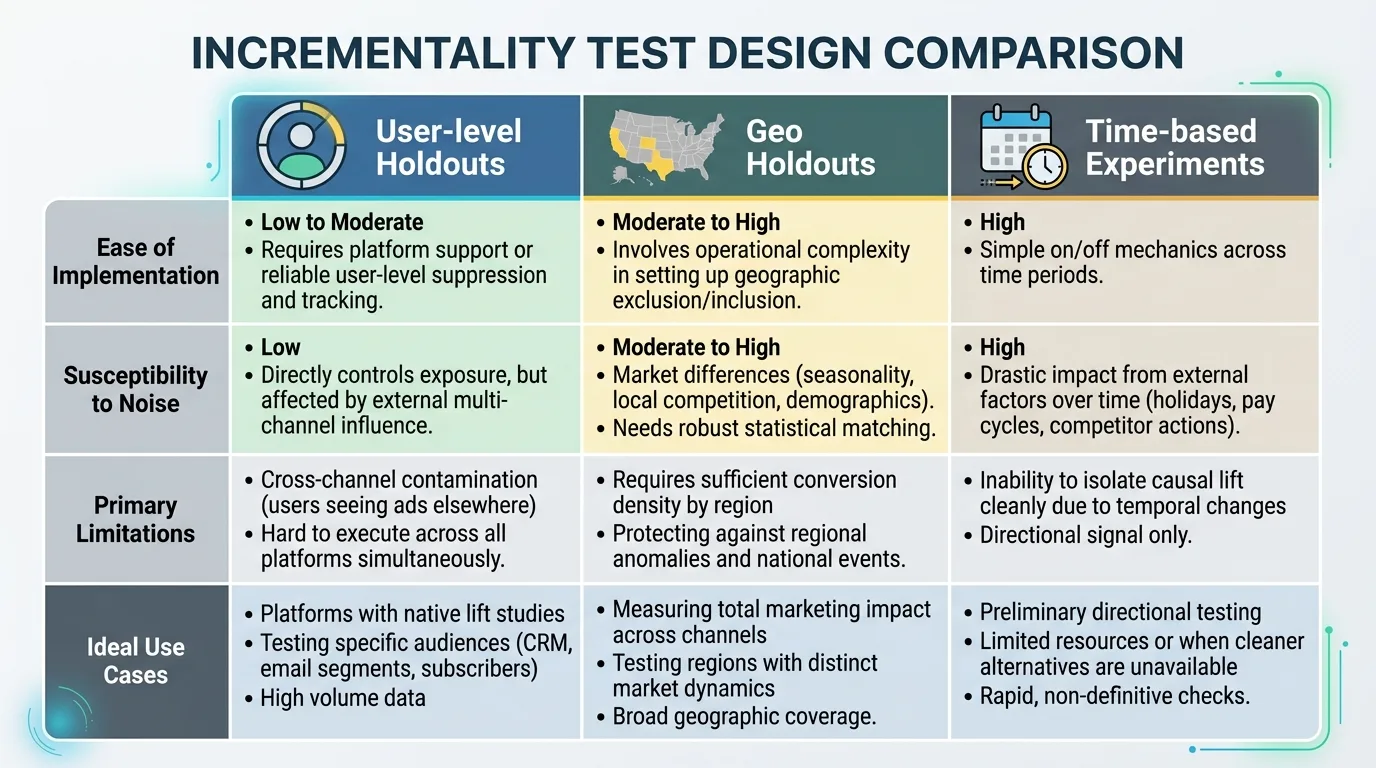
The right methodology depends on your conversion cycle, traffic volume, geographic footprint, customer data, and ability to suppress ads reliably. There is no single test that works for every business.
User-level holdout tests
A user-level holdout splits an eligible audience into treatment and control groups. The treatment group receives ads; the control group is intentionally withheld from exposure. You then compare conversion rates, revenue per user, or another business outcome.
This is often the cleanest approach for platforms with built-in conversion lift studies or reliable audience exclusion capabilities. It works particularly well when you have enough conversion volume and a defined audience, such as existing leads, subscribers, app users, or a CRM-based prospect pool.
Its limitation is cross-channel contamination. If the control group is excluded from one platform but still sees ads on another, you are measuring the lift of one channel within a broader media environment, not the lift of all paid media.
Geo holdout tests
Geo testing assigns comparable markets to treatment and control groups. Ads run in selected treatment regions and are paused or materially reduced in control regions. The analysis compares changes in outcomes between the two sets of markets over the same period.
This method is practical for businesses with broad US coverage and sufficient conversion density by market. It is also useful when user-level suppression is difficult or when you want to measure the combined impact of multiple channels.
The trade-off is noise. Markets differ in seasonality, competition, customer mix, and local demand. A strong geo test requires carefully matched regions, enough time to absorb normal variation, and protection against major changes such as promotions, pricing updates, inventory issues, or a national PR event.
Time-based experiments
Time-based tests compare performance during periods with and without spend. They are easier to launch but less reliable because demand changes over time. Seasonality, pay cycles, competitor activity, and product changes can all distort the result.
Use time-based tests when no better option exists, but treat the findings as directional unless you can support them with a strong forecasting model and stable operating conditions.
Set the business metric before you launch
A clean experiment can still produce a bad decision if it optimizes the wrong outcome. Start with the metric that connects media to the business model.
For ecommerce, that may be incremental contribution margin or incremental new-customer revenue rather than total tracked purchases. For lead generation, it may be incremental qualified leads, funded accounts, or sales-accepted opportunities. For subscriptions and apps, it may be incremental paid starts, retained subscribers, or projected payback-adjusted revenue.
Avoid selecting a metric simply because it is available faster. Clicks, landing-page views, and platform conversions can be useful diagnostic metrics, but they are not always decision metrics. If a lead source produces more form fills but fewer qualified opportunities, the apparent lift is not valuable lift.
Define the primary metric, the attribution source of record, and the evaluation window before launch. Then keep them fixed. Changing the success definition after results arrive is how teams turn experiments into validation exercises.
How to plan a test that produces usable signal
The goal is not statistical theater. The goal is a decision you can act on: scale, hold, cut, or retest.
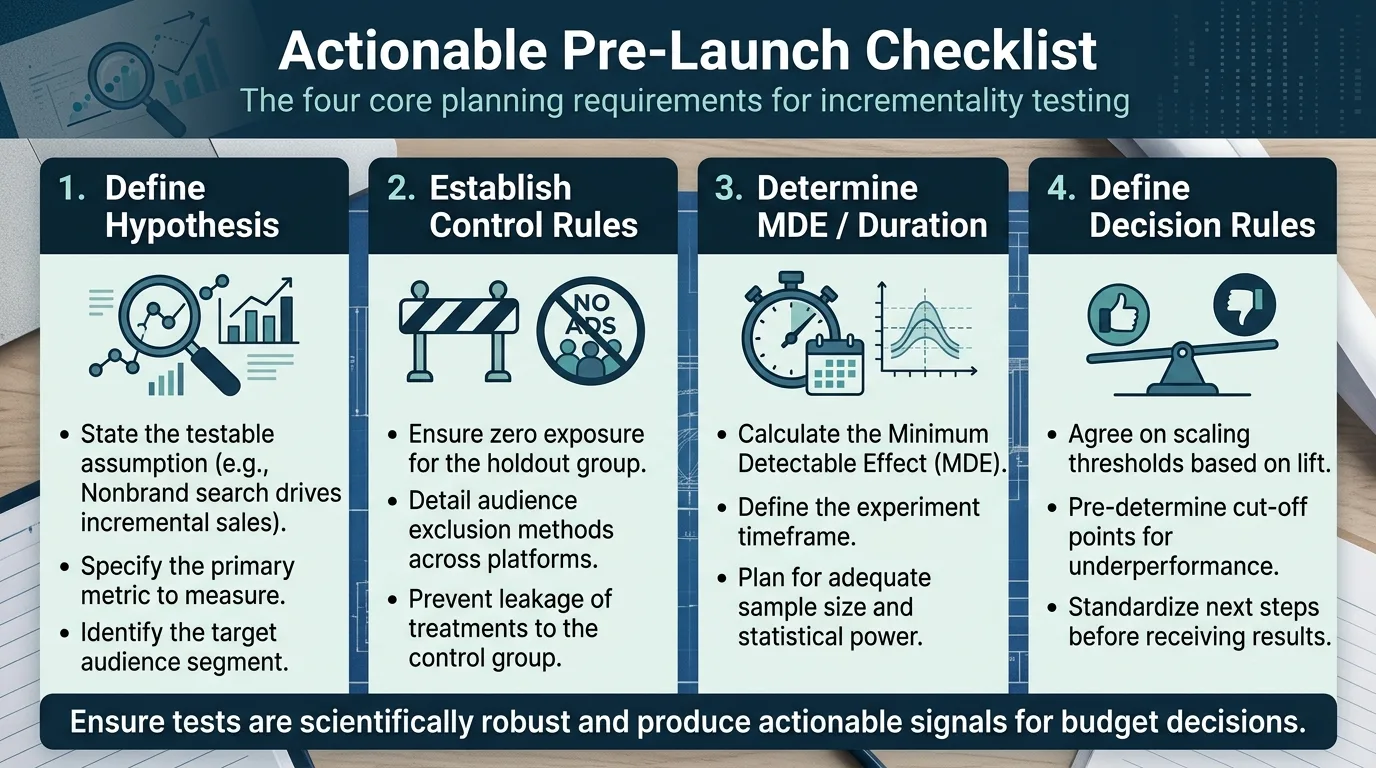
Before launching, document four things:
- The hypothesis, such as whether nonbrand search creates incremental qualified leads above a defined cost threshold.
- The treatment and control rules, including exactly who or which markets will be excluded from ads.
- The budget, duration, and minimum detectable effect needed for the test to be worth running.
- The decision rule, including what result would justify scaling, reducing, or reallocating spend.
The minimum detectable effect matters. If your business only has enough volume to detect a 25% lift, a 5% lift may be real but impossible to validate in that test. That does not mean the channel has no value. It means you need more time, more units, a more sensitive design, or a larger treatment difference.
Keep execution stable while the test runs. Do not launch a major promotion in treatment markets only. Do not refresh creative exclusively in one group. Do not shift budgets midway because an early read feels uncomfortable. Testing velocity matters, but a test that changes every three days is not velocity. It is noise.
Calculate incremental lift and incremental efficiency
At the simplest level, incremental lift is the difference between the treatment outcome and the control outcome.
If treatment markets generated $1,200,000 in revenue and matched control markets generated $1,000,000 after normalization, the estimated incremental revenue is $200,000. If incremental media spend was $80,000, incremental return on ad spend is 2.5x.
The normalized comparison is critical. Raw totals are rarely comparable. Your analysis may need to account for baseline revenue, population size, historical conversion rates, market size, and pre-test trends. For lead generation, normalize to qualified outcomes, not just top-funnel submissions. For ecommerce, separate new and returning customers if the business objective is customer acquisition.
Then compare incremental efficiency with your actual margin and payback requirements. A campaign with a lower platform-reported return can be a better scaling opportunity if it produces more net-new customers. Conversely, a high-attribution campaign may deserve a budget cut if the holdout shows limited lift.
Common failure modes that invalidate results
Most failed incrementality tests do not fail because the math is complicated. They fail because the operating environment was not controlled.
The first issue is leakage. Control users or control geographies still receive ads through another campaign, another platform, affiliates, or local targeting overlap. The second is poor matching. Treatment and control groups had meaningfully different baseline demand before the test began. The third is insufficient sample size, which produces a wide confidence range and invites overreaction to random movement.
A fourth issue is measuring too early. A seven-day test may work for low-consideration purchases, but it is not enough for a high-ticket product with a three-week sales cycle. Finally, teams often treat an inconclusive result as proof that a channel does not work. Inconclusive means the test did not isolate a reliable answer. It may need a different design, more volume, or a longer read window.
Turn test results into budget decisions
A test only matters if it changes how the account is managed. Build incrementality findings into weekly optimization, creative planning, and budget allocation rather than storing them in a quarterly deck.
If a channel shows strong incremental profit, scale it in controlled steps and continue monitoring blended outcomes. If it delivers some lift but misses your efficiency threshold, improve the offer, landing page, audience, or creative before adding spend. If it produces little lift, cut waste and move budget toward higher-confidence opportunities.
Creative deserves a direct role here. High-volume creative testing can improve incrementality when it reaches genuinely new audiences, communicates a stronger reason to act, or reduces friction for prospects who are not already shopping. But creative that only improves click-through rate among existing demand may inflate attributed performance without changing the business outcome. Judge the work against lift, not applause from the dashboard.
The best teams do not run one incrementality test and declare the measurement problem solved. They build a recurring testing cadence around their largest spend categories and biggest assumptions. Start where spend is high, attribution is questionable, and the answer would change a real budget decision. That is where better measurement turns into profitable growth.