
A Meta dashboard says a campaign drove 2,000 purchases. Google claims another 1,400. Your analytics platform reports 2,600 total orders. The gap is not a reporting problem you can solve with a better spreadsheet. It is why incrementality measurement matters.
Paid media platforms are built to claim credit for conversions. Their attribution systems use their own lookback windows, identity graphs, and modeled data. That is useful for in-platform optimization, but it does not answer the executive-level question: what would have happened if we had not spent the money?
For a growth team trying to scale efficiently, that distinction determines whether added budget produces new revenue or simply pays to capture demand that was already on its way.
What incrementality measurement actually measures
Incrementality measures the net-new outcome caused by marketing activity. It compares a group exposed to an intervention, such as ads in a market or audience segment, with a comparable group that was not exposed. The difference between those outcomes is the incremental lift.
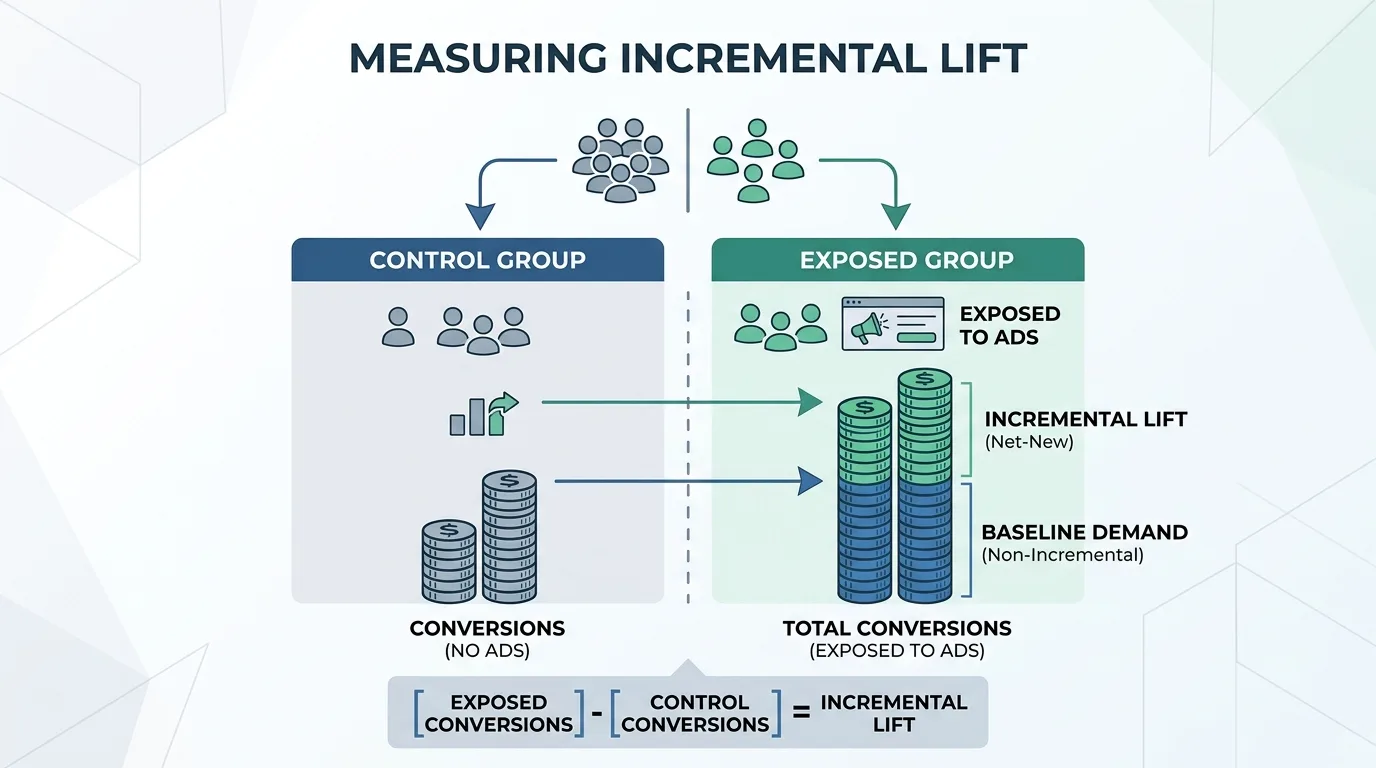
If an exposed group generates 10,000 conversions and a well-matched control group generates 8,500, the campaign produced an estimated 1,500 incremental conversions. The remaining conversions may still be real and attributed by a platform, but they cannot all be treated as new demand created by the campaign.
This is different from attribution. Attribution assigns credit among touchpoints. Incrementality asks whether the touchpoints changed behavior at all. Both have a role, but confusing one for the other creates a predictable scaling problem: teams increase spend on campaigns that look efficient in-platform while total business results barely move.
That problem is most common in branded search, retargeting, mature Meta accounts, and channels with a high concentration of returning buyers. These campaigns can be valuable. They can also be the first place inflated credit hides.
Why attribution alone breaks at scale
At low spend, attribution imperfections may not materially change a budget decision. At scale, small errors compound quickly. A campaign that is overcredited by 20% can absorb a meaningful share of the budget that should have gone to prospecting, new creative angles, or a different channel.
Platform reporting has incentives and limitations. It cannot fully observe organic demand, competitor activity, email performance, seasonality, repeat purchasing behavior, or users moving between devices. Privacy changes have made the picture less complete, which has pushed platforms toward more modeled conversions. Modeled data can improve directional decision-making, but it is not proof of causal impact.
The operational risk is straightforward. If your team optimizes every decision toward the lowest attributed CPA, it may systematically favor people closest to converting anyway. That can make dashboards look cleaner while customer acquisition gets less incremental and profit growth slows.
The core metrics that change the conversation
Incrementality does not replace standard performance metrics. It puts them in the right order.
The most useful metric is incremental CPA: total test spend divided by the additional conversions generated versus the control. For revenue-driven businesses, incremental ROAS compares the incremental revenue created with the media cost. Subscription and app teams may also track incremental trials, activated users, retained subscribers, or downstream contribution margin.
A simple example makes the difference clear. Suppose a retargeting campaign spends $50,000 and receives credit for 1,000 purchases, reporting a $50 CPA. A holdout test finds that people who did not see the ads still generated 700 purchases. The campaign created 300 net-new orders, making the incremental CPA $167.
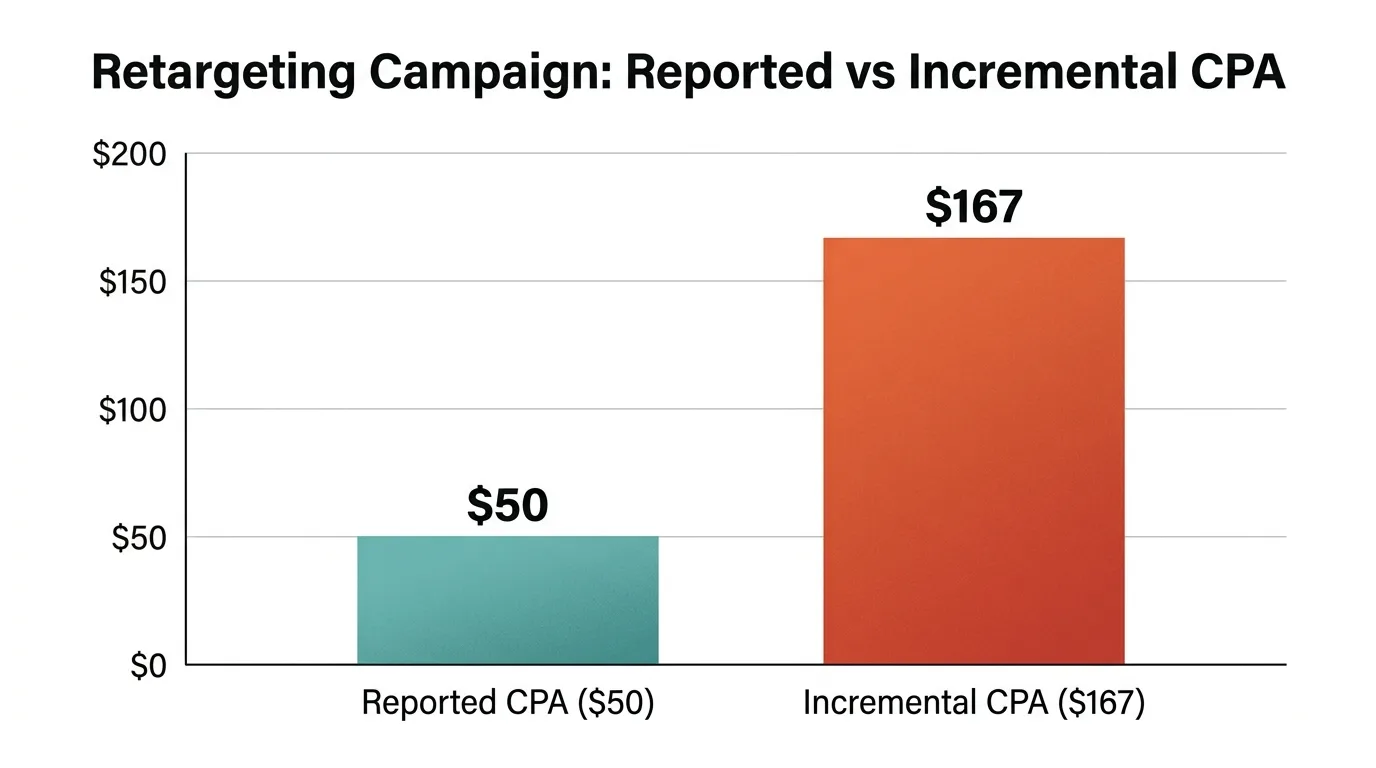
Worked Example: Retargeting CPA vs. Incremental CPA
| Metric | Platform Attribution | Holdout Test (Control) | Incremental (Causal) Result |
|---|---|---|---|
| Spend | $50,000 | $0 | $50,000 (Net Cost) |
| Purchases | 1,000 | 700 (Organic Baseline) | 300 (Net-New Purchases) |
| CPA | $50 | N/A | $167 (Incremental CPA) |
That does not automatically mean the campaign should be shut off. If the gross margin supports a $167 incremental CPA, it may still be profitable. The point is that the budget decision should be based on the real acquisition cost, not the most flattering attribution view.
How to run an incrementality measurement test
The best test design depends on budget, audience size, channel, sales cycle, and how easily customers can be isolated. The goal is consistent: create a credible control group, change one meaningful variable, and allow enough time for a detectable result.
Start with the decision, not the methodology
Do not run a test because “incrementality” is on the roadmap. Start with a decision that has real budget consequences. You might need to know whether branded search is incremental, whether expanding Meta prospecting is creating net-new customers, or whether a new creative system is lifting conversion volume rather than redistributing credit.
A useful test answers a question your team is prepared to act on. Define the spend at stake, the primary business outcome, the acceptable risk, and the action you will take if lift is weak, neutral, or strong. This prevents a common failure mode: generating an interesting report that changes nothing.
Choose a control group that reflects reality
For audience-based platforms, randomized conversion lift studies are often the cleanest option. A small percentage of eligible users is held back from ads, while the exposed group continues to receive normal delivery. The platform or measurement partner then compares outcomes between the groups.
Geo holdouts are often better for businesses with meaningful regional volume, offline conversion data, or channel-level questions. Similar markets are grouped into test and control cells, media pressure changes in the test markets, and the outcome is compared over time. Geo tests require careful matching because market differences in demand, inventory, competition, and seasonality can distort the result.
For search, a clean holdout is harder. Turning off branded campaigns can cause competitors to take the placement, alter organic click behavior, or change the customer experience. That does not make testing impossible. It means the test should be designed around the actual decision, with enough markets or time periods to separate the campaign effect from normal demand variation.
Protect the test from operational noise
Incrementality tests fail when too many variables move at once. If you launch a promotion, change pricing, alter landing pages, push email volume, and increase media spend during the same test window, the result will be difficult to trust.
Before launch, align media, creative, analytics, and lifecycle teams on what stays fixed. Confirm conversion definitions, data lag, exclusion rules, and test duration. If the test group receives a different creative mix, document that choice. Creative can be the intervention, but then the question is about creative lift, not simply channel lift.
Pre-test Checklist
- Statistical Significance: Ensure enough spend and conversion volume to detect a meaningful effect.
- Credible Control: Verify the control group is large enough to create a credible comparison.
- Stable Tracking: Confirm stable tracking and a shared definition of the conversion event.
- Pre-agreed Decision Rule: Establish a pre-agreed decision rule before results are visible.
A practical preflight should cover four areas:
- Enough spend and conversion volume to detect a meaningful effect
- A control group large enough to create a credible comparison
- Stable tracking and a shared definition of the conversion event
- A pre-agreed decision rule before results are visible
The last point matters more than most teams expect. Results are easier to rationalize after the fact. Agreeing on thresholds in advance keeps the test connected to business reality.
Where creative testing fits into incrementality
Creative and media should not be measured as separate systems. A new creative concept can improve click-through rate, lower platform CPA, and still produce little net-new lift if it mainly wins auctions for users already likely to convert. Conversely, a creative angle aimed at a new customer problem may look less efficient during its first week but expand the pool of people who respond.
This is why high-velocity testing needs a measurement hierarchy. Use platform-level signals to identify likely winners quickly. Validate the strongest themes against blended revenue, customer quality, and incremental outcomes before scaling them aggressively.
The right question is not, “Which ad has the lowest reported CPA?” It is, “Which message creates profitable demand we would not have captured otherwise?” That is a tougher standard, but it gives creative production a clearer job: generate new demand, not just harvest existing intent.
Reading results without overreacting
Incrementality is an estimate, not a magic truth machine. Confidence intervals matter. A test that suggests positive lift but has wide uncertainty should lead to a measured next step, not an immediate doubling of budget. A neutral result may mean the channel has no impact, but it can also mean the test was underpowered or the control group was contaminated.
Look at results alongside business context. A channel may have modest direct incrementality but support later conversion through other channels. It may improve new-customer mix, increase branded search demand, or create higher-value cohorts. Those effects should be investigated, not assumed.
At the same time, do not use “halo effects” as an excuse to avoid accountability. If a campaign needs broad strategic credit to justify weak measurable lift, set a clear hypothesis and test that hypothesis. Performance discipline means giving each dollar a job and requiring evidence that it did the job.
Build incrementality into the operating cadence
One-off studies are useful, but the value comes from repetition. Demand changes. Creative fatigue sets in. Channel mixes evolve. The incremental return from the next dollar is rarely the same as the return from the previous dollar.
A mature program uses platform reporting for daily optimization, blended performance for weekly budget management, and incrementality tests for high-stakes allocation decisions. That creates a practical system: move quickly on directional signals, then validate where the financial exposure is largest.
For teams managing high creative volume across Meta, Google, TikTok, Taboola, and other channels, the discipline is especially valuable. You do not need to test every ad individually. Test the decisions that change allocation: a new audience strategy, a material budget expansion, a channel launch, or a creative category that is becoming a major spend driver.
The next time a dashboard reports a breakout winner, treat it as a strong hypothesis, not a final verdict. The campaign that deserves more budget is the one that produces measurable lift in profitable customer behavior when the credit is stripped back to what it actually caused.