
A campaign can look stable in a blended dashboard while its best ads quietly lose their ability to convert. CPM may be flat. Spend may still be rising. But if click-through rate, conversion rate, or cost per acquisition begins moving in the wrong direction, your audience may have already seen too much of the same message.
Knowing how to analyze ad fatigue is not about reacting to a single bad day. It is about separating normal performance variance from a repeatable decline caused by creative repetition, audience saturation, or both. That distinction protects margin. It also tells your team whether to refresh the ad, expand the audience, adjust the offer, or leave a healthy campaign alone.
What ad fatigue actually looks like
Ad fatigue happens when a meaningful portion of the audience has seen an ad enough times that it stops earning attention or action at its previous rate. The platform can continue delivering impressions, but the creative is no longer doing the same amount of work.
The common mistake is treating frequency as the diagnosis. Frequency is a useful exposure metric, not proof of fatigue. A frequency of 3 can be too high for a narrow retargeting pool and completely acceptable for a broad prospecting audience. The right threshold depends on audience size, buying cycle, platform, creative format, and how quickly the account spends.
The more reliable signal is a deteriorating performance pattern that lines up with increased exposure. On Meta or TikTok, that often starts with declining outbound CTR or thumb-stop rate, followed by a higher CPC and then a worse CPA. On Google, the pattern may show up differently: lower engagement, weaker conversion rates, or rising costs as the same users repeatedly encounter similar messaging. On Taboola and other native placements, creative-level decay can appear as a falling CTR before conversion costs move.
The sequence matters. If CPM rises but CTR and conversion rate hold, the issue may be auction pressure rather than fatigue. If CTR drops while CPM is stable, the creative is the more likely problem. If clicks remain efficient but conversion rate falls, investigate the landing page, offer, tracking, checkout flow, or lead quality before replacing ads.
How to analyze ad fatigue with a clean diagnosis
Start at the ad level, then work upward. Campaign-level averages hide the exact creative, audience, placement, or segment that is pulling performance down. A winning ad can mask several fatigued ads, while a new test can temporarily disguise broad creative decline.
Use a consistent comparison window. For fast-spending accounts, compare the last three or seven days against the prior equivalent period. For lower-volume campaigns, use 14-day or 30-day windows so you are not making decisions on noise. Keep the day-of-week mix consistent when possible, especially for ecommerce, lead generation, and subscription offers with predictable weekly behavior.
At minimum, review these four metrics together:
- Frequency or average impressions per reached user
- CTR, outbound CTR, or another click-quality measure
- CVR from click to the primary conversion event
- CPA, CAC, or contribution-margin-adjusted acquisition cost
Then add spend and impression volume to the view. An ad that has spent $200 is rarely ready for a fatigue call, even if its CTR dipped. An ad that has absorbed 30% of account spend for three weeks is different. It has generated enough exposure and enough economic impact to justify a closer look.
A practical diagnostic might look like this: frequency rises from 2.1 to 3.8 over two weeks, outbound CTR falls from 1.4% to 0.9%, CPC rises 40%, and the landing page conversion rate remains unchanged. That is a strong creative fatigue case. The ad is earning fewer qualified visits because the message is no longer fresh, not because the post-click experience suddenly broke.
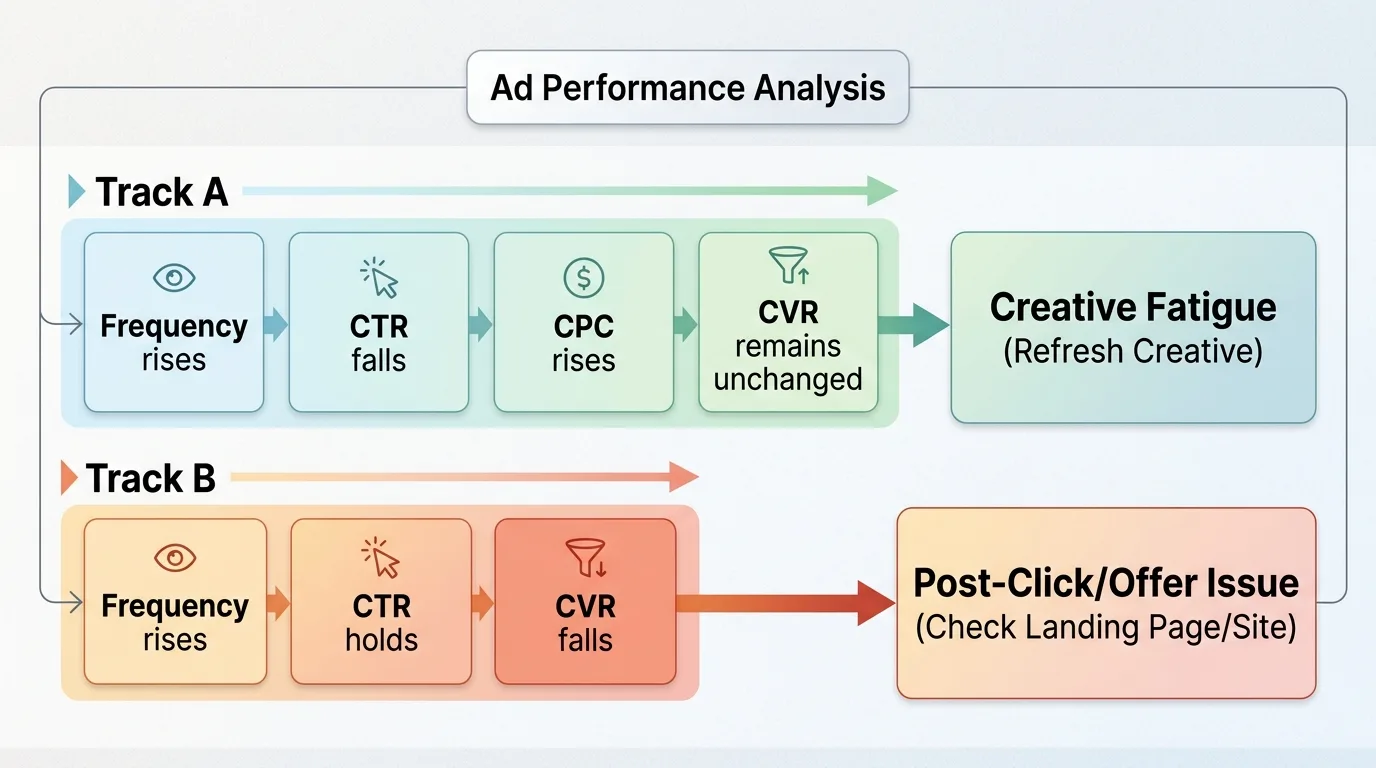
Now consider the inverse. Frequency rises, CTR holds, but CVR falls from 5% to 3%. Do not label that ad fatigue by default. Review site speed, inventory, form errors, pricing changes, geo mix, placement mix, and lead validation. A creative refresh may still help, but it will not fix a post-click problem.
Segment before you make a decision
The fastest way to waste a winner is to turn it off because a blended report looks weak. Break performance down by audience, placement, device, geography, and creative version.
A broad prospecting ad may be fatigued in one high-spend audience but still efficient in another. A video may be losing on Reels while its static adaptation continues to convert in Feed. A creative concept may be healthy, but one opening hook, headline, or testimonial has run too long. This is why high-volume creative programs should be organized around concepts and variants, not a folder full of disconnected assets.
Look for the segment where frequency and response decay meet. If performance is deteriorating only in retargeting, you may need a shorter recency window or a more varied sequence. If it is falling across prospecting audiences, the concept itself may have reached its useful life.
Check creative signals before bottom-funnel costs
CPA is the business metric, but it is a lagging indicator. By the time CPA has materially worsened, the account may have already spent through several days of declining creative efficiency.
For video, monitor early attention signals such as hold rate, three-second view rate, hook retention, and watch-time distribution. For statics, monitor CTR, engagement quality, and the relative performance of different visual angles. These metrics do not replace revenue or qualified leads, but they help identify fatigue before it becomes expensive.
Also compare the current performance of an ad against its own baseline, not only account benchmarks. A 1.2% CTR may beat the account average, but if that ad historically delivered 2.0% at the same audience and placement mix, it is decaying. Winners deserve stricter standards because they carry more of the budget.
Do not confuse fatigue with account-level change
Several issues mimic ad fatigue. Attribution changes can lower reported conversion volume overnight. A promotional offer ending can reduce CVR. Competitors may increase bids, raising CPM. Budget increases can force delivery into less responsive inventory. Seasonal demand can shift faster than creative performance.
Before acting, check whether the decline is isolated to one ad or visible across the account. If every creative loses efficiency at once, the problem is probably not one tired asset. Review auction metrics, tracking, site changes, offer changes, and spend pacing first.
This is also where media and creative must operate as one system. Media buyers can identify where delivery is weakening, but creative teams need the exact pattern: which audience, which placement, which angle, which format, and which metric moved first. Vague feedback such as “we need new creative” produces random volume. Specific feedback produces tests designed to solve the actual constraint.
What to do when fatigue is confirmed
Do not simply clone the same ad and change the thumbnail. Small cosmetic edits may reset an internal identifier, but they rarely reset audience response. The audience is reacting to the idea, the first frame, the claim, the proof, and the offer - not the ad ID.
Refresh the component most likely causing decline. If the concept still works but the hook is worn out, create new openings around the same core promise. If users still click but fail to convert, test stronger proof, clearer qualification, a different offer, or a better landing-page message match. If a narrow audience is saturated, broaden targeting, reduce retargeting windows, or shift budget toward fresher acquisition pools.
Maintain control while you refresh. Keep proven ads live where they remain efficient, reduce spend gradually on decaying segments, and introduce enough variants to learn which change restored performance. Turning off every established winner at once creates unnecessary volatility and removes the benchmark your tests need.
A disciplined testing system also prevents the next fatigue cycle from becoming an emergency. Build a creative pipeline before the account needs it. Launch multiple hooks, formats, proof types, and objections against the same offer. Tag each asset clearly so reporting can reveal whether the winner is the concept, the creator, the visual treatment, or the audience-message match.
Set decision rules your team can execute
Fatigue analysis gets inconsistent when every buyer uses a different threshold. Establish account-specific guardrails based on volume and acceptable economics. For example, a team may flag an ad for review after frequency rises materially while CTR drops 20% or more versus its trailing baseline, provided the ad has enough spend and conversions to support the conclusion.
The rule should trigger investigation, not automatic shutdown. An ad with a 20% CTR decline may still be profitable and worth keeping live while replacement creative gathers data. Conversely, a small decline in a high-spend asset can require immediate action because the financial impact is large.
The goal is not to eliminate frequency or chase perpetual novelty. It is to keep creative contribution high enough that spend can scale without silently eroding unit economics. When your reporting identifies decay early and your creative operation can respond quickly, fatigue becomes a manageable production signal instead of a surprise budget leak.
The best time to brief the next round of ads is when the current winner is still working. That is how teams protect momentum: not by waiting for performance to fail, but by building the next set of tests while the account still has room to make smart decisions.