
A creative that produces profitable conversions at $500 a day is not automatically ready for $5,000 a day. That gap is where many acquisition teams lose control. Knowing how to scale winning creatives means separating a real performance signal from a short-term spike, then expanding reach without exhausting the audience, breaking economics, or confusing the data.
The goal is not to make one ad run forever. The goal is to build a repeatable system that turns proven concepts into a larger, constantly refreshed creative pipeline. Creative and media need to operate as one system: media buying identifies the opportunity, creative production develops the next iteration, and reporting shows exactly what is improving or deteriorating.
Define What a Winning Creative Actually Means
A winner is not the ad with the highest click-through rate, the lowest CPM, or the most conversions in a single day. It is the creative that delivers the required business outcome at an acceptable cost with enough spend and enough time behind it to make the result credible.
For ecommerce, that may mean a contribution-margin-positive return on ad spend after first-purchase discounts, shipping, and fulfillment. For lead generation, it may mean qualified leads that convert to sales at a target customer acquisition cost. For subscriptions and apps, the real metric may sit further down the funnel: activated users, trial-to-paid conversion, retention, or predicted lifetime value.
Start with one primary decision metric and a small set of supporting diagnostics. The primary metric determines whether the ad earns more budget. Supporting metrics explain why it is performing. A strong thumb-stop rate with weak conversion may point to a landing-page mismatch. A low CPM with poor lead quality may indicate broad but unqualified reach.
Do not call a creative a winner before it has cleared a meaningful spend threshold. The right threshold depends on your conversion rate, target CPA, purchase cycle, and account volume. A high-volume lead generation account can validate faster than a low-volume, high-ticket B2B offer. The principle is the same: require enough data to make a decision, not just enough to feel optimistic.
How to Scale Winning Creatives With Controlled Expansion
Scaling should happen in stages. Increasing spend, audience reach, placements, and creative variants all at once creates a reporting problem. If results change, you will not know what caused it.
First, validate the original asset. Confirm performance across multiple days and enough conversion events. Check whether the creative is winning in one narrow audience or holding across several meaningful segments. Review downstream quality where available. A cheap conversion that creates no revenue is not a scalable win.
Next, expand budget gradually while maintaining the original creative as a control. The appropriate pace depends on platform behavior and account stability. Some accounts can absorb material daily increases; others need more measured adjustments to avoid resetting delivery or forcing the system into expensive inventory. What matters is that each increase is deliberate and measurable.
Then scale the creative idea, not only the exact file. A winning static, video, or advertorial angle contains components that can be reproduced: the hook, problem framing, proof point, visual pattern, offer, creator style, or call to action. Extract those components and turn them into a production brief.
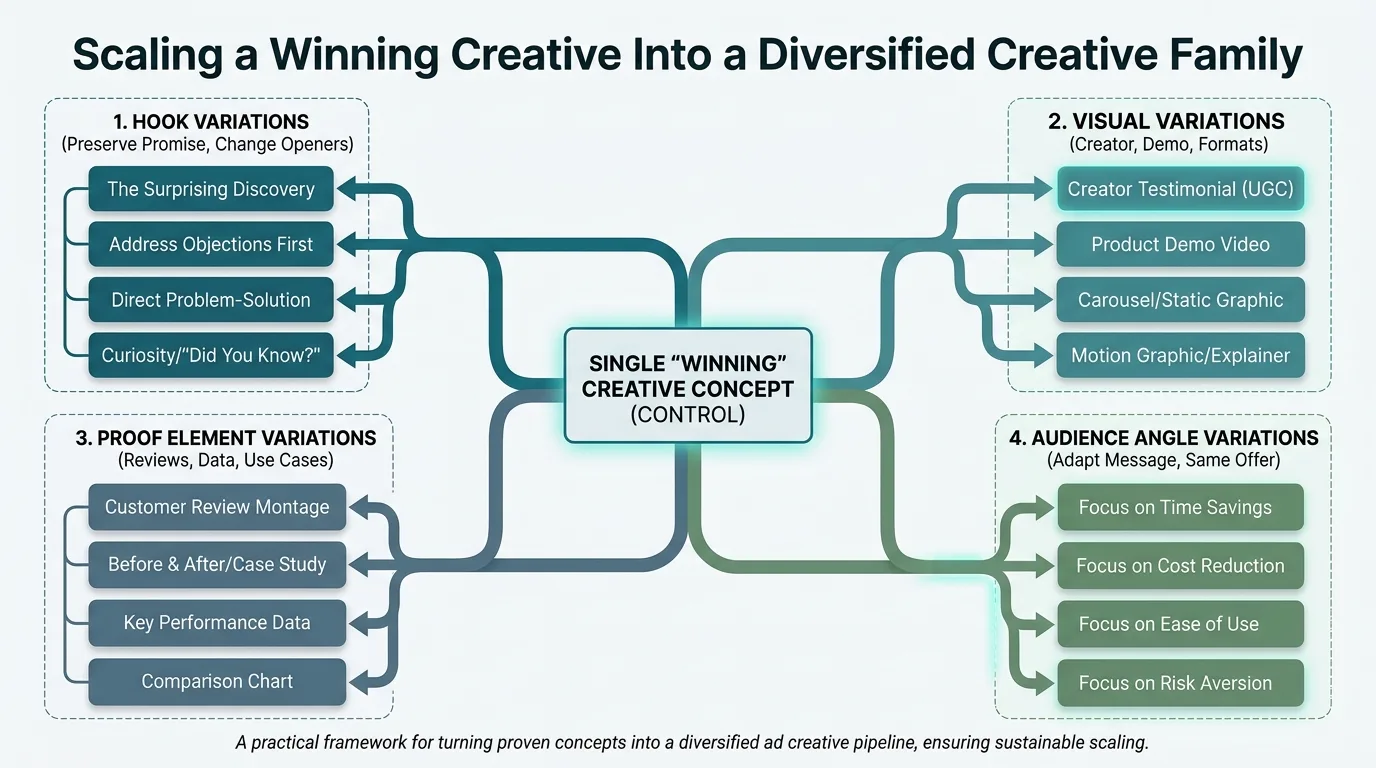
A practical scaling plan usually includes four types of iterations:
- New hooks that preserve the core promise while changing the opening angle.
- New visual executions, such as creator footage, product demonstrations, statics, carousels, or motion-led formats.
- New proof elements, including reviews, demonstrations, data points, objections, and use cases.
- New audience-specific versions that adapt the message to different motivations without changing the offer.
This is how a single winner becomes a creative family. The control remains live while new variants compete to become the next control. That process protects revenue while increasing the odds of finding a stronger ad.
Scale Concepts Across Formats, Not Just Audiences
A common mistake is taking one Meta winner and simply pushing it into broader targeting. That may work for a period, but reach expands faster than relevance. The creative needs enough variation to meet new audiences where they are.
A founder-led testimonial might be the best entry point on Meta, while a direct comparison or problem-solution video could perform better on TikTok. A clear utility message can work in Google demand capture environments, while native placements may require a more editorial framing. The underlying insight can travel across channels, but the execution should respect the platform and placement.
Do not force every asset everywhere. Instead, preserve the proven message while adapting pacing, dimensions, visual language, and the amount of context the viewer needs before acting. Cross-channel scaling is most efficient when performance data informs the next creative batch rather than when each channel operates as an isolated creative project.
Protect Against Creative Fatigue Before It Hurts Results
Creative fatigue rarely arrives as a single dramatic drop. More often, CPM climbs, click-through rate softens, frequency rises, and conversion efficiency begins to drift. By the time the original winner is clearly unprofitable, the replacement pipeline may be weeks behind.
Track fatigue at the creative level, but interpret it in context. Rising frequency alone does not prove an ad is exhausted. A highly efficient ad can remain profitable at a higher frequency if it reaches a concentrated, high-intent audience. Conversely, an ad can fatigue quickly at low frequency if the message is too narrow or the market has seen a wave of similar creative.
The best defense is production velocity. Keep new variations launching while winners are still working. This gives the account time to identify replacements without putting all spend behind an aging asset. High-volume testing is not about producing random volume. It is about creating enough focused variation to respond before performance declines become expensive.
Set clear operating rules. For example, define when a creative moves from test to validated winner, when a winner receives expanded budget, when a declining asset is refreshed, and when it is retired. These rules reduce subjective decision-making and keep teams from either killing ads too early or protecting them too long.
Build a Testing System That Produces Usable Signals
Creative volume without structure creates noise. If every test changes the hook, visual, offer, audience, landing page, and campaign settings, the team learns almost nothing. A strong system isolates the variable that matters while still moving quickly.
Use a simple hierarchy. Test broad concepts first: price sensitivity, transformation, social proof, pain point, comparison, authority, urgency, or product mechanism. Once a concept proves itself, test the executions within it. Then refine the strongest execution through new hooks, proof, pacing, and calls to action.
Naming conventions and centralized reporting matter more as volume grows. Every asset should be traceable to its concept, format, creator or source, launch date, audience context, and outcome. Without that structure, teams keep remaking the same weak ideas and cannot identify patterns across hundreds of ads.
This is where operational discipline becomes a competitive advantage. Conversion Collective uses integrated creative and media workflows to keep launches, performance signals, and iteration cycles connected. The value is not a dashboard for its own sake. It is faster decisions: more spend behind real winners, less spend behind noise, and clearer briefs for the next production cycle.
Avoid the Two Most Expensive Scaling Errors
The first error is overconcentration. When one asset generates strong results, teams often push an excessive share of spend into it. That can accelerate fatigue, create audience overlap, and leave the account exposed when performance turns. Keep the winner funded, but keep testing active around it.
The second error is treating every decline as a creative problem. A falling CPA can result from a better creative, but a rising CPA may come from landing-page issues, broken tracking, inventory shifts, offer changes, sales-team follow-up, or broader demand changes. Review the full acquisition path before rewriting the entire creative strategy.
Use Profitability Guardrails as Spend Grows
Scaling exposes inefficiencies that small budgets can hide. A campaign may look efficient on platform-reported conversions while margins disappear after discounts, refunds, lead quality, or delayed churn. Align creative decisions with the business metric that actually matters.
Build guardrails around acceptable CPA or return on ad spend, but allow room for learning. A new concept may need an initial test budget before it can prove itself. A validated winner should face a higher standard as spend increases because the opportunity cost of inefficient delivery rises with it.
Review performance by cohort when the business has a delayed conversion cycle. Immediate platform results are useful for optimization, but they are not always the final truth. The strongest scaling programs combine fast directional signals with downstream revenue and quality data.
Profitable scale comes from treating a winning creative as evidence, not a finish line. Keep the evidence organized, turn it into disciplined variations, and give every new iteration a clear job. That is how the account keeps finding its next winner before the current one runs out of room.