
A media budget becomes expensive long before the money leaves the account. It gets expensive when a team treats a forecast media spend as a finance exercise instead of an operating plan. The result is familiar: channel targets disconnected from creative capacity, acquisition goals built on stale CPA assumptions, and scale plans that collapse as soon as performance moves.
A useful forecast gives growth, finance, and media teams the same answer to one question: what has to be true for this budget to produce profitable growth? It should make assumptions visible, define the range of acceptable outcomes, and tell operators what to do when results land above or below plan.
Start With the Business Outcome, Not Last Month’s Spend
The wrong starting point is, “We spent $500,000 last month, so let’s add 20%.” That approach preserves momentum, but it does not explain whether additional spend can create incremental profit.
Start with the business outcome: revenue, contribution margin, qualified leads, subscriptions, installs, or new customers. Then translate that goal into the acquisition volume required. If a subscription business needs 4,000 new customers and expects a 70% trial-to-paid conversion rate, it needs roughly 5,715 trials. If its allowable cost per trial is $42, the initial paid media budget is about $240,000.
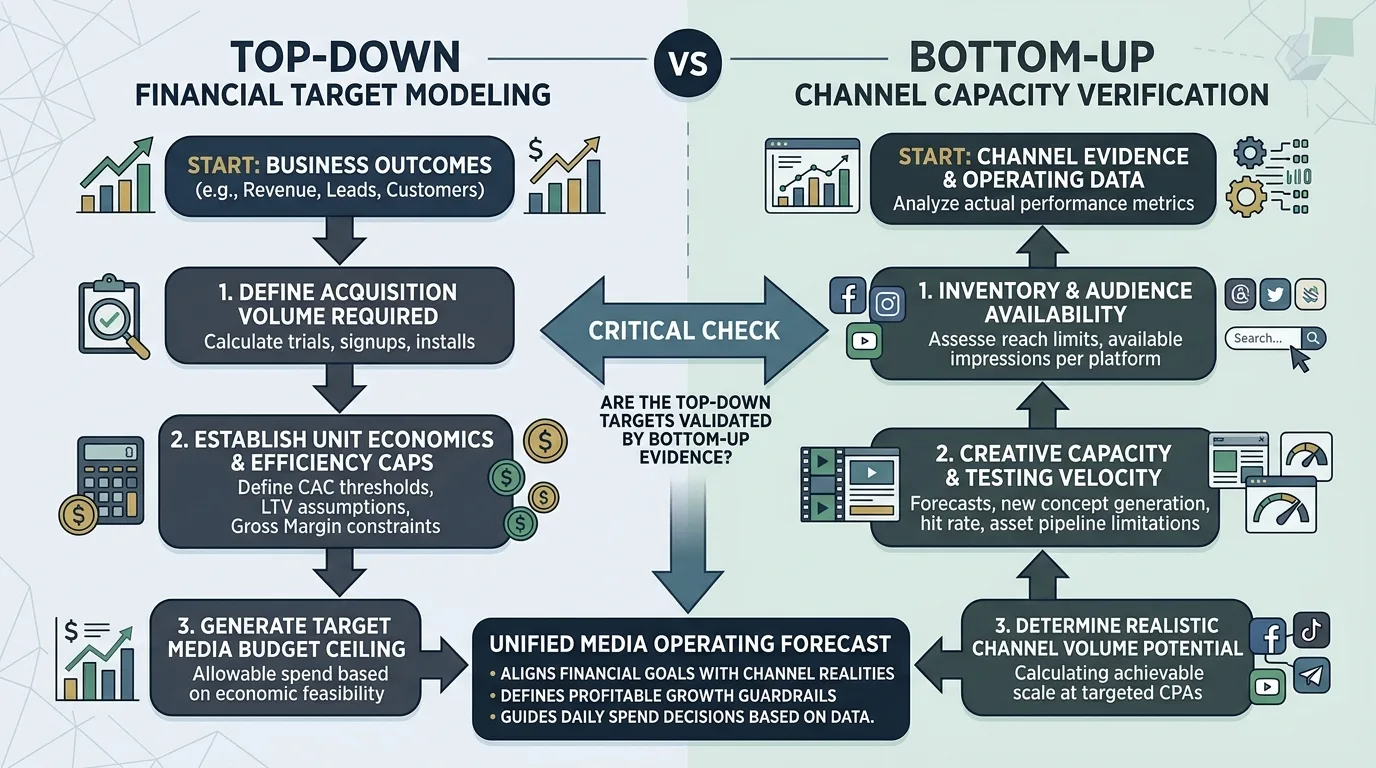
That is the top-down view. It creates a budget ceiling based on economics rather than a platform’s appetite for spend. The bottom-up view then tests whether the channels, audiences, landing pages, and creative pipeline can realistically deliver the required volume at that cost.
Neither view is sufficient alone. Top-down planning without channel evidence creates wishful targets. Bottom-up planning without commercial constraints can produce volume that looks efficient in-platform but destroys margin.
Build the Forecast Media Spend Model Around Unit Economics
Every forecast should have a clear definition of the acquisition event that matters. For ecommerce, that may be a first purchase. For lead generation, it may be a funded lead or sales-qualified appointment, not a form fill. For apps, it may be a subscriber or a user who reaches a retention threshold.
Use the deepest reliable conversion event available. Optimizing and forecasting against a cheap front-end event is acceptable only when the relationship to revenue is stable and well understood. If lead quality changes by source, geography, or creative angle, a blended cost per lead will hide the problem.
At a minimum, the model needs expected conversion rate, average order value or revenue per customer, gross margin, expected retention or payback period, and an allowable CAC or CPA. These inputs establish the difference between a growth budget and a loss-making one.
For example, a brand may tolerate a $120 first-purchase CAC because repeat-purchase data supports a six-month payback. Another brand with thinner margins may need a $55 CAC from day one. Both can buy traffic. Only one may have room to scale.
The key is to forecast ranges, not a single heroic number. A practical plan includes a base case, an upside case, and a downside case. The base case should use recent normalized performance, not the best week of the quarter. The upside case assumes that new creative, stronger conversion rates, or new inventory expands capacity. The downside case accounts for CPA pressure, saturation, tracking gaps, or a drop in creative response.
Scenario Planning Matrix
| Scenario | Key Assumptions | Expectation & Buffer |
|---|---|---|
| Base Case | Normalized recent CPA and conversion performance | Stable pacing and predictable payback |
| Upside Case | High creative hit rate and expanding inventory | Scaled spend with headroom for volume |
| Downside Case | CPA inflation, creative fatigue, and attribution lag | Controlled budget caps and tight efficiency limits |
Forecast by Channel Role, Not Just by Platform
Meta, Google, TikTok, Taboola, and other channels do not all perform the same job. A forecast that allocates spend only by historical platform share misses how demand is actually created and captured.
Google Search may be constrained by demand but deliver high-intent conversion. Meta may generate the volume, but require constant creative testing to hold CPA as spend rises. TikTok can create efficient reach and new customer volume, while native channels may work best with editorial-style angles for specific offers. Treating each platform as interchangeable creates bad expectations and poor budget decisions.
Assign a role to each channel: demand capture, demand creation, retargeting, creative exploration, or controlled scale. Then define the performance standard for that role. A prospecting channel may carry a higher immediate CPA if it supplies incremental customers and feeds efficient retargeting. Retargeting may show the strongest platform ROAS but has limited scale and cannot be allowed to absorb the full budget simply because its dashboard looks best.
This is where incrementality matters. A channel can receive credit for conversions it did not create. Forecasting should account for attribution windows, overlap between platforms, and the likely effect of reducing spend. If the team cannot run formal incrementality tests every quarter, it can still use directional holdouts, geo tests, audience exclusions, and budget-change observations to challenge easy assumptions.
Creative Capacity Is a Budget Input
Most media forecasts overstate scale because they assume stable performance from an aging set of ads. That assumption rarely survives contact with higher spend.
Creative is not an output of the media plan. It is an input to the plan. If the forecast calls for doubling Meta spend, ask whether the team can launch enough new concepts, hooks, formats, offers, and landing-page variations to maintain testing velocity. If the answer is no, the forecast should reflect a slower ramp and greater CPA pressure.
A practical creative forecast tracks more than the number of assets produced. It tracks the number of distinct concepts entering the account, the testing cadence, the expected hit rate, and the time required to move a winner from test budget to scaled spend. Ten resizing variations are not ten new bets.
This matters across channels. Search needs coverage for expanding query themes and offers. TikTok needs native-feeling video volume. Taboola often needs angle variation and fresh editorial treatments. Meta needs a steady flow of new messages and formats as audiences fatigue. The budget is only as scalable as the creative system supporting it.
Turn the Annual Plan Into Operating Guardrails
Annual or quarterly budgets are useful for financial planning. They are too slow for media buying. Operators need daily and weekly guardrails that explain what to do with the budget now.
Set a target spend range for each channel, a CPA or CAC threshold, and a decision rule for increasing or decreasing spend. The rule should account for conversion lag. Cutting spend because yesterday’s purchases have not all reported can be just as costly as ignoring a real decline.
A disciplined operating model separates short-term noise from a broken assumption. If spend is under plan but CPA is healthy, the constraint may be budget caps, limited creative coverage, audience size, or campaign structure. If spend is on plan but CPA is rising, the problem may be fatigue, landing-page conversion, offer competitiveness, or a shift in traffic quality.
Reporting should make these distinctions obvious. A useful weekly view compares forecasted spend, actual spend, forecasted acquisitions, actual acquisitions, CAC, revenue or margin, and the assumptions that changed. Do not bury the operating decision inside a dashboard full of platform metrics.
Reforecast When the Signal Changes
A forecast is not a document to defend. It is a model to update.
Reforecast when there is a material change in conversion rate, offer, pricing, inventory, sales capacity, measurement, or creative performance. Reforecast when a new channel proves it can sustain volume. Reforecast when a channel’s CPA deterioration persists beyond normal variance. The point is not to make the plan look accurate after the fact. The point is to keep resource decisions aligned with current evidence.
For high-velocity programs, a monthly reforecast is often the right baseline, with weekly pacing adjustments. Businesses with volatile demand, short sales cycles, or aggressive creative testing may need a lighter weekly refresh. Longer sales cycles require more patience because early conversion data can mislead, but they still need leading indicators tied to eventual revenue quality.
The best teams also record why the forecast changed. Was it a new winning creative angle? A landing-page improvement? A market-wide CPM increase? A tracking break? Over time, this creates an operating history that makes future plans less dependent on memory and more grounded in evidence.
The Standard for a Useful Media Forecast
A good forecast does not promise that every dollar will produce the exact modeled outcome. Paid media has uncertainty, and pretending otherwise produces false confidence.
It does give the team control. Everyone can see the economics, the channel assumptions, the creative requirements, the acceptable downside, and the actions triggered by performance. That is how spend stops being a monthly allocation and becomes a managed system for profitable growth.
When the next budget conversation begins, do not ask how much can be spent. Ask what performance, creative throughput, and conversion capacity must exist before more spend deserves to be released.