
A channel budget is not a commitment to spend the same amount on Meta, Google, TikTok, and native every month. It is a series of capital allocation decisions made with incomplete data. Knowing how to allocate channel budgets means moving dollars toward the next profitable conversion, not rewarding the channel that performed best last quarter.
That distinction matters when acquisition programs scale. A channel can produce a strong blended CPA at $20,000 per month and become inefficient at $100,000 because audience saturation rises, auction costs change, or the creative pipeline cannot support additional spend. The objective is not equal distribution. It is profitable growth with enough testing velocity to find the next set of winners.
Start With the Business Constraint, Not Channel Preference
Budget allocation starts with the metric the business can actually afford. For ecommerce, that may be contribution-margin CAC and payback period. For lead generation, it may be qualified lead cost, sales acceptance rate, and revenue per lead. For subscriptions and apps, it is usually a combination of CAC, activation rate, retention, and projected LTV.
Do not set channel targets from platform-reported ROAS alone. Platform attribution is directional, not a complete view of incrementality or business health. A channel that claims excellent last-click performance may be harvesting demand created elsewhere. Another may look weaker in-platform while introducing new customers who later convert through branded search or direct traffic.
Define three operating guardrails before assigning spend: the maximum allowable acquisition cost, the payback window, and the volume target. Those constraints make trade-offs visible. If a channel is above target but feeds a valuable audience or supports a high-LTV cohort, it may deserve controlled investment. If it is below target only because it is receiving credit for existing demand, it needs closer scrutiny.
Separate Scaling Spend From Learning Spend
The most common budgeting mistake is treating every dollar as though it has the same job. It does not. Some spend should compound proven performance. Some must buy information.
Scaling spend goes to campaigns, audiences, offers, and creative angles with sufficient conversion volume and stable economics. Learning spend funds new channels, new creative concepts, new audience segments, landing page tests, and fresh offers. Without a defined learning budget, teams tend to protect current winners until those winners decay. Without a cap on learning spend, experimentation becomes an expensive habit with no decision framework.
For a mature paid acquisition program, a practical starting point is to place the majority of spend behind validated demand, reserve a meaningful portion for creative and audience testing inside core channels, and hold a smaller allocation for channel expansion. The exact split depends on scale and risk tolerance. A brand with one reliable channel and aggressive growth targets should invest more in diversification than a brand with several proven sources and tight margin constraints.
The key is to label the spend correctly in reporting. A test that misses its CPA target is not necessarily wasted spend if it gives the team a clear answer quickly. A scaling campaign that quietly loses efficiency for three weeks is far more costly because it consumes budget without producing a usable insight.
How to Allocate Channel Budgets Using Marginal CPA
Average CPA is useful for reporting. Marginal CPA is more useful for allocation.
Average CPA tells you what a channel delivered across all spend. Marginal CPA tells you what the next dollars are likely to deliver. If Meta generated 1,000 customers at a $60 average CPA, that does not mean the next 100 customers will cost $60. They may cost $75, $110, or more as delivery expands into less responsive inventory.
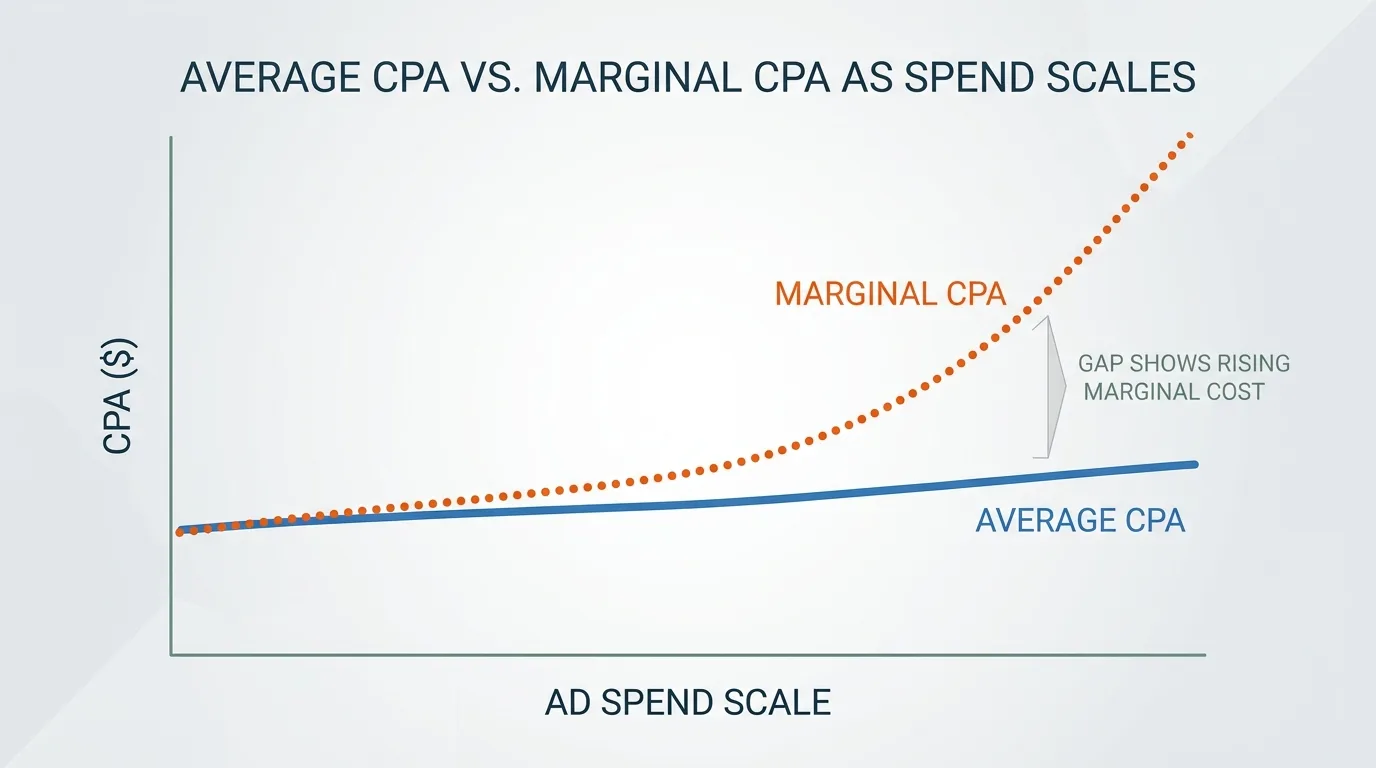
Review performance in spend bands rather than only at the account level. Compare what happened as daily spend moved from $5,000 to $7,500, then from $7,500 to $10,000. Did conversion volume rise proportionally? Did CPA stay within guardrails? Did the incremental volume hold after a few days, or did it rely on a short-lived promotion?
This is where budget allocation becomes a disciplined operating cadence. Add spend to the channel with the strongest expected marginal return, then measure the effect. Reduce spend when the next dollars consistently produce worse economics than the next-best alternative. Avoid dramatic swings based on one day of results. Most platforms need enough time and conversion volume to stabilize, while business conditions can change quickly enough that weekly decisions are often necessary.
A useful rule: scale in controlled increments when a channel is within target and supported by fresh creative. Larger increases can make sense when demand is clearly underfunded, but only if tracking, landing pages, inventory, and fulfillment can absorb the volume.
Treat Creative Capacity as a Budget Input
Media budgets and creative output are one system. If the account has limited new creative, increasing channel spend often accelerates fatigue rather than growth.
This is especially true on Meta, TikTok, and native platforms, where ad performance depends heavily on creative variety, message-market fit, and the ability to refresh winners before frequency and audience saturation erode results. A channel may appear capped when the actual constraint is not available audience. It is a thin creative pipeline.
Before increasing a channel budget, ask whether the team can support the increment with enough new concepts, iterations, and formats. That does not mean producing random volume. It means building a structured test plan around proven hooks, objections, use cases, offers, creator styles, and landing page messages.
Google Search may require less creative volume than paid social, but it still has capacity constraints. Search budget can only scale profitably when there is additional qualified query demand, broader campaign coverage, stronger feed quality, or better conversion rates. Taboola and other native channels may need more advertorial angles and pre-sell experiences to sustain scale. Budget should follow the asset supply each platform requires.
Allocate by Channel Role, Not Just Reported ROAS
Different channels play different roles in the acquisition engine. Search often captures active demand. Paid social creates and converts demand at scale. Native can open lower-cost reach and editorial-style discovery. TikTok can produce efficient volume when the creative feels native to the feed. Retargeting closes high-intent users but has a finite audience and should not be allowed to absorb budget simply because its attributed ROAS looks best.
The right allocation reflects these roles. A business with strong branded search and weak top-of-funnel activity may need to fund prospecting more aggressively, even if blended efficiency takes time to show up. A business with high social spend but poor conversion intent may need to strengthen search coverage, retargeting structure, or post-click conversion before forcing more prospecting budget into the account.
Use blended metrics to monitor the full system. Track total acquisition cost, new-customer revenue, qualified lead volume, and payback by cohort alongside channel-level data. If total spend rises while blended CAC stays within guardrails and volume grows, the mix may be working even when one platform’s dashboard tells an incomplete story.
Build a Weekly Reallocation Process
Budget decisions fail when they depend on memory, opinions, or isolated dashboards. Build a weekly review with a consistent scorecard: spend, conversion volume, marginal CPA or ROAS, creative performance, saturation signals, tracking confidence, and next actions.
Classify each channel or campaign group as scale, hold, fix, test, or cut. Scale means it has room to absorb more spend within target. Hold means performance is acceptable but evidence for an increase is not yet strong. Fix means the channel has potential but requires a creative, audience, landing page, or tracking intervention. Test means the goal is learning, with a defined hypothesis and spend cap. Cut means the channel is not producing a viable return or a credible path to one.
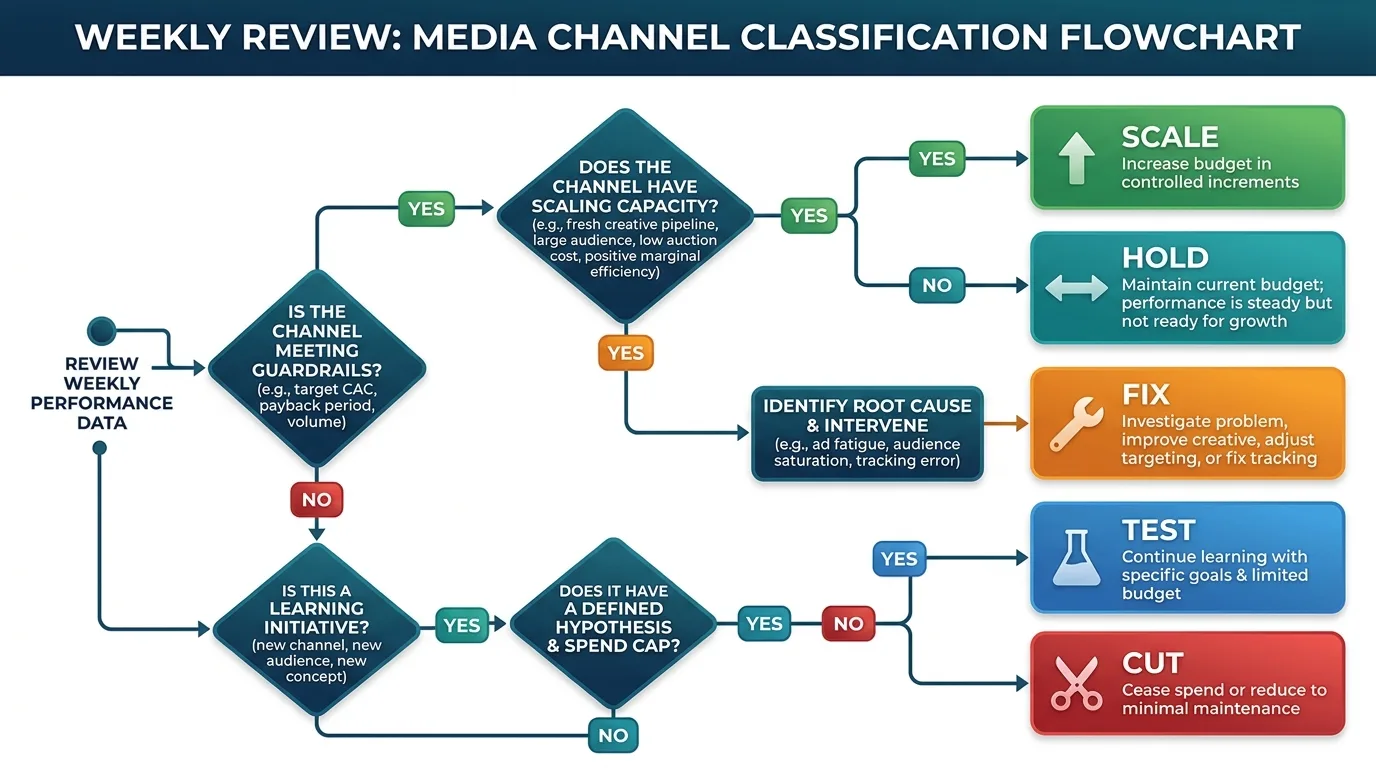
This process should also force decisions on creative. If a channel is held because of fatigue, the action is not merely to wait. Assign the next creative batch, define the concepts required, and set a launch date. High-velocity teams keep media buying, creative production, and reporting in one operating loop so that performance signals become new tests quickly.
Avoid the False Precision of Fixed Percentages
There is no universal rule that says 40% belongs in Meta, 30% in Google, and 10% in TikTok. Fixed splits can be useful as temporary planning assumptions, but they become harmful when treated as strategy.
The right mix changes with seasonality, promotion calendars, product availability, creative momentum, auction pressure, and the maturity of each channel. It also changes by business model. A lead generation company with strong sales follow-up may tolerate a higher top-of-funnel CPA than an ecommerce brand with narrow first-order margins. An app with excellent retention can bid more aggressively than one that loses users after a week.
Budget allocation is a repeated decision, not an annual formula. Give proven channels enough capital to show their real capacity. Give emerging channels enough runway to generate a valid signal. Then move with evidence, not platform loyalty.
The best budget plan is the one your team can execute, measure, and revise without delay. When the next dollar has a clear job and every test has a clear decision point, paid acquisition becomes easier to scale without losing control.