A Meta versus Google acquisition decision is rarely a true either-or choice. The real question is where the next dollar can produce incremental, profitable growth without hiding waste behind blended results. Meta creates demand at scale. Google captures demand when it is active. Treating them as interchangeable channels leads to the same outcome: generic creative, weak measurement, and budgets that rise faster than profit.
For growth teams, the answer is not to split budget evenly or follow a platform benchmark. It is to understand the job each channel does in the acquisition system, then build creative, campaigns, and reporting around that job.
Meta Versus Google Acquisition Starts With User Intent
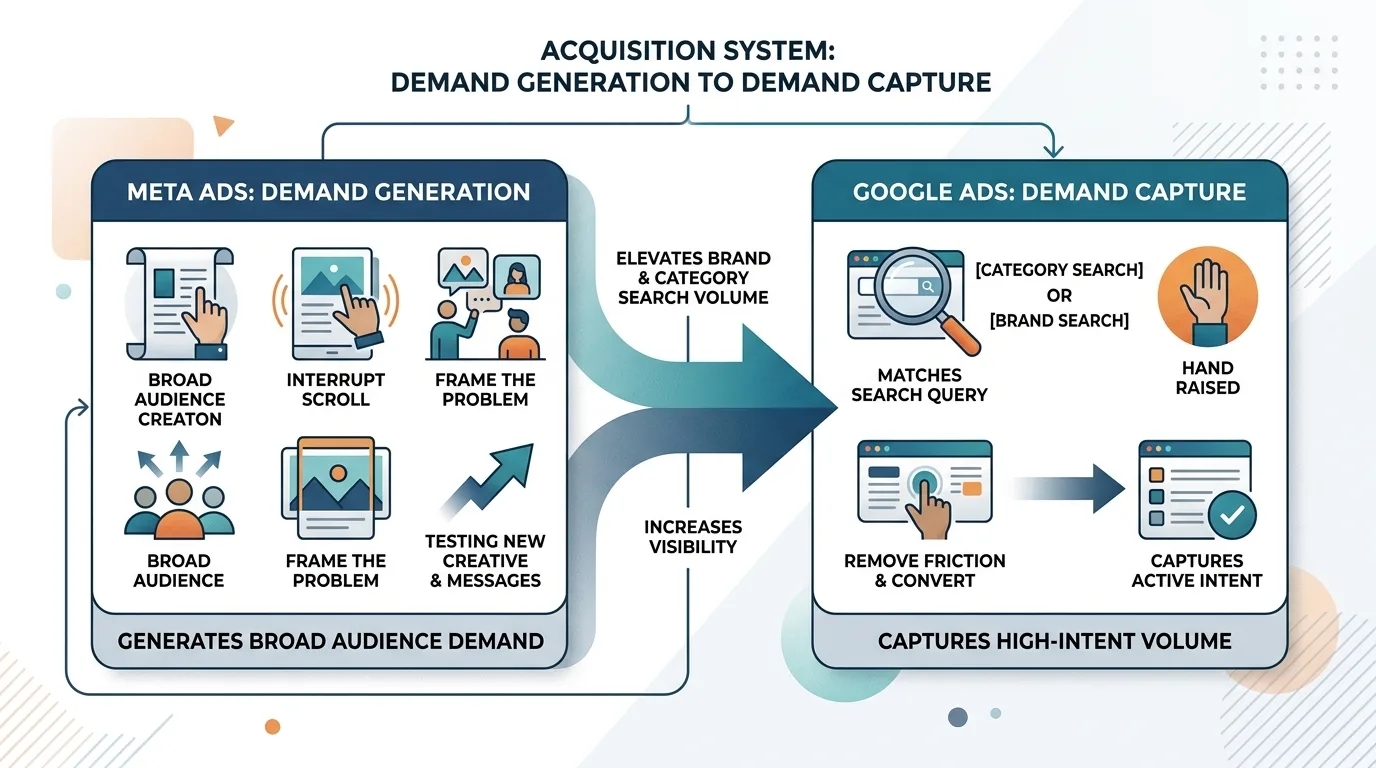
Google reaches people who are already signaling intent. A search for a product category, a competitor, a solution, or a high-intent problem gives the advertiser a clear opening. The user has raised their hand. Your job is to match the query, remove friction, establish credibility, and make the conversion path obvious.
That makes Google especially effective when a business has existing category demand, clear buying language, and a strong offer. Ecommerce brands can capture product and brand searches. Lead generation businesses can reach prospects researching a service. Subscription businesses can show up when users are actively looking for an alternative.
But demand capture has a ceiling. Search volume is finite, and the most obvious keywords often become expensive as competitors crowd the auction. Broadening keyword coverage can create volume, but it can also pull in lower-intent traffic that looks efficient in platform reporting and performs poorly downstream.
Meta works differently. It is primarily a demand-generation environment. People do not open Instagram or Facebook to search for your offer. They stop when the creative earns attention, the message feels relevant, and the offer creates enough urgency to act.
This gives Meta a larger potential audience than the active search market, particularly for products or services that solve a problem customers have not yet articulated. It also means creative is not a finishing touch. It is the targeting mechanism, the sales message, and often the biggest lever for scale.
The trade-off is that Meta requires more operational discipline. A winning audience can fatigue. A concept that drives cheap clicks can fail to produce qualified customers. And a campaign can look healthy until lead quality, refunds, or retention data catches up.
Choose the Channel Based on the Growth Constraint
The fastest way to waste spend is to ask every channel to solve the same problem. Start with the constraint instead.
If the business needs to convert existing demand more efficiently, Google is usually the first lever. This is common when branded search is under-defended, high-intent non-brand terms are missing, shopping feeds are weak, landing pages do not match queries, or campaign structure makes it impossible to see where spend is going.
Meta vs. Google Acquisition Comparison
| Dimension | Meta Ads | Google Ads |
|---|---|---|
| Intent Stage | Demand Generation (Passive) | Demand Capture (Active) |
| Creative Role | Interrupts scroll, frames problem & value | Matches search query, provides direct solution |
| Primary Measurement | Cohort CAC, contribution margin, holdout lift | Last-click / blended ROI, query-level conversion |
| Scaling Bottlenecks | Creative fatigue & hook ad variation | Finite search volume & rising CPCs |
If the business has maxed out search volume, has a differentiated offer, or needs to create demand beyond a narrow group of active shoppers, Meta becomes the larger growth lever. It can introduce the product to new customers, test multiple angles quickly, and build a pool of future branded searches.
For many mature advertisers, the bottleneck is neither platform. It is the operating system around the platforms. They have enough budget, enough data, and enough market demand, but their creative production is slow, launches are inconsistent, and reporting cannot connect platform performance to revenue quality. No channel allocation fixes that.
A useful diagnostic is simple: if you doubled spend on Google tomorrow, would there be enough profitable search demand to absorb it? If the answer is no, Meta deserves more attention. If you doubled spend on Meta tomorrow, would your team have enough new creative, landing page coverage, and conversion feedback to prevent performance from deteriorating? If the answer is no, solve the execution gap before scaling.
Creative Is the Major Difference
Google creative is usually about relevance and clarity. Search ads need to reflect the user’s language, answer the immediate question, and direct them to the right page. Shopping and Performance Max need accurate product data, strong imagery, competitive pricing, and clean conversion signals. The objective is to reduce the distance between intent and purchase.
Meta creative has to do more work. It needs to interrupt scrolling, frame a problem or desire, make the product understandable quickly, build belief, and earn the click. The best unit is not always the most polished asset. Often, it is the message that makes the right customer feel recognized.
That is why a high-velocity Meta program tests concepts before it over-optimizes formats. Test different hooks, pain points, use cases, proof types, offers, objections, and creator styles. Once a concept proves it can generate qualified conversions, produce iterations that give the algorithm more chances to find a winner.
Do not mistake variation for testing. Changing a background color or swapping the first line of copy is not a meaningful creative test if the core message remains identical. A useful test isolates a new hypothesis: perhaps customers respond better to savings than convenience, before-and-after proof than expert authority, or a specific use case rather than a broad claim.
Google needs iteration too, but the workflow differs. Search term analysis, feed optimization, asset testing, landing page alignment, and query-level performance matter more than chasing a constant stream of net-new visual angles. The right creative system reflects the channel’s role.
Measurement Must Protect Against False Winners
Both platforms optimize toward the data they receive. If the conversion event is weak, delayed, or disconnected from business value, the platforms will find cheap versions of the wrong customer.
For ecommerce, that means looking beyond first-purchase return on ad spend. Contribution margin, refund rates, repeat purchase behavior, and customer acquisition cost by cohort can change a supposedly winning campaign into a losing one. For lead generation, form fills are not the outcome. Contact rate, qualified lead rate, appointment rate, and closed revenue are closer to the truth. For apps and subscriptions, early conversions must be connected to retention and payback.
Meta is particularly vulnerable to false winners when optimization is based on shallow events. A low-cost lead campaign may be excellent at finding people willing to submit a form and terrible at finding people sales can close. Google can suffer from the opposite problem: branded search may appear to deliver exceptional efficiency while benefiting from demand created by Meta, email, affiliates, or the brand itself.
This is where incrementality matters. Platform attribution is directional, not a final verdict. Compare new-customer mix, geographic tests where practical, branded-search trends, holdout periods, and blended efficiency as spend changes. You will not get perfect certainty, but you can make better budget decisions than a team relying on last-click dashboards alone.
Build One Acquisition System, Not Two Silos
Meta and Google perform better when they are managed as connected parts of the funnel. Meta introduces a message, creates consideration, and often increases the number of people later searching for the brand or category. Google captures some of that demand and converts users who need more information before buying.
The handoff should be intentional. If Meta creative leads with a specific claim, product, or offer, the landing page and Google coverage should reinforce it. If search terms reveal repeated objections or language customers use, those insights should inform the next round of Meta ads. The channels should share creative intelligence, customer-quality signals, and a common view of profit.
Operationally, this requires a consistent launch process. Naming conventions, conversion definitions, creative tags, audience documentation, and reporting should make it easy to answer basic questions: What message is working? For which audience? At what stage? Does it create profitable customers after the platform’s attribution window closes?
This is also why fragmented agency arrangements often slow growth. One team produces creative, another buys media, and a third reports results. By the time an insight moves between them, the market has moved on. The stronger model treats creative and media as one testing engine, with rapid production tied directly to performance signals.
How to Allocate the Next Dollar
There is no fixed Meta-to-Google ratio that works across businesses. A high-intent B2B service may lean heavily toward Google because prospects actively research solutions. A visually demonstrable consumer product may find its largest scale on Meta. A subscription brand may use Meta to generate volume and Google to capture high-intent comparison traffic.
Budget should move based on marginal performance, not historical habit. Ask where the next increment of spend is likely to produce the best contribution after accounting for saturation, customer quality, and the channel’s role in the broader journey. That may mean funding Meta creative testing even when Google has the lower reported CPA, because the next Google dollar has little room to scale.
Set guardrails before scaling. Define acceptable acquisition cost, quality thresholds, payback expectations, and the point at which declining marginal returns require a budget shift. Then review those rules frequently enough to act while the signal is still useful.
The practical next step is to run each channel with a clear mandate for the next 30 days. Give Google a demand-capture objective with query, feed, and landing page priorities. Give Meta a demand-generation objective with a defined creative test volume and customer-quality feedback loop. When both teams are measured against profitable growth rather than isolated platform metrics, budget decisions get simpler and scaling gets far less chaotic.