
A weak hook can make a strong offer look unprofitable. When the first line, first frame, or opening claim fails to earn attention, the media team is left optimizing around a creative problem. Knowing how to test ad hooks is how performance teams separate an audience issue from a message issue, find winners faster, and stop funding ads that never had a real chance.
A hook is not just a catchy headline. It is the opening mechanism that gives someone a reason to pause, keep watching, or click. In static ads, it may be the headline, visual contrast, or first benefit. In video, it is usually the first one to three seconds: the visual, spoken line, on-screen text, and immediate promise working together.
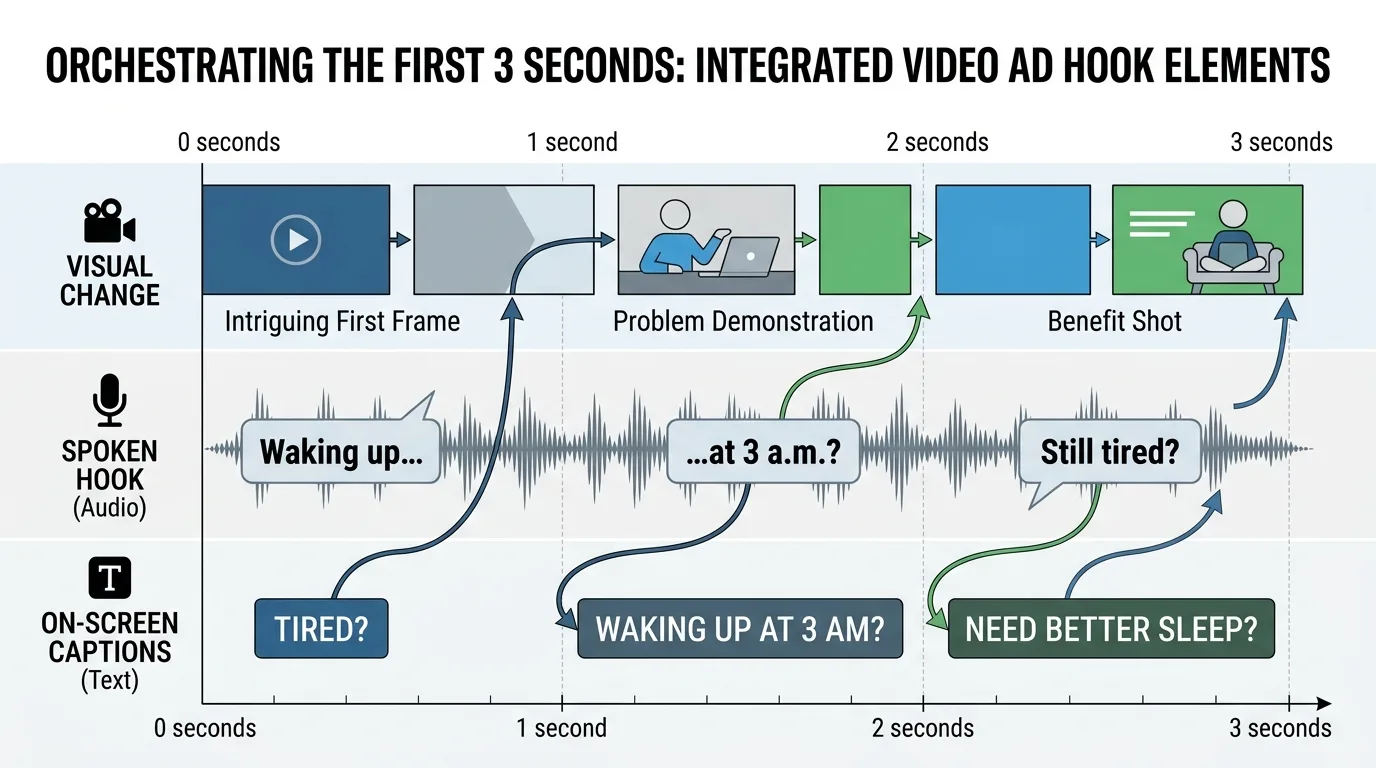
The goal is not to find the most entertaining hook. The goal is to find the hook that attracts qualified attention at a cost that can scale.
Start With a Testable Hook Strategy
Most hook tests fail before launch because the team changes too many variables at once. A new hook, new offer, new landing page, new audience, and new format may produce a better result, but no one can explain why. That does not create a repeatable creative system. It creates a lucky ad.
Start by choosing one message angle to test against another while holding the rest of the ad as stable as possible. The offer, core body copy, call to action, landing page, targeting, and campaign structure should remain consistent during the initial comparison. The hook is the variable under review.
For example, an ecommerce brand selling sleep supplements might test these distinct angles:
- A problem-led hook: “Still waking up at 3 a.m.?”
- A benefit-led hook: “Fall asleep faster without a groggy morning.”
- A proof-led hook: “Why 40,000 customers switched their nighttime routine.”
- A mechanism-led hook: “The mineral blend that supports deeper sleep.”
These are different claims, not minor rewrites of the same claim. That distinction matters. Testing “Wake up rested” against “Wake up feeling rested” is an execution test, not a meaningful hook-angle test.
Build a Hook Matrix Before Production
High testing velocity comes from planning batches, not requesting one new ad whenever performance drops. Create a hook matrix around the objections, desires, use cases, and proof points that repeatedly show up in customer research, sales calls, reviews, search queries, and landing-page behavior.
For a lead generation business, those categories may include speed, cost, risk reduction, expertise, social proof, and a pain-point diagnosis. For a subscription app, they may center on habit friction, immediate outcomes, personalization, and identity. The right hook depends on the buying context. A low-consideration impulse product can win with a sharp visual interruption. A high-ticket service may need credibility before curiosity.
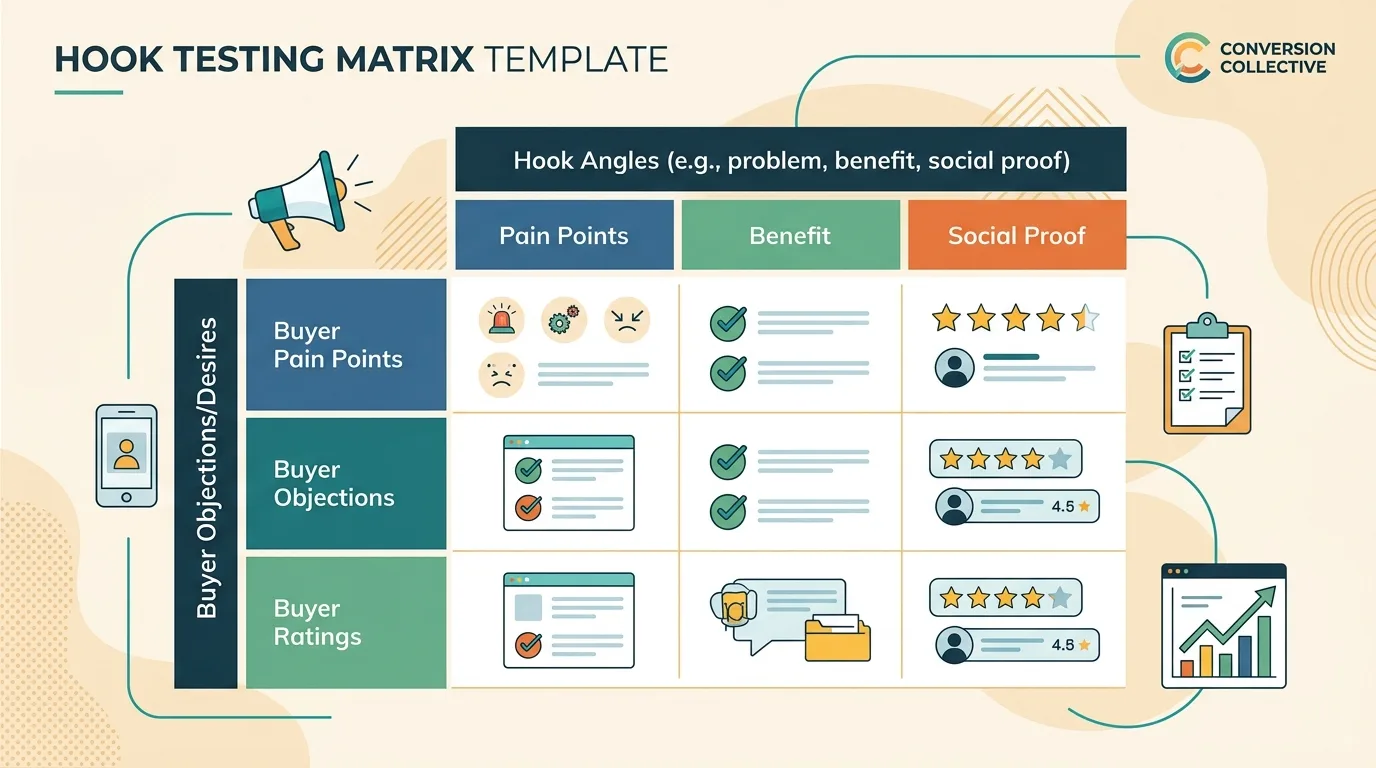
Assign each proposed hook a clear hypothesis. “This hook will improve qualified click-through rate because it names the problem our best customers already recognize” is useful. “This could go viral” is not a testing hypothesis.
How to Test Ad Hooks With Controlled Variables
The cleanest process runs in two stages. First, test concepts. Then test executions of the winning concepts.
At the concept stage, produce several ads that share a common structure. If you are testing video, keep the body, product demonstration, offer, and call to action similar while changing the opening. This gives each hook a fair opportunity to prove whether it earns attention and drives downstream action.
Once a hook angle shows promise, create execution variants around it. Change the creator, opening shot, pacing, headline treatment, first sentence, visual proof, or length. This is where performance often compounds. A winning message can still underperform if its delivery feels generic, slow, or mismatched to the platform.
Do not force every test into a rigid one-variable rule. In real production, a problem-led opening may require a different visual than a testimonial-led opening. The standard is not laboratory purity. The standard is operational clarity: can your team reasonably identify the reason an ad won and use that insight in the next batch?
Use Enough Variants to Learn, Not Just Launch
Three to five distinct hooks is usually a practical starting batch for a single creative concept. Fewer options can make results overly dependent on chance. Too many options can dilute spend and slow decisions, especially in accounts with limited conversion volume.
The correct number depends on budget, audience size, conversion lag, and the cost of the action you are optimizing toward. A mobile app generating hundreds of daily installs can test more aggressively than a B2B advertiser generating a handful of qualified demos per week. For lower-volume funnels, use leading indicators to triage weak ads, but avoid declaring a winner solely because it has a cheaper click.
Creative testing needs enough budget to expose meaningful performance differences. If every ad receives a trivial amount of spend, the team is measuring noise. Set a decision threshold before launch based on your normal cost per acquisition, conversion rate, and sales-cycle lag. Then apply the same standard across the batch.
Read Hook Performance in the Right Order
A hook’s job is to earn attention, but attention is not the final business outcome. Evaluate performance as a funnel rather than relying on one platform metric.
For video, start with early retention signals such as thumb-stop rate, three-second view rate, hold rate, or the percentage of viewers reaching a key point in the ad. For static placements, assess scroll-stopping ability through click-through rate and engagement patterns. These metrics tell you whether the opening is doing its primary job.
Next, check traffic quality. Look at landing-page views, bounce behavior, add-to-cart rate, lead completion rate, or other relevant post-click signals. A provocative hook may raise click-through rate while attracting people who have no intention of buying. That is not a winner. It is expensive curiosity.
Finally, judge the ad on the metric that matters to the business: cost per purchase, cost per qualified lead, cost per subscription, contribution margin, or return on ad spend. The best hook is one that improves the economics of acquisition, not one that produces the most platform applause.
When results conflict, use the funnel to diagnose the problem. High early retention and weak clicks may mean the opening is interesting but does not connect to the offer. Strong clicks and poor conversion can signal an expectation mismatch between the hook and landing page. Weak retention but solid conversion may indicate that a highly qualified audience is responding, which can still be worth scaling if the volume supports it.
Keep Media Conditions Fair
A creative test is only as useful as its delivery conditions. If one hook gets broad prospecting traffic while another is shown mostly to warm retargeting audiences, the comparison is compromised. The same applies when one ad receives premium placements, more time in learning, or a materially different bid environment.
Use consistent audiences, optimization events, placements, attribution settings, and budgets wherever the platform allows. On Meta or TikTok, that may mean placing comparable ads in the same ad set or using a structured campaign design that gives each asset reasonable delivery. On Google, Taboola, and native environments, the equivalent is maintaining comparable targeting and inventory conditions.
Platform automation creates a trade-off. Consolidated ad sets can help algorithms find efficient delivery, but they may quickly starve new ads before they have enough data. More isolated tests create cleaner reads, but can fragment spend and reduce efficiency. The right approach depends on account scale. Mature, high-spend accounts can afford more disciplined isolation. Smaller accounts often need a hybrid: controlled launch windows followed by consolidation around the strongest assets.
Kill Losers Fast, but Do Not Kill Learning
Fast testing does not mean reacting to every hour of data. Ads regularly fluctuate early, particularly when conversion volume is low. Build a review cadence that matches the buying cycle. An app install campaign may support daily decisions. A high-value lead-gen campaign may need several days or longer before downstream quality is visible.
Cut clear losers when they show weak attention and weak downstream signals after receiving a meaningful spend level. Keep borderline ads alive when they reveal a useful insight, such as unusually strong engagement from a valuable audience segment or a promising message with poor execution. A weak first frame can be fixed. A weak market message usually cannot.
Document every decision. Record the hook, audience, format, spend, key metrics, verdict, and learning. Over time, this becomes a creative intelligence system rather than a folder full of disconnected assets. Your next batch should build from what the account has already proven: which pain points convert, which proof types reduce skepticism, which language attracts low-quality traffic, and which formats give winners room to scale.
Turn Winning Hooks Into a Testing Engine
When a hook wins, do not simply increase its budget and move on. Extract the underlying principle. If “Stop paying for X” outperforms “Get more of Y,” the account may respond better to loss avoidance than aspirational benefits. If customer testimonial openings win repeatedly, the market may need peer proof before it will consider the offer.
Use that principle across formats, creators, product lines, and platforms. A winning TikTok opening may need different pacing on Meta, a different headline treatment in native, or a more explicit claim in search-ad copy. The message can travel, but the execution should fit the environment.
The teams that scale paid acquisition consistently do not wait for a single breakout ad. They operate a repeatable loop: research the market, produce structured hook batches, launch under controlled conditions, evaluate against business outcomes, and feed the learnings directly into the next production cycle. That is how creative volume becomes performance leverage instead of production noise.
The next time an account needs better results, do not start by changing bids. Start by asking whether the first second of the ad gives the right customer a compelling reason to stay.