
A campaign can look efficient at $5,000 per day and break down completely at $50,000. That is why learning how to scale paid acquisition profitably is less about finding a new audience switch and more about building an operating system that can absorb more spend without losing control of CAC, conversion rate, or margin.
Most teams do not fail because they lack ideas. They fail because their creative pipeline, measurement model, and campaign structure were built for maintenance, not volume. Profitable scale comes from increasing testing velocity while making faster, cleaner decisions about where every additional dollar should go.
Start With the Economics, Not the Budget
Before increasing spend, define what profitable acquisition actually means for the business. A platform-reported return on ad spend is useful, but it is not the operating metric if refunds, fulfillment costs, sales commissions, churn, or payment processing materially change the picture.
For ecommerce, the core question is contribution margin after acquisition cost. For lead generation, it is revenue per qualified lead and the conversion rate from lead to sale. For subscription and app businesses, it may be payback period, retention-adjusted lifetime value, and cohort-level margin. The right metric depends on the model, but it needs to be stable enough to guide daily decisions.
Set a clear ceiling for acquisition cost and a range for acceptable payback. Then separate your targets into three levels: a goal worth scaling toward, a guardrail that triggers closer review, and a hard stop. This prevents a common mistake: treating every campaign below a blended target as a failure, even when it is creating valuable new-customer volume that improves the overall business.
Target Segment Checklist
- Goal: The ideal target acquisition cost or payback period worth scaling aggressively toward.
- Guardrail: The performance threshold that triggers a manual review and tactical adjustments.
- Hard Stop: The strict limit where campaigns must be paused or budgets significantly reduced to protect margins.
Blended performance matters because platform attribution is directional, not absolute. Use platform data to optimize individual campaigns and creative. Use your source of truth for revenue, qualified leads, subscriptions, or retained users to decide whether the entire acquisition program is producing profit.
Scale Paid Acquisition Profitably by Expanding What Works
Scaling is not synonymous with raising budgets. Increasing spend on a single winning ad can work for a short period, but it often accelerates frequency, creative fatigue, and audience saturation. The more durable approach is to expand the number of profitable paths to conversion.
That means scaling across four variables at the same time:
- More validated creative angles and formats
- More audiences or intent signals that can support the offer
- More placements and channels suited to the buying journey
- More conversion paths, such as landing pages, advertorials, quizzes, or lead flows
The order matters. Creative is usually the highest-leverage variable because it changes both attention and conversion efficiency. A new winning message can create incremental scale on the same platform without forcing the media team to chase increasingly expensive inventory.
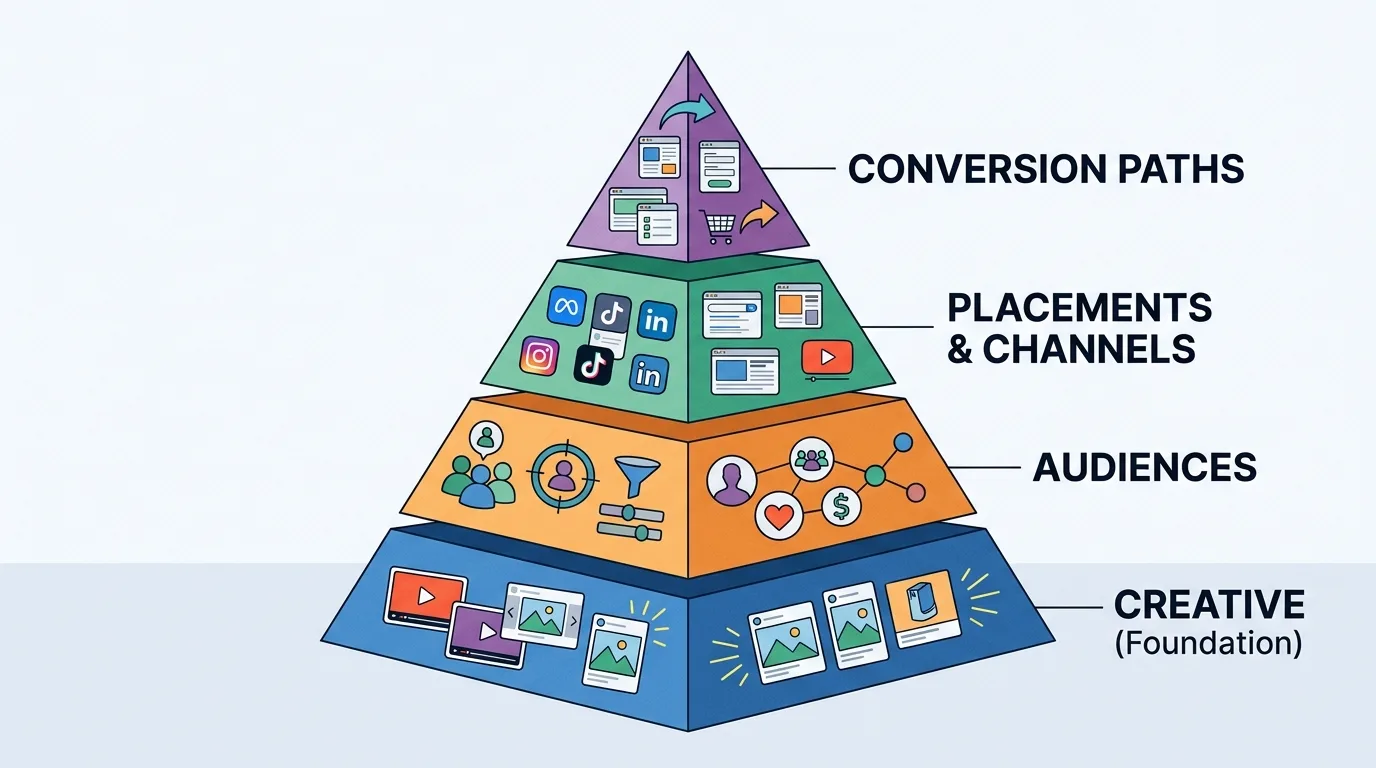
Audience expansion comes next. Broad targeting can be highly effective when creative and conversion tracking are strong, but it is not a substitute for positioning. If a broad campaign underperforms, the issue may be the message, the offer, or the landing-page experience rather than the audience itself.
Channel expansion should follow evidence, not anxiety. Meta, Google, TikTok, Taboola, and custom channels all serve different demand states. Search can capture existing intent. Social can create demand and reach new audiences. Native can scale editorial-style education. A channel belongs in the mix when its economics work at the right attribution window, not because competitors are spending there.
Treat Creative as a Performance System
The fastest-growing acquisition teams do not wait for one perfect concept. They build a repeatable system for producing, launching, and learning from a high volume of static and video ads.
Every test should begin with a hypothesis. A useful hypothesis connects a specific audience tension to a message and a proof point. For example, a financial product may test urgency around rising costs, certainty around a fixed outcome, social proof from similar customers, or skepticism toward the category. These are distinct angles, not minor headline variations.
From there, create multiple executions of the strongest angles. Change the hook, visual mechanism, spokesperson, pacing, offer framing, proof, and call to action. This gives the media team enough variation to identify whether the signal is in the core message or in a single execution.
Do not judge creative only on click-through rate. High CTR paired with weak post-click conversion often means the ad overpromises or attracts the wrong audience. Low CTR with strong conversion may still be scalable if the economics are there. Review the full path: thumb-stop rate or video hold, click-through rate, landing-page conversion rate, cost per acquisition, and downstream quality.
Creative fatigue is not simply an ad that has been live for a long time. It is declining efficiency after accounting for spend, audience reach, and normal performance volatility. The answer is not always to turn off the asset immediately. Sometimes a refreshed first three seconds, a new proof device, or a different landing-page match can restore performance. But a mature account needs a steady flow of replacements before fatigue becomes expensive.
Build Campaign Structures That Preserve Signal
Over-segmentation is one of the quietest enemies of profitable scale. When budgets are split across too many campaigns, ad sets, audiences, and minor creative variations, no individual unit receives enough spend to produce a reliable signal. Teams end up optimizing noise.
Keep the account structure simple enough for each campaign to learn. Consolidate where the platform needs room to optimize, then use naming conventions and reporting views that make it easy to isolate performance by creative angle, offer, funnel, audience type, and channel.
This does not mean every account should use the same structure. A business with strict geography, product, or compliance requirements may need tighter controls. A high-volume ecommerce brand may benefit from more consolidation. The principle is consistent: structure campaigns around meaningful business decisions, not around every possible targeting combination.
Budget changes should also be controlled. Large, frequent edits can reset delivery patterns or make it difficult to determine what caused a result. Increase budgets at a pace the campaign can absorb, and separate budget scaling from creative testing when possible. If you change everything at once, the data cannot tell you what created the lift or the decline.
Use Decision Windows, Not Emotional Reactions
Paid acquisition creates constant temptation to react. A bad morning can trigger cuts to campaigns that would have recovered by the end of the day. A strong day can lead to aggressive budget increases that erase efficiency within a week.
Set decision windows based on spend and conversion lag. A low-volume, high-ticket lead campaign may need several days or weeks of downstream data before it can be evaluated. A high-volume ecommerce campaign may reveal directional signals much faster. The right answer depends on conversion volume, not on a universal rule.
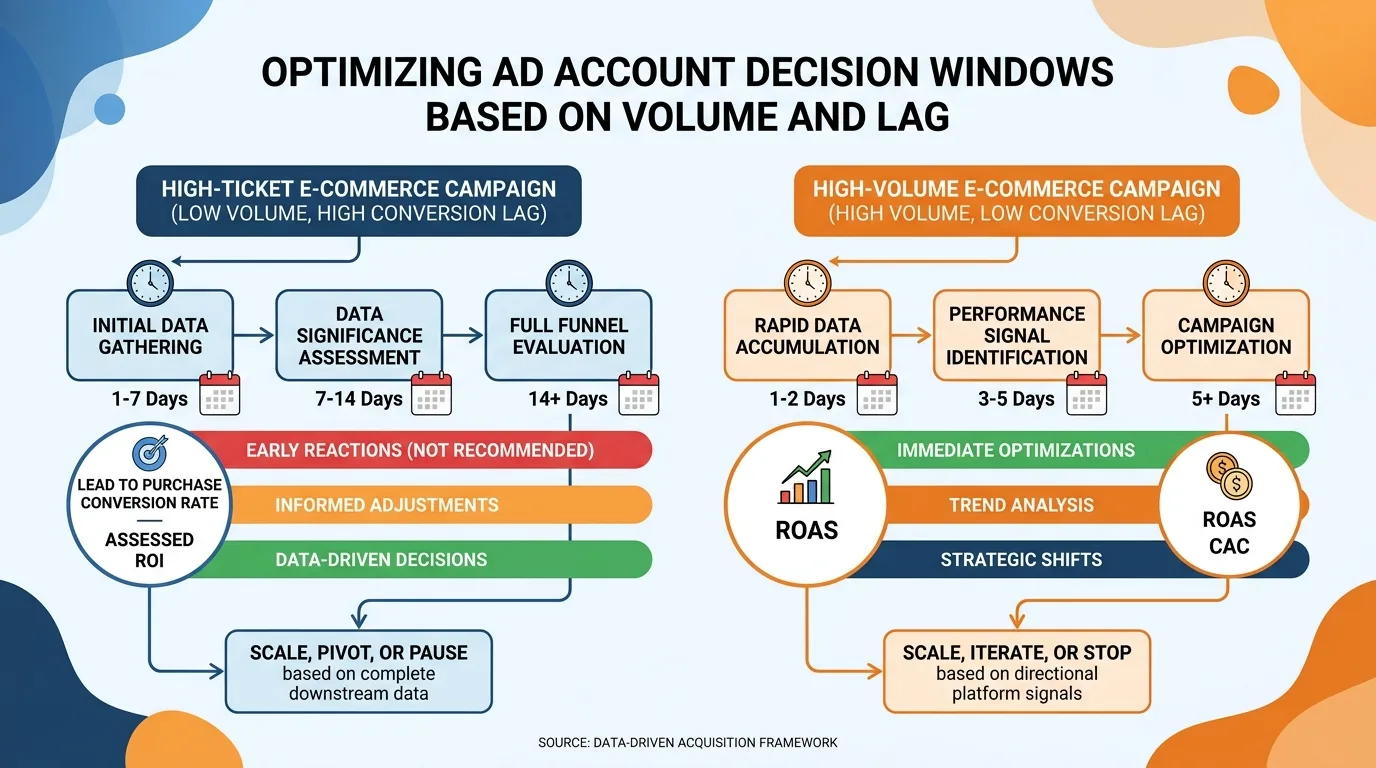
Define what qualifies as a winner before launch. A winning test might be an ad that beats the account average on cost per qualified action after a minimum spend threshold. It might be a concept that performs acceptably on platform metrics but drives unusually strong retention. The key is consistency.
When performance softens, diagnose the failure point before changing budgets. Is CPM rising because the market is more competitive? Has click-through rate declined because the creative is tired? Has conversion rate dropped because of a landing-page issue, inventory problem, or weaker offer? Different causes require different fixes.
Measure Incrementality as Spend Increases
At lower spend levels, attribution can make almost every campaign look efficient. As budgets rise, the risk of paying for customers who would have converted anyway increases. This is especially relevant for branded search, retargeting, and high-frequency social campaigns.
Use holdouts, geo tests, lift studies, or controlled budget changes when the economics justify the effort. You do not need a complex experimentation program to start. Even a disciplined comparison between markets, cohorts, or periods can expose whether reported platform gains are translating into incremental business growth.
Watch blended CAC alongside new-customer volume, revenue quality, and margin. If spend rises 40 percent while new-customer growth rises 10 percent, the account may be reaching diminishing returns even if a subset of campaigns still reports strong attribution.
Create an Operating Cadence for Scale
Profitability is protected by execution discipline. Creative production, launches, optimizations, reporting, and analysis need clear owners and a predictable cadence. Otherwise, the team discovers a winning angle after the opportunity has already passed.
A strong weekly operating rhythm reviews business-level performance first, then channel trends, creative winners and losers, active tests, funnel issues, and the next set of decisions. Daily work should focus on monitoring spend, pacing, major delivery issues, and obvious performance shifts. Strategic changes belong in a documented process, not in a stream of disconnected platform edits.
Centralized reporting is critical once multiple platforms are involved. The team needs one view of spend, acquisition cost, conversion quality, revenue, and margin, with enough detail to trace business outcomes back to campaigns and creative. Clear reporting does not mean more dashboards. It means fewer unanswered questions.
The companies that scale fastest build this discipline into the system. Creative and media buying operate as one function, data is organized around decisions, and every test has a path from launch to learning to expansion.
Profitable scale is not a moment when a campaign suddenly takes off. It is the point where your acquisition engine can produce more winners, fund them with confidence, and cut waste before it becomes a margin problem.