
A campaign can look busy while quietly losing money. Spend rises, dashboards fill with activity, and the team keeps making small bid changes while the real problem sits upstream: weak creative, muddy measurement, loose targeting, or a campaign structure that hides what is actually working. Knowing how to reduce wasted ad spend is not about spending less by default. It is about moving budget out of unproven activity and into repeatable acquisition systems.
For performance teams, waste is rarely one dramatic mistake. It is usually the accumulated cost of slow decisions. A losing ad runs for too long. A high-intent search term is buried under broad-match traffic. A winning concept never gets enough budget because the account cannot identify it quickly. The fix is operational control, not endless platform tinkering.
How to Reduce Wasted Ad Spend at the Source
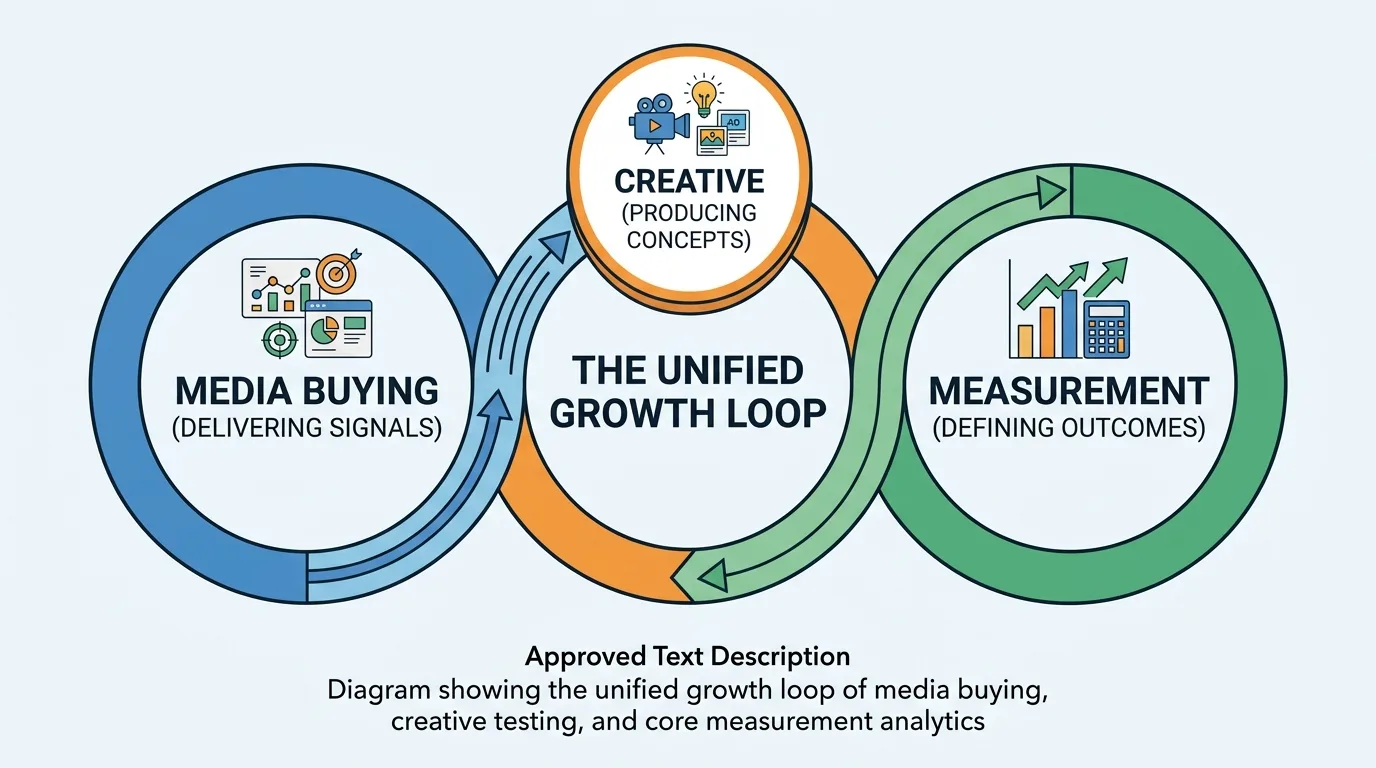
The fastest way to cut waste is to stop treating media buying, creative, and measurement as separate functions. They create one feedback loop. If the creative team does not understand what the media team is seeing, production slows and the same weak angles return. If reporting is delayed or fragmented, buyers cannot confidently kill losers or scale winners.
Start by defining waste in terms the business can act on. For an ecommerce brand, that may be spend beyond an acceptable customer acquisition cost after a meaningful click and conversion threshold. For lead generation, it may be leads that fail quality checks or never progress into sales opportunities. For subscriptions and apps, it may be installs with no activation, trial start, or retained revenue.
A cheap click is not automatically efficient. Neither is a low cost per lead. Waste is spend that fails to produce the downstream outcome the business needs. That distinction prevents teams from optimizing toward platform metrics that look positive but do not create profit.
Set clear kill rules before launch
Every campaign needs a defined decision framework before it goes live. Without one, underperformers tend to stay active because someone thinks they need “a little more time.” More data is useful, but only when the campaign has a credible path to improvement.
Set spend thresholds based on your target economics. If your target CPA is $100, decide what happens after an ad spends $100, $150, or $200 without producing a conversion. The right threshold depends on conversion lag, purchase frequency, traffic volume, and the amount of signal available. A high-ticket B2B offer may require more patience than a low-friction ecommerce product.
The point is not to kill every ad at the first sign of volatility. It is to replace subjective debate with consistent rules. Ads that fail to earn another dollar of spend should exit quickly. Ads that show efficient early signals should move into a larger test or scaling environment.
Build a Creative Testing System, Not a Creative Calendar
Creative fatigue and weak message-market fit are major sources of wasted spend, especially on Meta, TikTok, Taboola, and other feed-based channels. Yet many teams still launch a handful of assets each month, call it testing, and wait for performance to decline before producing more.
That pace is too slow. Paid acquisition requires a creative pipeline built around volume, variation, and rapid learning. The goal is not to make more ads for the sake of output. The goal is to isolate the variables that change performance: the hook, problem framing, offer, proof, format, creator, opening visual, call to action, and audience-specific message.
A useful test separates concepts from executions. A concept tests a different reason to buy, such as saving time, lowering costs, improving status, or avoiding a painful problem. An execution changes how that idea is delivered, such as a founder-led video, customer testimonial, static comparison, or product demonstration.
If you only change colors, headlines, and thumbnails, you may improve an asset marginally while missing the bigger opportunity. Test distinct angles first. Once an angle wins, produce enough variations to determine whether it can hold performance at scale.
Creative reporting should also go beyond a single blended CPA. Review performance by concept, format, audience, placement, and spend level. A creative that performs well at $200 per day may collapse at $2,000 per day. That does not make it a failure. It means it has a ceiling, and the account needs more winners.
Fix Measurement Before You Make Budget Decisions
Poor measurement makes efficient optimization impossible. If Meta reports one number, Google reports another, and your CRM or ecommerce platform tells a different story, the team will optimize based on partial information. That is how low-quality leads and unprofitable sales receive more budget.
Establish a single source of truth for core business outcomes. At minimum, align on how the team will measure spend, conversions, revenue, CAC, contribution margin where available, and conversion lag. Then make sure campaign naming, UTMs, tracking events, and reporting logic are consistent across channels.
This does not mean every platform must receive credit only for the final click. Channel-level attribution will always have limits, especially for longer buying cycles and multi-touch journeys. It means the team needs a decision model that is stable enough to identify directional winners and catch obvious waste.
For example, platform-reported CPA can be useful for daily optimization, while CRM-qualified lead rate and closed-won revenue should inform weekly budget allocation. For ecommerce, daily purchase data may be sufficient for many decisions, but new customer rate, refund rate, and contribution margin should still shape scale decisions.
Do not wait for perfect attribution. Build a practical measurement hierarchy and use it consistently.
Tighten Campaign Structure Without Overbuilding It
Campaign structure should create clarity, not complexity. Overly fragmented accounts spread budget across too many ad sets, audiences, geographies, and experiments. Each segment receives too little spend to generate a reliable signal, while the team loses the ability to see where waste is coming from.
At the same time, excessive consolidation can hide meaningful differences in performance. The answer depends on budget, conversion volume, platform behavior, and how different your offers or markets actually are.
A practical structure separates three jobs: controlled testing, proven scaling, and retargeting. Testing environments are where new creative, audiences, offers, and landing pages earn their place. Scaling environments prioritize validated winners with enough budget to perform. Retargeting should be monitored closely because it often looks efficient while taking credit for demand created elsewhere.
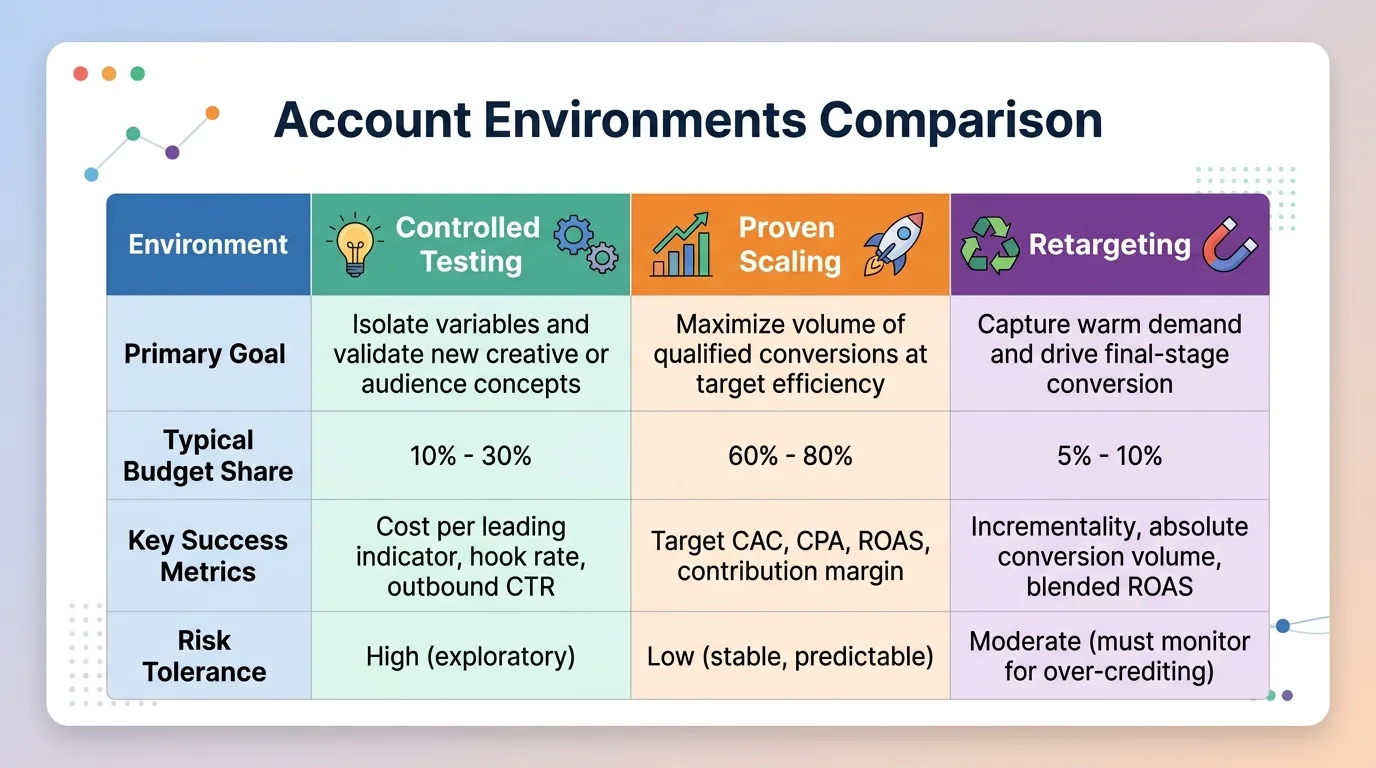
Account Environments Comparison
| Environment | Primary Goal | Typical Budget Share | Key Success Metrics | Risk Tolerance |
|---|---|---|---|---|
| Controlled Testing | Isolate variables and validate new creative or audience concepts | 10% - 30% | Cost per leading indicator, hook rate, outbound CTR | High (exploratory) |
| Proven Scaling | Maximize volume of qualified conversions at target efficiency | 60% - 80% | Target CAC, CPA, ROAS, contribution margin | Low (stable, predictable) |
| Retargeting | Capture warm demand and drive final-stage conversion | 5% - 10% | Incrementality, absolute conversion volume, blended ROAS | Moderate (must monitor for over-crediting) |
Avoid making audience exclusions, bid strategies, and campaign types so complicated that nobody can explain why a given setup exists. If a campaign cannot be understood and audited quickly, it will be difficult to optimize at speed.
Control Budget Allocation With Evidence
Budget caps are not enough. Teams need a clear process for reallocating spend as performance changes. The objective is to increase exposure to proven opportunities without giving a temporary spike too much credit.
Scale in measured increments when possible. A significant budget jump can reset delivery, push an ad into less efficient inventory, or create performance volatility that is hard to interpret. The right pace depends on the platform and account maturity, but the principle holds: increase spend with a reason, monitor the result, and reverse quickly when economics deteriorate.
This is also where blended performance matters. One campaign may look expensive in isolation but support profitable new-customer growth across the account. Another may report a strong ROAS because it captures branded demand or retargets visitors who were already going to purchase. Budget decisions should account for incrementality, not just the most flattering dashboard number.
Review budget allocation on a regular cadence. Daily reviews catch delivery issues and clear losers. Weekly reviews should shift money between campaigns, creative concepts, and channels. Monthly reviews should challenge larger assumptions about offers, customer segments, landing pages, and channel mix.
Reduce Waste Beyond the Ad Account
Not all wasted ad spend originates in media buying. A slow landing page, unclear offer, broken mobile checkout, or sales team that follows up two days late can make perfectly qualified traffic look unprofitable.
When performance drops, diagnose the full path before changing targeting. Check click-through rate, landing page views, page speed, conversion rate, lead quality, sales acceptance, and downstream revenue. If click-through rate is strong but conversion rate falls, the issue may be the page or offer. If lead volume is high but sales quality is poor, review form questions, qualification logic, and the feedback loop from sales to media.
The same applies to creative. A lower CTR is not always bad if it filters out low-intent users and produces a better conversion rate. Performance teams should resist optimizing one metric in isolation. Profitable growth comes from the relationship between metrics, not from winning a single column in a report.
Make Speed an Advantage
The companies that protect budget best are not necessarily the ones with the smallest accounts. They are the ones that learn faster. They can launch a new concept quickly, see the data in one place, identify the signal, and put more budget behind what is working before the opportunity disappears.
That requires disciplined execution: consistent campaign builds, clear creative briefs, reliable reporting, and enough testing volume to avoid overreacting to one asset or one day of data. It also requires accountability. Every dollar should have a job, a measurement standard, and an owner responsible for acting on the result.
Wasted spend will never reach zero. Testing requires controlled risk, platforms fluctuate, and buyers do not behave like spreadsheet models. The goal is to make waste temporary and informative. When weak ideas are cut fast and winning patterns are scaled with confidence, paid acquisition becomes a system for profitable growth rather than an expensive guessing game.