
A paid media account can have clean campaign structure, disciplined bidding, and enough budget to scale - then stall because the creative pipeline cannot keep up. High volume ad creative production solves that constraint by giving media teams enough fresh, structured inputs to test real hypotheses, identify winners faster, and prevent fatigue from turning profitable spend into waste.
The goal is not to make more ads for the sake of activity. The goal is to produce enough purposeful variations to understand what changes performance: the hook, visual format, offer framing, proof point, landing-page message, audience angle, or call to action. When creative and media buying operate as one system, volume becomes a source of signal rather than chaos.
Why Creative Volume Is a Growth Constraint
Most paid acquisition teams do not lose because they have no ideas. They lose because good ideas take too long to launch, testing is inconsistent, and performance data is too fragmented to tell the team what actually worked.
A handful of polished ads may be enough for a brand campaign. It is rarely enough for a performance program buying at scale across Meta, TikTok, Google, Taboola, and other channels. Each platform rewards different formats and behaviors. Each audience segment responds to different motivations. And every winning ad eventually faces diminishing returns as frequency rises, competitors copy the angle, or the market simply moves on.
That creates a simple operating reality: if spend grows, the creative system must grow with it. A team spending five figures per month can often manage with an informal process. A team spending six or seven figures needs predictable throughput, clear prioritization, quality control, and a direct connection between creative output and media performance.
Volume without discipline can make the problem worse. If every asset launches with unclear naming, inconsistent messaging, or no test rationale, reporting becomes unreliable. The team sees data, but not insight. More ads then become more noise.
What High Volume Ad Creative Production Actually Means
High volume does not mean producing hundreds of unrelated assets and hoping the algorithm finds something useful. It means building a repeatable production engine that creates a meaningful number of distinct tests without sacrificing speed, brand standards, or learnings.
The unit of production should be the test, not just the ad. A static image with a new headline is one test. A creator-style video with a different opening claim is another. A revised version of a proven concept that changes the offer, proof, or customer pain point can be more valuable than a fully original idea because it isolates a variable with known demand.
For a lead generation business, that might mean testing whether prospects respond better to cost savings, speed, expert support, or risk reduction. For an ecommerce brand, it could mean testing product demonstration, customer proof, comparison messaging, founder-led storytelling, and offer-led creative. For an app or subscription business, the creative may need to test the job the product performs before it tests a feature list.
The output mix also depends on the platform. Meta may support a broad range of statics, short-form video, carousels, and creator-led assets. TikTok generally needs native-feeling video built around a strong first second. Google can require message discipline across visual and text-led inventory. The system should preserve the core insight while adapting execution to the placement.
Build the Production Engine Around Testing Velocity
The fastest teams are not necessarily the ones with the largest creative department. They are the ones that remove unnecessary handoffs and make decisions from a consistent operating rhythm.
Start With a Clear Test Backlog
Every production cycle needs a prioritized backlog tied to business outcomes. That backlog should draw from performance data, customer research, sales objections, landing-page behavior, competitor positioning, and platform-level trends.
Each brief should answer a few practical questions: What is the hypothesis? Who is the message for? What variable is changing? What format fits the channel? What does success look like? This does not need to become a slow strategy document. It needs to give designers, editors, copywriters, and media buyers enough direction to produce work that can later be evaluated.
Prioritization matters. If a campaign is showing strong conversion rates but weak click-through rates, the immediate opportunity may be stronger hooks and more disruptive visual openings. If click-through rate is healthy but conversion rate is weak, the issue may be message-to-landing-page alignment, offer clarity, or audience quality. Creative production should respond to the bottleneck, not follow a generic content calendar.
Use Modular Creative, Not One-Off Assets
Modular production is how teams increase output without starting from zero every time. Build reusable components: product shots, customer testimonials, motion templates, benefit statements, creator footage, visual proof, offer cards, and brand-safe end frames. Then combine them into distinct executions.
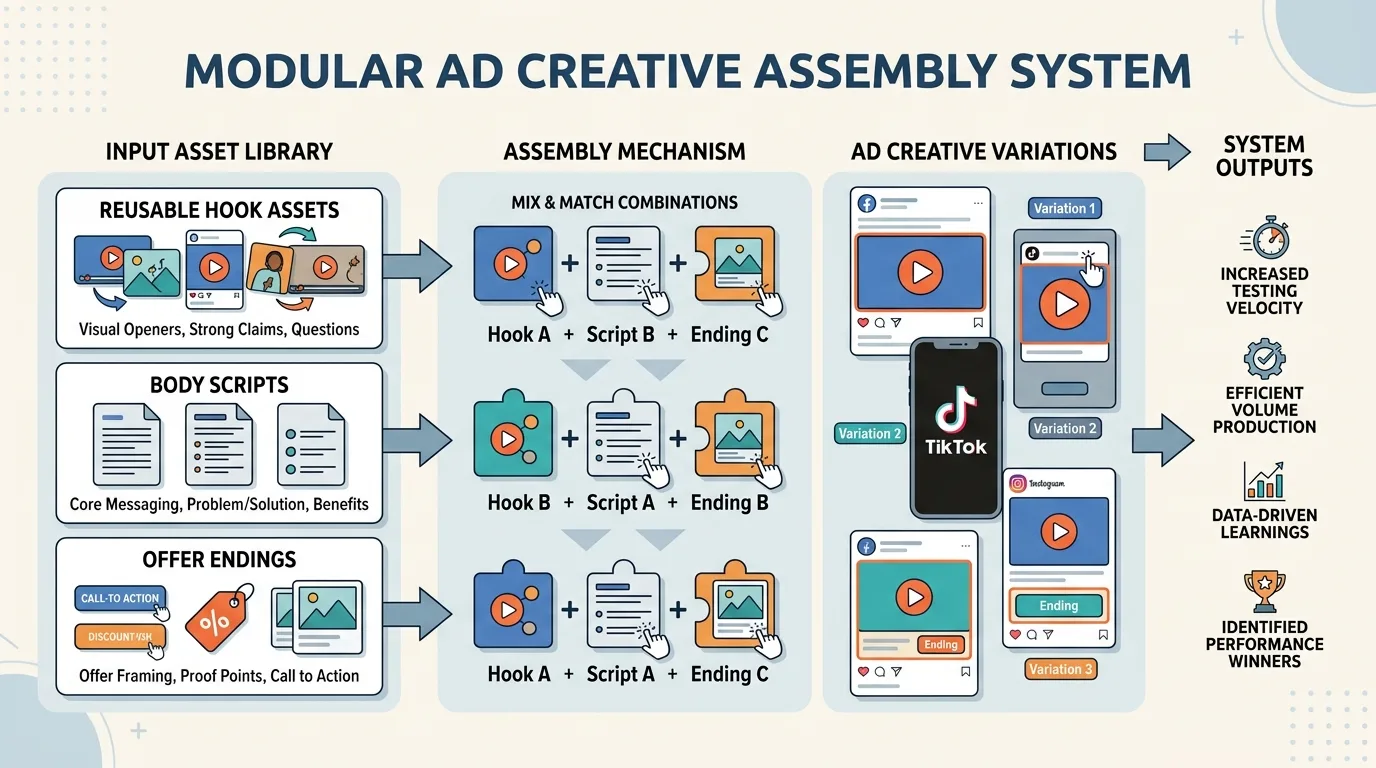
This approach shortens production time, but it has a more important benefit: it makes testing cleaner. If the team changes only the opening hook while holding the core message and edit style constant, it can learn whether the hook caused the performance shift. If everything changes at once, a winner may emerge, but the reason remains unclear.
Templates should create speed, not sameness. The risk is producing an assembly line of ads that all look and feel identical. Strong systems preserve room for new formats and unexpected ideas while making proven production tasks easier to repeat.
Put Launch Operations on Rails
A finished creative file is not a live test. Assets need correct naming, platform specifications, copy variants, tracking, campaign placement, approvals, and a launch schedule that avoids gaps in delivery.
Launch Quality Checklist
A finished creative file is not a live test. To launch successfully, ensure every asset meets these operational standards:
- Correct Naming: Follow structured campaign naming conventions for accurate attribution.
- Platform Specifications: Match exact aspect ratios and file size limits for each placement.
- Copy Variants: Prepare primary text, headlines, and descriptions tailored to the platform.
- Tracking Implementation: Validate UTM parameters and tracking pixels before publish.
- Campaign Placement: Map assets to correct ad sets based on targeting criteria.
- Approvals: Secure brand and legal sign-off to maintain standards.
- Launch Schedule: Coordinate timing to avoid delivery gaps or overlapping schedules.
This is where many teams lose momentum. Creative lives in one tool, media plans in another, feedback in email, and reporting in a spreadsheet that updates after the fact. The result is delayed launches and uncertainty about what is live.
Centralized launch systems reduce that drag. At Conversion Collective, internal tooling such as LaunchBox is designed to help manage campaign volume with consistent execution and centralized data. The principle applies whether a team uses proprietary technology or a carefully built internal workflow: creative production and campaign operations should share one source of truth.
Measure Creative Against Business Outcomes
Creative metrics are useful, but they are not the finish line. A high click-through rate can be a warning sign if it brings low-intent traffic. A low cost per click can hide a weak conversion rate. Conversely, an ad with an average engagement profile may produce excellent downstream revenue because it filters for serious buyers.
The right scorecard depends on the business model. Ecommerce teams may focus on contribution margin, new-customer acquisition cost, and blended efficiency. Lead generation teams may need to measure lead quality, contact rate, appointment rate, and closed revenue. App marketers may look beyond installs to activation, retention, and subscription value.
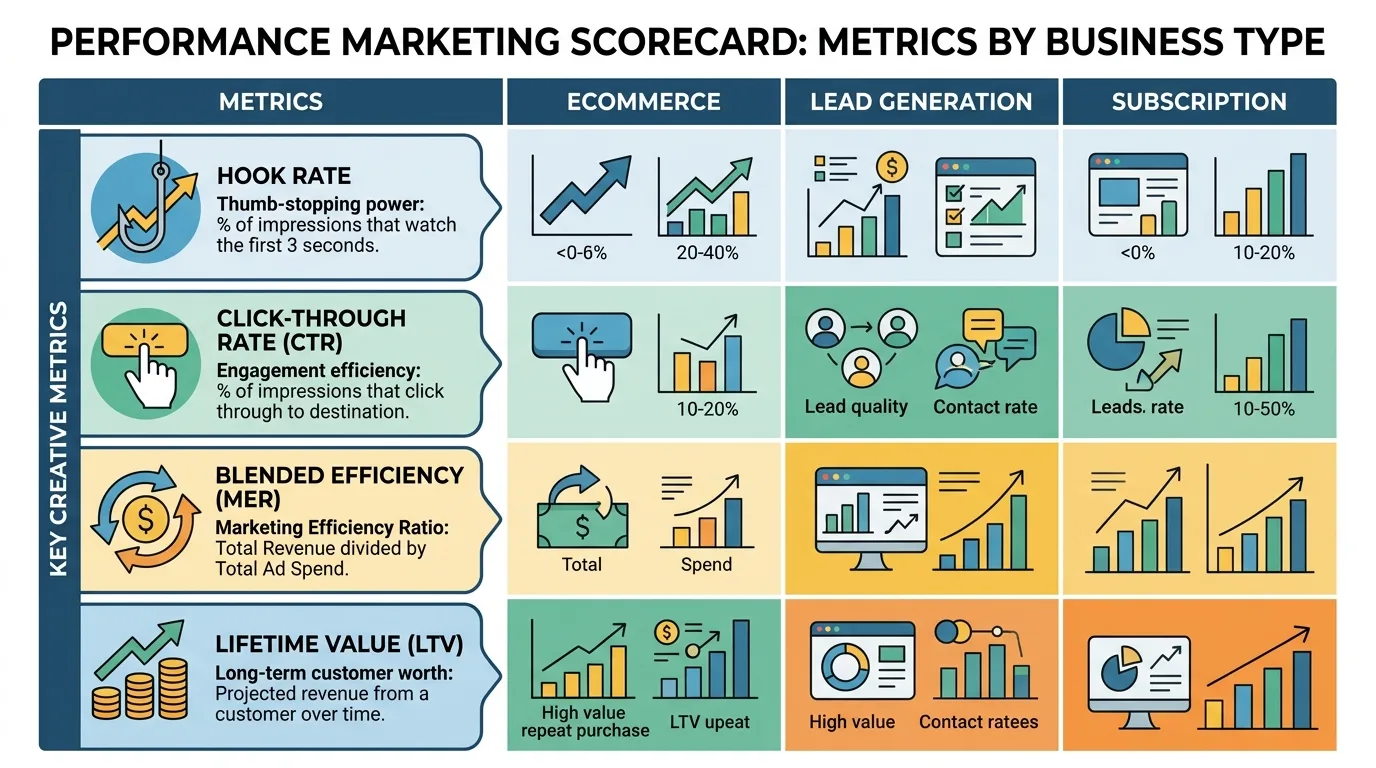
Creative reporting should make decisions easier. It should show which concepts, hooks, formats, messages, and offers are producing meaningful business results. It should also identify fatigue early enough to refresh a winner before performance deteriorates.
This requires patience as well as speed. Not every creative test reaches statistical confidence at the same rate. A high-spend account may get a directional read in days. A lower-volume account may need longer windows or a more concentrated testing plan. The answer is not to wait indefinitely, but to set decision rules that match available traffic and conversion volume.
Scale Winners Without Killing Them
Once an ad works, the instinct is to push budget hard. That can be correct, but it should be controlled. Scaling too quickly can change delivery conditions, expand into weaker audiences, and make a proven concept look broken when the real issue is how it was deployed.
A better approach is to scale in measured steps while creating adjacent variations immediately. Keep the winning core, then test new openings, updated proof, alternate formats, different customer personas, and fresh visual treatments. This extends the life of the insight instead of depending on a single asset.
The strongest creative programs maintain three lanes at once: proven winners receiving budget, iterations designed to improve those winners, and new concepts that could become the next growth driver. If all production is focused on current winners, fatigue eventually catches up. If all production is experimental, the account lacks stable scale.
The Operating Standard That Makes Volume Useful
High-volume creative programs work when ownership is clear. Someone needs to own the testing roadmap, someone needs to own production throughput, and media buyers need the authority and context to turn creative results into budget decisions. Those roles can sit within one internal team or an integrated managed service, but they cannot operate as disconnected vendors.
The standard is straightforward: every asset should have a reason to exist, every launch should be trackable, and every result should influence the next production cycle. That is how a paid acquisition program gets faster without getting messier.
The next useful creative idea is rarely hidden in a brainstorm. It is usually sitting in the gap between what customers respond to, what the account data reveals, and how quickly your team can act on both.