
A paid media budget allocation guide is only useful if it helps you make decisions when performance shifts. Most teams do not lose money because they picked the wrong channel. They lose money because budgets stay attached to familiar campaigns, weak creative runs too long, and there is no clear rule for moving spend toward what is working.
The job is not to spread budget evenly across Meta, Google, TikTok, Taboola, and every new opportunity. The job is to build a system that protects efficient acquisition today while creating enough testing velocity to find the next set of winners.
Start With the Economics, Not Channel Preferences
Budget allocation starts with the business model. Before setting a channel mix, define the metrics that make spend viable: allowable customer acquisition cost, contribution margin, payback period, conversion rate, and the volume required to hit the growth target.
A subscription business with a 12-month payback window can afford a different testing posture than an ecommerce brand that needs first-order profitability. A lead generation company may optimize to qualified leads or funded deals rather than form fills. Mobile apps may accept an expensive day-one install if downstream retention supports it. The platform does not determine the budget. The unit economics do.
From there, calculate the monthly acquisition requirement. If the business needs 2,000 incremental customers at an allowable CAC of $100, paid media needs to produce roughly $200,000 in efficient spend before management fees, creative costs, and any planned test budget. That math turns a channel conversation into an operating plan.
Do not confuse a blended target with a campaign-level target. Blended CAC is the scorecard for the business. Campaign and platform targets should account for attribution differences, conversion lag, and each channel’s role in the path to purchase. Holding every campaign to the same last-click benchmark is a reliable way to underfund channels that create demand and overfund channels that harvest it.
Use Three Budget Pools
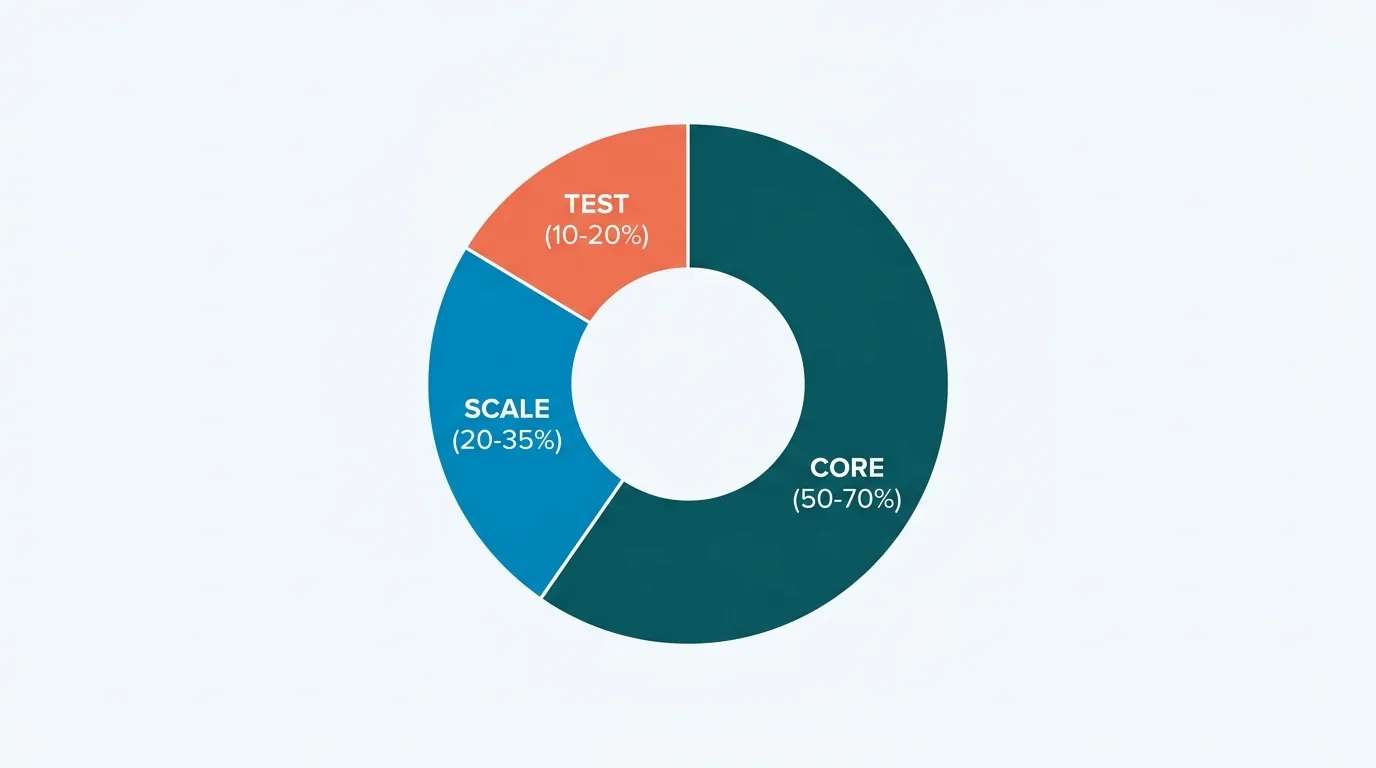
The most practical paid media budget allocation guide separates spend into three pools: core, scale, and test. The percentages vary by business maturity, but the separation matters because each pool has a different job and a different decision rule.
Core budget protects proven demand
The core pool funds campaigns with established conversion history, dependable tracking, and repeatable economics. For many growth-stage businesses, this is 50% to 70% of spend. It may include branded search, high-intent nonbrand search, mature Meta prospecting campaigns, retargeting, or evergreen publisher placements.
Core does not mean untouched. It means proven enough to protect while you test around it. If performance degrades materially, investigate whether the cause is creative fatigue, auction pressure, landing page changes, tracking loss, inventory quality, or a real demand shift. Cutting spend before diagnosing the problem often destroys useful signal.
Scale budget funds current winners
The scale pool is typically 20% to 35% of spend. It goes to campaigns, audiences, creatives, offers, and placements showing positive momentum but not yet enough history to be considered foundational.
This is where teams often hesitate. A winner gets a modest increase, performs well, then waits another week for a second increase. Slow budget movement leaves revenue on the table and gives competitors time to win the auction. Scale in controlled steps, but move with intent. The exact step depends on account size and volatility. A $5,000-per-day campaign can absorb a different increase than a $200-per-day campaign.
Watch marginal performance, not just blended performance. If spend rises 30% and conversion volume rises 25% while CAC stays within tolerance, the campaign is scaling efficiently. If volume barely moves while CAC climbs, the audience or creative may be saturated. The answer may be new creative, a broader audience, a different bid strategy, or a lower allocation rather than more budget.
Test budget buys future efficiency
Reserve 10% to 20% for testing. Smaller accounts may need the lower end until they have enough conversion volume to read results. Accounts trying to enter new channels, offers, or markets may need more. What matters is that test spend is protected from daily pressure to feed the current best campaign.
Testing is not a miscellaneous category. Give each test a hypothesis, a success metric, a spend threshold, and a decision date. For example: can creator-style video improve Meta prospecting CPA versus the current static control? Can a native placement generate leads that meet the sales team’s qualification threshold? Can a new landing page increase conversion rate without reducing lead quality?
Without a clear failure rule, teams keep funding ambiguous tests. Without a clear success rule, they fail to move money quickly when a test works.
Allocate by Signal Quality, Not Just ROAS
Platform-reported ROAS is useful, but it is not enough to direct every dollar. A campaign can look efficient because it captures users who were already going to buy. Another can appear expensive inside the platform while expanding qualified demand that later converts through search, direct traffic, or another device.
Use a hierarchy of signals. First, protect business outcomes such as profit, qualified revenue, retention, and payback. Second, use platform conversion data to optimize in real time. Third, validate major budget shifts with blended trends, cohort performance, CRM outcomes, and incrementality where the volume supports it.
This does not mean waiting for perfect attribution. Perfect data rarely arrives on the same schedule as an auction. It means knowing which decisions require fast platform signals and which require a broader business read.
Search illustrates the trade-off well. Brand search may produce exceptional reported returns, but it has limited capacity and often captures existing demand. Meta or TikTok may look less efficient initially, yet create the demand that brand search converts later. Fund both roles deliberately rather than allowing the cleanest dashboard metric to absorb the entire budget.
Make Creative a Budget Allocation Variable
Media and creative are one system. If creative production is slow, budget allocation becomes constrained by fatigue. The team sees declining CPA, assumes the channel is exhausted, and shifts spend away when the real problem is that the account has no fresh concepts to test.
Treat creative as an input to capacity. A channel with multiple proven angles, formats, hooks, and landing page combinations can absorb more budget than one running two aging ads. Before scaling spend, ask whether the creative pipeline can support the increase for the next two to four weeks.
Build testing around meaningful variations. Changing a headline color is rarely enough. Test different customer problems, mechanisms, proof points, offers, visual formats, creator styles, and levels of message awareness. Keep a clear control, then introduce enough contrast to learn what is actually moving performance.
High creative velocity also improves budget discipline. When a campaign weakens, you can replace fatigued assets quickly instead of raising bids or accepting worse economics. That is how teams preserve scale without paying more for the same result.
Set Decision Cadence Before Performance Forces It
Daily optimization and weekly allocation are not the same activity. Daily work handles delivery issues, broken tracking, spend pacing, disapprovals, and obvious outliers. Weekly reviews determine where the next meaningful tranche of budget goes. Monthly reviews assess channel roles, blended economics, creative throughput, and whether the overall mix still matches the business plan.
A practical operating rhythm includes a scorecard that shows spend, conversions, CAC or CPA, revenue quality, marginal efficiency, creative-level performance, and budget movement by channel. Avoid reporting that only explains what happened. The reporting should make the next decision obvious: maintain, increase, decrease, test, or stop.
Set guardrails in advance. A scale campaign might earn more budget after sustaining target CAC at a defined spend threshold. A test might be paused after spending a predetermined multiple of the target CPA without producing qualified conversions. A core campaign might trigger a creative refresh once frequency, CTR, or conversion efficiency moves beyond its normal range.
The right thresholds depend on sales cycle, conversion volume, and volatility. Low-volume, high-ticket lead generation needs more patience than direct-response ecommerce. But every account needs rules that prevent emotional reallocations after one bad day or one unusually strong day.
Common Allocation Mistakes That Create Waste
The first mistake is splitting small budgets across too many platforms. Five channels with insufficient conversion volume do not create diversification. They create five underfunded experiments and very little learning. Concentrate where there is evidence, then expand once the team has the creative and operational capacity to support another channel.
The second is treating retargeting as incremental growth. Retargeting can be highly efficient, but its audience is limited by prospecting and organic demand. If it consumes too much of the budget, reported efficiency may improve while new-customer growth stalls.
The third is reallocating based on platform dashboards alone. Platform data should inform action, not replace business judgment. Reconcile it with backend revenue, lead quality, refunds, cancellations, and sales feedback.
The fourth is failing to reserve budget for creative testing. When all spend is committed to existing campaigns, the account becomes dependent on yesterday’s winners. That is not efficiency. It is delayed risk.
Build a System That Can Move Fast
The goal is not a fixed percentage by channel. It is a disciplined way to move money as evidence changes. Mature accounts may have stable core allocations for months while rotating creative aggressively. Early-stage accounts may shift budget weekly as they search for a repeatable acquisition engine. Both can be correct.
At Conversion Collective, the operating advantage comes from connecting high-volume creative testing, campaign execution, and unified reporting so budget decisions are based on current performance signals rather than isolated opinions. The same principle applies whether your media function is in-house, outsourced, or hybrid: the people making allocation decisions need direct visibility into creative, conversion quality, and margin.
Keep the budget flexible enough to reward winners, strict enough to stop waste, and funded enough to learn. The next profitable growth lever is usually not hidden in a new channel. It is sitting in a faster decision cycle that moves spend toward evidence.