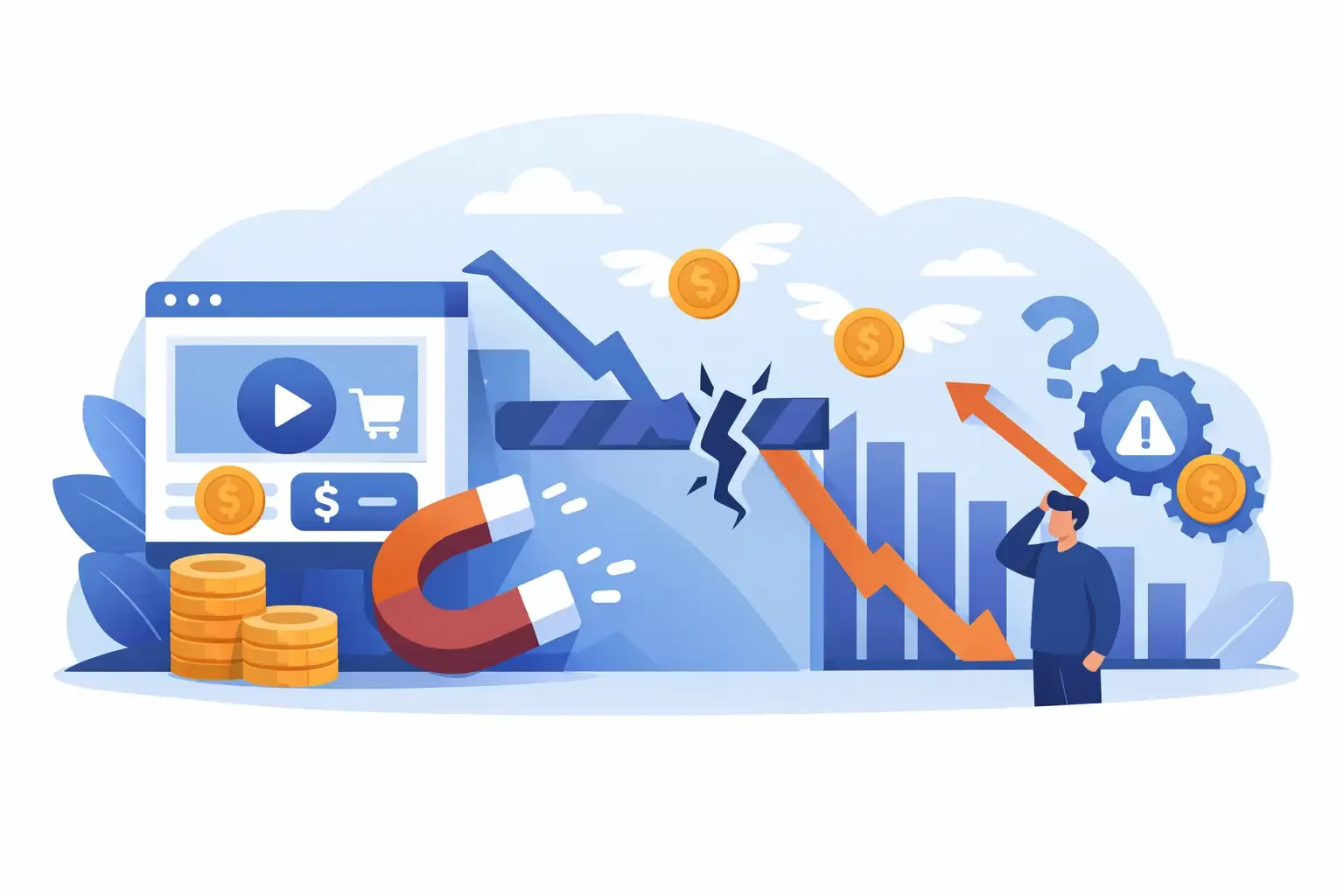
A campaign can look healthy on Monday and become unprofitable by Friday without a single obvious platform alert. Spend rises, delivery holds, click-through rate may even look acceptable, but CPA climbs and volume dries up. If you are asking, why do ads stop converting, the answer is rarely that the platform suddenly stopped working. More often, a performance signal changed somewhere in the system and the account was not built to identify it fast enough.
Paid acquisition is not a set-and-forget channel. It is a live operating system made up of creative, audiences, bids, auctions, measurement, offers, landing pages, and fulfillment. When conversion rate falls, the job is not to make random edits until results return. The job is to isolate the failure point, protect spend, and relaunch testing at speed.
Why Ads Stop Converting: Start With the Right Diagnosis
The most expensive response to declining performance is assuming every metric is equally responsible. It leads teams to change targeting, creative, budgets, landing pages, and bidding at once. After that, they cannot tell what fixed the issue, what made it worse, or whether the apparent recovery was just normal variance.
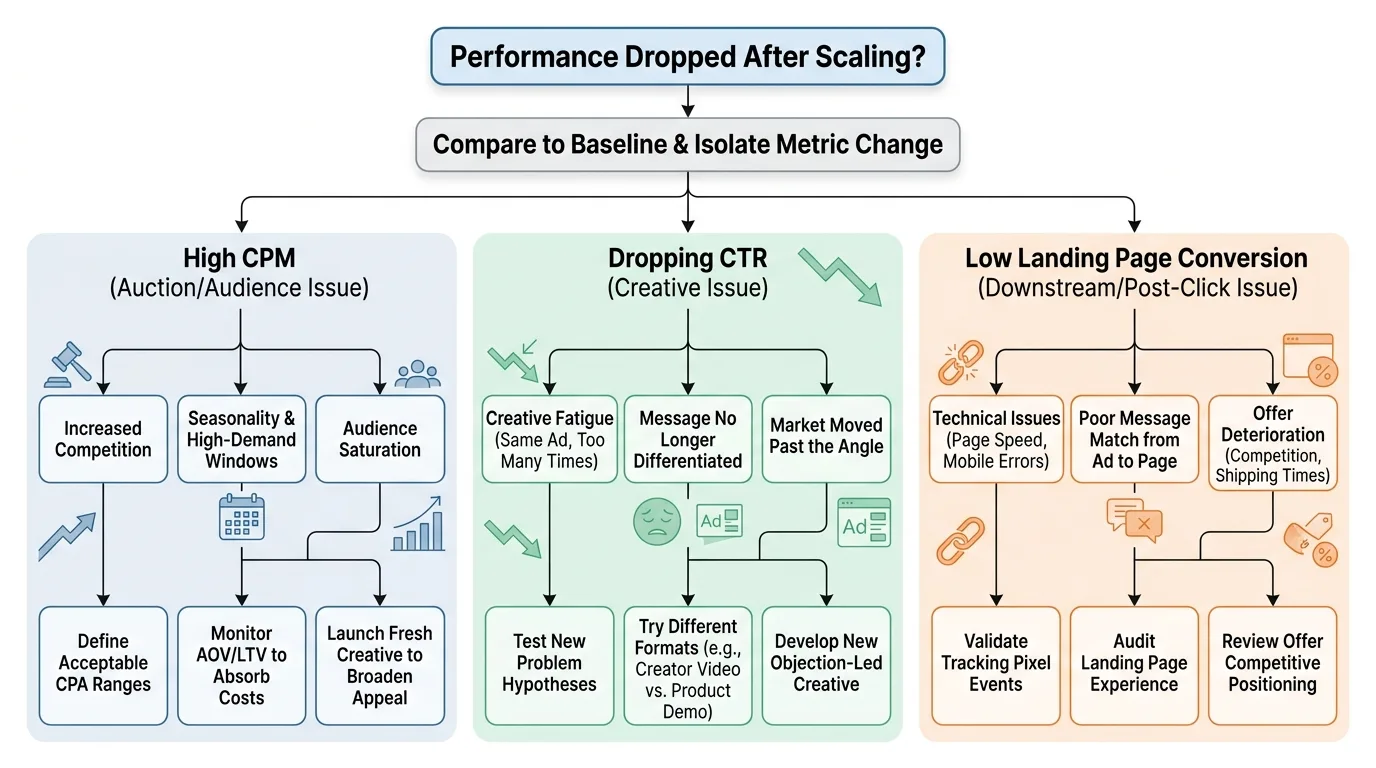
Start by comparing a recent underperforming period against the last stable baseline. Review spend, impressions, CPM, click-through rate, cost per click, landing-page view rate, conversion rate, CPA, and revenue or lead-quality metrics. Then separate the issue into one of three categories: the ad is reaching people less efficiently, the ad is getting weaker responses, or post-click conversion has deteriorated.
A higher CPM with stable click-through and conversion rates points toward an auction or audience issue. A falling click-through rate usually points to creative or message-market fit. Stable traffic metrics paired with lower landing-page conversion suggests the problem is after the click. This is simple, but it prevents a great deal of wasted spend.
Do Not Diagnose From Platform CPA Alone
Platform-reported CPA is useful, but it is not the entire operating picture. Check CRM outcomes, approved leads, subscription retention, refund rates, purchase cohorts, and contribution margin where relevant. A lead generation campaign may look worse because tracking changed, while actual qualified-lead volume is stable. It may also look better while lead quality quietly collapses.
The optimization event needs to reflect the outcome you can profitably scale. If the account is optimized toward a shallow event because conversion data is delayed or incomplete, the platform will find more people likely to complete that shallow event. That is not necessarily a media buying failure. It is an optimization design problem.
Creative Fatigue Is Real, but It Is Often Misdiagnosed
Creative fatigue is one of the most common answers to declining results, and sometimes it is correct. The same people see the same ad too many times, attention drops, click-through rate declines, and costs rise. Frequency is a helpful signal, especially in smaller audiences or retargeting pools.
But fatigue does not always mean an asset has been shown too often. It can mean the market has simply moved past the message. Competitors may have copied the angle, a seasonal need may have passed, or the initial curiosity around a bold claim may be gone. An ad can fatigue even at modest frequency when its hook is no longer differentiated.
The fix is not to make cosmetic changes to a winning ad. New background colors, swapped music, and minor headline edits rarely create a new performance signal. Build new creative around distinct hypotheses: a different problem, proof point, audience identity, objection, use case, offer framing, or format.
For example, an ecommerce brand whose product-demo ads are slowing may test a customer comparison, an objection-led creator video, a gift-oriented angle, and a value-per-use calculation. A lead generation brand may move from broad outcome claims to specific qualification criteria, case-based proof, or a sharper cost-of-inaction message. High testing velocity matters because no individual creative is permanent.
Auction Conditions Can Change Before Your Team Notices
You do not control the auction. Competitors enter, seasonality shifts, inventory changes, and platforms adjust delivery systems. During major retail periods, election cycles, product launches, or other high-demand windows, CPM can rise quickly. A campaign that was profitable at one acquisition cost may not survive the same conversion rate at a much higher impression cost.
Do not respond to every CPM increase by cutting budgets immediately. First determine whether the increase is temporary and whether your conversion rate or average order value can absorb it. Some businesses should reduce spend during expensive windows. Others should hold position because customer lifetime value supports a higher first-purchase CPA.
The key is knowing your guardrails before volatility arrives. Define an acceptable CPA range, a margin-based break-even point, and the conditions that justify scaling, holding, or reducing spend. Without those thresholds, teams make emotional budget decisions based on a few bad days.
Audience saturation can create similar symptoms. Broad targeting can continue to perform for a long time, but it is not infinite. As spend increases, the platform may move further from your highest-intent pockets. That does not automatically mean you need dozens of fragmented ad sets. It means you need enough creative variety and enough budget control to give the algorithm fresh conversion paths.
When Clicks Hold but Conversions Fall, Look Past the Ad
If click-through rate and cost per click are stable while conversion rate declines, the ad is likely doing its job. The break is downstream.
Check the landing-page experience first. A page can slow down after a development release, break on a specific mobile browser, lose a form field integration, show an out-of-stock product, or introduce a checkout error. These failures are more common than teams think because campaign reporting and site monitoring often live in separate workflows.
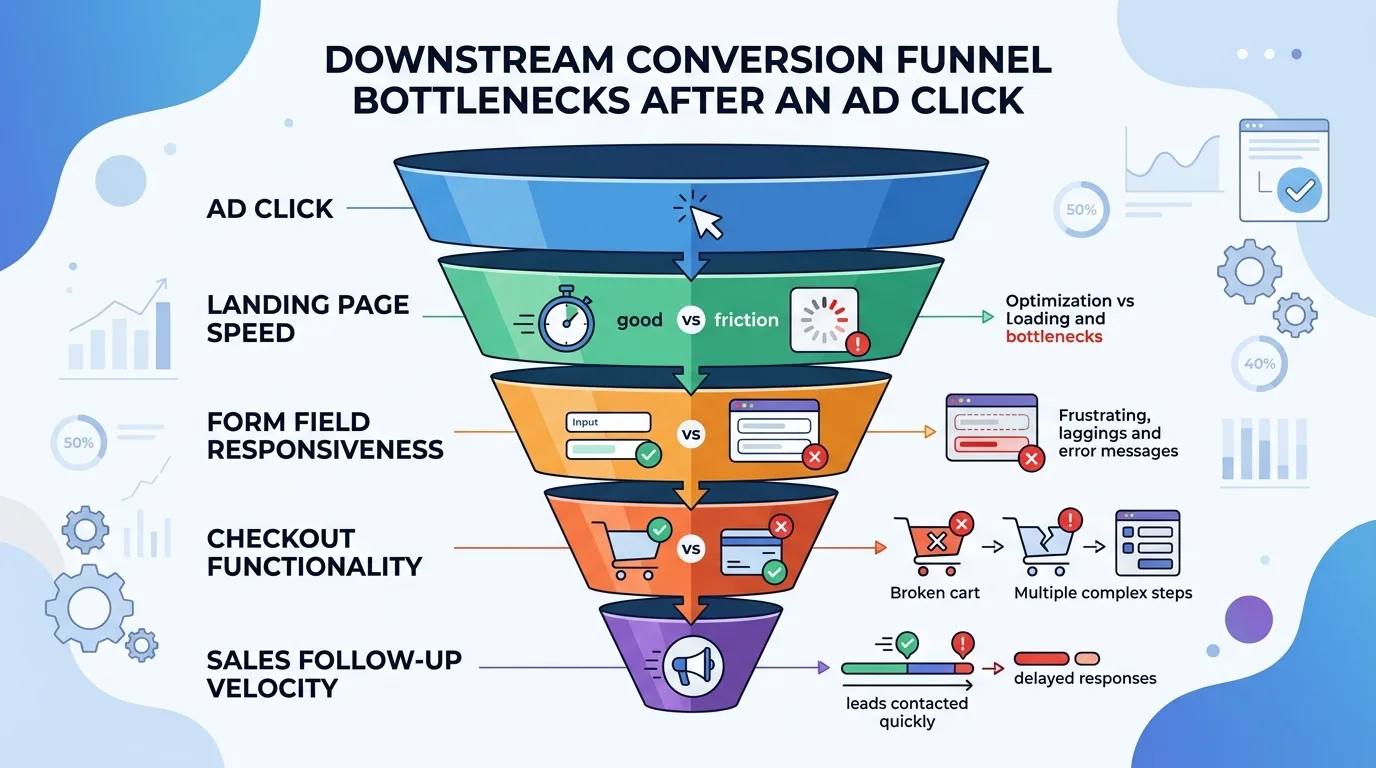
Then review message match. Ads create expectations. If the creative promises a fast quote, a limited-time discount, a clear product benefit, or a particular use case, the page must continue that conversation immediately. Sending all traffic to a generic homepage introduces friction and forces the visitor to rediscover what motivated the click.
Offer deterioration is another overlooked cause. A competitor may undercut pricing, shipping times may extend, a promotion may end, or sales follow-up may slow down. For lead generation, response time has a direct impact on conversion quality. Media can generate the same lead volume while the business converts fewer leads because contact rates or sales capacity changed.
Tracking Problems Can Make Good Ads Look Bad
A sudden performance drop is sometimes a measurement issue, not a demand issue. Pixel events can fail after a site update. Consent changes can reduce observed conversions. A CRM integration can duplicate or suppress offline events. Attribution windows can change, and reporting delays can make recent performance look worse than it is.
Validate the event chain before rebuilding campaigns. Confirm that key events fire correctly, values are passed accurately, deduplication is working, and server-side and browser-side signals are aligned where applicable. Compare platform-reported conversions with your source-of-truth business data.
This does not mean ignoring platform data. It means treating it as one decision input rather than the only answer. The goal is a measurement system that gives media buyers enough signal to optimize while giving leadership a clear view of profitable customer acquisition.
A Better Response Than Constant Campaign Rebuilds
When ads stop converting, avoid the urge to rebuild the entire account. Full resets destroy learning, blur the diagnosis, and can replace a manageable problem with several new ones. Protect proven structures unless the evidence says the structure itself is the constraint.
A disciplined recovery sequence works better:
- Verify tracking and business-side conversion data.
- Identify whether the break occurred in auction costs, ad response, or post-click conversion.
- Reduce waste by pausing clear losers, not every campaign that misses target for a day.
- Launch fresh creative based on specific hypotheses, with enough variation to learn quickly.
- Monitor leading indicators early, then judge winners on the business outcome that matters.
The trade-off is speed versus certainty. Pausing too slowly can burn budget after a real decline. Pausing too aggressively can kill ads that are experiencing ordinary volatility. Use spend thresholds and time windows that match your sales cycle, conversion volume, and margin profile. A high-volume ecommerce account can make decisions faster than a B2B campaign with a 30-day sales cycle.
Build an Account That Expects Decay
The strongest paid growth programs do not rely on one evergreen winner. They assume that creative wears out, auctions move, audiences change, and tracking will occasionally break. Their advantage is operational: they can spot the change, produce new tests, launch cleanly, and scale the next set of winners before the old ones consume the budget.
That requires creative and media buying to operate as one system. Creative teams need feedback on hooks, formats, objections, and audience segments that are producing qualified conversions. Media teams need a steady pipeline of genuinely different assets, not a few monthly variations. Reporting needs to show where performance changed, not just whether the blended number is up or down.
When performance falls, treat it as a signal to improve the system rather than a reason to chase a platform trick. The account that wins over time is the one that can turn a bad week into a clear hypothesis, a fast test cycle, and a more durable path to profitable growth.