
A media buyer should not be waiting three weeks for a new angle while a winning campaign runs out of room. Yet that is the operating reality for many growth teams: media is ready to scale, creative is stuck in a queue, and the budget keeps moving toward ads that have already peaked. Creative ops for paid media fixes that bottleneck by turning creative production, testing, launch, and learning into one accountable system.
The goal is not simply to make more ads. It is to produce the right volume of differentiated creative, get it live with clean campaign structure, identify the signals that matter, and direct the next production cycle toward what is working. When those steps are disconnected, teams create noise. When they are integrated, creative becomes a repeatable lever for profitable acquisition.
Why creative becomes the constraint on paid growth
Paid media platforms reward fresh inputs. On Meta and TikTok, performance can decay as audiences tire of an asset. On Google, new messages and landing-page combinations can expose demand that existing ads miss. Across native, display, app, and lead-generation programs, the same pattern holds: the account cannot find more winners if the creative pipeline is too narrow.
Most teams do not have a media buying problem first. They have an operating problem. Strategy lives in one document, briefs live in another, designers receive incomplete feedback, and media buyers launch assets without a consistent naming convention or test plan. Reporting then arrives after the fact, too aggregated to explain why an ad worked.
That fragmentation creates expensive behavior. Teams recycle a small handful of assets, mistake platform volatility for a creative insight, and increase spend before a concept has earned it. They also spend too much time coordinating work that should be standardized.
Creative operations brings order to the handoffs. It defines who decides what to test, how an idea becomes a production-ready brief, where assets live, how launches are checked, and how results feed the next round. The payoff is speed, but not speed for its own sake. It is the ability to place more disciplined bets before competitors do.
Creative ops for paid media is a closed-loop system
The strongest creative programs do not treat production as a service desk for media. They operate as a loop: performance data informs hypotheses, hypotheses shape briefs, briefs create distinct asset families, campaigns generate comparable results, and results determine the next set of tests.
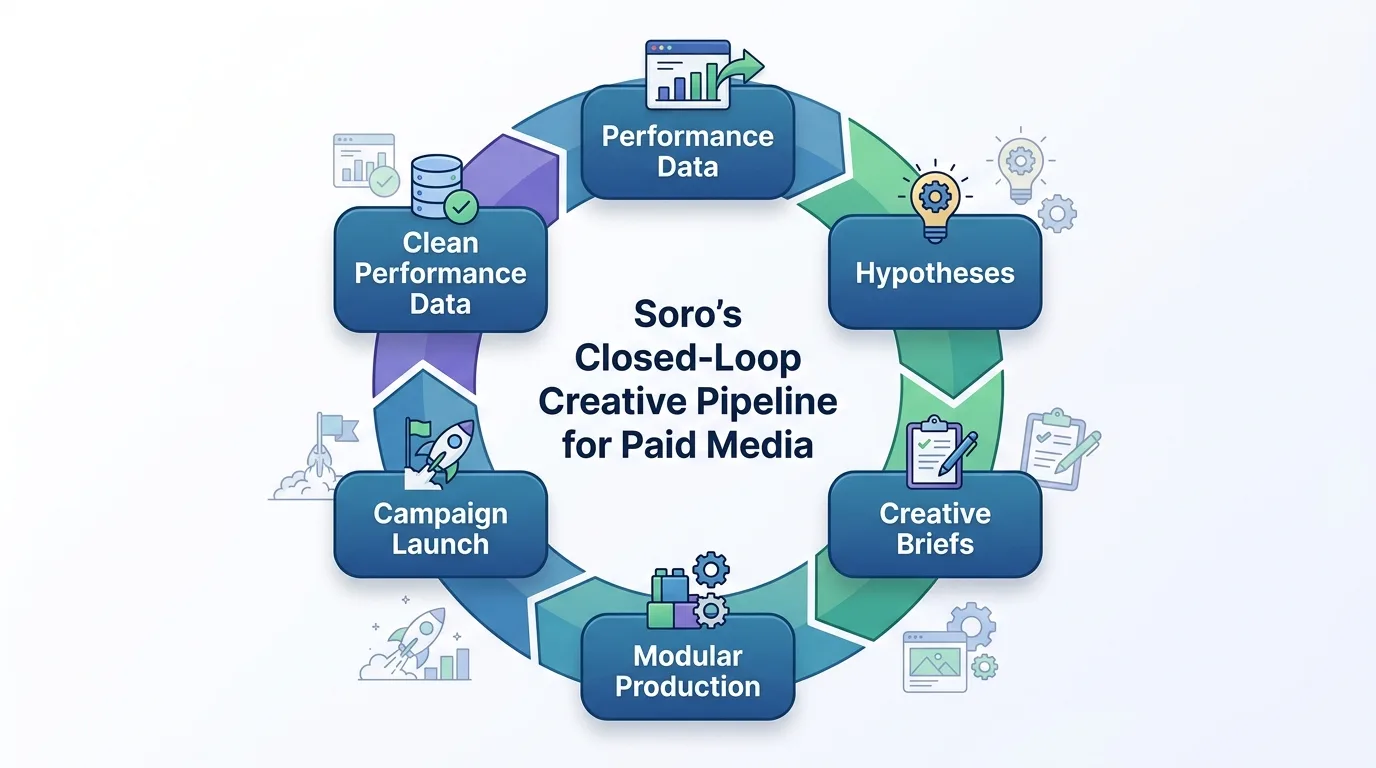
That loop needs shared definitions. A “winner” cannot mean high click-through rate to the creative team and acceptable customer acquisition cost to the media buyer. The primary metric should match the business model: profitable new-customer acquisition for ecommerce, qualified cost per lead for lead generation, trial-to-paid efficiency for subscriptions, or downstream revenue for apps. Supporting metrics help diagnose performance, but they should not replace the outcome.
It also needs a clear test hierarchy. Start with the variables most likely to change the result: audience problem, offer, hook, format, proof, and call to action. Do not spend a full production cycle debating button colors while the core message remains unproven. Small executional changes have a place once an angle is validated, but they rarely rescue a weak concept.
Build a usable creative hypothesis
A useful hypothesis is specific enough to test and commercial enough to matter. For example: busy homeowners respond better to a cost-of-delay message than a feature-led product explanation. That statement gives the team direction on the hook, the visual tension, the proof needed, and the audience context.
A weak brief says, “Make new UGC ads.” A usable brief identifies the audience, desired action, message angle, offer, format, proof points, objections, and the metric that will determine whether the test advances. It also separates the concept from its variations. One concept may produce several opening hooks, creator reads, static treatments, or lengths without becoming a pile of duplicate ads.
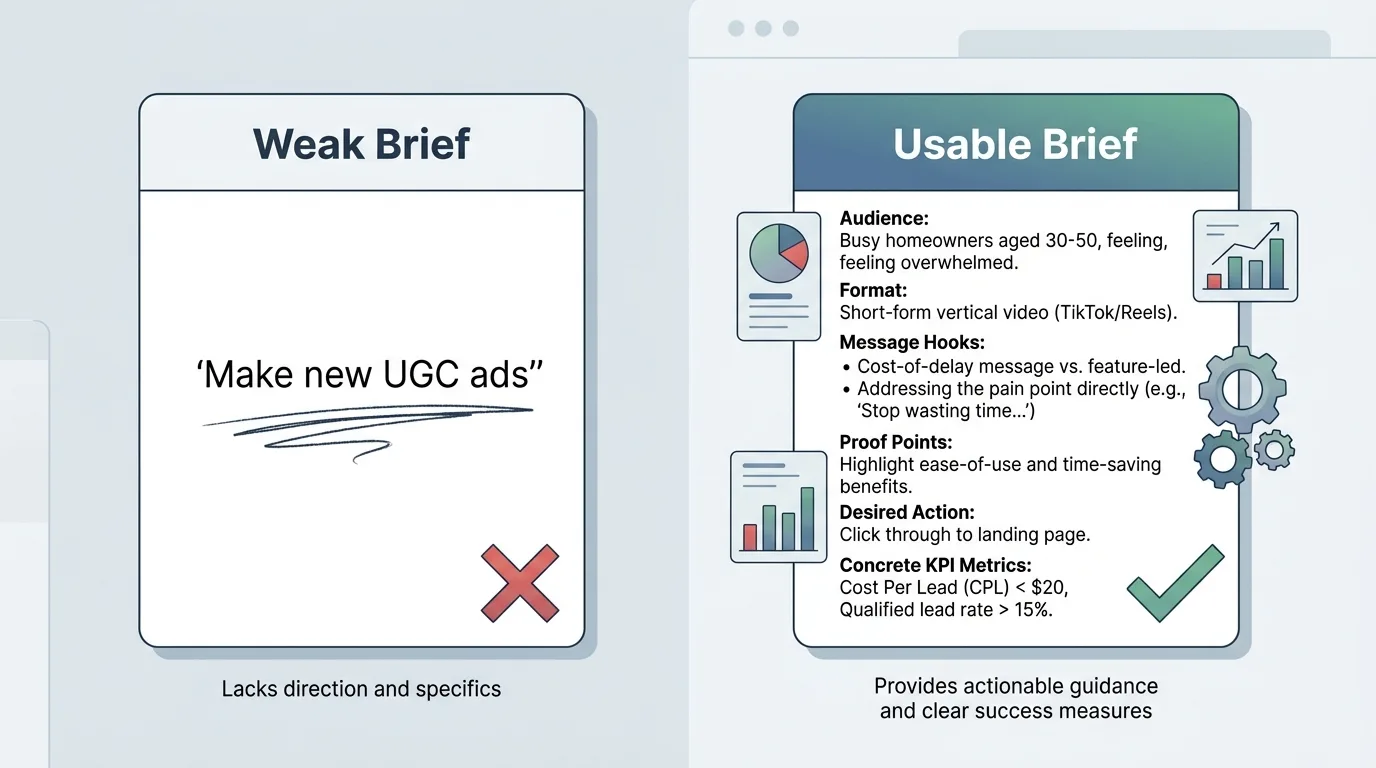
This distinction matters at volume. If 30 assets are all minor edits of the same message, the team may technically hit a production target while learning almost nothing. High output only has value when it creates meaningful contrast.
Design production for iteration, not one-off launches
Creative teams often lose time rebuilding components that should be modular. Offer cards, product demonstrations, testimonials, comparison frames, brand-safe claims, end cards, and creator footage libraries should be organized for reuse. That does not mean every ad should look identical. It means the team can spend its time on new angles instead of recreating approved building blocks.
For video, establish a library of raw footage and a system for labeling it by product, persona, scene, claim, and usage rights. For statics, maintain editable templates that preserve platform-specific dimensions while allowing rapid changes to headlines, images, offers, and proof. The operational standard is simple: a winning insight should be easy to turn into multiple fresh executions.
There is a trade-off. Templates can increase throughput but can also flatten creative if teams use them as a substitute for thinking. The answer is not to abandon templates. It is to reserve original production effort for the highest-potential concepts and use modular systems to expand validated messages quickly.
Launch discipline protects the value of the test
An excellent asset can still produce unusable data if it is launched into a messy account. Creative operations must extend through campaign setup, not stop at export.
Every asset needs a traceable name that ties it to its concept, format, hook, audience or campaign context, and production date. That makes it possible to answer practical questions later: Did the testimonial angle work across formats? Did the first-three-seconds hook improve hold rate? Is the offer driving conversion, or is the creator doing the work?
Testing also requires enough control to interpret outcomes. This does not mean every test must be a perfect laboratory experiment. Paid platforms are dynamic, and business conditions change. It does mean avoiding unnecessary variables. If a team changes the audience, budget, landing page, offer, and creative at once, it may get a result but not an insight.
Pre-launch quality assurance is equally important. Confirm tracking, destination URLs, copy compliance, platform specs, naming, budgets, and campaign placement before assets go live. These checks are unglamorous, but they prevent avoidable waste. At scale, a small error repeated across dozens of campaigns becomes a major cost.
Pre-Launch Quality Assurance Checklist
- Tracking: Confirm URL parameters and pixel tracking are firing correctly.
- Destination URLs: Verify all destination landing pages resolve and are active.
- Copy Compliance: Double-check ad copy spelling, grammar, and compliance guidelines.
- Platform Specs: Ensure aspect ratios, lengths, and file formats meet platform guidelines.
- Naming Conventions: Check that campaign and asset naming matches setup taxonomy.
- Budgets & Placements: Verify accurate budget limits and channel placement rules.
Centralized launch tooling can make this process far more reliable. At Conversion Collective, internal systems such as LaunchBox are designed to standardize execution across large campaign volumes, so teams can move faster without losing visibility or control.
Make reporting useful to the people making ads
Creative reporting fails when it is either too shallow or too slow. A leaderboard of top ads is not enough. It tells the team what won, not what to make next.
The reporting cadence should match the spend level and test velocity. Fast-moving accounts may need daily monitoring for delivery problems and early signals, with a more deliberate weekly read on performance. Lower-volume programs may need longer windows before calling a result. The right timeline depends on conversion lag, budget, audience size, and the volatility of the channel.
The useful report connects outcomes to creative attributes. Rather than saying a video outperformed, identify that a direct problem-first opening, a named customer persona, and an early proof point showed up repeatedly in efficient ads. Then distinguish correlation from a decision. One outlier is a lead. Repeated performance across executions is a production priority.
This is where media and creative teams need to work from the same scorecard. Media buyers can see delivery patterns, audience saturation, placement behavior, and cost movement. Creative strategists can see message, format, and execution patterns. Neither view is complete on its own.
Set operating metrics beyond creative volume
Volume is necessary, but it is not the score. A healthy creative ops function tracks how quickly briefs become live tests, what percentage of launches are materially distinct, how many viable concepts are produced each cycle, and how often insights result in a follow-up iteration.
It should also track business impact. Watch the share of spend moving toward validated creative, the time required to replace fatigued assets, the reduction in wasted spend on unproductive variants, and the incremental growth generated by new winners. These metrics expose whether the system is producing learning or merely producing files.
For a lean team, the best first move is usually not hiring more people or buying another project-management tool. It is documenting the workflow from insight to launch and removing the slowest handoff. For a larger team managing multiple channels, the priority may be governance: shared taxonomy, approval rules, asset libraries, and a single reporting layer that can handle volume.
The next production cycle should already be clear
The best creative meeting ends with decisions, not observations. Keep the angle, cut the execution, rework the hook, expand the proof, test the offer, or move budget. Every result should have an operational consequence.
That is the discipline behind scalable paid acquisition. When creative is managed as an integrated operating system, teams do not wait for performance to decline before reacting. They build a pipeline that keeps the account supplied with stronger ideas, cleaner tests, and faster paths to the next winner.