A winning ad can become an expensive liability faster than most teams expect. The question is not simply when should you refresh ad creative. It is whether performance is declining because the audience has seen too much of the same message, because the offer has weakened, or because the account structure is preventing a good ad from finding enough efficient reach.
Refresh too early and you cut off a potential winner before it has scaled. Refresh too late and you keep buying impressions from an audience that has already made its decision. The answer is a disciplined creative operating system built around performance signals, spend velocity, and a steady pipeline of new testable concepts.
When Should You Refresh Ad Creative?
Refresh creative when the data shows that an ad’s ability to acquire customers profitably is deteriorating, not because it has been live for an arbitrary number of days. Calendar-based refresh rules are useful for production planning, but they are not optimization strategy.
For a low-spend account, an ad may run for weeks without reaching meaningful audience saturation. For a high-spend ecommerce, app, lead generation, or subscription program, the same asset can burn through its most responsive audience in days. The more quickly you buy reach, the faster creative fatigue can appear.
The clearest refresh trigger is a sustained decline in efficiency after the ad has had enough delivery to establish a baseline. That may look like rising cost per acquisition, falling conversion rate, declining click-through rate, or a shrinking contribution to profitable spend. One weak day is noise. A repeated negative trend across enough spend is a signal.
The signals that matter most
Start with the metric closest to the business outcome. If the goal is qualified leads, do not refresh an ad based solely on click-through rate. If the goal is purchases, do not protect a high-click ad that attracts low-intent traffic and produces weak conversion rates.
Watch for a combination of these changes:
- Cost per acquisition rises while conversion quality or downstream revenue remains flat.
- Click-through rate declines after a period of stable delivery, particularly on social platforms where the same audience sees the ad repeatedly.
- Frequency rises and efficiency worsens at the same time.
- Spend shifts away from a former winner because the platform can no longer find efficient auctions for it.
- New creative consistently beats the incumbent on cost, conversion rate, or contribution margin.
No single metric should make the decision in isolation. A rising CPM, for example, may be driven by auction competition rather than creative fatigue. A lower click-through rate can be acceptable if the people who do click convert at a higher rate. The job is to identify the cause before prescribing the fix.
Separate Creative Fatigue From Other Problems
Creative is often blamed for every performance drop because it is visible and easy to replace. That creates waste. Before briefing a refresh, check whether the issue is actually caused by the offer, landing page, tracking, audience, budget allocation, or seasonality.
Diagnostic Checklist: Is It Really Creative Fatigue?
Before pausing or replacing your ad creative, run through these diagnostic checks:
- Landing Page Speed & Stability: Has page load time spiked, or are checkout errors occurring?
- Offer Relevance & Pricing: Is the offer still competitive, or have competitor deals weakened your conversion rates?
- Tracking & Attribution: Are pixels and tracking parameters firing correctly across platforms?
- Audience & Budget Allocation: Has the platform shifted spend to a narrower or higher-cost audience segment?
- Seasonality & Market Competition: Are external holiday demands or competitor bid spikes driving up CPMs?
If click-through rate is stable but conversion rate drops, the message may still be doing its job. The breakdown is more likely happening after the click. Review landing page speed, checkout errors, lead form completion, inventory status, pricing, and offer consistency.
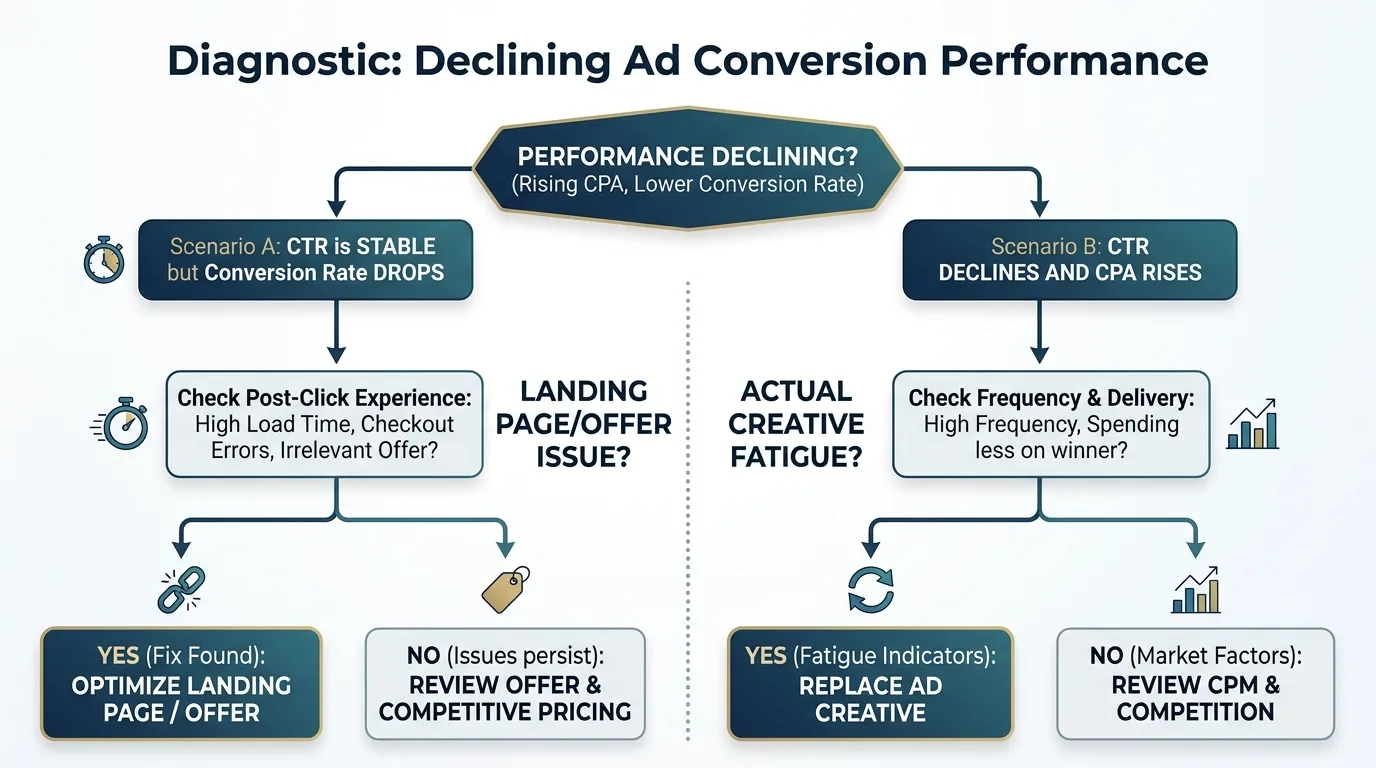
If CPM rises sharply across the account while engagement and conversion rates remain healthy, market conditions may be the issue. Holiday demand, competitor activity, and platform-level volatility can raise costs without making the creative less relevant. In that case, cutting a proven asset may reduce volume without improving efficiency.
Creative fatigue is more likely when frequency increases, engagement softens, and conversion efficiency declines on the same audience. It is especially common in narrow retargeting pools, local lead generation, and high-budget campaigns with limited audience expansion. Those programs need a deeper bench of angles and formats than broad prospecting campaigns.
Build a Refresh Cadence Around Spend, Not Opinion
High-velocity creative does not mean replacing everything every week. It means producing and testing enough variation that the account always has fresh candidates when performance changes.
A practical cadence starts with spend. The faster an account spends against a defined audience, the faster it should generate new concepts. A brand investing a few thousand dollars per month may need a structured creative batch every month or two. A business deploying significant daily spend across Meta, TikTok, Google, Taboola, and other channels may need new assets entering the account every week.
The operating principle is simple: creative production should run ahead of creative decay. If the team starts making new ads only after a major winner collapses, performance will fall during the production gap. That is how paid acquisition becomes reactive and unpredictable.
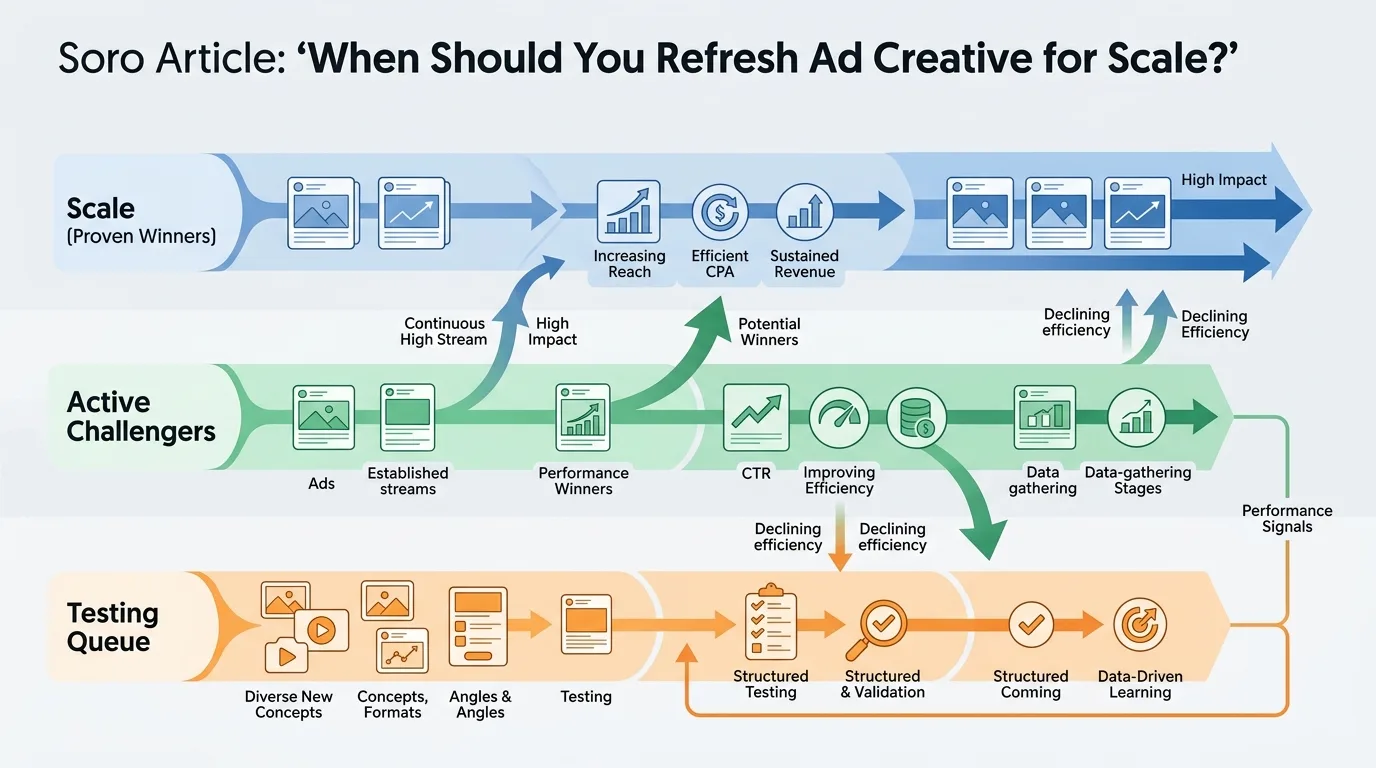
For each major campaign, maintain three groups of assets: proven winners receiving scale, active challengers gathering signal, and new concepts entering the testing queue. Winners should not be turned off merely because they are old. Keep them live while they remain profitable, then reduce allocation as challengers prove they can take over efficiently.
Refresh the Concept Before You Refresh the Color
Most weak refreshes are cosmetic. A new background color, a different opening frame, or a slightly revised headline can help extend an asset, but it rarely creates a new performance ceiling. If the audience has already absorbed the core message, minor design changes will not reset demand.
A useful refresh changes at least one meaningful variable: the audience problem, the promise, the proof, the mechanism, the offer framing, or the format. For example, an ecommerce brand can move from a product demonstration to a customer objection, an expert explanation, a comparison, or a social proof-led story. A lead generation advertiser can test urgency, cost avoidance, qualification, outcome proof, or a different pain point.
This is why creative testing needs a concept library, not just a folder of exports. Tag each asset by angle, hook, offer, format, audience, and funnel stage. Over time, that system reveals which messages drive efficient scale and which visual patterns are merely decoration.
Keep winners intact while testing challengers
Do not edit a winning ad until you can no longer measure what made it work. Create a distinct variant instead. Preserve the original control, isolate the major change, and give the challenger enough budget to produce a credible read.
This matters most when an ad is carrying meaningful revenue. Replacing a winner with an unproven update creates a false choice between freshness and scale. You can have both by using controlled testing and deliberate budget allocation.
The right test volume depends on account size, but the logic stays the same. Test enough creative to find the next winner without spreading budget so thin that no asset receives useful signal. A large account can support multiple angles, formats, and audience-specific versions at once. A smaller account should prioritize fewer, higher-conviction concepts.
Channel Differences Change the Refresh Plan
Creative wearout does not look identical across platforms. Meta and TikTok often reveal fatigue through frequency, declining engagement, and slowing conversion efficiency. Short-form video also has a fast-moving native language, so format fatigue can arrive before message fatigue.
Google Search is different. Ads may need refreshing when copy no longer reflects the offer, competitive positioning, or high-intent search behavior, but search demand is driven heavily by keyword intent and auction dynamics. Display, native, and Taboola placements tend to reward a larger volume of headline-image combinations and regular angle rotation.
Platform Comparison: Social vs. Search & Display Refresh Strategies
| Channel Type | Primary Wearout Signals | Key Refresh Triggers | Optimal Cadence |
|---|---|---|---|
| Paid Social (Meta, TikTok) | High frequency, declining hook/hold rates, rising CPA | High frequency + declining conversion efficiency | Weekly to bi-weekly batches |
| Search & Display (Google, Taboola) | Low CTR, outdated copy, shifts in competitor bids | Changes in product offers or search intent trends | Monthly or seasonal updates |
Do not force one creative cadence across every channel. Use one reporting framework and one source of truth, then apply channel-specific thresholds for saturation, spend, and acceptable efficiency. Integrated media and creative management makes this easier because the people reading performance data are also directing the next production batch.
Measure Refreshes Against Business Outcomes
The goal of a creative refresh is not novelty. It is profitable growth. That means evaluating new ads against the metric that governs scaling: contribution margin, cost per qualified lead, first-purchase profitability, subscription payback, install-to-purchase rate, or another validated business KPI.
Set a baseline before launching the test. Define the minimum spend, conversion volume, and decision window needed to call a result. Then document what happened. Did the new hook reduce CPA? Did a new customer proof angle improve lead quality? Did the format earn cheaper clicks but lower conversion rates? Those answers should shape the next round of production.
The fastest teams do not treat a refresh as a one-time rescue mission. They turn every result into a clearer hypothesis, build the next batch from that insight, and keep the account supplied with challengers before the current winners lose momentum. That is how creative becomes an acquisition system rather than a recurring emergency.