
A paid social account can have a capable media buyer, a healthy budget, and clean tracking - then stall because the creative system cannot produce enough meaningful tests. That is the gap the best performance creative agencies are built to close. They do not simply make ads that look polished. They create, launch, measure, and replace ads fast enough to keep acquisition moving.
For growth teams, selecting an agency is not mainly a portfolio exercise. It is an operating-model decision. The right partner gives your team more shots on goal, clearer insight into why ads are winning, and a controlled path from early tests to profitable scale. The wrong one adds meetings, waits for approvals, and calls a handful of monthly deliverables a testing program.
Performance creative is not traditional creative
Traditional creative agencies are often optimized for campaigns, concepts, and brand consistency. Those capabilities have value, especially when a company is defining its category or refreshing its identity. But paid acquisition has a different job. It needs a steady supply of ads designed to answer specific performance questions.
Traditional vs. Performance Creative Agencies
| Dimension | Traditional Creative Agency | Performance Creative Agency |
|---|---|---|
| Primary Goal | Brand awareness and concept polish | Measurable acquisition and ROAS |
| Output Velocity | Campaign-based (monthly/quarterly launches) | Continuous testing (weekly batch releases) |
| Key Metrics | Reach, impressions, brand recall | CPA, CAC, MER, contribution margin |
| Iteration Process | Long approval cycles, fixed assets | Rapid variation based on performance data |
Will a founder-led hook outperform a product demonstration? Does a problem-first angle reduce cost per lead? Which benefit matters most to a new audience? Does a short-form video convert better with a direct offer or a story-driven setup?
A performance creative agency should turn those questions into controlled tests, then use the results to decide what gets more spend. The objective is not to find one magical ad. It is to build a repeatable system that finds winners, creates informed variations, and retires fatigued concepts before they drain budget.
That requires creative strategy and production, but it also requires media buying discipline. Creative data without clean campaign structure is hard to trust. Media buying without a reliable creative pipeline eventually runs out of momentum. When those functions sit in separate organizations, teams often spend weeks debating results that should have been obvious in reporting.
What separates the best performance creative agencies
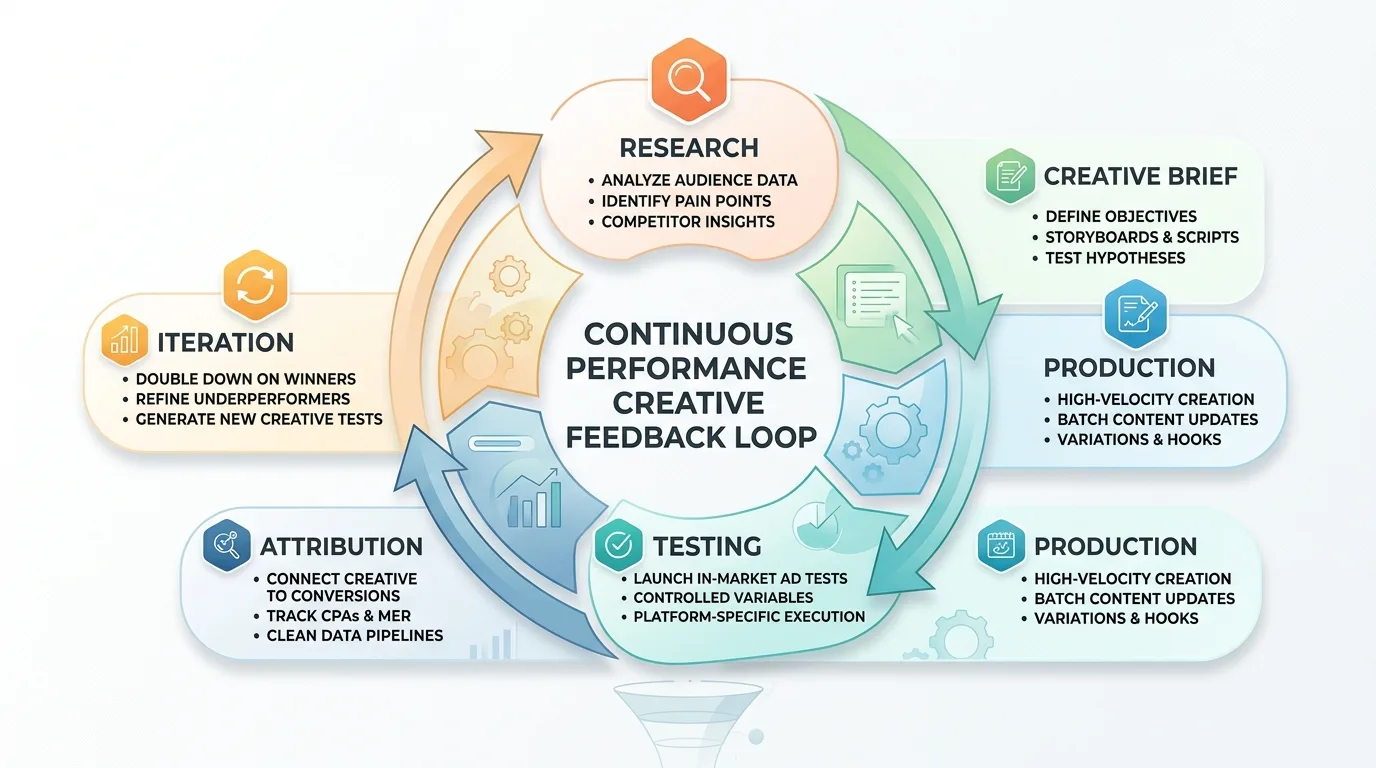
The strongest agencies make their process visible. They can explain how work moves from research to briefs, production, launch, analysis, and iteration. More importantly, they can show where accountability sits when performance changes.
Testing velocity with a reason
Volume matters, but random volume is waste. An agency that sends 50 loosely related ads into an account has created more noise, not more learning. Ask how it develops a test matrix and how it distinguishes a new concept from a minor variation.
A useful creative test usually isolates a meaningful variable: the audience pain point, the hook, the offer framing, the visual mechanism, the spokesperson, or the proof element. Once a concept works, the agency should know how to expand it without confusing the data. That might mean producing multiple openings around the same core promise, adapting the winner for TikTok and Meta, or pairing the proven message with a stronger call to action.
Speed still matters. If it takes three weeks to turn a performance insight into a live test, the account loses ground. Look for an agency with a defined production cadence, clear approval paths, and enough internal capacity to act on what it learns.
Media and creative under one performance system
The best performance creative agencies treat the ad and the delivery system as one unit. They understand that an excellent creative concept can fail if it is launched into the wrong audience, evaluated too early, or constrained by poor budget allocation. They also know that a low-cost ad is not automatically a good ad if it attracts low-intent traffic or weak downstream conversion.
This is especially important across multiple channels. Meta, Google, TikTok, Taboola, and native placements each create different creative demands. The message may travel, but the execution should change based on user behavior, placement constraints, and the stage of intent.
An integrated partner can make those adjustments quickly because the people reading platform signals are connected to the people making the next batch of creative. That shortens the distance between insight and execution.
Reporting that leads to decisions
Most teams do not need another dashboard full of vanity metrics. They need to know which ads are producing profitable customers, what patterns are emerging, and what will be tested next.
Ask to see the agency’s reporting logic. Can it connect creative performance to the metrics that matter to your business, such as qualified leads, purchases, subscriptions, retention, or contribution margin? Does it explain spend shifts and performance changes in plain language? Can it separate a true creative winner from an ad that benefited from a temporary audience or placement advantage?
Clear reporting is also a sign of operational maturity. Agencies managing high testing volume need systems that keep naming, asset tracking, campaign launches, and performance data organized. Without that foundation, scale becomes chaos and useful learning gets lost.
Commercial alignment beyond ad spend
Be careful with incentives. An agency paid primarily as a percentage of spend may still be excellent, but the model deserves scrutiny. More spend is not the same as more profit. Your partner should be able to talk comfortably about efficient scale, marginal returns, and when to reduce spend rather than force volume through a declining campaign.
The right compensation structure depends on your business, tracking maturity, margins, and sales cycle. A lead generation company with offline conversion data may need a different model than an ecommerce brand with same-day purchase feedback. What matters is whether the agency’s incentives reinforce the outcome you are trying to achieve.
Questions to ask before you sign
A confident agency should answer operational questions without hiding behind vague strategy language. In a selection process, ask how many new concepts and variations it can produce in a typical month, who owns final launch QA, and how quickly it can react when a winner emerges.
Agency Vetting Checklist
- Clarify monthly concept and variation production volume.
- Identify who owns campaign launch QA and asset naming consistency.
- Confirm turnaround time for iterating on winning creative concepts.
- Evaluate how performance winners are defined beyond vanity metrics.
- Review communication rhythms, review meetings, and approval workflows.
Also ask how it defines a winner. Some teams optimize for thumb-stop rate, click-through rate, or cost per acquisition in isolation. Those signals can be useful, but none should override business economics. A strong partner will explain the leading indicators it watches while remaining accountable to the conversion event and revenue quality that actually matter.
Request examples of how the agency handled creative fatigue, a scaling plateau, or a major performance decline. The answer will reveal more than a polished case study. You want to hear a practical sequence: diagnose the issue, check tracking and delivery variables, review creative patterns, launch prioritized tests, and document the result.
Finally, clarify the working rhythm. High-velocity performance work requires decisive communication. Find out who attends weekly reviews, how feedback is captured, how approvals are managed, and what happens when stakeholders disagree. An agency can have strong talent and still fail if the client-agency process turns every new test into a committee decision.
When a specialist agency is the right choice
A specialist performance creative partner is most valuable when paid acquisition is material to growth and the internal team cannot keep up with the required volume or coordination. This is common for ecommerce brands scaling on Meta and TikTok, lead generation businesses buying across paid social and native, publishers managing large campaign portfolios, and subscription companies constantly fighting fatigue.
It may be less necessary for a company running a small, stable paid budget with little need for iteration. In that case, an internal generalist or a narrow media buying engagement may be enough. The economics have to justify the operating complexity.
For teams already spending heavily, the question is usually not whether they need more creative. It is whether they can turn creative output into reliable learning. Conversion Collective approaches that problem as a managed growth function: high-volume production, disciplined media execution, and centralized systems designed to identify winners without losing control of the account.
Choose an operating system, not a vendor
The agency you hire will influence how quickly your business learns from paid media. That is why the decision should come down to more than creative taste, channel badges, or a promising first deck. Look for a partner that can produce at pace, test with intent, connect results to profit, and make the next decision easier than the last.
The useful question is not, “Can this agency make ads for us?” Ask whether its team and systems can help your acquisition engine respond faster every time the market, audience, or platform changes.