
A paid acquisition program rarely stalls because a team has no creative ideas. It stalls because the team cannot turn ideas into live tests fast enough. Knowing how to improve creative throughput means building an operating system that moves from market signal to production to launch to decision without unnecessary handoffs, rework, or reporting delays.
For growth teams spending meaningful budget across Meta, Google, TikTok, Taboola, and other channels, creative throughput is not a design metric. It is a revenue lever. More relevant tests create more chances to find a winner. Faster feedback prevents weak concepts from consuming budget for weeks. The objective is not to publish more ads for the sake of activity. It is to produce a consistent flow of differentiated, testable creative that media buyers can evaluate and scale with confidence.
Start With the Real Constraint
Most teams assume the bottleneck is production capacity. Sometimes it is. More often, the constraint appears earlier: unclear priorities, weak briefs, slow approvals, scattered performance data, or a media team that cannot explain why an ad worked.
Before hiring more editors or designers, map the path from a new insight to a live campaign. Measure the time spent at each stage: research, briefing, scripting, production, review, launch, and performance readout. Then identify where work waits. A three-day edit cycle is not the problem if a concept sits in approval for nine days.
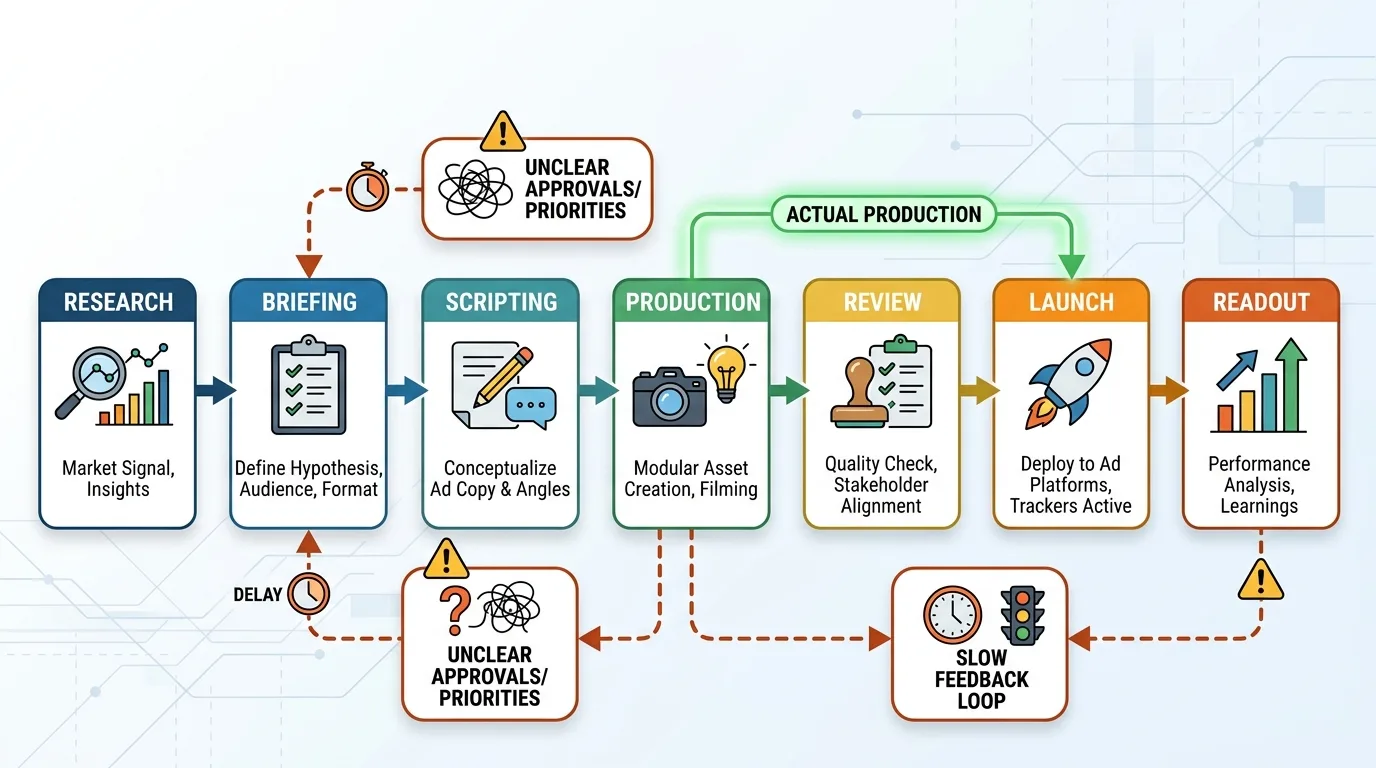
This audit should also separate necessary quality control from habitual friction. Brand review may be essential for regulated products or established consumer brands. But requiring five stakeholders to approve every hook variation is usually a throughput problem disguised as governance.
Build a Creative Input System, Not an Idea List
High-volume output starts with high-quality inputs. A generic request for “more UGC” or “new statics” forces the creative team to fill in strategic gaps on its own. The result is often polished work that repeats the same message, audience, and visual pattern.
Every creative request should begin with a testable hypothesis. Define the audience or awareness level, the message to test, the format, the desired action, and the performance signal that will determine whether the test moves forward. For example, instead of requesting five new video ads, specify that the team is testing a founder-led proof angle against a customer-led outcome angle for cold audiences who have not yet encountered the offer.
Strong briefs are short, but they are not vague. They give producers room to execute while making the learning objective clear. Include the source of the insight, whether it came from comments, sales calls, landing page behavior, competitor patterns, or prior ad results. When the creative team knows what it is trying to disprove or validate, production becomes faster and variation becomes more useful.
Organize Production Around Modular Assets
Throughput falls when every ad is treated as a one-off project. That approach creates excessive setup work and makes iteration expensive. A better model is to build modular creative components that can be combined into purposeful variations.
For video, this may mean maintaining approved libraries of hooks, product demonstrations, creator footage, social proof clips, CTAs, captions, and end cards. For static ads, it means reusable design systems, image treatments, testimonial layouts, offer treatments, and headline structures. The point is not to make every ad look identical. It is to avoid rebuilding the parts that do not need to be rebuilt.
Modularity also improves testing discipline. If you change the hook, spokesperson, offer, format, and landing page at the same time, the result tells you very little. A component-based workflow makes it easier to isolate meaningful variables while still producing enough volume to keep accounts fresh.
There is a trade-off. Templates can become a creative crutch if teams only swap headlines on the same tired design. Set a threshold for when a winning structure deserves more variants and when fatigue or performance decline requires a net-new concept. Scale repeatable production, not repetitive thinking.
Create Separate Lanes for Iteration and Net-New Concepts
A mature creative pipeline needs two distinct workstreams. One lane iterates on existing winners. The other develops new angles, formats, and market narratives.
Iteration is where much of the efficient scale comes from. If a video is producing profitable conversions, create versions with stronger openings, tighter edits, different proof points, additional creators, and audience-specific framing. Preserve the mechanism that is working while improving the parts that limit reach, attention, or conversion rate.
The net-new lane protects the account from creative fatigue and false confidence. Paid media environments change quickly. A winning testimonial format can decline because audiences have seen it too often, competitors have copied it, or the market has moved to a new concern. New concepts should draw from customer research, objections, reviews, sales language, landing page behavior, and category shifts, not just an internal brainstorm.
The right allocation depends on account maturity. A newer account with limited signal may need more broad concept exploration. An account with several validated winners may put more capacity into iteration. Neither approach works if it becomes permanent. Review the split regularly based on performance and how concentrated spend has become around a small number of ads.
Put Media Buyers Inside the Creative Feedback Loop
Creative and media cannot operate as separate services if the goal is profitable growth. The media team sees delivery patterns, CPM changes, placement behavior, audience response, conversion rates, and budget sensitivity. The creative team needs that context quickly enough to act on it.
A useful performance readout does more than label ads as winners or losers. It explains what happened. Did the ad earn low-cost attention but fail to convert? Did it convert well but struggle to spend? Did it work on Reels but not Feed? Did a particular hook improve thumb-stop performance while a proof point lifted downstream conversion? Those distinctions tell production what to make next.
Set a recurring feedback cadence, but do not wait for a weekly meeting when the account is moving quickly. Clear dashboards and centralized campaign data let teams flag material shifts as they happen. Conversion Collective approaches creative and media as one operating system for this reason: launch speed matters, but the quality of the feedback loop determines whether speed creates learning or just more noise.
Reduce Launch Friction With Defined Rules
An excellent creative pipeline still breaks down if assets wait in folders, naming is inconsistent, campaigns are built manually, or no one knows who owns the launch. Standardize the last mile.
Use clear naming conventions that connect every asset to its concept, angle, format, audience, and version. Establish launch checklists for tracking, placements, copy, destination URLs, budget settings, and platform-specific requirements. Maintain a single source of truth for asset status so producers, buyers, and account leads are not working from competing spreadsheets.
Approval rules deserve the same discipline. Decide what requires legal or brand review, what can be approved by a single owner, and what can launch under pre-approved guardrails. If every small test needs executive review, the business is choosing lower testing velocity. That may be appropriate for a high-risk claim or a major brand campaign. It is rarely appropriate for routine performance creative.
Measure Throughput by Learning, Not Asset Count
Counting delivered assets is easy, which is why teams rely on it. It is also incomplete. Twenty ads that test the same idea in slightly different packaging do not create twenty useful learning opportunities.
Track production volume, launch rate, time from brief to live, and the percentage of assets that reach a meaningful spend threshold. Then connect those measures to outcomes: how many new winning concepts were identified, how quickly winners were iterated, how much spend shifted toward validated creative, and how much waste was cut from weak tests.
A practical scorecard should reveal whether the system is moving. If output rises but launch rate falls, campaign operations are the constraint. If launch rate is high but few tests reach meaningful spend, targeting, budget allocation, or concept quality may be the issue. If winners are found but never scaled, the media strategy is leaving revenue on the table.
How to Improve Creative Throughput Without Lowering the Bar
The goal is not a content factory that floods ad accounts with interchangeable assets. The goal is controlled velocity: a pipeline that produces enough distinct creative to expose signal, enough structure to interpret that signal, and enough operational discipline to act before the opportunity disappears.
Start with one change that removes waiting time from the system. Tighten the brief, reduce an approval layer, standardize asset modules, or create a daily media-to-creative feedback channel. Then measure the effect on time to launch and quality of learning. Small operational fixes compound quickly when every improvement helps the next test reach the market faster.