
Most Facebook ad accounts do not have a targeting problem. They have a creative throughput and decision-making problem. Creative testing for Facebook ads is the operating system that turns spend into usable insight: which message earns attention, which format creates intent, which offer converts, and which ads can scale without eroding margin.
The difference matters. Publishing more ads is not a testing strategy. Neither is changing five variables at once and calling the best result a winner. A high-performing program creates enough focused variation to learn quickly, gives each test a fair opportunity to spend, and moves proven concepts into scale with control.
Why creative is the primary performance lever
Meta has steadily automated more of the mechanics that media buyers once controlled manually. Broad audiences, automated placements, and campaign-level budget allocation can work extremely well, provided the system receives strong creative inputs. The ad itself increasingly does the work of qualifying the audience, framing the problem, and persuading the click.
That means creative is not a finishing touch after media buying. It is a core acquisition lever. A new hook can open a larger qualified audience. A clearer proof point can improve conversion rate. A better first three seconds can lower the cost of reaching people who will actually engage.
Creative also has a shelf life. Frequency rises, competitors copy angles, and audience response changes. Even a profitable control can fade. Brands that wait for performance to break before producing new creative are already behind. The goal is to maintain a pipeline of new tests while scaling what is working.
Build a testing system before you build more ads
The most common failure is random iteration. A team sees weak results, requests “new creative,” receives several unrelated ads, and learns very little when one happens to outperform the others. That approach creates activity, not signal.
Start by defining the business event that matters. For ecommerce, that may be contribution-margin-adjusted new customer revenue. For lead generation, it may be qualified leads that reach a sales milestone, not raw form fills. For subscriptions or apps, it could be trial-to-paid conversion, predicted lifetime value, or an early retention signal.
Then organize creative around a testing matrix. The matrix should separate the components that influence performance: audience problem, hook, value proposition, offer, proof, format, visual treatment, and call to action. This lets the team test one primary hypothesis at a time while keeping enough consistency to interpret the result.
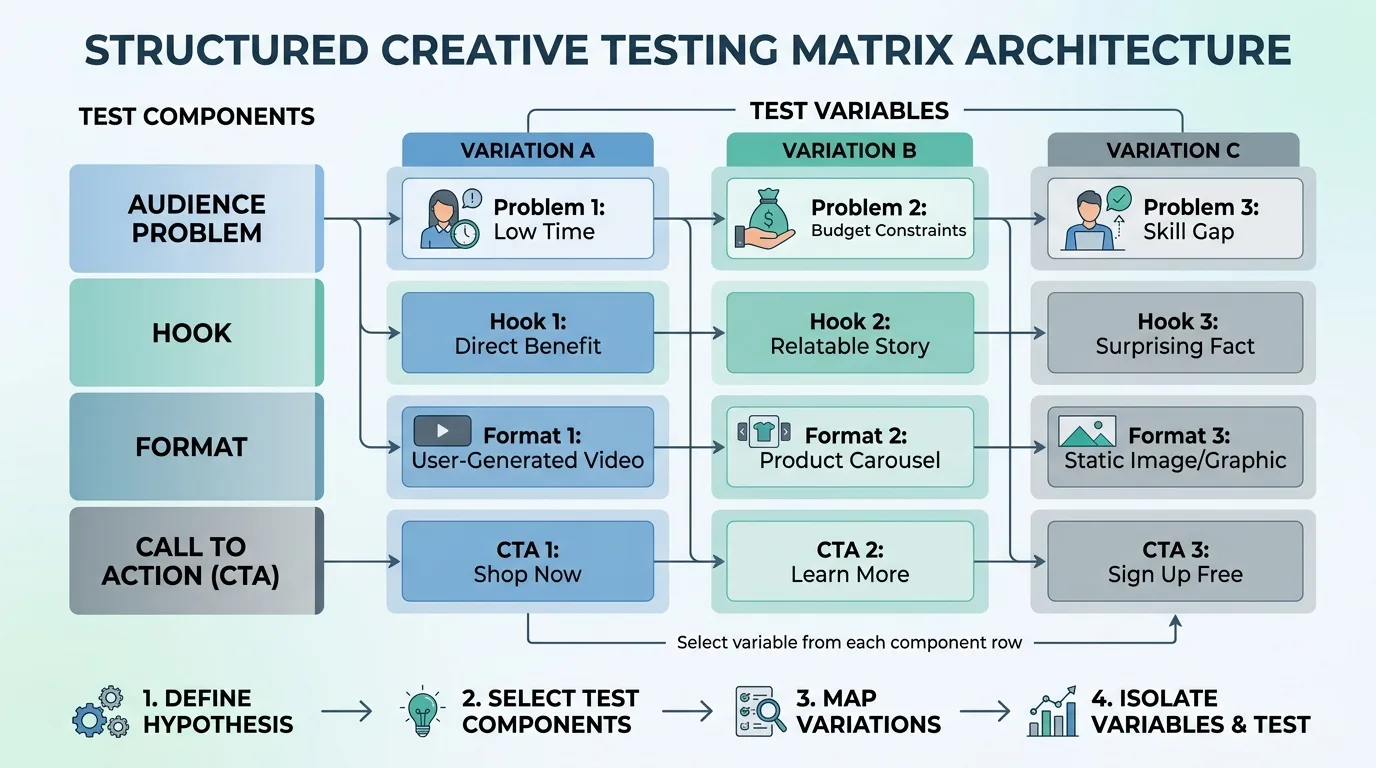
For example, a financial lead generation advertiser might test three distinct angles: speed of approval, monthly payment reduction, and expert guidance. Within the winning angle, the next round can test proof devices such as customer stories, calculator results, or lender credibility. Once the message is validated, test formats and executions to extend its reach.
This hierarchy prevents a costly mistake: abandoning a strong message because one execution underperformed, or scaling a flashy execution without understanding why it worked.
Separate concept testing from iteration
Concept tests answer bigger questions: What pain point is most valuable? Which buyer motivation creates the strongest response? Is the offer compelling enough to interrupt the feed?
Iteration tests improve a validated direction. They may change the opening line, spokesperson, edit pace, headline, product demonstration, or visual proof. Both matter, but they should not be mixed together in reporting. If every variation is labeled “Version 2,” no one can tell whether the account is improving because of a new concept or minor production changes.
Concept Testing vs. Iteration Testing
| Testing Type | Core Objective | Primary Variables | Key Metrics |
|---|---|---|---|
| Concept Testing | Validate new angles, hooks, and core messages. | Visual hook, problem frame, offer structure. | Outbound CTR, hook rate, CPA. |
| Iteration Testing | Optimize a proven creative direction. | Headline, CTA text, color palettes, background music. | Conversion rate, lower-funnel CPA. |
A useful naming structure records the angle, hook, format, offer, and version. It sounds operational, because it is. Clean naming turns ad-level data into a creative library the team can use six weeks later instead of rediscovering the same lessons.
How to structure Facebook ad creative tests
There is no single campaign structure that fits every account. Budget, conversion volume, sales cycle, and account maturity all affect the right setup. But the principle is consistent: isolate learning enough to make decisions, then consolidate enough to give delivery systems room to work.
For early concept tests, use a dedicated testing environment with controlled budgets and a clear set of competing ads. Avoid loading dozens of unrelated ads into one ad set with limited spend. Meta will quickly favor a small number of ads, leaving the rest without enough delivery to generate meaningful evidence.
Once a concept clears the performance threshold, move it into a scaling campaign where it can compete alongside proven controls. This is where broader audiences and more flexible budget allocation are useful. The test has earned more spend, and the objective shifts from finding a signal to validating durability.
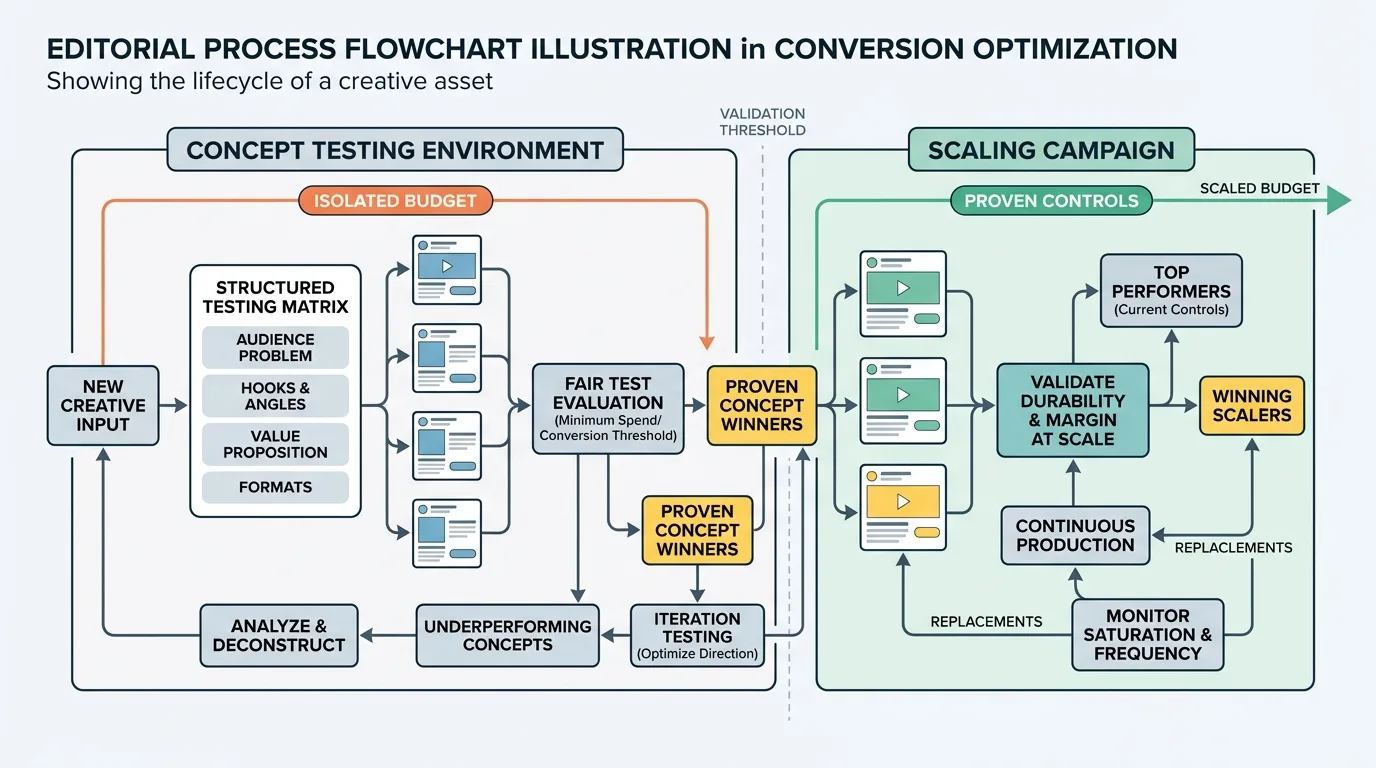
The right amount of control depends on spend. An account investing a few thousand dollars per month cannot support a complex, fragmented test matrix. It needs fewer, higher-conviction tests and longer evaluation windows. A high-spend account can run parallel concept, format, and offer tests because it can generate data quickly.
Do not confuse platform delivery preference with creative quality. If an ad receives limited spend in a crowded campaign, it may be a weak ad, or it may simply have lost the early delivery race. Structured testing exists to separate those outcomes.
Measure winners with business context
Click-through rate can identify whether a hook earns attention. Cost per click can reveal friction between ad and landing page. Conversion rate shows whether the promise holds after the click. None of those metrics alone defines a winner.
The decision should follow the economics of the business. A creative that produces cheap leads but weak sales quality is not a winner. An ad with a higher front-end CPA may be more profitable if it attracts customers with higher order values, lower refund rates, or stronger retention.
Set decision rules before launch. That includes the target CPA or return threshold, the minimum spend or conversion volume needed for review, and the secondary quality checks that must hold. Predefined rules reduce subjective decisions and stop teams from protecting ads they personally like.
Pre-Launch Creative Testing Checklist
- Define Target CPA: Establish the maximum acceptable cost per acquisition or minimum ROAS.
- Set Minimum Spend Threshold: Determine the budget or conversion volume (e.g., 50 conversions) required before making decisions.
- Identify Secondary Quality Metrics: Monitor retention rate, refund rates, or qualified lead milestones.
- Establish Evaluation Windows: Allow enough attribution time for standard sales-cycle delay.
- Document Predefined Rules: Lock in decision criteria in writing to prevent emotional or subjective bias.
Also distinguish between a testing winner and a scaling winner. A test winner beats its peers with enough evidence to justify the next round of spend. A scaling winner maintains efficient economics as budget rises. Some ads do both. Many do not. A concept that works at $100 per day may saturate or deteriorate at $1,000 per day, which is why validation after promotion matters.
Increase testing velocity without creating chaos
High velocity is not synonymous with high volume. It is the ability to move from insight to production, launch, readout, and the next decision without bottlenecks. That requires a connected creative and media workflow.
The strongest programs use weekly production rhythms. Media buyers share performance patterns with creative teams in a usable format: the hook that drove qualified traffic, the objections appearing in comments, the format that held attention, and the audience segment that responded. Creative teams convert those signals into focused briefs, not vague requests for more variations.
A practical testing backlog should include proven concepts that need fresh executions, strategic hypotheses that have not been tested, seasonal or promotional opportunities, and fatigue replacements for current spend leaders. Prioritize it by potential impact and confidence, not by who requested it most recently.
At scale, operational consistency becomes a competitive advantage. Clear briefs, standardized asset naming, launch checklists, centralized reporting, and campaign templates make it possible to test hundreds of assets without losing control of what is live or what has been learned. Systems such as Conversion Collective’s LaunchBox are built for this exact problem: managing campaign volume while keeping execution and data disciplined.
Common mistakes that waste Facebook ad spend
The first mistake is testing only surface-level changes. Swapping colors, captions, or music can be useful after a concept is proven, but it rarely creates a step-change in performance. Lead with meaningful differences in message, proof, or offer.
The second is declaring winners too early. A few conversions can be directionally useful, especially when budgets are constrained, but they are not certainty. Review results against spend, conversion volume, attribution lag, and downstream quality before shifting serious budget.
The third is treating every losing ad as a failed idea. A poor result may indicate a weak hook, unclear landing-page continuity, unsuitable format, or delivery issue. Capture the lesson at the component level. “Customer testimonial angle lost” is less useful than “testimonial opening lacked a specific outcome, while the same promise performed when stated upfront.”
Finally, do not let winning ads run untouched until they collapse. Monitor frequency, CPA trends, spend concentration, and engagement quality. Build replacements before the control is exhausted, then introduce them gradually so the account keeps learning while revenue stays protected.
The next profitable Facebook ad is rarely found through a single breakthrough asset. It comes from a disciplined loop: form a clear hypothesis, produce focused creative variation, give the test a fair read, and turn every result into the next stronger test. Build that loop well, and creative stops being a recurring fire drill and becomes a predictable growth engine.