
A campaign can show a lower CPA and still make the business less money. That happens when media teams optimize to the metric the platform makes easiest to see, while creative, offer economics, lead quality, and downstream conversion are treated as someone else’s problem. A profit focused ad agency is built to prevent that gap. Its job is not to buy more traffic. Its job is to build a paid acquisition system that can find, verify, and scale profitable demand.
For growth-stage businesses, that distinction becomes critical once spend is large enough for small mistakes to compound. A slow creative pipeline leaves winners running too long. Fragmented channel management creates conflicting decisions. Reporting that stops at clicks or platform ROAS hides whether new customers, leads, or subscribers are actually worth acquiring. Profitable growth requires operational control across the whole system.
What a Profit Focused Ad Agency Actually Optimizes
Profit is not a single dashboard number. It is the result of several connected decisions: who you target, what the creative promises, where you buy the impression, how quickly you test alternatives, and what happens after a prospect clicks. The agency should understand the client’s real economic constraint before it starts pushing budget.
For ecommerce, that may mean contribution margin after product cost, shipping, returns, discounts, and fulfillment. For lead generation, it may be qualified-lead rate, contact rate, close rate, and revenue per funded or closed deal. For subscriptions and apps, it may be trial-to-paid conversion, retention, payback period, and expected lifetime value. The right optimization target depends on the business model, but it must connect to value beyond the ad platform.
This does not mean every decision waits for perfect revenue data. That would slow testing to a crawl. Strong operators use leading indicators to make fast budget decisions while validating them against downstream outcomes. A new creative may earn additional spend because it improves cost per qualified lead. It becomes a genuine winner only when sales quality confirms the signal.
The practical question is simple: what metric tells you whether another dollar of spend creates more profitable growth? If the agency cannot answer that in plain language, its incentives and reporting structure need scrutiny.
Creative and Media Must Operate as One System
Many agencies separate creative production from media buying. One team delivers a batch of assets; another team launches them and reports on results. That model creates delay at exactly the point where speed matters most.
Creative is a targeting mechanism. A headline, opening frame, product angle, testimonial, offer, or call to action changes who responds to an ad. Media buying determines how efficiently those messages reach a viable audience. When both functions work from the same performance data, the team can turn performance signals into better tests quickly.
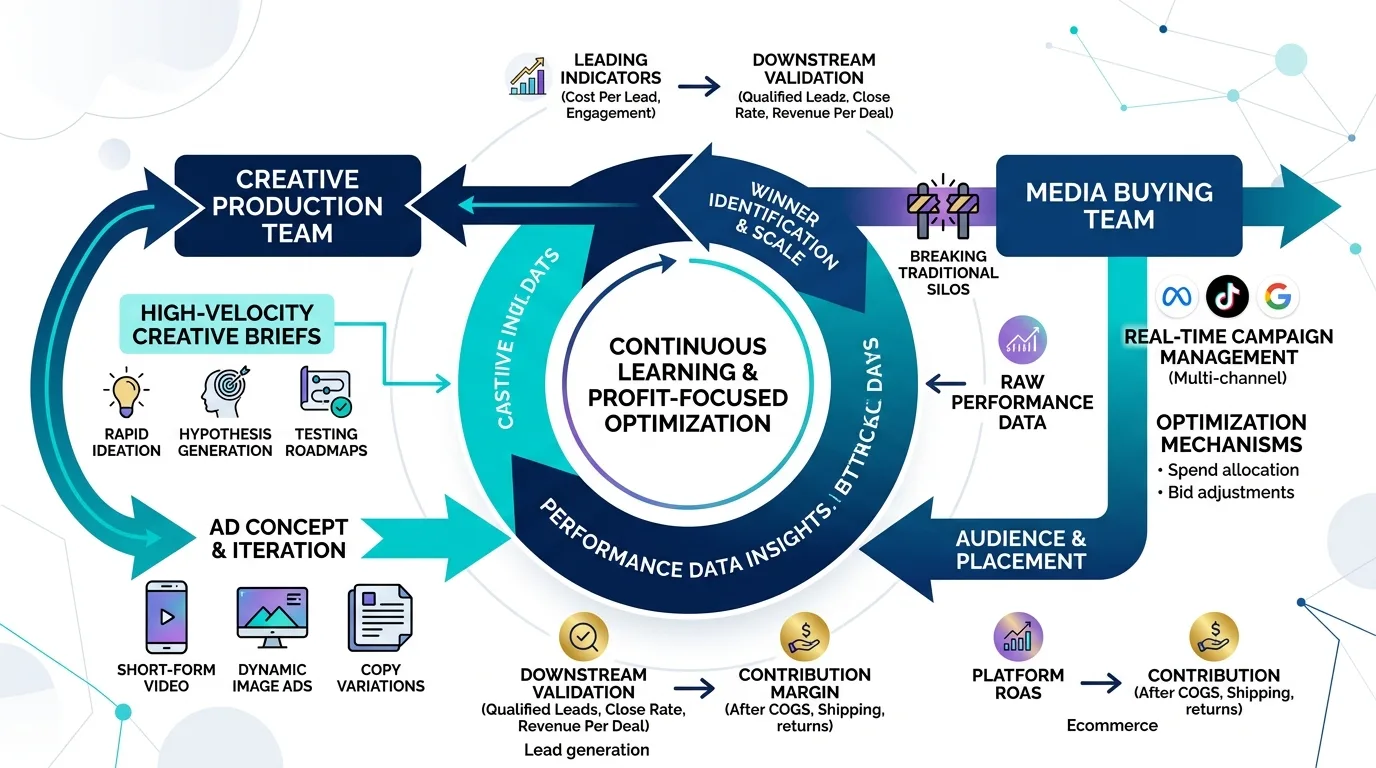
For example, if short-form video centered on a specific customer pain point produces lower-cost, higher-quality leads than feature-led ads, the next round should not be a cosmetic variation of the original. It should develop that angle across new hooks, creators, proof points, formats, and audience contexts. At the same time, the media team can identify whether the signal holds across Meta, TikTok, Google, Taboola, or another channel.
That is the advantage of testing velocity. The goal is not to generate a large volume of ads for its own sake. It is to create enough informed variation to isolate what drives response, then scale the winners before performance decays. High output without a testing framework creates noise. Low output with perfect production values creates stagnation. The useful middle ground is disciplined volume tied to clear hypotheses.
A winner needs a definition
An ad is not a winner because it has a high click-through rate, cheap CPM, or a strong first day. Those signals can be useful, but they are incomplete. A winner is an asset that performs against the business’s decision metric with enough spend and enough time to separate signal from randomness.
The definition should also account for durability. Some ads work briefly because they exploit novelty or a narrow audience pocket. Others can support meaningful scale across placements, audiences, and channels. A capable agency distinguishes between an interesting test result and a creative system worth expanding.
The Operating Model Matters More Than the Pitch
Most paid media problems are not caused by a lack of strategy slides. They come from inconsistent execution: campaigns launched with different naming conventions, creative feedback trapped in email threads, budget changes made without context, and reporting that arrives after the opportunity has passed.
A profit-focused partner needs an operating system. That means a repeatable process for intake, creative briefs, production, approvals, launches, test design, optimization, and performance review. It also means centralized campaign data, so decisions are based on the same definitions across teams and platforms.
At Conversion Collective, internal systems such as LaunchBox support consistent campaign execution at scale. The point is not the software itself. The point is control. When a team is managing hundreds or thousands of campaigns and creative variations, operational consistency protects both speed and spend.
Ask how an agency handles the work between the kickoff call and the monthly report. Who owns the testing roadmap? How are creative insights converted into new briefs? What triggers a budget increase, pause, or channel expansion? How quickly can a concept move from insight to live campaign? Specific answers matter more than broad claims about being data-driven.
Reporting Should Drive Decisions, Not Decorate Meetings
A polished dashboard can still fail the business if it does not tell the team what to do next. Reporting should make the current state of acquisition clear: where budget is going, what is improving, what is declining, which creative themes are producing quality, and where the next test should focus.
The best reporting connects platform metrics with business outcomes without forcing executives to sift through every campaign. Leadership needs a clean view of spend, acquisition volume, efficiency, and profit-oriented performance. The operators need enough detail to act on creative, audience, placement, and funnel signals.
There are trade-offs. Attribution is imperfect, especially when channels influence each other or conversion cycles are long. A platform may claim more credit than it deserves, while last-click reporting may understate upper-funnel work. The answer is not to pretend the data is exact. It is to establish a consistent measurement approach, use blended business metrics where appropriate, and make budget decisions with stated assumptions.
A credible agency will tell you when the data does not support a confident conclusion. That is accountability, not hesitation.
Compensation Should Not Reward Waste
Agency compensation shapes agency behavior. A percentage of ad spend can be simple, but it creates an obvious tension: the agency earns more as spending rises, even if marginal performance worsens. That does not make every spend-based agreement bad. It can work when there are strong guardrails, transparent targets, and a client who wants a stable operating structure.
But businesses focused on efficient acquisition should look for alignment beyond budget growth. A managed service structure tied to outcomes, performance targets, or profit-minded incentives better reflects the work required to scale responsibly. The precise model depends on data access, sales cycle length, margin visibility, and the level of agency control.
No compensation plan replaces management discipline. The agency should still have clear performance thresholds, regular business reviews, and the authority to cut wasted spend. Incentives help, but the operating cadence makes them real.
How to Evaluate an Agency Before You Commit
Start with the agency’s ability to explain its testing process. You should hear a concrete answer about creative volume, hypotheses, launch cadence, learning loops, and how it identifies winners. If the answer centers on vague optimization or proprietary secrets, expect limited visibility once the engagement begins.
Then examine channel capability in context. Being present on Meta, Google, TikTok, and native platforms is not enough. The team should know when each channel fits the offer, the creative requirements it introduces, and how performance will be measured across the mix. Expanding into a new channel before the existing acquisition engine is stable can create more complexity than growth.
Finally, evaluate the relationship as an extension of your growth function. The right partner brings speed, but it also brings order: a shared scorecard, a clear creative roadmap, a launch process that does not break under volume, and direct conversations when performance misses the mark.
Profitable paid acquisition is rarely the result of one clever campaign. It comes from a team that can keep producing better inputs, reading the right signals, and making disciplined decisions at the pace your market demands. Choose the agency that is prepared to do that work when the numbers are good, and especially when they are not.