
A paid acquisition program rarely breaks because a team lacks ideas. It breaks because the handoffs are slow, creative feedback arrives after budgets have moved, and media buyers are forced to optimize around incomplete signals. An integrated creative media system fixes that operational gap by treating creative, media buying, testing, and reporting as one performance engine.
For growth teams spending seriously across Meta, Google, TikTok, Taboola, and custom channels, this is not a branding preference. It is a control system for finding winners faster, scaling them with confidence, and cutting spend on ads that have stopped earning their place.
Why Separate Creative and Media Teams Lose Speed
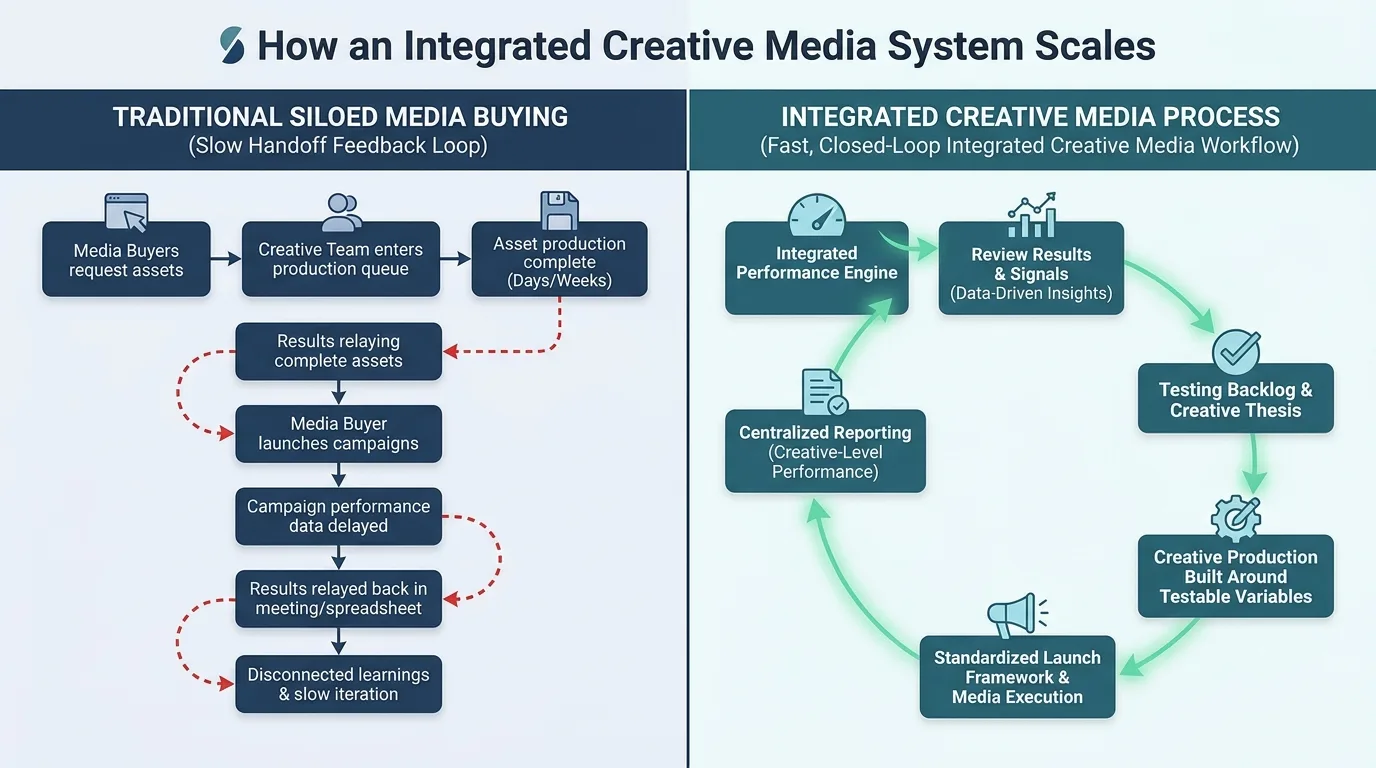
Most paid media teams still operate through a familiar chain: media buyers request assets, creative teams enter a production queue, campaigns launch days or weeks later, and performance results are relayed back in a meeting or spreadsheet. By the time the next round arrives, the market, audience saturation, or offer may have changed.
That model can work at low spend. It becomes expensive at scale.
Creative is not simply an input to media buying. It is one of the largest levers affecting CPM, click-through rate, conversion rate, and the volume of inventory a campaign can profitably access. A media buyer who sees a weak hook, a declining thumb-stop rate, or audience fatigue needs a new test quickly. A creative team that does not see placement-level results often keeps producing variations that look different but test the same underlying hypothesis.
The result is motion without learning. More assets get made, more campaigns get launched, and the account becomes harder to read.
An integrated model closes the loop. Creative decisions begin with media signals. Media structure reflects the testing plan. Reporting shows not just what spent money, but which message, angle, format, audience, and offer created the result.
What an Integrated Creative Media System Includes
An integrated creative media system is not a shared Slack channel between an agency and an in-house designer. It is a defined operating model with clear inputs, consistent naming, rapid production, disciplined launch processes, and centralized performance data.
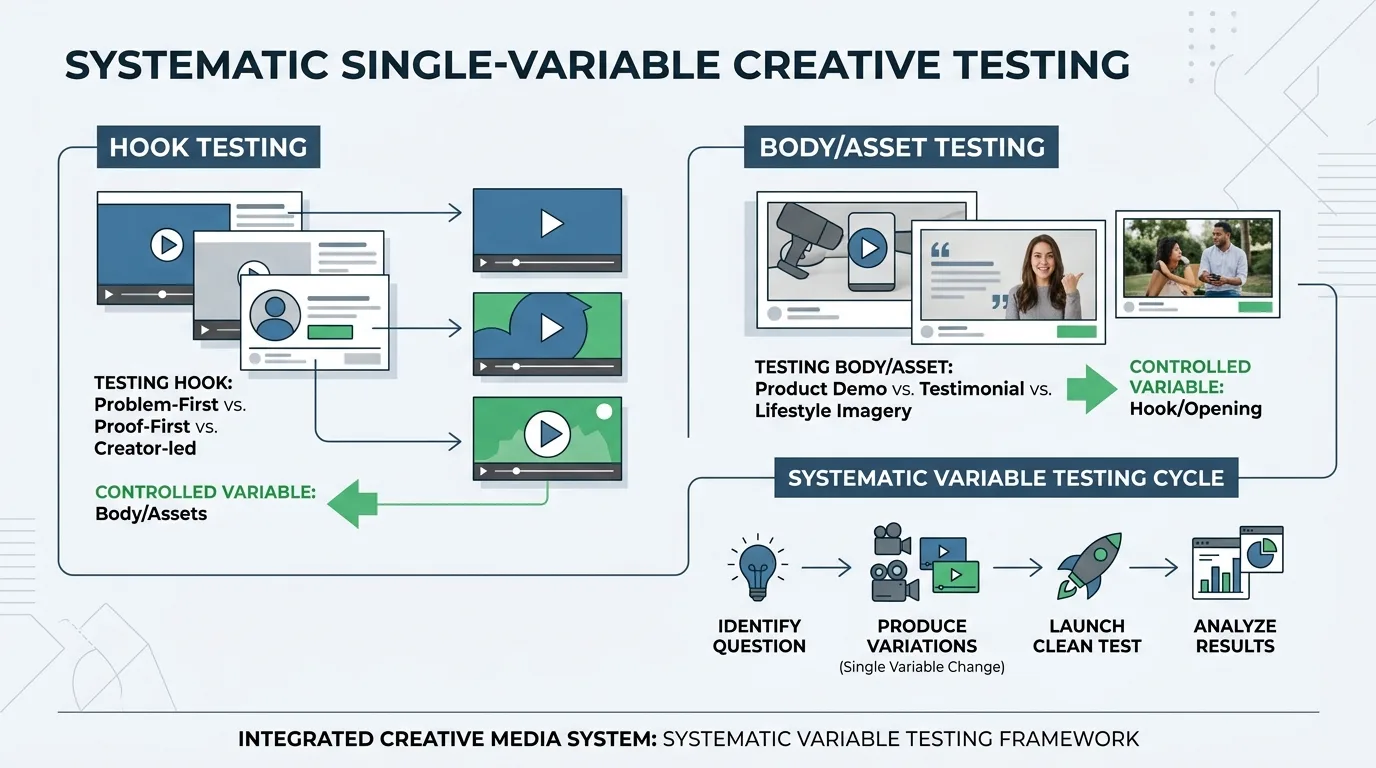
The system starts with a testing backlog. This is where the team translates performance questions into executable creative and media tests. Rather than asking for “more ads,” the backlog identifies what needs to be learned: whether a problem-first hook outperforms a proof-first hook, whether creator-led video can beat polished product footage, or whether a specific audience responds to urgency versus education.
Every test should have a reason to exist. The goal is not maximum creative volume for its own sake. The goal is enough quality variation to isolate meaningful performance signals before spend is wasted.
Creative Production Built Around Testable Variables
High-velocity production works when variation is intentional. A strong system can change one major variable at a time - the opening hook, core claim, visual format, proof element, offer framing, or call to action - while retaining enough consistency to understand why performance moved.
This does not mean every test must be scientifically perfect. Paid media is messy. Platform delivery changes, audiences overlap, and ads interact with one another. But teams still need a practical level of control. If ten new ads each change the hook, product, offer, format, and landing page message, a winning result teaches almost nothing.
The right creative mix depends on the business. Ecommerce brands may need frequent product demonstrations, testimonials, offer variants, and seasonal refreshes. Lead generation programs may need more angle testing around pain points, qualification, and form friction. Mobile apps often require a large volume of visual concepts that map to different user motivations. The common requirement is a production process tied to a clear testing thesis.
Media Buying That Preserves Learning
Campaign structure determines whether tests can produce usable answers. If new concepts are launched into inconsistent audiences, budgets, optimization events, and placements, the data becomes difficult to compare.
Media buyers need a repeatable launch framework: standardized naming, defined testing budgets, stable optimization settings, and rules for when an ad has earned more spend or should be cut. The exact thresholds vary by account. A subscription business with a long payback window cannot judge an ad the same way a low-ticket ecommerce offer does.
Still, every account needs decision rules. Without them, optimization becomes subjective. One buyer gives a weak ad more time because the creative looks promising. Another cuts a potential winner too early after a poor first day. Consistent rules create accountability while leaving room for experienced judgment.
Reporting That Connects Spend to Decisions
Reporting should not be a monthly recap of impressions, clicks, and platform-reported conversions. Those numbers matter, but they do not tell the team what to make next or where to allocate the next dollar.
Useful reporting connects creative-level performance to business outcomes. It shows which concepts are generating efficient acquisition, which formats are decaying, which channels are producing incremental volume, and where the bottleneck sits. Sometimes the problem is not media efficiency. It may be a landing page, an offer, a checkout flow, or lead quality after the initial conversion.
Centralized data also prevents a common scaling mistake: declaring an ad a winner based only on surface metrics. A high click-through rate can be worthless if it attracts low-intent traffic. Cheap leads can damage economics if sales-qualified rates collapse. The winning ad is the one that contributes to profitable growth, not the one with the prettiest dashboard metric.
How the System Runs Week to Week
The operating cadence matters as much as the strategy. High-performing teams run a continuous cycle: review results, identify the next questions, produce assets, launch clean tests, assess performance, and reallocate budget. The cycle should move fast enough to respond to changing conditions without creating chaos.
At Conversion Collective, this requires operational tooling that keeps campaign launches, creative versions, naming conventions, and performance data connected at high volume. When an account contains hundreds or thousands of campaigns, manual coordination is not a growth strategy. It is a source of avoidable errors.
A practical weekly review should focus on decisions, not presentations. Which creative angles are producing scalable economics? Which ads are losing efficiency because of fatigue? Which tests need more spend before the team can call them? What needs to be produced next to extend a winning message or replace declining inventory?
The answers should flow directly into production and media actions. If a testimonial format is working, the next move may be to test different customer profiles, stronger opening statements, or alternative proof points. If a static image is winning on Meta but not TikTok, the lesson may be channel-specific rather than universal. Scale comes from preserving that nuance instead of forcing one asset everywhere.
The Trade-Off: More Volume Needs More Discipline
More creative volume usually improves the odds of finding new winners. It also creates more complexity. Without standards, high-volume testing produces duplicate concepts, muddled reporting, inconsistent launches, and a backlog of ads nobody can evaluate properly.
That is why speed and control must increase together. Teams need asset libraries that make previous tests easy to find, clear ownership across production and media, and a shared language for creative concepts. They also need the discipline to retire losing ideas instead of keeping them alive because someone spent time making them.
The best system is not necessarily the one that produces the most ads. It is the one that produces the highest rate of useful learning per dollar spent.
When an Integrated System Matters Most
This approach becomes especially valuable when paid acquisition is a material growth channel, creative fatigue appears frequently, multiple platforms are in play, or internal teams are spending too much time coordinating vendors. It is also valuable when leadership cannot get a clear answer to a basic question: what is working, why is it working, and what should we test next?
Smaller teams may not need a complex operation on day one. A lean process with a focused test plan can be enough. But once spend, channel count, and creative demand rise together, fragmented execution becomes a tax on performance. The cost shows up in slow launches, missed learnings, weak attribution, and budget that keeps flowing to yesterday’s winners.
Build the system around decisions. Every asset, campaign, and report should help the team make the next allocation of time and spend with more confidence. That is how paid acquisition becomes easier to scale without becoming harder to manage.