A subscription business can have a strong offer, a functional checkout flow, and a healthy trial-to-paid rate yet still fail to scale because it puts the wrong message in the wrong channel. The best channels for paid subscription growth are not simply the platforms with the lowest cost per trial. They are the channels that produce subscribers who retain, renew, and generate payback inside the business’s required window.
That distinction changes the media plan. A $15 trial from one source is expensive if those users churn before month two. A $35 trial from another source may be highly profitable if it brings users with clear intent and durable retention. Channel selection needs to start with contribution margin and cohort quality, then work backward into audience, creative, bidding, and testing volume.
Start With the Subscription Economics, Not the Platform
Before assigning budget, define the acquisition target that the business can actually support. This means more than a target CPA. Model trial conversion rate, first-payment revenue, gross margin, expected retention, refund behavior, and the time required to recover ad spend. For annual plans, account for cash collected upfront but avoid treating every annual purchase as equally valuable when refund risk or early cancellation is material.
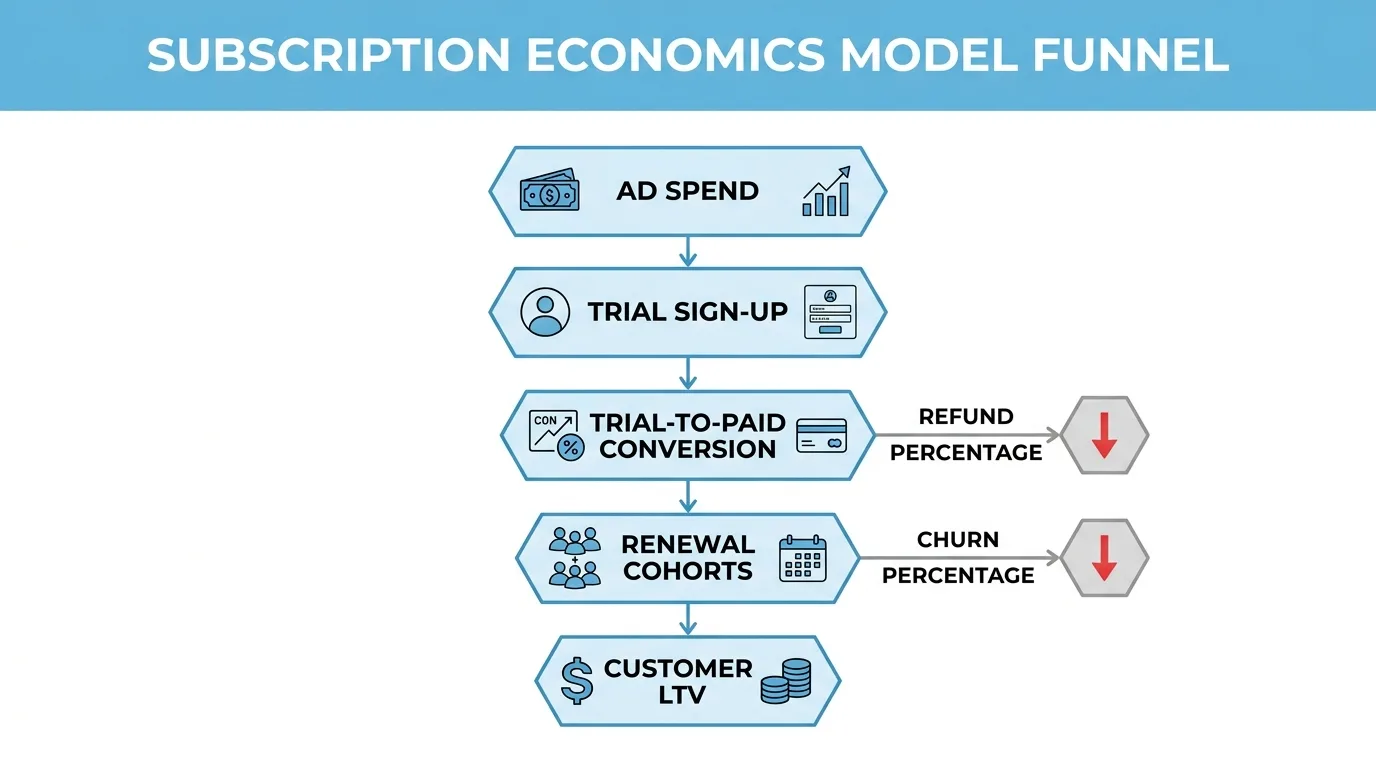
The operating metric should be a channel-level view of predicted or realized contribution margin, not a dashboard built around cheap clicks. Early-stage subscription brands may need to optimize to qualified starts or first purchases because retention data is immature. As cohorts mature, optimization should move toward downstream events: second payment, retained subscriber, predicted LTV, or a blended profit signal.
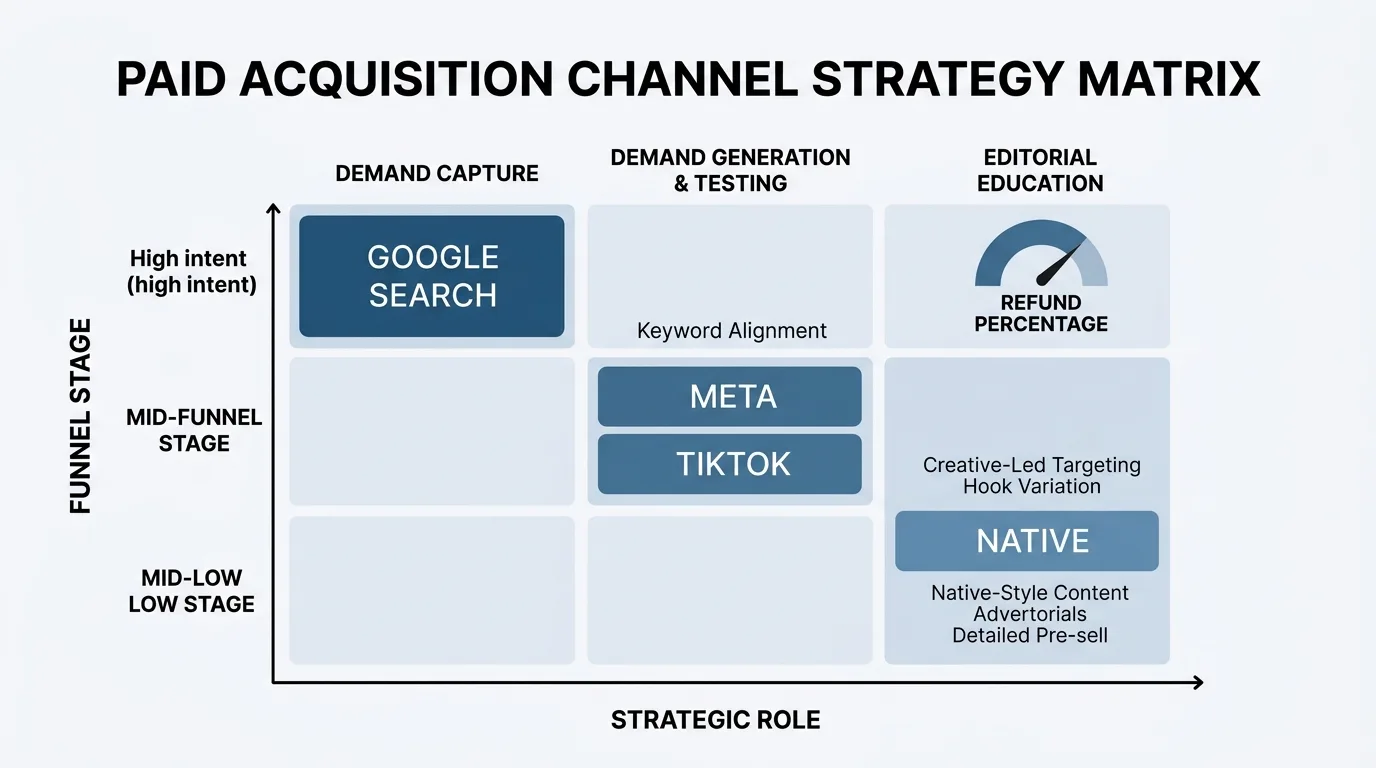
This is also where channel roles become clear. Search often captures existing demand. Social platforms create and shape demand. Native placements can scale editorial-style education. No channel should be judged by the same attribution window or expected conversion path.
| Channel | Primary Role | Intent Level | Optimization Strategy |
|---|---|---|---|
| Google Search | Demand Capture | High | Keyword alignment & frictionless checkout |
| Meta | Demand Gen & Testing | Medium-High | Creative-led targeting & hook variation |
| TikTok | Creative Discovery | Medium | Native-style content & routine demo |
| Native (Taboola) | Editorial Education | Medium-Low | Advertorials, quizzes & detailed pre-sell |
| YouTube | Visual Consideration | Medium | Visual demos, testimonial trust-building |
The Best Channels for Paid Subscription Growth
Google Search: High Intent, Limited Ceiling
Google Search is usually the first paid channel to validate for subscription offers with clear problem awareness. Someone searching for a meal plan, language-learning app, market intelligence service, or niche content subscription is already telling you what they want. The job is to align keyword, landing page, offer, and checkout path without adding friction.
Search frequently delivers strong first-purchase efficiency and better early retention because intent is explicit. It is especially valuable for brands with a differentiated category, a clear use case, and landing pages that answer the buyer’s immediate question. Brand search should be separated from non-brand campaigns so performance is not overstated by demand created elsewhere.
Its trade-off is volume. Search captures demand but rarely creates enough of it to carry an ambitious growth plan alone. Broad-match expansion and automated bidding can increase scale, but they need tight search-term review, clean conversion signals, and a clear view of incremental value. If a campaign claims every returning visitor who searches the brand name, it is not an acquisition engine.
Meta: The Core Testing Engine for Most Offers
Meta is often the highest-leverage growth channel for consumer subscriptions because it combines scale, mature optimization, and broad creative flexibility. It works when creative does the targeting work: identifying the audience, surfacing the pain point, demonstrating the product, and making the offer feel timely.
For subscriptions, the strongest ads generally do more than promote a discount. They establish the before-and-after outcome, explain why the product earns an ongoing place in the customer’s routine, and set realistic expectations around the trial or billing model. That reduces low-intent trial volume that looks good in a top-line report but damages payback later.
Meta performance is highly dependent on testing velocity. One polished founder video or a single winning static is not a system. Build multiple concepts around distinct angles, then produce meaningful variations in hooks, first frames, proof points, formats, offers, and calls to action. Scale proven concepts while fresh creative enters the account continuously. Creative fatigue is not a minor execution issue on Meta. It is often the primary constraint on growth.
TikTok: Efficient Discovery When the Creative Fits
TikTok can produce efficient subscription acquisition when the product benefits from demonstration, identity, routine, transformation, or social proof. It is particularly useful for wellness, education, productivity, content, and app-based offers where a customer can quickly show the product in use.
The platform rewards ads that behave like native content. Highly polished brand assets may underperform a direct, specific video that opens with a recognizable problem and shows a credible solution. That does not mean producing random creator-style content at volume without a performance framework. The concepts still need disciplined testing, clear offer disclosure, and an event strategy tied to subscriber quality.
TikTok’s trade-off is traffic intent. It can be excellent at creating initial interest, but some offers will see lower trial conversion or weaker retention than search or Meta. The answer is not to abandon the channel after one rough cohort. Break results down by creative angle, landing-page path, plan type, and user cohort. A practical use case may attract better subscribers than a broad aspirational message, even when its click-through rate is lower.
Native and Taboola: Scale the Education Layer
Native platforms such as Taboola are valuable when the buyer needs more context before committing. They work well for paid newsletters, research products, health and wellness subscriptions, financial education, and other offers where an advertorial, quiz, assessment, or detailed landing page can pre-sell the value.
Native traffic does not behave like search traffic. Users are in a content-consumption mindset, so direct-response creative needs a stronger bridge between the headline and the offer. The campaign has to earn attention, build belief, and then move the user into the subscription flow. Thin landing pages that jump straight from curiosity to checkout will usually waste spend.
This channel can offer meaningful scale once the message is proven, but quality control matters. Break out placements, monitor engagement and post-click behavior, and judge performance by downstream conversion rather than cheap sessions. It is a poor fit for offers that require instant trust but have no credible proof, explanation, or differentiated story.
YouTube and Custom Channels: Expand After the System Works
YouTube can be a strong expansion channel for subscriptions with a visual product story or a problem that benefits from explanation. The first five seconds must still create urgency, but the format gives marketers room to demonstrate use cases, show testimonials, answer objections, and build trust before the click. It is often more effective for consideration than last-click acquisition, so measurement should account for assisted conversions and lift.
Custom channels, including newsletters, podcast inventory, creator partnerships, and affiliate placements, can add profitable pockets of volume. They are not automatically scalable, and they can introduce attribution noise or low-quality incentive traffic. Treat them as controlled tests with defined tracking, placement-level reporting, and quality thresholds. A partner channel that delivers subscribers with strong retention deserves more investment. One that merely produces cheap trials does not.
Build a Channel Mix Around Roles
The common mistake is forcing every platform to hit the same CPA target at the same attribution window. That approach starves demand-generation channels and overfunds bottom-funnel demand capture until the account runs out of room.
A stronger operating model gives each channel a job. Search captures high-intent demand. Meta and TikTok create demand and rapidly test new messages. Native content educates audiences who need more proof. YouTube expands consideration. Retargeting converts qualified visitors and trial users, but should remain controlled so it does not inflate reported performance by claiming conversions driven by prospecting.
Budget allocation should shift based on marginal performance, not platform preference. When Meta has a winning concept with stable payback, increase spend while monitoring auction costs, frequency, and cohort quality. When search impression share is constrained by budget on high-value non-brand terms, fund it. When a new channel is still learning, cap the test long enough to collect meaningful conversion data instead of reacting to two days of noise.
The System That Makes Channels Profitable
Channel strategy breaks down when creative, media buying, landing pages, and reporting operate as separate workstreams. Subscription growth requires one feedback loop. Media data should identify which audiences and angles are producing qualified starts. Creative teams should turn those findings into new concepts quickly. Landing pages should reinforce the promise made in the ad. Retention data should expose where the acquisition message is attracting the wrong customer.
Create a testing cadence that is realistic for spend level. Each test should have a clear hypothesis: a pain-led hook will outperform a feature-led hook for annual-plan purchasers; a quiz flow will produce higher trial quality than a direct checkout flow; a price anchor will improve conversion without increasing refunds. Track the result, decide what changed, and use the learning to launch the next round.
Speed matters, but undisciplined volume creates chaos. Campaign naming, creative taxonomy, clean event tracking, and centralized reporting make it possible to see winners early and cut wasted spend before it compounds. This is the operating discipline that turns a collection of ad accounts into a paid growth engine.
The right next move is rarely to add every platform at once. Identify the channel where your offer has the strongest evidence of fit, build enough creative volume to test it properly, and measure the subscribers it produces after the first conversion. Scale from that truth, not from the cheapest number in the dashboard.