
A subscription business can report a strong acquisition month while quietly creating a retention problem that will show up two quarters later. That is why subscription business paid media cannot be managed like a standard ecommerce campaign. The job is not simply to buy the cheapest first conversion. The job is to acquire customers whose future revenue supports the cost of acquiring them.
The difference changes how you evaluate creative, structure campaigns, set bids, read platform signals, and decide when to scale. A low introductory-price CPA can look like a win until refunds climb, first-bill churn accelerates, or paid members fail to reach a second renewal. Efficient paid growth starts when media buying is connected to the full subscriber journey.
Subscription Business Paid Media Starts With the Right Economics
CAC is necessary, but it is not a complete decision metric. A subscriber acquired for $40 is only more valuable than one acquired for $65 if the lower-cost cohort produces enough retained revenue and contribution margin to justify the difference.
The operating model needs a few clear numbers: first-purchase revenue, gross margin, trial-to-paid conversion rate, refund rate, retention by billing cycle, and projected lifetime value by acquisition source. For annual plans, payback may be visible quickly. For low-priced monthly plans, the business may need several renewal cycles before it knows whether a cohort is truly profitable.
This does not mean waiting six months to make every media decision. It means using leading indicators that have a proven relationship to long-term value. If subscribers who complete onboarding in their first three days retain at twice the rate of those who do not, onboarding completion belongs in the acquisition dashboard. If a specific offer attracts unusually high cancellation rates before the second charge, that signal should influence how much budget the campaign receives.
The goal is a practical measurement ladder. Optimize early campaigns against the conversion event the platform can learn from, then validate that result against downstream quality data as cohorts mature. Media platforms need volume and speed. Finance needs confidence in payback. A strong operating system gives both teams a shared version of the truth.
Stop Treating the Offer as a Footnote
For many subscription brands, the offer drives performance as much as the ad itself. A seven-day free trial, a $1 first month, a discounted annual plan, and a paid trial are not minor variations. They attract different customer motivations, create different friction points, and can produce very different retention profiles.
A deep discount may increase front-end conversion volume, especially on broad social audiences. It can also train customers to value the promotion more than the product. A paid trial can reduce conversion volume while improving commitment and lowering refund risk. Annual plans can improve cash flow and shorten payback, but the higher price point may require more education and stronger proof before conversion.
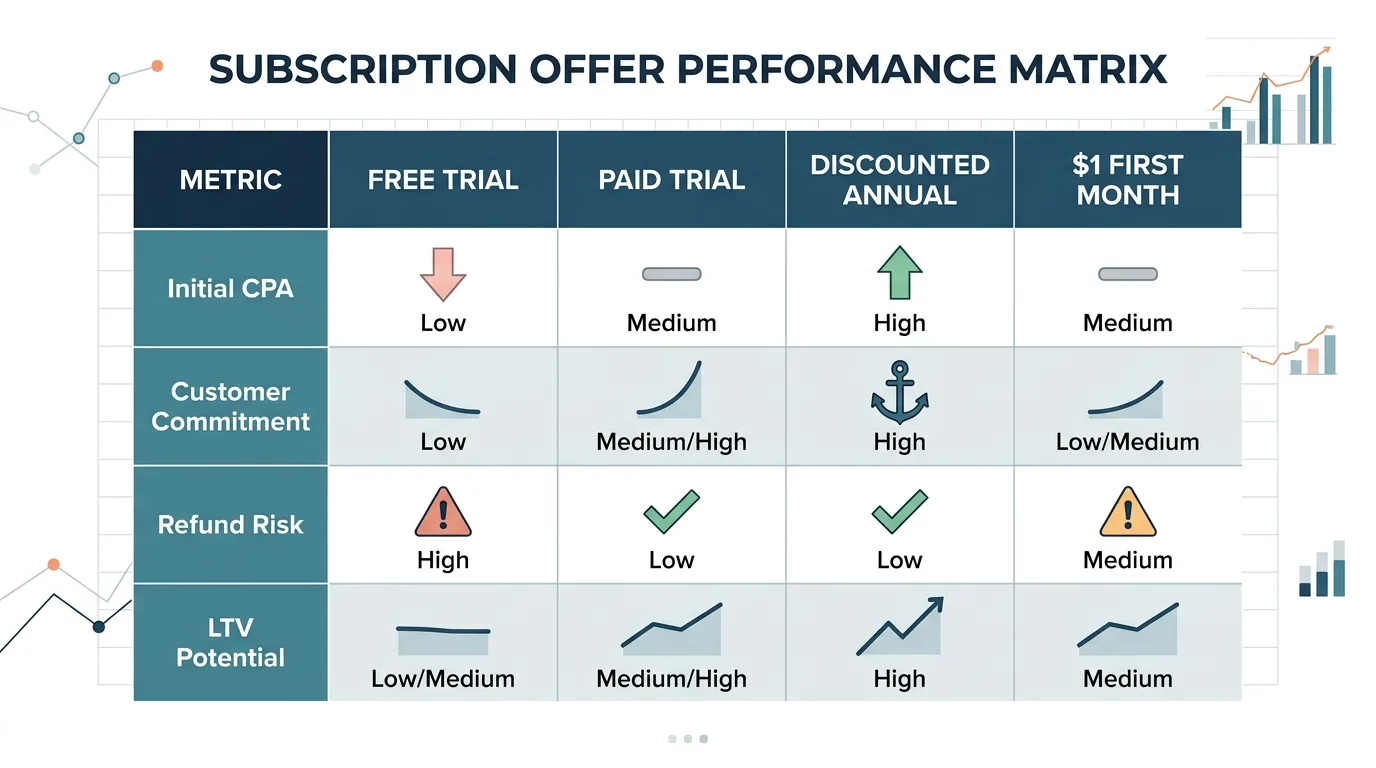
Test offers with the same discipline used for creative. Hold the audience and core landing page experience as steady as possible, run enough spend to reach a meaningful read, and evaluate results beyond the initial conversion. The winning offer is not always the one with the lowest CPA. It is the one that produces the strongest contribution margin over the period that matters to the business.
This is especially relevant when acquisition teams are pressured to hit a weekly new-subscriber number. Volume targets without quality guardrails invite bad decisions. Every growth team should know which offers can scale profitably, which are useful only for reactivation or remarketing, and which should be retired even if they produce attractive top-line dashboard results.
Build Creative Around the Subscription Decision
Subscription creative has to sell the product and the commitment. That means addressing more than a feature list or a one-time purchase benefit. Prospects are deciding whether the product will keep earning a place in their budget.
The most effective creative programs test multiple angles, not just multiple edits of the same ad. A practical testing slate might include problem-aware ads, product demonstration, customer proof, comparison messaging, price-value framing, founder-led education, and urgency tied to the offer. Each angle should answer a different objection or appeal to a different motivation.
For example, a wellness app may find that one audience responds to a clear routine and visible progress, while another responds to expert credibility and the cost of avoiding a larger health problem. A digital publisher may see one creative theme win on authority and exclusive reporting, while another wins on utility such as market alerts or research tools. These are different acquisition narratives, not cosmetic variations.
High testing velocity matters because creative fatigue is a subscription growth tax. Once an ad has reached the most responsive audience, frequency rises and efficiency erodes. Teams that wait for fatigue to become obvious are already late. They need a pipeline of new concepts entering the account before the current winners lose momentum.
Creative production and media buying should operate as one system. Media data should identify which hooks, formats, audiences, and claims are generating quality subscribers. Those insights should determine the next batch of ads. When creative and buying sit in separate workflows, learning slows down and spend stays attached to stale assumptions.
Give Each Channel a Clear Job
A cross-channel mix works best when each platform has a defined role in the growth engine. Meta and TikTok are often strong discovery environments, where visual proof, relatable use cases, and native creative can create demand at scale. Google Search can capture active intent from people already looking for a solution, competitor alternative, or category. Taboola and other native placements can work well when the product needs more education before the subscription decision.
The right mix depends on category maturity, price point, creative assets, and demand capture opportunity. A highly searched software category may justify serious Search investment from the start. A new consumer subscription that requires category education may need social and native channels to create demand before Search can absorb meaningful budget.
Do not force every channel to hit the same CPA target on day one. Prospecting channels often support the top of the funnel and may show longer conversion paths. Intent channels can look more efficient because they harvest demand that other channels helped create. That does not make one channel inherently better. It means attribution needs enough context to avoid cutting the campaigns that create future demand.
Still, channel roles are not an excuse for weak accountability. Every platform should have a documented hypothesis, an approved test budget, a decision window, and a clear rule for what happens next. Scale it, iterate it, constrain it, or stop it. Undefined experiments are where wasted spend hides.
Optimize for Cohorts, Not Blended Averages
Blended reporting can mask expensive problems. A subscription business may have a healthy average CAC while a new campaign, placement, or audience segment is bringing in subscribers who churn at an unsustainable rate. Looking at cohorts by channel, campaign, creative theme, offer, device, and signup date makes those patterns visible.
The level of detail should match available volume. If the business has only a few hundred new subscribers each month, slicing performance into dozens of tiny segments creates noise. Start with the decisions that materially affect spend, then add granularity as volume supports it.
A useful reporting cadence separates immediate media signals from mature subscriber signals. Daily reporting should focus on delivery, spend, conversion volume, CPA, creative performance, and tracking health. Weekly reviews should assess budget allocation, test results, and emerging quality indicators. Monthly cohort reviews should evaluate retention, refunds, revenue, and payback against the acquisition source.
This structure prevents two common errors: optimizing only for yesterday’s CPA and waiting so long for LTV data that the team cannot act. Speed matters, but speed without feedback loops is just faster waste.
Scale Only When the System Can Absorb It
Budget increases expose weak operations. More spend creates more campaigns, more creative requirements, more reporting complexity, and more chances for tracking or landing-page issues to distort decisions. Scaling is not raising a budget cap. It is maintaining control as volume increases.
Before increasing spend aggressively, confirm that tracking is reliable, creative production can keep pace with demand, the offer has been validated beyond a narrow audience, and the landing experience can convert added traffic without a sharp quality decline. Also confirm that customer success, fulfillment, and onboarding can support the additional subscriber volume. Acquisition cannot be called profitable if operational strain causes retention to deteriorate.
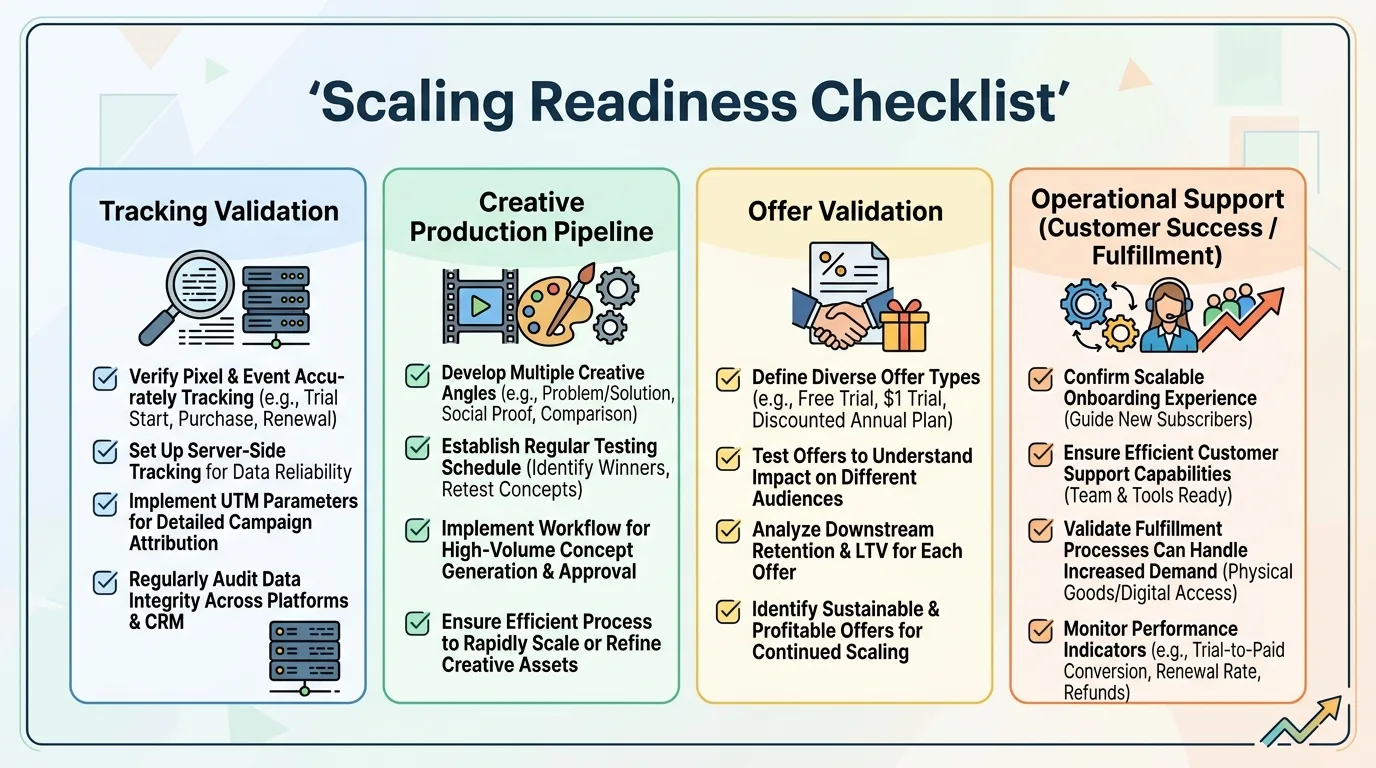
Scale in measured increments, watch marginal efficiency rather than only account averages, and keep a portion of spend reserved for testing. If every dollar is committed to current winners, the account becomes vulnerable the moment those winners fatigue or a platform changes delivery.
The strongest subscription growth programs do not chase a perfect dashboard number. They build a repeatable way to find qualified demand, test the message and offer quickly, measure downstream value, and move budget with discipline. That is how paid media becomes a durable acquisition engine instead of a monthly gamble.