
A TikTok account can spend thousands of dollars teaching you almost nothing if every new ad changes the offer, hook, edit, creator, CTA, and audience at once. TikTok ad creative testing is not a contest to produce the most videos. It is a system for isolating what drives attention, intent, and profitable action - then putting more budget behind the patterns that hold up.
For growth teams, the operational challenge is rarely a lack of ideas. It is turning those ideas into a controlled testing pipeline fast enough to keep pace with creative fatigue, platform volatility, and aggressive growth targets. The answer is not random variation. It is a repeatable process that connects creative production, media buying, and performance reporting.
What TikTok Creative Testing Must Actually Answer
Every test should answer a business question. If it cannot, it is content production disguised as performance marketing.
At the highest level, TikTok creative needs to earn three outcomes: stop the scroll, build enough belief to create intent, and move the viewer to take the next action. A low cost per thousand impressions may indicate a strong opening, but it does not prove that the ad can drive profitable purchases, leads, installs, or subscriptions. Likewise, a high click-through rate can reflect curiosity without producing qualified conversion volume.
That is why creative testing needs a hierarchy of signals. Early engagement metrics help diagnose why an ad is or is not getting distribution. Conversion metrics determine whether it deserves additional spend. Profitability determines whether it is ready to scale.
The exact metrics depend on the business model. Ecommerce teams may prioritize contribution margin and new-customer CPA. Lead generation teams may need qualified lead rate, contact rate, and downstream revenue. App teams often need to look beyond installs to activation, trial starts, and retained users. The platform event is only useful when it is connected to the outcome that matters.
Start With a Testing Framework, Not a Batch of Ads
The fastest teams do not send a collection of unrelated concepts into market and hope one wins. They organize creative around clear hypotheses.
A hypothesis can be as simple as: a founder-led problem statement will outperform a polished product demo for high-intent prospects. Or: showing the end result in the first second will reduce CPA for a cold audience. The point is to define what you are testing before the data arrives.
A useful TikTok testing framework separates variables into four creative layers:
- Angle: The core reason to care, such as a pain point, aspiration, objection, comparison, proof point, or offer.
- Hook: The first one to three seconds that earns attention through a statement, visual, question, or pattern interrupt.
- Execution: The delivery format, including creator-led UGC, product demonstration, testimonial, screen recording, founder video, or native-style montage.
- Conversion device: The element that creates action, such as social proof, pricing context, urgency, a guarantee, a direct CTA, or a landing-page bridge.
Test one primary variable at a time when you need a clean read. If the angle is the variable, keep the core offer and format reasonably consistent. If the hook is the variable, preserve the body of the ad. This does not mean every test must be scientifically perfect. Paid media operates in a live auction, and speed matters. It does mean you should know what likely caused the result.
Build Creative Families Instead of One-Off Assets
A single winning TikTok ad is useful. A winning creative family is scalable.
When an ad performs, do not immediately declare it a finished asset and move on. Break down why it worked. Was it the opening claim? The creator’s delivery? The visible product result? The objection it handled? Then create deliberate iterations around that insight.
For example, if a testimonial-style ad wins because it addresses skepticism about results, the next round might keep the proof-led angle while testing different hooks, proof formats, customer profiles, and calls to action. This produces a family of related assets instead of one ad carrying the account until fatigue sets in.
Creative families also protect against false positives. An individual ad can win because of timing, audience match, or auction conditions. When multiple variants built on the same mechanism perform, you have stronger evidence that the underlying message is working.
This is where production speed becomes a performance advantage. A team that needs three weeks to make a follow-up batch loses the signal. A team that can launch iterations while the original winner still has momentum can compound it.
How to Structure TikTok Ad Creative Testing
Campaign structure should make performance easier to interpret, not harder. Over-segmenting budgets and audiences can starve ads of delivery. Combining every concept in one large campaign can make it difficult to see what is actually working. The right setup depends on spend level, conversion volume, optimization event, and account history.
For most accounts, separate exploration from exploitation. Exploration is where new concepts earn enough spend to generate a meaningful signal. Exploitation is where proven ads receive more budget under conditions designed to scale efficiently.
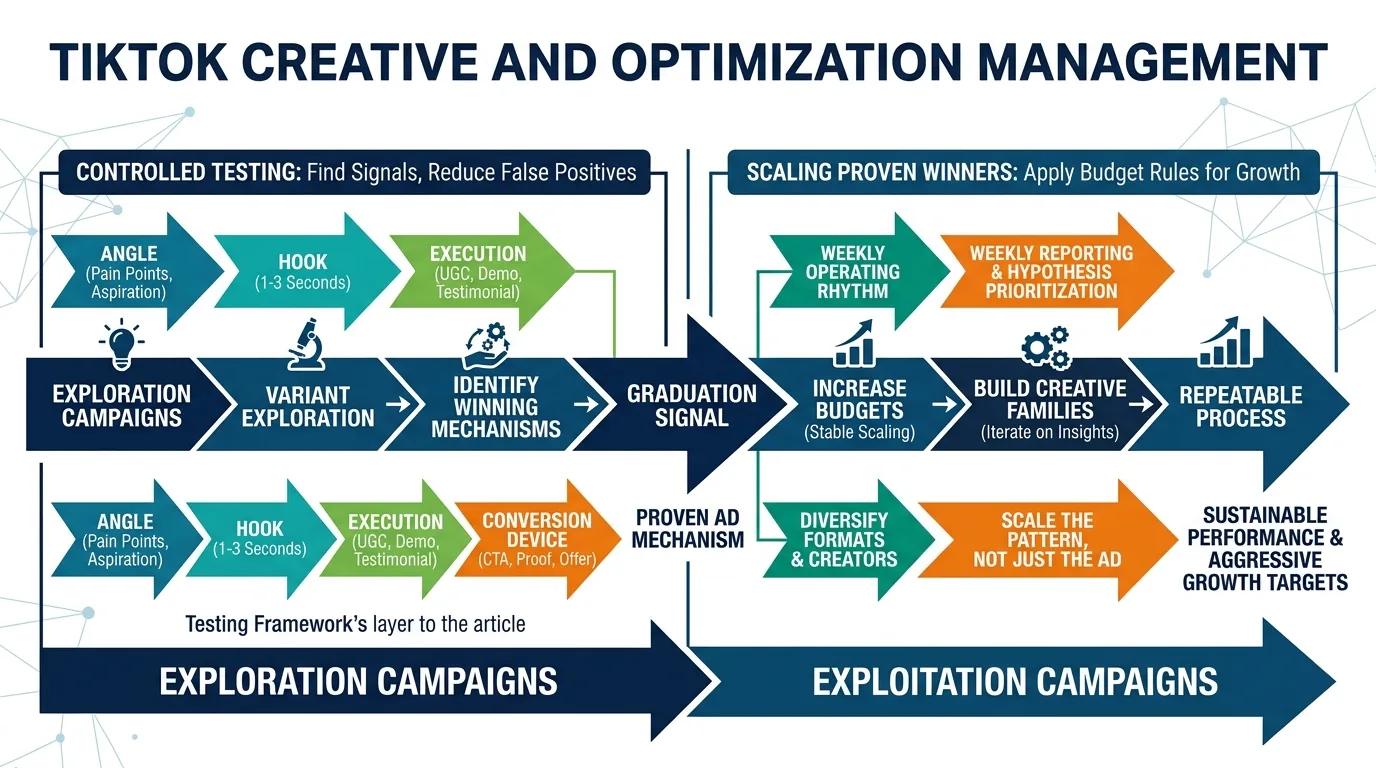
In the exploration environment, keep the number of moving parts controlled. Launch a defined batch of concepts, give them comparable conditions where possible, and avoid changing budgets, bids, landing pages, and creative all at once. If an offer change is necessary, treat it as a separate test. Otherwise, the reporting will not tell you whether performance moved because of the ad or the economics behind it.
The amount of spend required for a decision is not fixed. A low-volume, high-ticket lead program cannot use the same decision rules as a high-volume ecommerce account. Rather than waiting for arbitrary thresholds, set criteria based on expected CPA, conversion lag, and the confidence needed to make a budget decision. Early indicators can help prioritize, but they should not override conversion quality.
Read the Signals Without Killing Ads Too Early
The most common testing mistake is treating every weak first impression as a loser. The second is leaving obvious underperformers live because the team does not have a defined cutoff.
Start by looking at the funnel. If the ad has weak thumb-stop performance or poor early retention, the hook likely needs work. If viewers stay but do not click, the message may be interesting without being relevant or actionable. If clicks are strong but conversions are weak, inspect message-to-landing-page alignment, offer clarity, page speed, and traffic quality before blaming the creative alone.
Do not optimize only for watch time. TikTok rewards content that holds attention, but the business is buying outcomes. Some direct-response ads will be less entertaining than organic content and still drive more profitable acquisition. The goal is not to make ads that look native at any cost. The goal is to make ads that earn distribution while making a credible, compelling case for action.
It also helps to distinguish between a tired execution and a tired angle. A creator may fatigue while the message remains strong. In that case, refresh the talent, visual treatment, edit pace, or opening scene before abandoning the concept. If multiple executions of the same message deteriorate, the angle itself may need to rotate.
Create a Weekly Operating Rhythm
High-velocity testing only works when there is a clear rhythm from insight to production to launch. Weekly reporting should not be a gallery of ads and metrics. It should document what was tested, what the result suggests, what gets scaled or cut, and what the next batch will prove.
That discipline forces creative and media teams to operate as one system. Media buyers need enough context to allocate spend intelligently. Creative teams need specific feedback, not vague requests for more UGC. Leadership needs a view of performance that connects ad-level findings to acquisition efficiency and revenue quality.
A productive weekly cycle often includes reviewing active winners and fatigue risk, identifying the strongest creative mechanisms, prioritizing the next hypotheses, producing variants, launching with consistent naming and tracking, and making budget decisions from a shared scorecard. Internal operating systems matter here. Consistent campaign setup and centralized data reduce manual errors and make cross-account patterns easier to spot.
Establish a Weekly Operating Rhythm
A productive weekly operating rhythm helps teams systematically move from insights to execution:
- Review active winners and fatigue risk — Identify which creatives are holding up and which need replacement.
- Identify the strongest creative mechanisms — Isolate hooks, angles, or styles driving performance.
- Prioritize the next hypotheses — Align on the exact variables to test next.
- Produce variants — Build out creative families around proven ideas.
- Launch with consistent naming and tracking — Ensure clean data collection across campaigns.
- Make budget decisions from a shared scorecard — Rely on unified metrics rather than platform dashboards.
Internal operating systems matter here. Consistent campaign setup and centralized data reduce manual errors and make cross-account patterns easier to spot.
Scale the Pattern, Not Just the Ad
When a winner emerges, scaling should be deliberate. Increase budget in a way that preserves enough stability to read the result. Expand the creative family before the original is exhausted. Test the same mechanism across additional formats, creators, audiences, and offer presentations.
There are trade-offs. A more aggressive budget increase can capture momentum, but it may raise CPA or destabilize delivery. Broader targeting can create more scale, but it may lower conversion quality. The right move depends on margin, payback window, conversion volume, and how much proven creative depth exists behind the current winner.
The account is healthiest when the next winners are already in production before the current ones fade. That is the practical standard for TikTok ad creative testing: not finding a lucky video, but building an operating system that keeps producing profitable reasons for people to act.
The next useful question is simple: what is the single creative variable your team needs to prove this week? Put that answer into market quickly, measure it against the outcome that pays the bills, and let the next batch be smarter because of it.