
Most paid acquisition accounts do not stall because the media buyer missed a bid adjustment. They stall because the team has exhausted the creative that got them there. Frequency rises, click-through rate falls, conversion efficiency weakens, and the account starts paying more to reach the same customer.
Ad creative is the variable that gives a paid growth program new ways to win. It creates new angles, new audiences, new reasons to click, and new data for the media team to act on. But volume alone is not the answer. A folder full of loosely connected ads is not a creative system. It is production without control.
The teams that scale efficiently treat creative as an operating function. They build it around clear hypotheses, fast launches, structured testing, and decisive optimization. The objective is not to make more ads. It is to identify profitable winners quickly, understand why they work, and produce the next round with better inputs.
Ad Creative Is a Performance Input, Not a Brand Exercise
Brand standards matter. So do strong design and clean messaging. But performance creative has a more immediate job: earn attention from the right person, establish relevance fast, and move that person toward a measurable action.
That changes how it should be evaluated. A visually polished video can underperform a simple founder clip with a sharp opening. A highly produced static image can lose to a plain comparison ad that makes the offer easier to understand. The question is not whether an asset looks premium in a review meeting. The question is whether it can profitably acquire the intended customer at scale.
This does not mean abandoning brand discipline. It means matching the level of production to the market, channel, audience awareness, and offer. A subscription product may need a direct demonstration of recurring value. A lead generation campaign may need specificity around eligibility, outcomes, or speed. An ecommerce offer may need proof, objections, and product utility in the first few seconds.
Creative and media also need to operate as one system. The media team sees where spend concentrates, which audiences respond, and when an ad is losing efficiency. The creative team turns those signals into new concepts. When those functions are split across disconnected vendors, feedback slows down and budget keeps flowing to fatigued or poorly understood assets.
Build Creative Around Testable Hypotheses
Random variation creates random learning. Changing the hook, headline, format, offer, audience, and landing-page message at once may produce a winner, but it will not tell you what made it win. That makes the next production cycle slower and less reliable.
Start with a hypothesis tied to a business constraint or market signal. For example: prospects may understand the product but doubt the result; price-sensitive users may need a clearer value comparison; mobile users may respond better to a product demonstration than a lifestyle image. Each hypothesis should become a distinct creative angle.
Within an angle, test controlled variations. Keep the core promise intact while testing the opening line, visual proof, headline, call to action, creator, or edit pace. This produces usable learning without turning the test into a guessing game.
Separate concepts from variations
A concept is the strategic idea behind an ad. “Stop paying for hidden fees” is a concept. So is “See the result in under five minutes” or “Compare this to your current process.” Variations are executions of that concept: different hooks, footage, headlines, voiceovers, formats, or thumbnails.
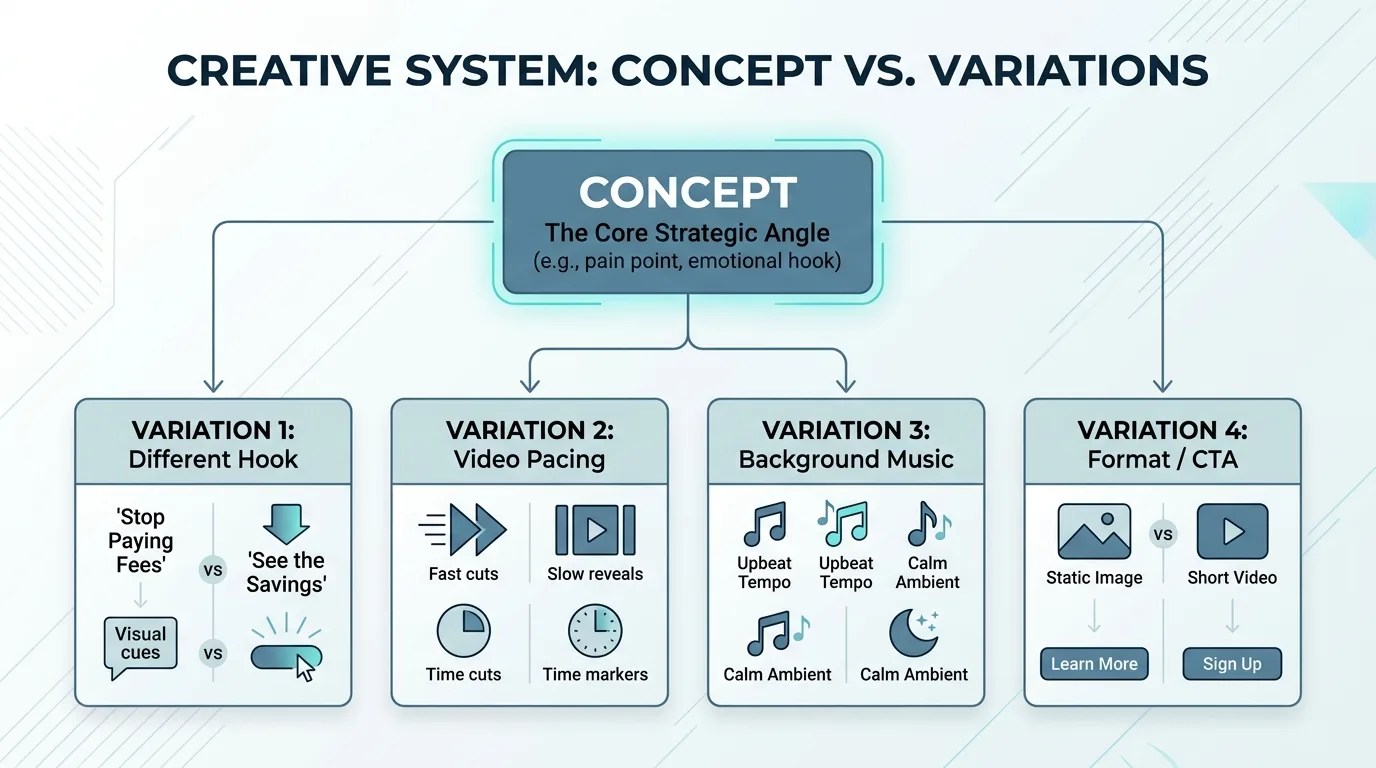
| Dimension | Concept | Variation |
|---|---|---|
| Focus | Strategic messaging and core angles (e.g., pain points, emotional hooks, unique value propositions). | Tactical executional adjustments (e.g., text pacing, color schemes, background tracks, CTAs). |
| Objective | Unlocks entirely new audience segments and scales new core ideas. | Iterates on and extracts maximum efficiency from a validated core message. |
| Example | ”See the results in under 5 minutes” (Speed/Convenience) | Changing the opening creator hook or swapping background music on the same “5 minutes” pitch. |
Both are necessary. Concepts help a team find new demand pockets. Variations help maximize a promising concept before it is exhausted. An account that tests only variations often gets incremental gains but misses bigger opportunities. An account that tests only new concepts creates too much noise and fails to compound what is working.
Match the hypothesis to the funnel
Prospecting creative typically needs to create demand or make an unfamiliar problem feel immediate. Retargeting can be more direct, using product proof, reviews, urgency, or a clearer offer. Existing customers may respond to expansion use cases, feature education, or replenishment prompts.
Do not assume one winning ad belongs everywhere. An ad that attracts cold traffic may be inefficient for a warm audience that already knows the product. The right creative architecture reflects customer awareness, not just platform placement.
Testing Velocity Only Matters When Launches Are Controlled
Speed is valuable because market feedback has a shelf life. If a team needs three weeks to produce, approve, tag, launch, and report on a test, it will always be behind the account’s needs. By the time the result is clear, the original winner may already be fatigued.
But fast production without launch discipline creates a different problem: no one knows what is live, which version is spending, or whether a result is meaningful. Naming conventions, asset IDs, clean campaign structure, and centralized performance reporting are not administrative extras. They are what make high-velocity testing possible.
A controlled operating rhythm usually looks like this: identify opportunities from current performance, brief a focused batch of concepts, produce platform-ready assets, launch with consistent tagging, monitor early delivery and conversion signals, then promote, iterate, or cut based on defined thresholds. The exact cadence depends on spend, conversion volume, approval complexity, and platform. A high-spend app account can reach directional answers faster than a specialized B2B lead program with a long sales cycle.
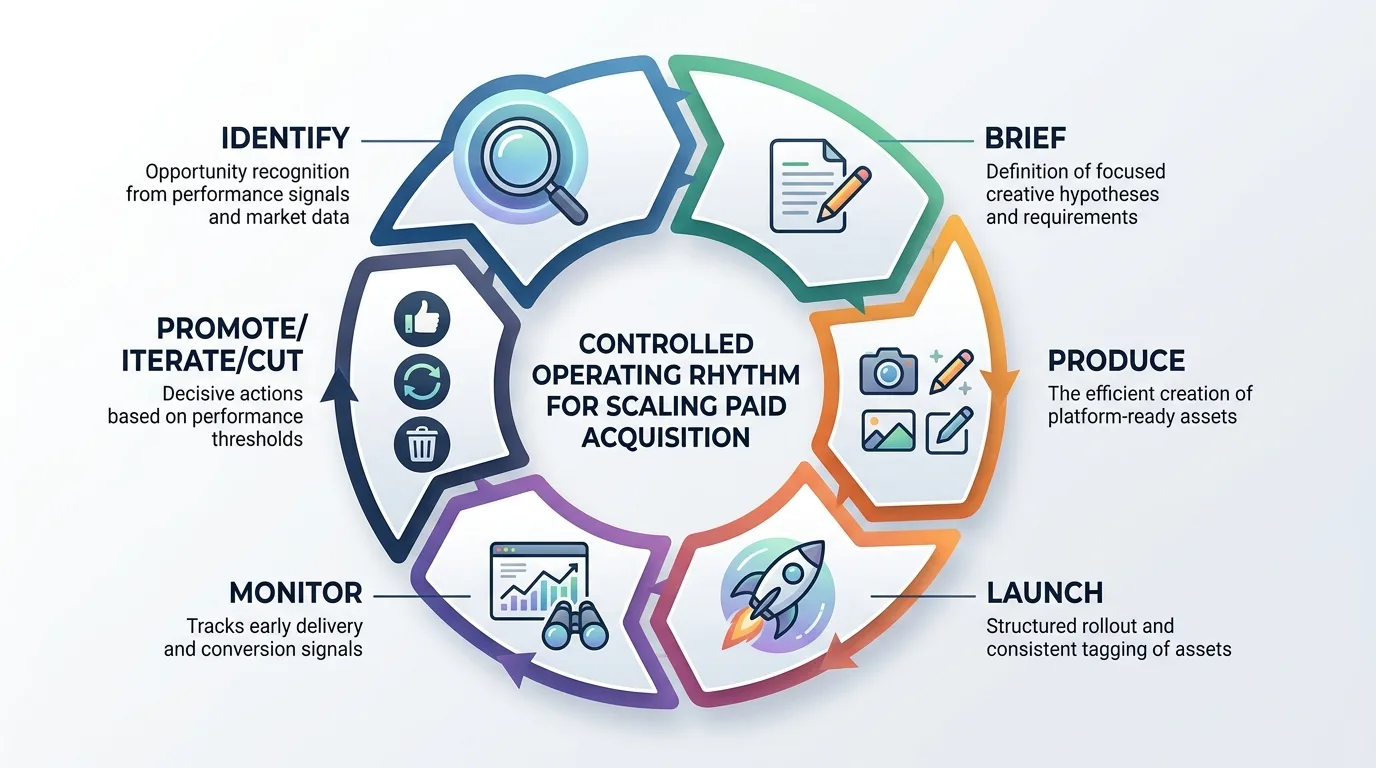
The key is to avoid treating every asset as equal. Some ads are exploratory tests with limited budget. Others have earned a larger allocation because they demonstrate efficient conversion at meaningful spend. Budget should follow evidence, not internal enthusiasm.
Read Results Beyond Click-Through Rate
Click-through rate is useful, especially when comparing hooks and thumb-stopping power. It is not a final verdict. An ad can generate cheap clicks from curious but low-intent users and still fail to produce qualified leads, subscriptions, purchases, or profitable customers.
The right decision metric depends on the business model. Ecommerce teams may prioritize contribution margin and new-customer return. Lead generation teams may need qualified lead rate, contact rate, and downstream revenue. Mobile apps may look at cost per install alongside activation, trial start, or predicted lifetime value.
This is where creative reporting often breaks down. Teams see a top-line cost per acquisition and declare an ad a winner without checking quality. Or they kill an ad early because its click-through rate is average, even though the traffic converts at a better rate and produces higher-value customers.
Performance reporting should connect the asset to the outcome that matters. At minimum, teams need to see spend, impressions, click-through rate, conversion rate, cost per acquisition, and return or quality signals by creative. More importantly, they need a practical interpretation: which message is winning, for whom, at what scale, and what should be produced next.
Know When to Iterate and When to Replace
Creative fatigue is not always a reason to discard an idea. If a concept has proven it can acquire efficiently, the first response should often be iteration. Refresh the opening, change the visual setting, use a different spokesperson, update proof points, or recut the message for a new placement. The underlying customer insight may still be strong.
Replacement is necessary when the concept itself is no longer competitive, when it cannot maintain efficiency beyond a small budget, or when the offer and market have changed. A stale product claim, an outdated promotion, or a message that competitors have copied may require a new angle rather than another edit.
The trade-off is real. Iterating on proven winners is lower risk and usually faster. New concepts carry more uncertainty but are essential for finding the next growth ceiling. Strong programs allocate capacity to both instead of betting everything on the latest winner or endlessly refreshing a declining asset.
Create a System That Makes Winners Repeatable
The most valuable output of an ad creative program is not a single high-performing ad. It is a repeatable method for producing more of them.
That requires an accessible record of what has been tested, what the team learned, and what remains unproven. Store winning angles with the relevant audience, offer, format, platform, spend level, and performance window. Record failures too. Knowing that an objection-led message did not resonate with a specific segment can prevent wasted production in the next cycle.
At Conversion Collective, creative testing is managed alongside media execution because the learning loop has to be tight. Performance signals should move directly into the next brief, not sit in a monthly report waiting for a separate creative partner to interpret them.
The best next ad is rarely a blank-page idea. It is usually a sharper response to what the account has already shown you. Keep the feedback loop short, protect the structure around testing, and let verified customer behavior determine what gets scaled.