
A paid acquisition operating model is what separates a growth engine from a collection of ad accounts. When spend rises, fragmented workflows become expensive fast: creative arrives late, buyers lack usable inputs, tests overlap, reporting trails reality, and teams keep funding campaigns because nobody can clearly explain what replaced them.
The answer is not more meetings or another dashboard. It is a defined operating system that connects creative, media, measurement, and decision-making around one outcome: finding winners quickly and scaling them without losing control of margin.
What a Paid Acquisition Operating Model Must Do
A strong model turns paid media from a channel-by-channel activity into a repeatable production system. It establishes who owns each decision, what gets tested, how results are read, and when budget moves. That matters whether the business is buying leads on Meta and Google, app installs on TikTok, subscriptions through native, or ecommerce revenue across several platforms.
The objective is not simply to lower CPA for a week. It is to create enough testing velocity that the business can identify durable performance signals before the market, audience, or creative environment changes.
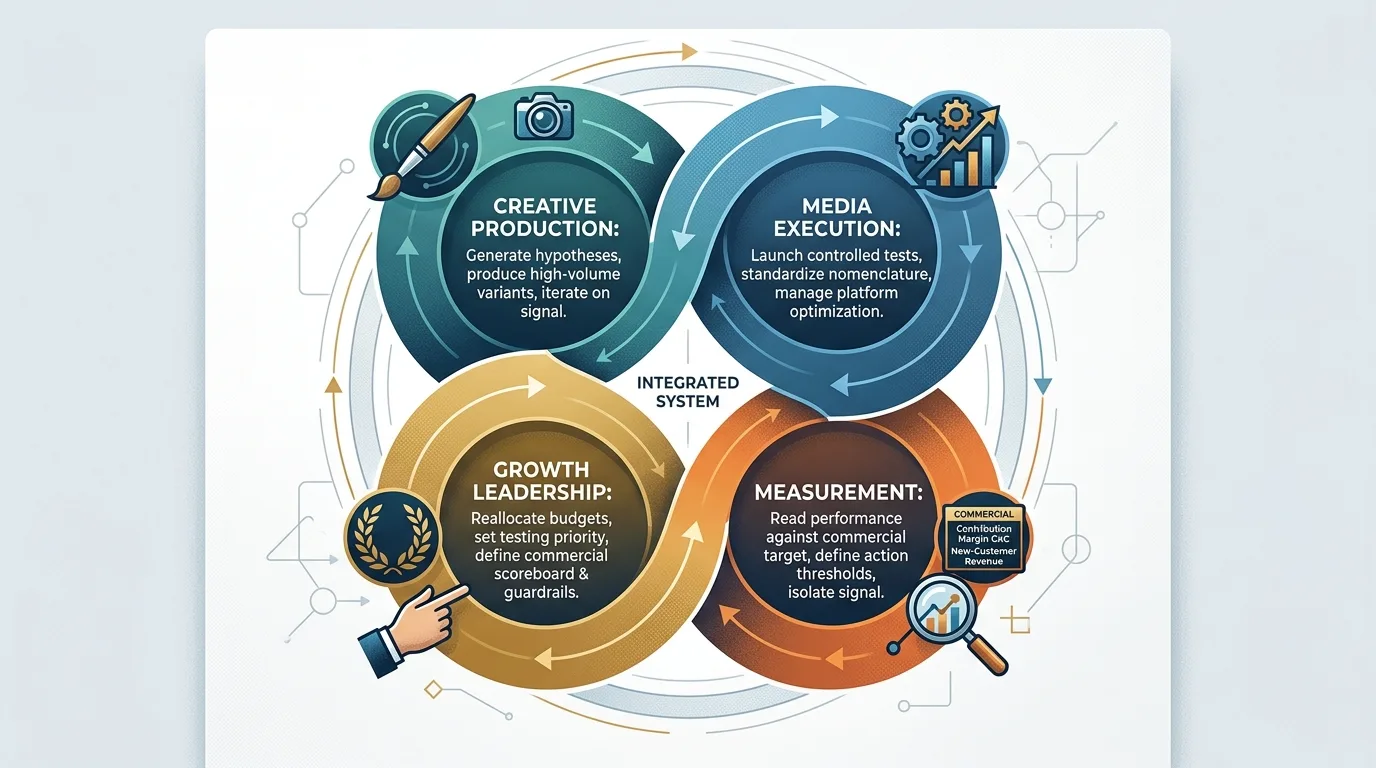
That requires four functions to work as one system: creative production, media execution, measurement, and growth leadership. If any one function runs on a separate cadence, scale slows down. A media buyer cannot optimize around creative that arrives monthly. A creative team cannot improve if feedback is vague. Leadership cannot make budget decisions from reports that explain last month rather than this week.
Start With One Commercial Scoreboard
Every operating model needs a primary business metric and a small set of guardrails. For an ecommerce brand, that may be contribution-margin CAC and new-customer revenue. For lead generation, it may be qualified lead cost, contact rate, and downstream conversion. For a subscription product, it could be trial CAC, paid conversion rate, and projected payback.
Platform metrics still matter, but they are diagnostic inputs, not the finish line. CTR can reveal whether a concept earns attention. CPM may explain delivery pressure. CPA tells you what the platform reports. None should override the metric that determines whether growth is actually profitable.
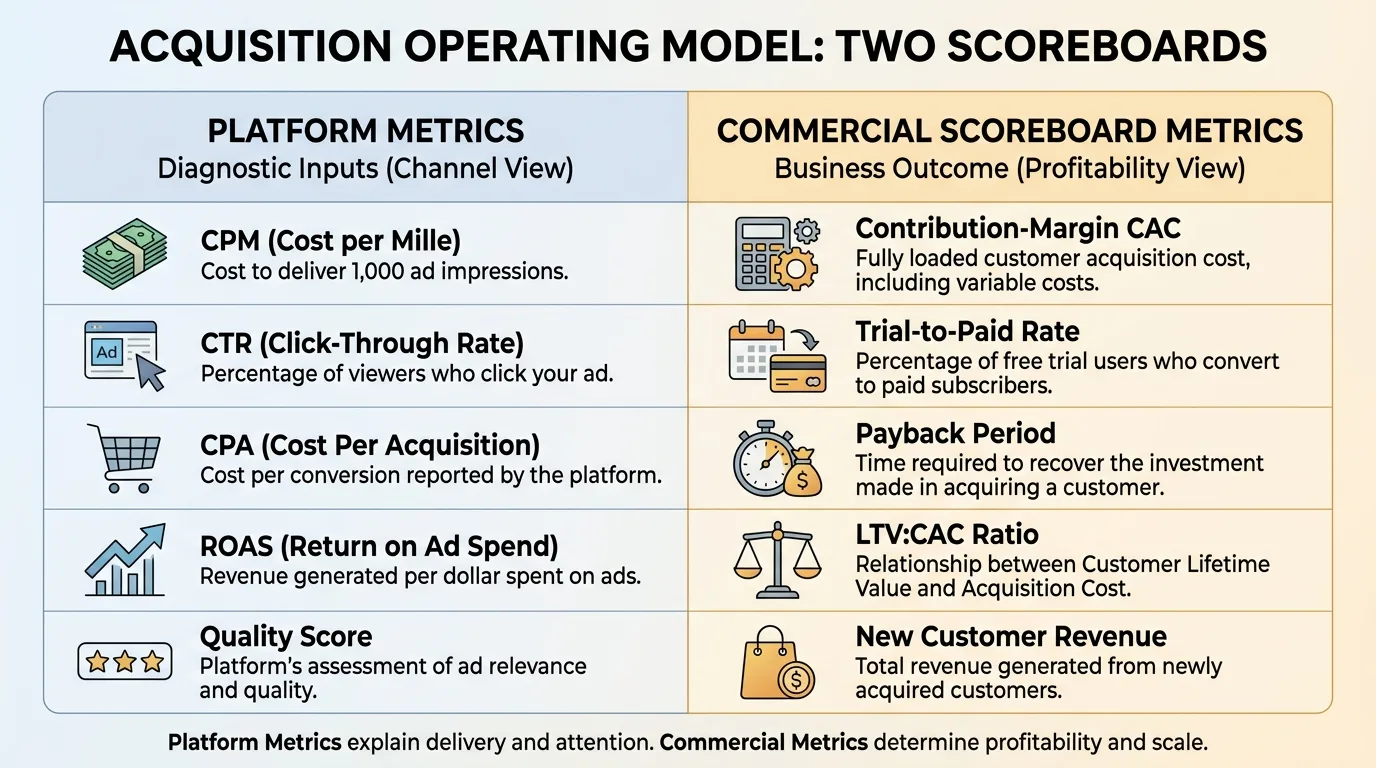
Define the scoreboard before debating campaign structure. Then set clear thresholds for action. Teams should know what makes a test promising, what makes it a likely loser, and what evidence is required before increasing spend. Without those rules, optimization becomes preference-driven and budgets drift toward the loudest opinion.
There is no universal threshold. A business with strong retention can tolerate higher acquisition cost than a one-time-purchase offer. A new product may accept a temporary learning premium to gain market signal. The discipline is in making those trade-offs explicit, not pretending every campaign has the same target.
Build the Creative and Media Loop Together
Creative is often treated as an input to media buying. At scale, it is a variable the media team must actively manage. New angles, formats, hooks, claims, offers, creators, and landing-page messages create the supply of testable opportunities. Media buying creates the controlled environment that reveals which of those opportunities deserve more budget.
The operating loop should be tight:
- Performance data identifies the audience, message, format, or funnel problem worth investigating.
- Creative strategy turns that problem into specific hypotheses, not vague requests for “more ads.”
- Production delivers enough variants to isolate meaningful variables while maintaining throughput.
- Media launches tests with consistent naming, budgets, tracking, and placement logic.
- Results are reviewed on a fixed cadence, then winners are iterated and losers are retired.
The important point is that creative feedback must be usable. “This ad underperformed” is not a direction. “The product demo held attention but the opening claim failed with first-time buyers” is a direction. The first statement produces more random volume. The second produces a better next round of work.
High-volume production does not mean indiscriminate production. It means building a deliberate test matrix. If an offer is working but performance is fading, test new hooks and visual treatments before replacing the entire message. If click-through rate is weak across concepts, investigate the angle. If clicks are strong but conversion is weak, the issue may be offer clarity, landing-page continuity, or traffic quality rather than the ad itself.
Use a Campaign Architecture That Preserves Signal
Campaign structure should make performance easier to interpret, not merely look organized in an account. Too much fragmentation starves ad sets and campaigns of data. Too little structure hides meaningful differences between audiences, products, markets, or funnel stages.
The right level of consolidation depends on spend, conversion volume, platform behavior, and how different the underlying economics are. But the operating principle is consistent: isolate tests when you need a clean answer, then consolidate proven activity where the platform can efficiently allocate delivery.
Naming conventions are not administrative overhead. They are the foundation of reliable reporting and fast decision-making. Every campaign and creative asset should make it possible to identify the channel, market, objective, audience logic, concept, format, offer, and launch date. When a team manages hundreds or thousands of active campaigns, inconsistent labels turn analysis into manual archaeology.
This is where standardizing campaign creation and creative taxonomy matters. Teams can use standardized execution sheets or custom marketing automation scripts to manage campaign creation, asset handoff, and naming across channels. The goal is not tooling for its own sake, but launching faster without creating operational debt or losing the clean data structure needed for rapid analysis.
Set Decision Cadences, Not Endless Status Meetings
Paid acquisition needs distinct operating rhythms because not every decision should happen at the same speed. Daily monitoring catches delivery failures, overspend, tracking breaks, and clear budget leaks. More meaningful creative and audience assessments usually need enough conversion volume to avoid reacting to noise. Weekly reviews should focus on where to reallocate budget, which tests to repeat, and what production needs next.
A practical weekly review answers four questions: What scaled profitably? What lost efficiency and why? What did we learn that changes the next test plan? Where should resources move now?
This is different from a report readout. Reporting describes performance. An operating review assigns action. Each action should have an owner, a deadline, and a measurable expected outcome. If the team agrees that an angle is working, someone should own the next iterations, the launch plan, and the budget path. Otherwise, insights remain slides.
Monthly reviews belong at the commercial level. They should examine blended acquisition efficiency, payback, channel mix, creative fatigue, incrementality where measurement allows, and capacity constraints. They are the place to challenge assumptions about the growth plan, not to debate whether one ad set should receive another $200.
Make Testing a Portfolio, Not a Queue of Requests
The healthiest testing programs balance exploitation and exploration. Most budget should support proven campaigns and concepts that are meeting the commercial target. A defined portion should fund structured experiments that could produce the next winner: new audiences, new channels, new offers, new creative territories, or landing-page paths.
The exact allocation depends on business maturity. A company fighting for cash efficiency will test more conservatively than one entering a new category. But zero exploration is not conservative. It leaves the business dependent on a shrinking set of familiar ads until fatigue forces a rushed response.
Prioritize tests by expected impact, confidence, effort, and time to signal. A new headline variation may be quick to launch but offer limited upside. A new offer can materially change conversion economics but may require legal, product, and landing-page work. Both can be valuable, but they should not compete for attention as if they cost the same.
Keep a visible test log with the hypothesis, inputs, launch date, spend, result, decision, and next action. This prevents the team from rerunning failed ideas under new names and gives new operators context without slowing them down.
Create Clear Accountability Across Teams
The paid media owner should be accountable for deployment, pacing, optimization, and surfacing signal. The creative lead should own production velocity, quality, and turning performance evidence into stronger concepts. Analytics should own measurement integrity and explain material gaps between platform data and business outcomes. Growth leadership should own targets, budget allocation, and the trade-offs between efficiency and scale.
Those roles can sit within one internal team or a managed service partner. What matters is that ownership is explicit and that creative and media do not operate as disconnected vendors. When they are separated, the media team asks for more assets while the creative team asks what to make. Neither question moves the program forward.
A capable partner should function as an integrated growth unit: launching campaigns accurately, maintaining testing throughput, cutting wasted spend, and delivering insight that changes the next decision. Accountability should be tied to profitable outcomes, not inflated spend or activity volume.
Build for Speed Without Creating Chaos
Speed is an advantage only when the system can absorb it. Launching ten times more campaigns with inconsistent tracking, unclear hypotheses, and no retirement process does not create learning. It creates noise.
The strongest paid acquisition operating model makes fast work repeatable. It gives the team a shared scoreboard, a reliable creative-to-media loop, structured tests, clean data, and firm decision rights. That is how paid growth becomes easier to scale: not because every campaign wins, but because the business knows what to do when one does.