
A Google Ads creative strategy is not a design exercise. It is the operating system for turning search intent, product value, and landing-page economics into profitable acquisition. When creative is treated as a last-mile task, teams end up with polished ads that say the same thing, learn slowly, and give media buyers very little to optimize.
The better approach is to build creative as a testing system. Each asset should answer a specific question: Which problem creates urgency? Which proof point earns the click? Which offer filters for buyers rather than browsers? The goal is not to make one ad look perfect. The goal is to produce enough disciplined variation to find messages that can scale.
Why Google creative needs a different operating model
Google ads run across very different environments. Search captures active demand. Performance Max and Display create or intercept demand across feeds, video, apps, and publisher inventory. YouTube has to earn attention before it can earn consideration. A single brand line rarely works equally well in all of them.
That distinction matters because an ad can produce a strong click-through rate and still be a poor acquisition asset. Search copy may attract broad, low-intent queries. A YouTube hook may generate views but fail to communicate the product clearly enough to drive qualified traffic. A Performance Max image may win cheap conversions while introducing customers with poor downstream value.
Creative decisions should therefore be connected to the conversion event that actually matters: qualified leads, activated users, first purchases, subscriptions, or contribution margin. If the optimization target is weak, the creative learning will be weak too.
Build a Google Ads creative strategy around hypotheses
High-velocity creative is not random volume. Every new asset needs a reason to exist and a clear comparison point. Start with the commercial problem the campaign needs to solve, then translate it into testable messaging angles.
For a subscription brand, that might mean testing whether prospects respond more strongly to convenience, price certainty, expert curation, or a specific product outcome. For lead generation, the real question may be whether prospects need proof of speed, proof of credibility, proof of savings, or a clearer explanation of eligibility.
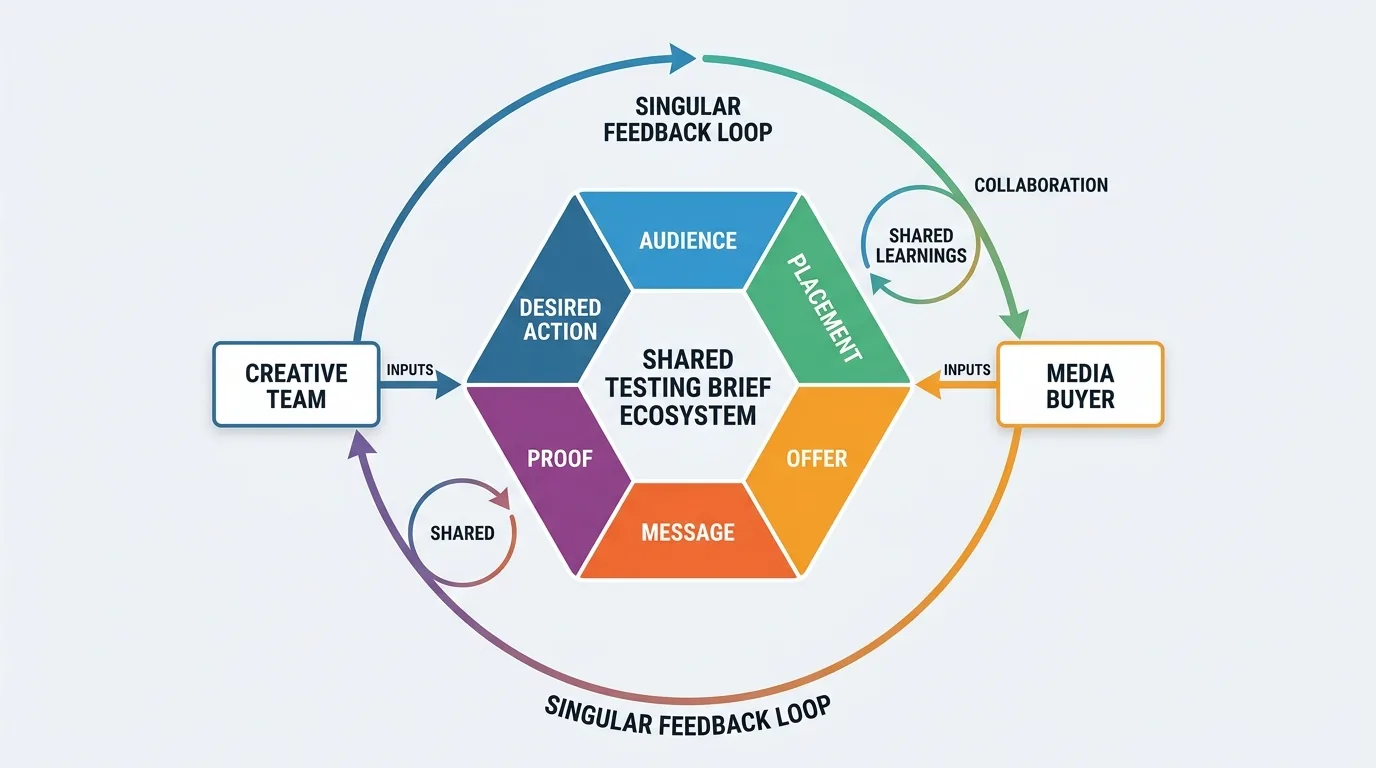
A useful testing brief defines the audience, placement, offer, message, proof, and desired action. It also identifies the metric that will determine whether the test moves forward. This keeps the creative team and the media buyer working from the same decision framework instead of optimizing separate parts of the funnel.
Start with message families, not isolated ads
A message family is one core angle expressed through multiple executions. For example, a financial service might build a “save time” family featuring a direct claim, a customer quote, a comparison visual, and a short product demonstration. The team can then determine whether the underlying promise is working before drawing conclusions about a single headline or image.
This prevents a common mistake: killing a valuable angle because one execution underperformed. It also prevents the reverse mistake of declaring a winner when an ad only benefited from a temporary placement, audience, or bid advantage.
Build message families around the strongest sources of conversion friction:
- The cost, complexity, or delay customers want to avoid
- The outcome they want sooner or with less risk
- The proof they need before changing behavior
- The reason to choose now rather than later
These are not interchangeable. A discount can create action, but it may train customers to wait for promotions. Social proof can improve trust, but it may not overcome a weak offer. The right emphasis depends on market maturity, purchase consideration, and customer economics.
Match the creative to the Google surface
Search creative has limited space and a high-intent job. Headlines should reflect the query’s commercial intent, reinforce the offer, and resolve the biggest objection. Descriptions should add specificity, not repeat the headline in different words. Strong search ads make the next click feel obvious.
For Performance Max, asset variety matters because Google is assembling ads across formats and inventory. Supply clear image concepts, short and long video variations, distinct headlines, and meaningful descriptions. Avoid sending a library of near-duplicates. If every asset repeats the same claim, the system has little to learn from.
YouTube requires more upfront discipline. The first few seconds should establish the problem, outcome, or contrast quickly. Product demos, direct-response testimonials, creator-style explanations, and visual comparisons can all work, but only when they make the value proposition understandable without sound or context. Brand atmosphere alone is rarely enough for performance campaigns.
Design the testing cadence before launch
The speed of creative learning depends less on how many ideas a team has and more on whether it can launch, measure, and replace assets without operational drag. Many accounts stall because every new concept requires a new brief, multiple approval rounds, fragmented file handoffs, and manual campaign edits.
Set a regular cadence for creative production and decision-making. The exact volume depends on spend, conversion lag, and channel mix. A large ecommerce account may support weekly batches across several product angles. A high-value B2B lead generation program may need fewer assets and longer evaluation windows because lead quality takes time to validate.
The principle is consistent: create faster than fatigue and market change can erode performance, but do not produce so much that learnings become impossible to interpret. Testing velocity without structure is just content throughput.
A practical workflow has three stages. First, launch enough variation to test a message family fairly. Next, review performance using conversion quality and spend thresholds, not early engagement alone. Then, turn confirmed winners into follow-up tests that isolate the reason they worked. That may mean testing the same proof point with a new hook, offer, format, or audience context.
Read performance without confusing correlation for signal
Creative reporting should help a team make decisions, not create a gallery of surface-level metrics. Click-through rate, view rate, and cost per click are diagnostic signals. They can reveal a weak hook or an irrelevant message. They are not the final score.
For most performance programs, the decision hierarchy should move from spend and conversion volume to cost per qualified outcome, then to downstream revenue or margin where data is available. A creative asset that produces higher-cost clicks may still be the better investment if those clicks convert at a materially higher rate or create more valuable customers.
Segmentation is equally important. Review performance by campaign type, placement, audience signal, device, and creative angle where volume permits. A message that works on branded search may tell you very little about what will work on YouTube prospecting. Likewise, an image that performs in Performance Max may be carrying a different role than a video asset driving new demand.
Do not overreact to short windows. But do not let underperformers consume budget because the team is waiting for certainty that will never come. Establish decision rules before launch: minimum spend, minimum conversion volume, acceptable cost range, and the downstream metric that confirms quality. This creates accountability when opinions are strong and data is still developing.
Connect creative feedback to the full acquisition system
The highest-value insights rarely stay inside Google Ads. If a “fast setup” message wins in YouTube and Performance Max, test it in landing-page headlines, lifecycle email, and other paid channels. If a lead-generation angle drives volume but sales rejects those leads, revise the ad’s qualification language rather than asking the sales team to absorb the mismatch.
This is where creative and media buying must operate as one system. Media buyers see how ads enter auctions, where delivery expands, and where budget is wasted. Creative teams see which messages earn attention and which formats communicate value. Neither side has the full answer alone.
A centralized launch and reporting process makes that feedback loop practical. At Conversion Collective, the objective is not to generate more assets for their own sake. It is to create a repeatable path from creative hypothesis to campaign launch, performance signal, and scaled winner without losing control of the account.
Make every winner earn its next dollar
A winning ad is not a permanent answer. Competitors copy claims, audiences tire of familiar formats, offers change, and platform delivery shifts. Scale can also expose an asset to less responsive inventory, making yesterday’s economics look different at higher spend.
Treat winners as starting points for the next round of learning. Preserve the core message, then test the variable most likely to expand its reach: a sharper hook, stronger proof, a new visual format, a more qualified call to action, or a landing page aligned to the promise. That is how creative becomes a compounding growth asset instead of a recurring production bottleneck.
The best next move is usually not another campaign rebuild. It is a clearer hypothesis, a faster launch, and enough operational discipline to know whether the market actually agreed.