
A campaign can hold a strong CPA for weeks, then deteriorate without any obvious change in targeting, budget, or landing page. This is the operational question behind why do paid campaigns lose efficiency: scale changes the conditions under which an ad is bought, seen, measured, and converted.
The wrong response is to treat every decline as a bidding problem. Cutting budgets, narrowing audiences, and making isolated account edits may temporarily improve blended numbers, but they rarely address the underlying constraint. Paid efficiency declines when a growth engine runs out of fresh demand, fresh creative, clean data, or the capacity to act on performance signals quickly.
For teams spending across Meta, Google, TikTok, Taboola, and other channels, the goal is not to prevent every fluctuation. It is to identify whether the decline is normal auction variance, a scaling limit, or a system failure that is wasting spend.
Why Do Paid Campaigns Lose Efficiency at Scale?
Efficiency is not a fixed property of a campaign. It is the result of the relationship between media cost, conversion rate, average order value or lead value, and the quality of the people reached. As spend rises, that relationship usually gets harder to maintain.
At lower spend levels, platforms can concentrate delivery around the highest-propensity users. Your best creative reaches the most responsive segment first. As you ask the platform to spend more, it needs additional impressions, broader inventory, and more auctions. The marginal dollar is often less efficient than the first dollar.
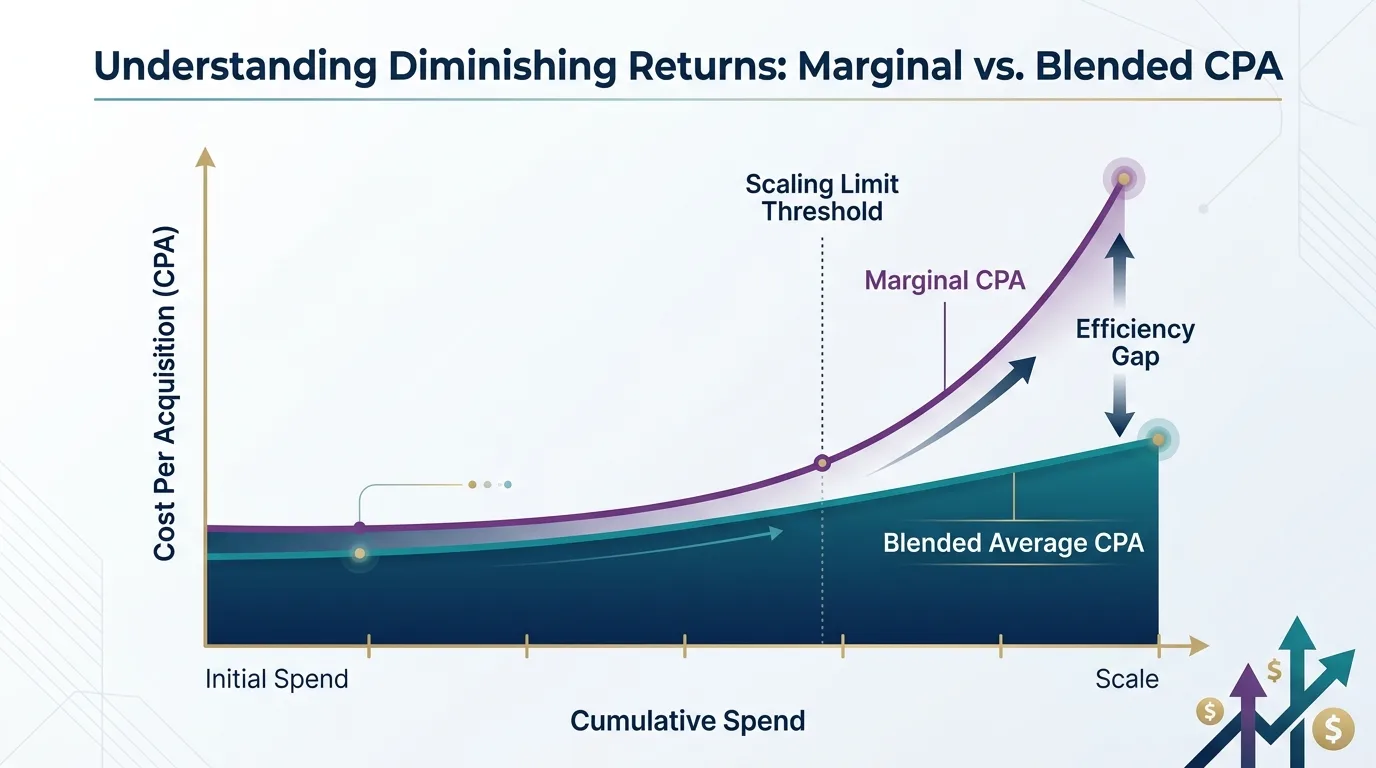
That does not mean scale is unprofitable. It means the team needs a clear marginal efficiency threshold. A campaign that moves from a $40 CPA to a $48 CPA may be a problem if contribution margin cannot support it. For a subscription business with strong retention or an ecommerce brand with repeat purchase behavior, it may be entirely acceptable. The decision should be based on economics, not a rigid platform benchmark.
Audience saturation raises the cost of the next conversion
Most teams notice audience saturation after frequency rises, but frequency is only one signal. Saturation can also show up as stable click-through rates paired with falling conversion rates, rising CPMs within a previously reliable audience, or weaker new-customer mix.
The platform may still find impressions. The issue is that the people seeing the ads have already converted, decided not to convert, or have seen enough of the message to stop responding. Retargeting pools are particularly vulnerable because they are finite by design. Repeatedly asking a small group to carry more spend will inflate frequency and reduce incremental return.
Broad targeting can delay this problem, but it does not remove it. Broad campaigns depend on the platform’s ability to find new pockets of demand. If creative, offer, and conversion data do not give the algorithm enough strong signals, broad delivery becomes expensive exploration rather than profitable expansion.
Creative fatigue is usually a production problem
A creative can decline because the market has seen it too often. More often, it declines because the business has not produced enough distinct angles to keep reaching new motivations, objections, and awareness levels.
Changing a headline color or trimming three seconds from a video is not a meaningful creative refresh. Strong testing creates variation in the core sales argument: the hook, problem framing, proof, product demonstration, offer, audience context, and call to action. A direct-response founder testimonial, a comparison ad, a problem-solution static, and a product demo may all promote the same offer, but they give the platform different paths to demand.
Creative fatigue compounds when production is slow. By the time a team notices a winner weakening, briefs replacements, waits for approvals, and launches new assets, spend has already shifted toward deteriorating inventory. High testing velocity is not a branding preference. It is the control mechanism that keeps media buying from depending on a few aging winners.
Auction conditions change even when your account does not
CPMs, search costs, and conversion rates move with seasonality, competitor behavior, inventory supply, and consumer demand. A lead generation advertiser may see costs rise when competitors increase budgets around a regulatory deadline. An ecommerce brand may face compressed margins during promotional periods when every competitor is bidding for the same buyer. A publisher may find that the same traffic costs more while downstream monetization softens.
These changes are not always fixable inside the ad account. The practical question is whether the market shift affects your business disproportionately. If every comparable campaign becomes more expensive, you may need an offer adjustment, a revised margin target, or a temporary budget decision. If your account degrades while the market is stable, the issue is more likely creative, campaign structure, landing page performance, or measurement.
The Hidden Causes of Paid Media Inefficiency
The visible metric is usually CPA or ROAS. The root cause often sits further down the operating chain.
Measurement gaps cause bad optimization decisions
Platforms optimize to the events and values they can observe. If purchase events are delayed, lead quality feedback never reaches the platform, attribution is inconsistent, or offline revenue is missing, the algorithm learns from incomplete data. It may optimize toward cheap leads that do not close, low-value customers, or conversions that would have happened without the ad.
This is why a platform-reported ROAS can improve while business profitability declines. Channel reporting is useful for directional optimization, but it should be reconciled against source-of-truth revenue, margin, lead disposition, retention, and incrementality where possible.
Do not wait for perfect attribution. It rarely exists. Build a decision framework that combines platform signals with blended performance. Track new-customer acquisition separately from returning-customer revenue. Compare spend changes against total conversions and contribution profit. Where sales cycles are long, send qualified lead and closed-won feedback back into the media system quickly enough to matter.
Campaign fragmentation destroys signal quality
Accounts often become inefficient because too many campaigns, ad sets, audiences, and exclusions compete for the same users. Fragmentation divides data, restarts learning, complicates reporting, and gives operators too many places to hide weak performance.
Structure should reflect a real control need, not an old account convention. Separate campaigns when budgets, geographies, offers, conversion goals, or reporting requirements genuinely differ. Consolidate when splits prevent the platform from gathering enough conversion data or when overlap is driving internal auction competition.
The trade-off matters. Over-consolidation can hide meaningful differences in offer performance or audience economics. Over-segmentation produces noise and slow decisions. The right architecture gives the platform room to learn while preserving clear levers for budget allocation and testing.
The offer and landing page can become the bottleneck
Media teams are often asked to solve a conversion problem created after the click. If click-through rate holds while conversion rate falls, investigate the post-click experience before rewriting every ad. A slow mobile page, broken form, unavailable product variant, weak proof, unclear pricing, or mismatched message can erase gains made in the auction.
The same applies to the offer. Competitors may not have better targeting. They may have stronger bundles, faster fulfillment, clearer guarantees, more credible proof, or a sales team that follows up in minutes instead of days. Paid acquisition amplifies the full customer journey. It cannot compensate indefinitely for a weak one.
Diagnose the Decline Before You Change the Account
When efficiency falls, establish the pattern before acting. Look at the timing of the change, which campaigns and creatives are affected, and whether the deterioration appears above or below the click.
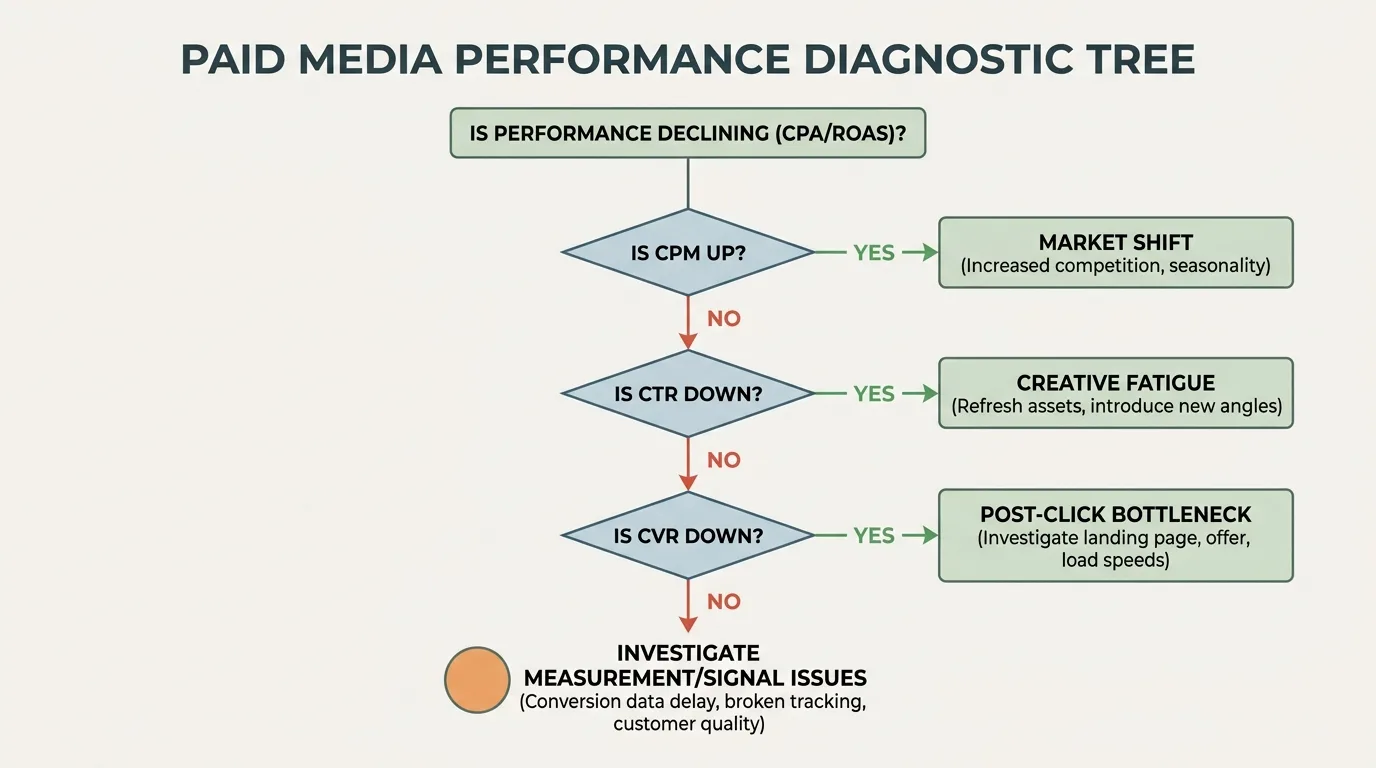
Four comparisons usually create clarity:
- Compare CPM, click-through rate, and conversion rate over the same weekday pattern, not just day-over-day.
- Separate new creative from mature creative to identify fatigue versus broad auction pressure.
- Review marginal performance at higher spend levels rather than relying only on blended account averages.
- Compare platform-reported conversions with qualified leads, new customers, revenue, and contribution margin.
If CPM rises but click-through and conversion rates hold, the market may simply be more expensive. If click-through rate falls on mature ads, creative fatigue is likely. If clicks remain efficient while conversion rate drops, investigate the landing page, offer, checkout, or sales process. If platform metrics look healthy but business outcomes weaken, focus on attribution, customer quality, and incrementality.
| Performance Symptom | Likely Cause | Recommended Next Steps |
|---|---|---|
| CPM rises but click-through and conversion rates hold | Market is more expensive | Review offer margins, check seasonal competitor bidding, adjust budgets |
| Click-through rate falls on mature ads | Creative fatigue | Refresh creative assets, run variations on the core sales hook |
| Clicks remain efficient while conversion rate drops | Post-click bottleneck | Investigate landing page loading speeds, checkouts, or sales follow-ups |
| Platform metrics look healthy but business outcomes weaken | Measurement / attribution gaps | Focus on blended acquisition cost, customer quality, and incrementality |
This diagnostic work prevents the common mistake of changing targeting, creative, budgets, and landing pages simultaneously. When everything changes at once, nothing is learned. Controlled testing may feel slower in the moment, but it is faster than repeatedly rebuilding the account around guesses.
Build an Operating System That Protects Efficiency
Profitable scale requires a repeatable rhythm: launch creative, classify performance, identify the reason a winner is working, produce informed variations, reallocate spend, and retire losers without delay. Creative and media buying need to operate as one system because neither can scale efficiently in isolation.
That system needs clear thresholds. Define what qualifies as an early creative signal, when an asset receives more budget, when it is cut, and what level of performance decline triggers a refresh. Use enough spend and enough time to avoid killing ads on random variance, while moving quickly enough that weak assets do not consume meaningful budget.
It also needs ownership. Reporting should not merely state that CPA rose. It should identify where it rose, why that is likely happening, what is being tested next, and what decision will follow if the test succeeds or fails. Operational clarity is what turns data into lower wasted spend.
The strongest paid programs do not depend on finding one evergreen ad or one perfect campaign structure. They create a disciplined pipeline of new demand signals and make better allocation decisions every week. When efficiency starts to slip, that discipline gives the team options before the decline becomes an expensive surprise.
Paid campaigns will always encounter diminishing returns as they scale. The advantage goes to the operator that can tell the difference between a normal marginal cost increase and a failing growth system, then respond with better creative, cleaner measurement, and faster execution.