The channel with the lowest cost per lead is often the one creating the biggest sales problem. If you are asking which channel drives qualified leads, the useful answer is not Meta, Google, TikTok, or any other platform in isolation. It is the channel that produces leads your team can contact, qualify, close, and retain at an acquisition cost that leaves room for profit.
That distinction sounds obvious. In practice, it gets lost when dashboards prioritize form fills, landing page conversions, or platform-reported cost per lead. Those are activity metrics. Qualified pipeline and revenue are business metrics. Paid acquisition only scales when the two are connected.
Which channel drives qualified leads? Start with intent
Every channel can generate leads. Fewer can generate the right lead at a volume and cost that support your growth model. The difference usually comes down to intent, offer-market fit, and how effectively your creative filters for the customer you actually want.
Search traffic often carries explicit intent. A prospect searching for a solution, provider, or price is telling you they are already problem-aware. That can make Google Search a strong source of sales-ready leads, particularly for high-consideration B2B services, local businesses, subscription products, and urgent consumer needs. The trade-off is competition. High-intent keywords tend to be expensive, volume can be limited, and broad match expansion can quickly dilute quality if it is not controlled.
Meta and TikTok create demand as much as they capture it. They are powerful when the market needs education, when the offer has a clear emotional or visual hook, or when your creative can qualify the audience before they click. These channels can deliver efficient scale, but weak messaging often produces cheap, curious, unqualified submissions. The platform did what it was asked to do: find people likely to complete a form. It was not asked to find people likely to become customers.
Native channels such as Taboola can be effective for editorial-style offers, lead generation funnels, and products that benefit from a longer explanation before conversion. They usually require a stronger pre-sell experience and disciplined creative testing. Sending cold native traffic directly to a short lead form can work, but it often hides a quality problem until the sales team starts chasing leads that never had enough context to buy.
The channel is only one variable. A strong offer with a clear qualification mechanism can outperform a weak offer on nearly any platform.
Define qualified before you buy more traffic
A qualified lead should not mean someone who submitted a form and included a phone number. Define qualification using the events that matter after the lead enters your CRM.
For a B2B company, that may be a lead from the right company size, industry, geography, and job function that books and attends a sales call. For an ecommerce brand with a high-ticket consultation flow, it may be a prospect with the appropriate budget who completes a fit assessment and purchases. For an app or subscription business, it could be a lead that activates, reaches a key product milestone, and converts to paid.
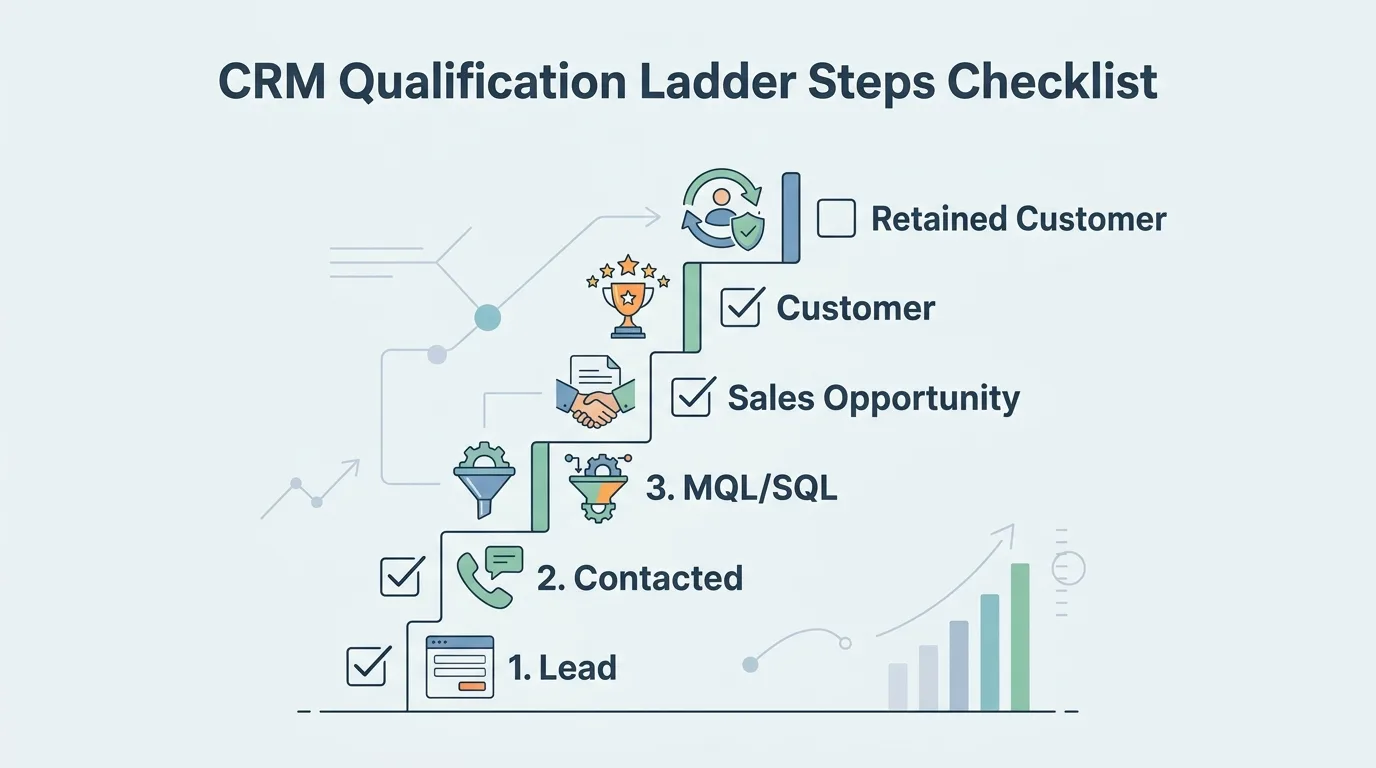
Build a simple qualification ladder: lead, contacted lead, qualified lead, sales opportunity, customer, and retained customer. Then agree on the precise rules for each stage. If sales rejects a lead due to budget, location, duplicate status, or lack of need, that reason should be captured consistently. Without this feedback, media buyers optimize against an incomplete version of reality.
The key metric is rarely cost per lead. Use cost per qualified lead as an operating metric, then evaluate cost per opportunity, customer acquisition cost, payback period, and contribution margin as volume increases. A channel producing $35 leads may be superior to one producing $12 leads if its qualified-lead rate is three times higher.
Match the channel to the buying journey
There is no universal winner because businesses sell at different levels of urgency and consideration.
Search is usually strongest when prospects know what they need and are ready to compare options. It captures existing demand well. It is less effective when your category is new, your buyer does not use obvious search terms, or the product needs demonstration before the value is clear.
Paid social is often the better growth engine when you need to reach an audience before it starts searching. It gives you more creative room to frame the problem, demonstrate the product, establish proof, and move people into a lead flow. For many brands, Meta is not a replacement for search. It is what creates the demand that later appears as branded search and direct traffic.
TikTok can be a major source of efficient reach for offers with a strong creator angle, a clear transformation, or a product that benefits from rapid visual explanation. It can also be a poor fit for sales cycles that require immediate trust, detailed technical validation, or senior executive approval. The answer depends on the message and buyer, not the platform’s popularity.
Native can extend reach to audiences consuming content rather than actively shopping. It is especially useful when advertorials, quizzes, assessments, and educational pages do meaningful qualification work before a user becomes a lead. Expect more funnel engineering than you would need for high-intent search.
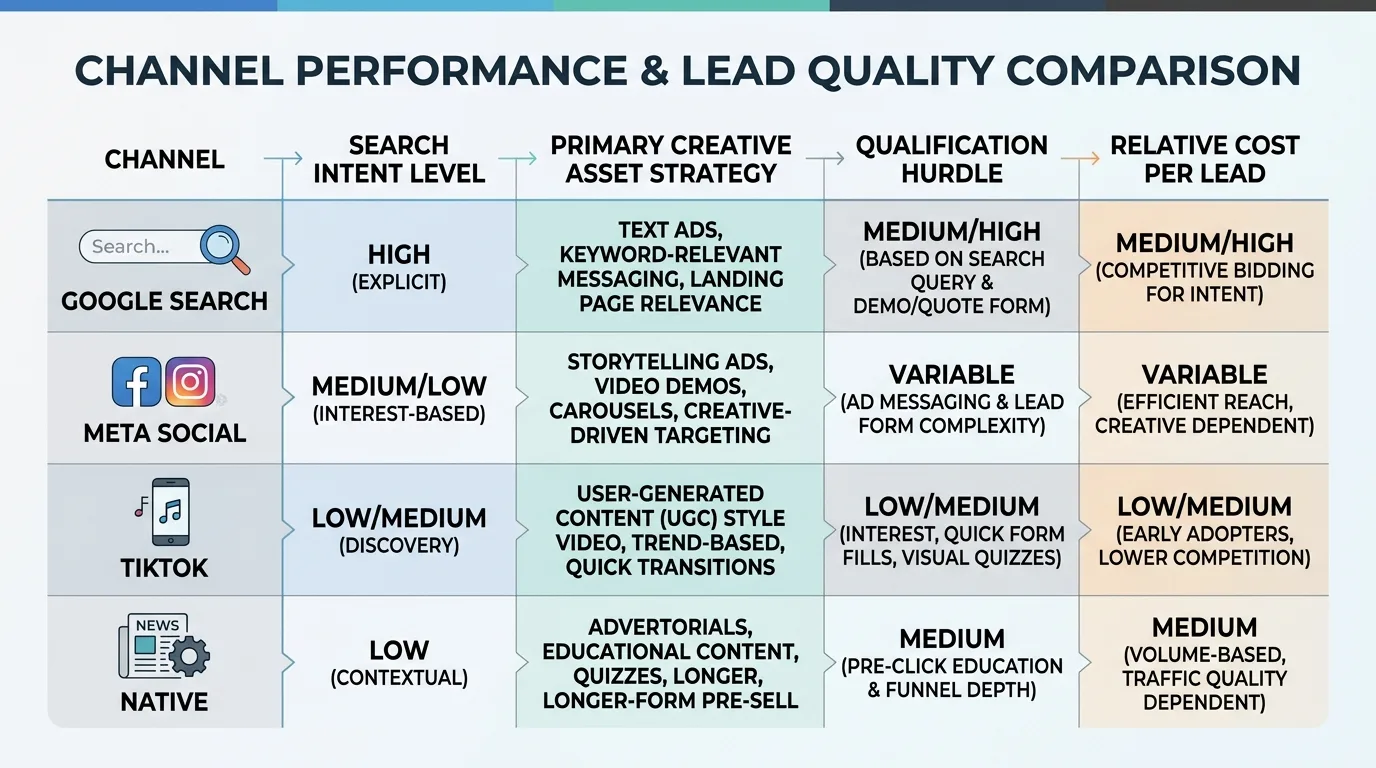
Channel Performance Comparison
| Channel | Intent Level | Speed-to-Trust | Best Qualification Method |
|---|---|---|---|
| Google Search | High | Fast | High-intent search terms & direct demo requests |
| Meta Social | Medium/Low | Moderate | Pre-click ad messaging & multi-step lead forms |
| TikTok | Medium/Low | Moderate | Creator-style transformations & visual quizzes |
| Native Ads | Low | Slow | Educational advertorials, assessments & pre-sell content |
Creative determines lead quality more than most teams admit
Media targeting is useful, but creative is often the highest-leverage targeting layer available. The ad determines who raises their hand. If the ad speaks broadly, promises too much, or hides the actual commitment, it will attract broad, low-intent volume.
Good qualification starts before the click. State who the offer is for. Be clear about the use case, price context when appropriate, location constraints, timeline, and next step. A lead form that asks for a budget range or business size can help, but the best filter is a message that causes poor-fit prospects to opt out before they consume sales capacity.
This does not mean making ads less compelling. It means making the promise specific. A vague message may produce a high click-through rate and a low cost per lead. A direct message can reduce both while increasing booked-call rate, close rate, and revenue per dollar spent. That is a favorable trade when your goal is profitable growth.
High testing velocity matters here. Test different customer problems, proof points, offer structures, formats, hooks, and qualification language. Do not declare a platform weak after testing three ads with the same underlying message. Often the channel is not failing. The creative has not found the right buyer signal yet.
Build measurement that can survive scale
Platform reporting is directional, not final. Each ad platform will claim credit according to its own attribution rules, and lead quality can change after the conversion event. Your operating system needs a source of truth that connects spend to downstream CRM outcomes.
Pass campaign, ad set, ad, creative, landing page, and offer identifiers into your CRM. Connect those identifiers to qualification and revenue stages. Where possible, send qualified-lead and customer events back to the platforms so their optimization systems receive better signals than basic form submissions.
Review performance in cohorts, not only in same-day dashboards. A channel that looks expensive during the first 48 hours may produce better opportunities after a seven-day sales cycle. Conversely, a channel that looks efficient on day one may collapse once contact rates and disqualification reasons arrive.
Use blended economics alongside channel-level attribution. If increasing social spend lifts total qualified opportunities and branded search conversions, last-click reporting may understate social’s contribution. If a channel’s reported results rise while total business outcomes stay flat, it may be claiming demand that would have converted anyway.
Test channels without creating reporting chaos
The right question is not, “Should we be on every channel?” It is, “What is the next test most likely to produce incremental qualified pipeline?”
Start with a controlled test budget, a defined conversion event, and a clear pass or fail threshold. Keep the offer and landing experience stable long enough to assess the channel, but test creative aggressively within that structure. Evaluate lead volume, qualification rate, speed to contact, opportunity rate, acquisition cost, and any early revenue signal.
Avoid forcing every channel to use the same funnel. Search may convert best on a direct demo request. Cold social may need a lead magnet, quiz, webinar, or proof-heavy landing page before a sales call is appropriate. The objective is consistent: earn qualified demand profitably. The route can differ by channel.
At Conversion Collective, creative and media operate as one system because that is how lead quality improves fastest. A media buyer needs rapid creative inputs when quality falls. A creative team needs downstream sales data to understand which messages attract buyers rather than browsers. Separating those functions slows learning and extends wasted spend.
The best channel is not the one with the cleanest platform dashboard. It is the one that gives your sales team conversations worth having and gives your business enough margin to buy the next customer with confidence. Keep the measurement honest, keep the creative moving, and let qualified pipeline decide where the next dollar goes.