A rising CAC is not a diagnosis. It is an alarm. If you want to know how to diagnose rising CAC, do not start by cutting budgets or demanding lower CPMs. Start by identifying where the economics changed: the auction, the ad, the funnel, the audience mix, or the measurement itself.
This matters because the wrong response compounds the problem. Cutting spend can hide a broken conversion path. Launching more campaigns can fragment data and make delivery worse. Blaming a channel can cause you to pull back from an audience that is still profitable at the right level of spend.
The job is to isolate the first metric that moved, then determine whether it is a temporary fluctuation or a structural shift.
Start With a Clean CAC Definition
Before investigating performance, make sure every stakeholder is looking at the same number. CAC should reflect the cost required to acquire a new customer, not simply the cost per platform-reported conversion.
For an ecommerce brand, that may mean total paid media spend divided by first-time purchasers. For a lead generation business, it may mean spend divided by qualified leads, approved applications, or funded customers. For subscriptions, the meaningful version is often spend divided by new subscribers who survive an initial retention threshold.
Platform conversion data is useful for optimization, but it is not the final answer. It can over-credit campaigns, miss offline outcomes, or change because of attribution settings rather than true customer behavior. Compare platform reporting with source-of-truth business data on a consistent lag. If CAC rose in the ad account but did not rise in CRM or order data, your first issue may be measurement, not acquisition efficiency.
Also separate blended CAC from channel CAC. Blended CAC tells you whether the business is becoming less efficient overall. Channel CAC tells you where to investigate. Both are necessary, especially when Meta, Google, TikTok, native, affiliates, and email are influencing the same customer journey.
How to Diagnose Rising CAC by Finding the First Break
CAC is the output of a system. Break it into the inputs that create it:
CAC = CPM / CTR / conversion rate, adjusted for your purchase or lead qualification rate.
That is not a perfect financial formula, but it gives the team a practical operating model. A higher CAC usually comes from one or more of four changes: media got more expensive, ads got weaker, the site or lead flow converted worse, or the quality of acquired users declined.
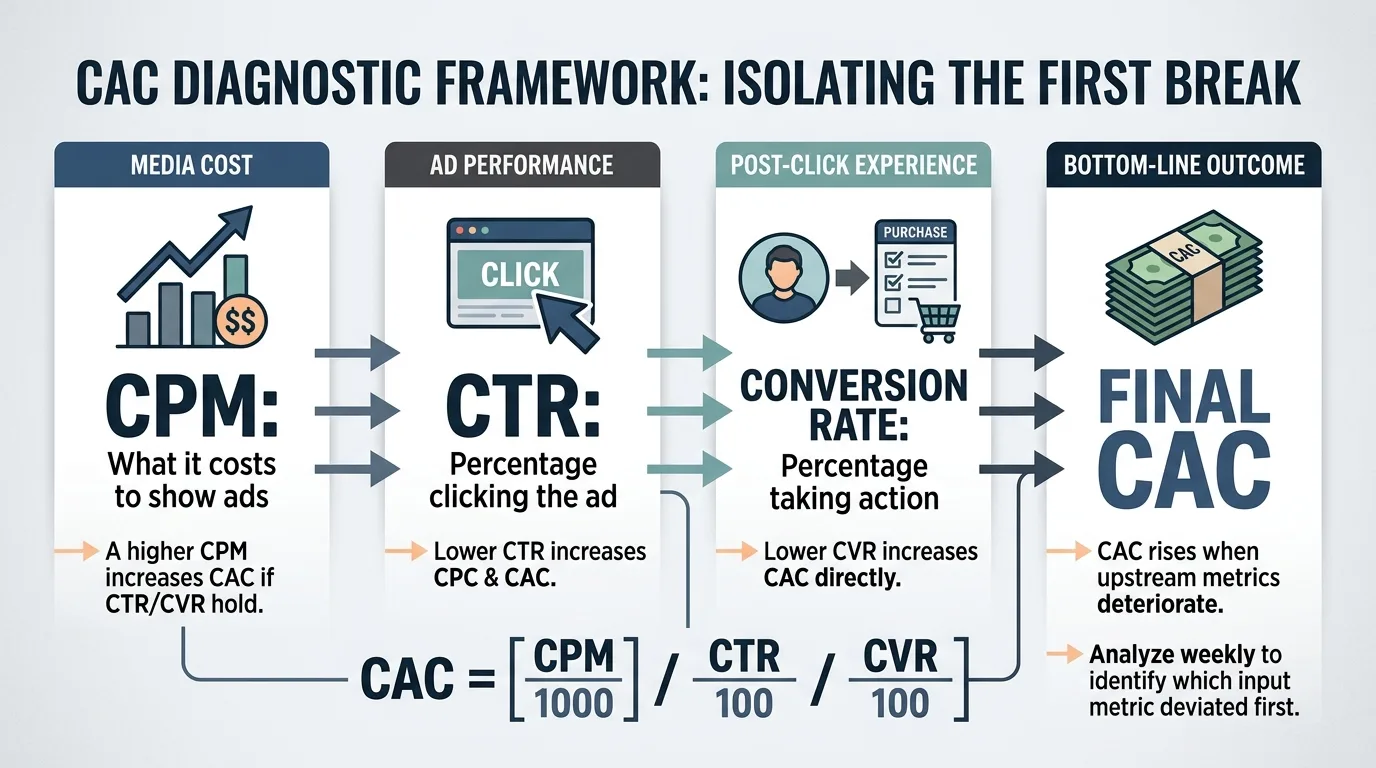
Pull a weekly view for the last 8 to 12 weeks, then compare it with the prior stable period. Review CPM, CTR, CPC, landing page conversion rate, cost per conversion, qualification rate, and revenue or margin per customer. Segment this view by platform, campaign type, audience, creative concept, device, geography, and new versus returning customers.
Do not look for one ugly blended number. Look for the earliest point of divergence.
If CPM rose while CTR and conversion rate held, auction pressure or audience availability is likely the issue. If CTR fell before CPC and CAC climbed, creative is usually the first place to look. If click costs are stable but the landing page conversion rate drops, the problem is after the click. If every front-end metric looks healthy but qualified CAC rises, your targeting, offer framing, lead routing, or sales process may be attracting lower-intent demand.
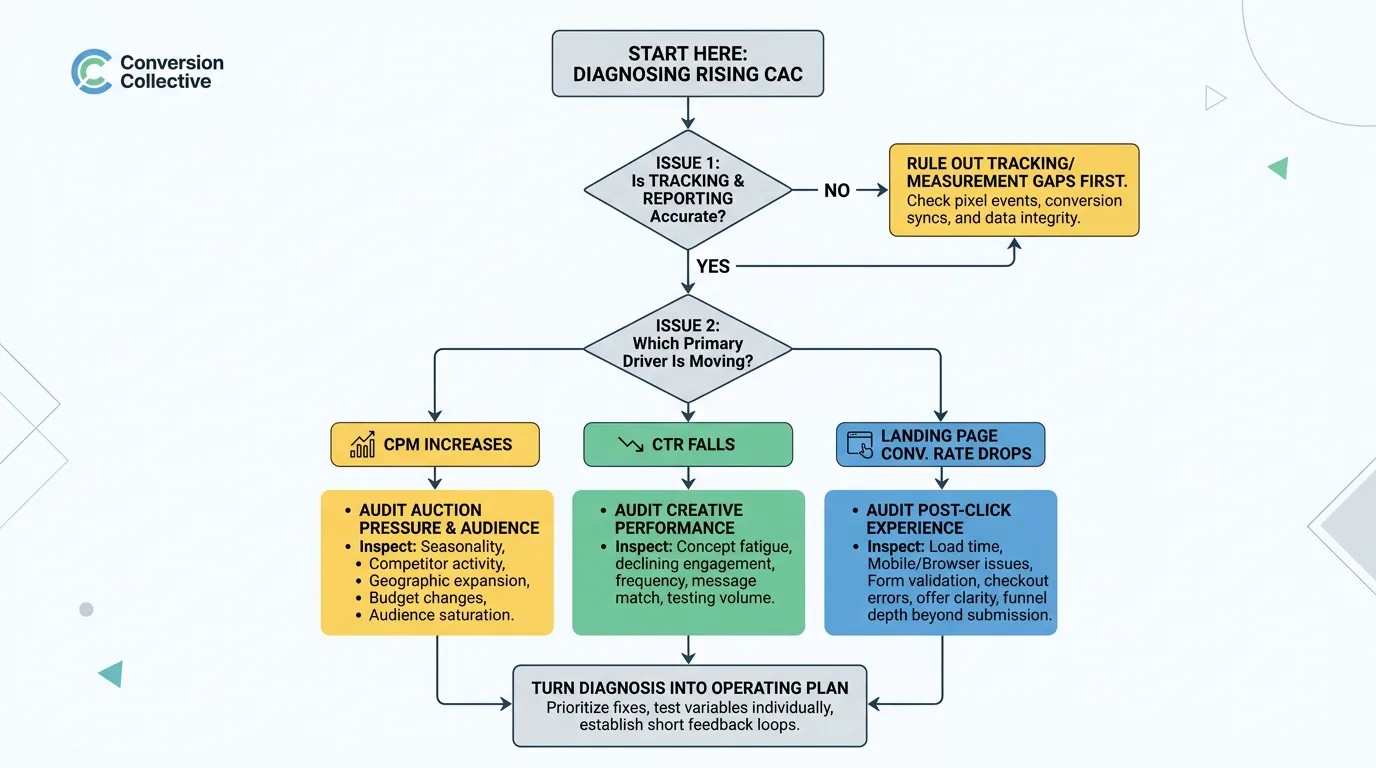
This sequence prevents teams from treating every CAC increase as a media buying problem.
Rule Out Tracking and Reporting Gaps First
A tracking problem can create weeks of bad decisions if it is not caught early. Check whether pixel events, server-side events, CRM uploads, purchase values, and attribution windows changed around the time CAC moved. Review consent rates, URL parameters, checkout releases, form changes, payment processor issues, and duplicate event firing.
A common failure mode is optimizing against a conversion event that no longer represents the business outcome. A lead form may still fire correctly, while lead quality collapses because required fields were removed or a qualification question changed. The media team sees stable CPL. The business sees rising CAC. Both reports are technically correct, but the optimization signal is no longer aligned with revenue.
Use a simple reconciliation process. Compare ad platform conversions, analytics conversions, and backend outcomes by day and by source. The numbers will never match perfectly. What matters is whether their relationship is stable. A sudden gap deserves investigation before the team rewrites its media strategy.
Determine Whether the Auction or the Creative Changed
When CPM is the primary issue, do not assume the platform has become permanently more expensive. Check seasonality, competitor activity, promotional periods, geographic expansion, audience saturation, and budget changes. A rapid budget increase can push delivery into more expensive impressions before the account has enough creative breadth to maintain efficiency.
There is a trade-off here. Restricting bidding, shrinking audiences, or capping costs may lower reported CAC in the short term, but it can also reduce volume and prevent the system from finding incremental customers. The better question is whether the marginal customer is still profitable, not whether every additional dollar performs like the first dollar.
When CTR falls, inspect creative performance at the concept level, not only by asset. One winning video may have dozens of edits, but they are still dependent on the same message. If that message has exhausted its audience, changing the hook or thumbnail will not fully reset performance.
Look for declining engagement, rising frequency within core audiences, lower thumb-stop rates for video, and a shrinking share of spend going to recent creative. Then compare new concepts against the previous control. High testing velocity matters because creative fatigue is rarely solved by one replacement ad. You need a system that produces enough distinct angles, offers, formats, and proof points to keep finding winners.
Audit the Post-Click Experience
Media teams often inherit CAC problems caused by a conversion path they do not control. That does not make it someone else’s problem. It makes shared visibility non-negotiable.
Review the customer journey on the devices and browsers driving spend. Test load time, checkout behavior, form validation, broken promo codes, payment errors, offer clarity, and message match between the ad and landing page. A creative that promises a fast quote but sends visitors to a long, generic form will generate expensive traffic even if the targeting is strong.
For lead generation, measure the funnel beyond submission: contact rate, qualification rate, appointment rate, show rate, close rate, and time to follow-up. A one-hour delay in lead contact can look exactly like a paid media deterioration when viewed only through CAC.
For ecommerce and subscriptions, examine average order value, discount depth, refund rate, and early churn alongside acquisition cost. A lower front-end CAC is not a win if it comes from customers who refund, churn, or require aggressive discounting to convert.
Check Mix Shifts Before Declaring a Channel Broken
Blended CAC can rise while individual campaigns remain stable because the business has changed where it spends. You may be allocating more budget to prospecting, entering a new geography, testing a broader audience, or moving from branded search into nonbrand search. Those moves often increase CAC while expanding the addressable market.
That can be healthy. It depends on contribution margin, payback period, retention, and the incremental value of the new customer. A mature brand cannot scale forever by harvesting branded demand or retargeting users who were already likely to buy.
Separate efficiency deterioration from intentional expansion. Create cohorts by acquisition date, source, campaign objective, and audience type. Then compare revenue quality and payback, not only day-one CPA. If new-market cohorts have a higher CAC but reach profitability within an acceptable window, the right action may be to improve the operating model around that expansion rather than shut it down.
Turn the Diagnosis Into an Operating Plan
Once the primary break is clear, assign an owner and a short feedback loop. If creative fatigue is driving the increase, launch new concepts against the highest-spend audiences and set a decision window before judging them. If the landing page is leaking, prioritize the fix ahead of more media tests. If auction inflation is the cause, protect profitable segments while expanding inventory through fresh creative, additional placements, or complementary channels.
Avoid changing ten variables at once. A new bid strategy, new landing page, new audience, and new creative launched on the same day may improve performance, but it will not teach you why. Controlled change is slower at the individual-test level and faster at the system level because it produces reusable insight.
The most effective teams maintain a weekly CAC diagnostic view, a creative testing queue, and a clear definition of profitable scale. That operational discipline is what keeps a temporary performance dip from becoming a quarter-long growth problem.
When CAC starts rising, move quickly, but do not rush to a verdict. The first metric that changed will usually tell you where the real work begins.