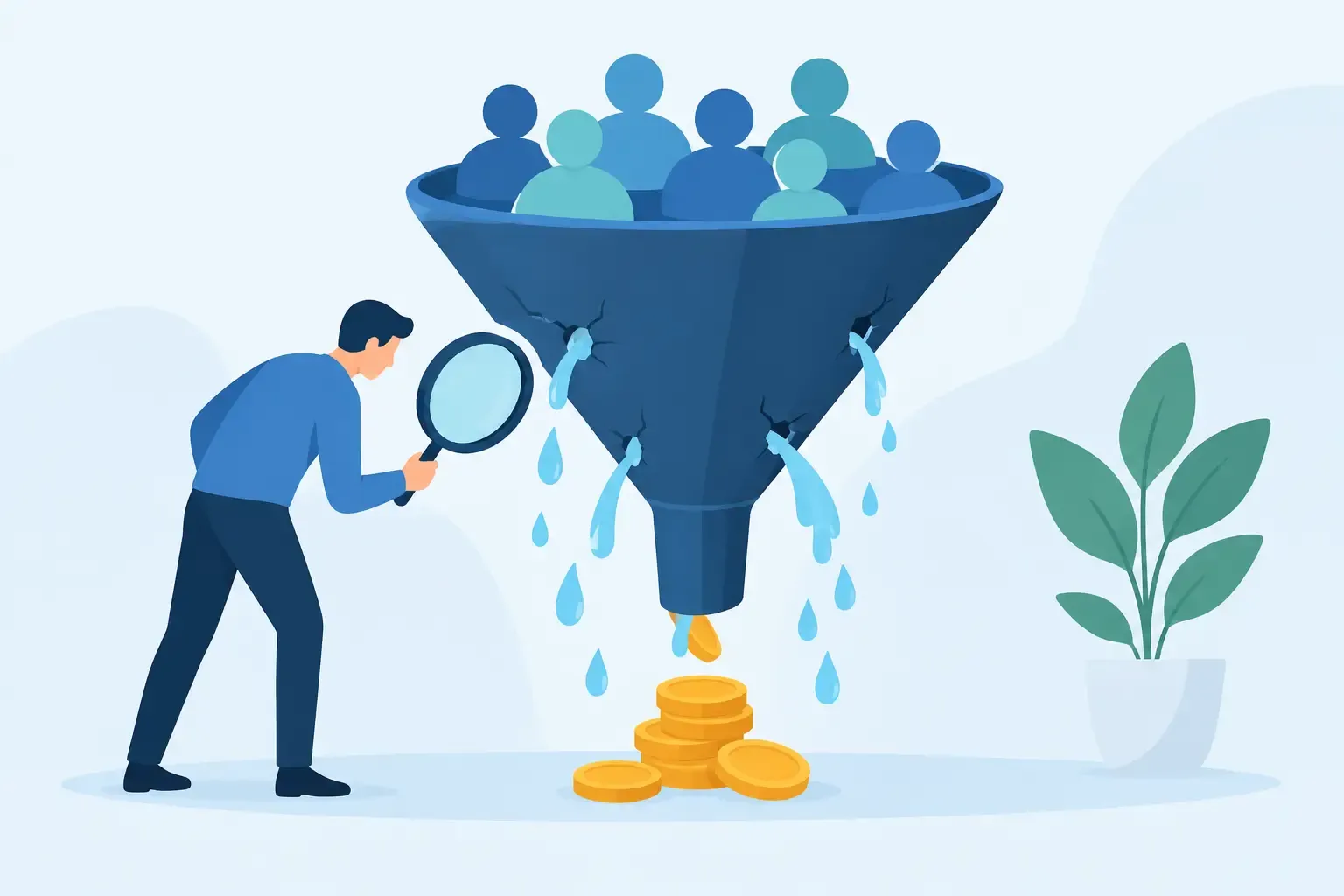
A rising CAC rarely starts with one bad campaign. It usually starts when a paid acquisition system loses its ability to identify, test, and scale winners fast enough. If you are asking what causes high CAC, the useful answer is not simply competition or expensive CPMs. Those are symptoms. The real causes are often hidden in creative fatigue, weak offer alignment, funnel friction, poor measurement, and slow operating cadence.
For growth teams, the goal is not to force CAC down at all costs. The goal is to understand which part of the system is consuming budget without producing incremental customers, then fix that constraint before scaling spend.
What causes high CAC in paid acquisition?
Customer acquisition cost increases when the cost to generate qualified traffic rises, the percentage of that traffic converting falls, or both happen at once. The basic math is simple: total acquisition spend divided by new customers. The diagnosis is not.
A higher CAC can be perfectly acceptable if customer quality, conversion to paid, retention, or lifetime value rises with it. A $150 CAC may outperform a $70 CAC if the first customer is far more likely to renew, repurchase, or become a high-value account. The problem is high CAC with no corresponding improvement in downstream economics.
That is why teams need to look beyond a blended number. Break the change apart by channel, audience, creative concept, landing page, offer, device, geography, and cohort. Averages can hide the exact campaign, segment, or funnel step where efficiency broke.
Creative fatigue and weak creative-market fit
For most paid social programs, creative is the first place to look. Platforms optimize toward engagement and conversion signals, but they need a steady supply of differentiated inputs to find new pockets of efficient demand. Running the same few ads for too long narrows the system’s options.
Creative fatigue does not always show up as a sudden collapse. More often, frequency climbs, click-through rate slowly declines, and CPM rises as the platform must work harder to reach people who will respond. Teams may then increase bids or broaden targeting, which can push CAC higher without solving the underlying issue.
Weak creative-market fit creates a different version of the same problem. The ads may earn cheap clicks but attract people who do not understand the product, do not qualify, or are not motivated by the offer. This is common when creative is built around generic benefits instead of a specific customer problem, proof point, objection, or use case.
The fix is not just making more variations of a winning ad. Volume matters, but meaningful variation matters more. Test different hooks, buyer anxieties, claims, formats, offers, visual angles, creators, and landing-page messages. A new headline on the same concept is not a testing system. It is a minor edit.
An offer that cannot carry the media cost
Even excellent media buying cannot make an uncompetitive offer profitable forever. If prospects can find comparable alternatives at a lower price, with less commitment, or with clearer proof, paid traffic becomes expensive because conversion resistance is built into the purchase decision.
Offer problems often get mislabeled as targeting problems. A team sees low conversion volume and assumes the audience is wrong. Then it cycles through interests, lookalikes, keywords, and placements while the actual issue is that the customer has no compelling reason to act now.
Review the offer from the buyer’s perspective. Is the value proposition clear in the first few seconds? Is the price justified with tangible outcomes or proof? Is there a credible reason to choose now rather than later? For lead generation, are you promising enough value to earn the form completion, and does the follow-up experience deliver on that promise?
There is a trade-off here. Discounts can improve short-term CAC, but they can also attract lower-intent customers, compress margins, and train buyers to wait for promotions. In many cases, better proof, stronger packaging, clearer risk reversal, or tighter qualification improves acquisition economics without weakening the business model.
Landing-page friction and conversion leaks
A paid campaign can generate qualified clicks and still produce a high CAC because the post-click experience is leaking demand. Landing pages commonly fail for simple reasons: slow load times, unclear message match, crowded pages, weak calls to action, long forms, checkout surprises, or too many steps before a prospect receives value.
Message match is especially important. If an ad promises a fast solution for a specific pain point, the landing page should continue that exact conversation. Sending visitors to a broad homepage forces them to rediscover why they clicked. Every extra decision introduces drop-off.
Do not judge the page only by its overall conversion rate. Segment performance by traffic source and creative. A landing page that works for branded search may fail for cold Meta traffic because those visitors need more education and trust. Conversely, a long-form page that performs for high-intent search can slow down users arriving from a direct-response video.
Prioritize the highest-impact leaks first. If qualified click volume is strong but conversion rate fell from 5% to 2.5%, the landing page or offer deserves immediate attention. If conversion rate is stable but cost per click doubled, focus upstream on creative, audience saturation, and auction dynamics.
Poor measurement creates false CAC problems
Sometimes CAC is genuinely high. Sometimes the reporting system is assigning credit poorly.
Platform-reported results, analytics tools, CRM data, and finance numbers often disagree because they use different attribution windows, identity resolution rules, revenue definitions, and timing. This becomes more pronounced when customers convert across devices, return through branded search, or complete purchases after a delayed sales process.
A weak measurement setup leads teams to cut campaigns that create demand because the conversion is credited elsewhere. It can also make retargeting look artificially efficient by giving it credit for customers influenced by prospecting, email, organic content, or direct traffic.
Use one operating definition of CAC for decision-making, then layer platform reporting underneath it for optimization. Connect ad spend to qualified leads, purchases, activated users, or revenue in the system that best reflects the business outcome. For longer sales cycles, evaluate cohorts by mature conversion rates instead of making major budget decisions based on early lead volume alone.
Measurement will never be perfect. The standard is not perfect attribution. It is a consistent view that helps the team make better allocation decisions over time.
Slow testing velocity and fragmented ownership
High CAC often persists because no one is operating the full acquisition loop. Creative is handled by one team, media by another, landing pages by a third, and reporting by someone who sees the results weeks later. By the time a performance signal reaches the people who can act on it, too much budget has already been wasted.
Speed matters because paid media environments change quickly. A winning concept can fatigue. A new competitor can alter auction prices. A platform update can change delivery. Teams that launch, measure, and iterate quickly can cut losers before they become expensive and move budget into validated winners while the opportunity is still open.
This requires a disciplined operating system: clear naming conventions, clean tracking, a repeatable creative brief, structured test design, launch quality control, and reporting that distinguishes signal from noise. It also requires ownership. Someone must be accountable for turning performance data into the next creative, targeting, bid, or funnel decision.
At Conversion Collective, creative production and media buying are treated as one performance system for this reason. Creative is not a monthly deliverable. It is an active input to optimization.
Audience saturation, channel limits, and auction pressure
Some CAC increases are structural. If you have already reached your highest-intent audience, the next dollar of spend will usually be less efficient. This is normal diminishing returns, not necessarily poor execution.
The mistake is treating a saturated audience as a reason to keep forcing more budget through the same campaigns. Watch marginal CAC, not just blended CAC. If adding 20% more spend raises CAC sharply while conversion quality falls, the channel may be at its efficient capacity for that audience and offer.
At that point, expansion should be deliberate. Test new creative angles before simply broadening audiences. Add channels when you have a clear role for them in the customer journey. Search may capture existing demand, while Meta, TikTok, Taboola, or other discovery channels can create and qualify demand differently. Each channel needs its own creative, measurement expectations, and economics.
How to diagnose high CAC without creating more chaos
Start with a short time-series view. Compare the last seven, 14, and 30 days against a stable baseline, then isolate where the deterioration began. Look at CPM, click-through rate, cost per click, landing-page conversion rate, purchase or lead quality, and downstream conversion rate.
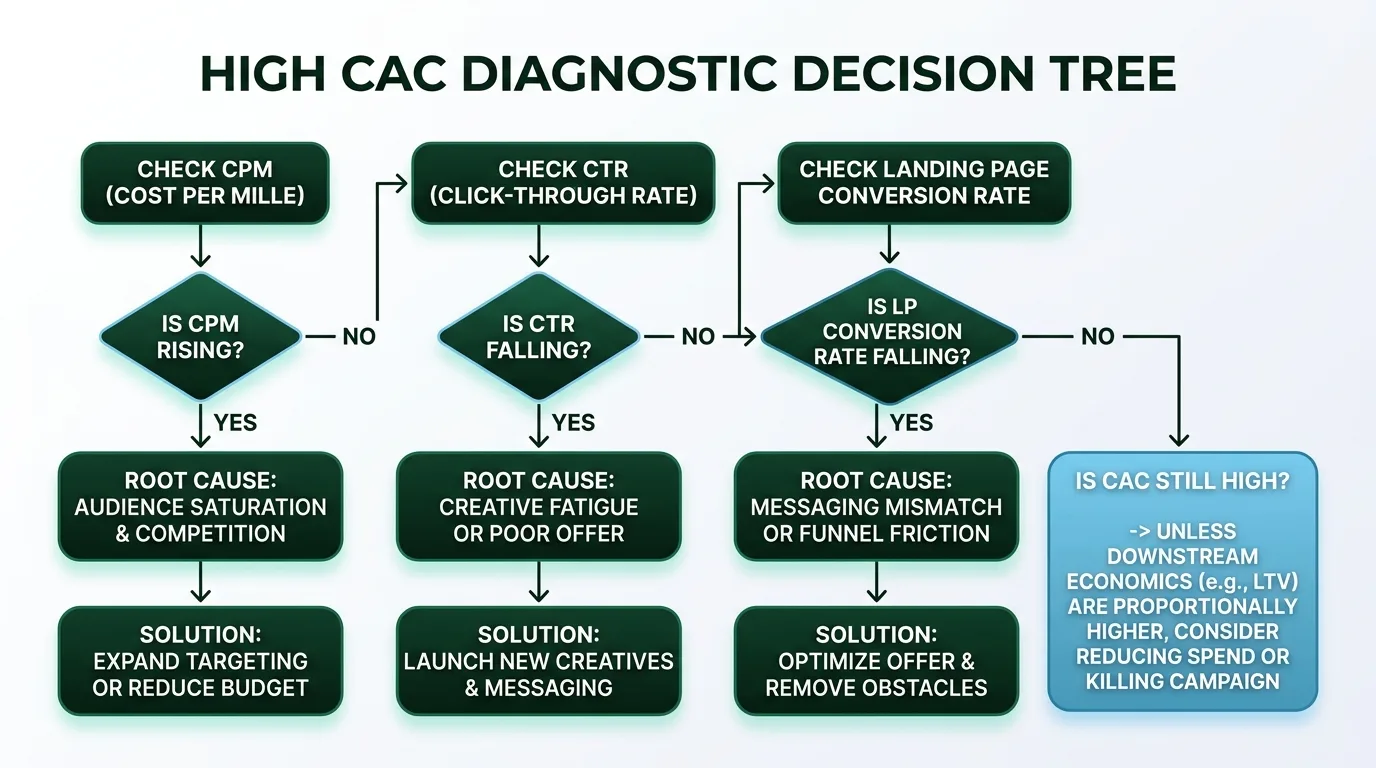
If CPM is rising while click-through rate is stable, investigate auction pressure, audience saturation, and budget concentration. If click-through rate is falling, creative is the likely constraint. If traffic metrics are stable but CAC rises, look at the landing page, offer, checkout, lead handling, and data quality. If platform CAC rises but business-level CAC does not, validate attribution before making aggressive cuts.
High CAC Diagnostic Quick Reference
| Metric Trend | Likely Root Cause | Recommended Action |
|---|---|---|
| Rising CPM, Stable CTR | Auction pressure, audience saturation, or budget concentration | Investigate audience targeting, diversify channels, or adjust bidding strategy |
| Falling CTR | Creative fatigue or poor creative-market fit | Launch new creative concepts, test fresh hooks, or update ad copy |
| Stable Traffic Metrics, Rising CAC | Landing page friction, weak offer, checkout issues, or lead quality drop | Optimize conversion paths, simplify forms, or audit checkout experience |
| Rising Platform CAC, Stable Business-Level CAC | Attribution discrepancy or tracking loss | Validate attribution rules and cross-channel tagging before cutting spend |
Then choose one or two high-confidence actions. Launch a new creative batch against the weakest message angle. Remove a conversion step. Tighten lead qualification. Shift budget away from campaigns with deteriorating marginal returns. Resist the urge to change every variable at once. Fast testing is valuable only when the team can still learn what caused the result.
High CAC is not a verdict on a channel or a business. It is a signal that the acquisition engine needs a clearer constraint, a faster feedback loop, and a more disciplined next test. Find the leak closest to the economic change, fix it with speed, and let the numbers determine what earns the next dollar of spend.