
A campaign is spending $20,000 a day, CPMs are stable, and the media team wants more video because video is supposed to stop the scroll. Meanwhile, a simple static image is quietly generating the lowest cost per qualified lead. This is why static ads versus video ads is the wrong debate when treated as a winner-take-all choice.
The format does not create performance on its own. The offer, audience, message, placement, landing-page match, and speed of iteration matter more. Static and video ads solve different jobs inside a paid acquisition system. The brands that scale profitably build a process that gives both formats a fair test, identifies where each one wins, and reallocates spend before fatigue or wasted budget takes over.
Static Ads Versus Video Ads Is a Testing Decision
Static ads are fast to produce, easy to version, and unusually effective at isolating a single message. A strong image, a clear value proposition, proof, and a direct call to action can communicate the full reason to click in less than a second. That is valuable when an audience already understands the problem and needs a clear reason to choose your solution.
Video adds motion, pacing, demonstration, and emotional context. It can show a product in use, build belief through a customer story, answer objections, or turn a complex mechanism into something obvious. For products that need explanation or categories where trust takes time, that added context can improve conversion quality as much as click-through rate.
Neither advantage is permanent. A static ad can outperform video because it delivers the message faster. A video can outperform static because it earns attention long enough to make the message credible. The right answer depends on the conversion event, traffic temperature, creative concept, and channel economics.
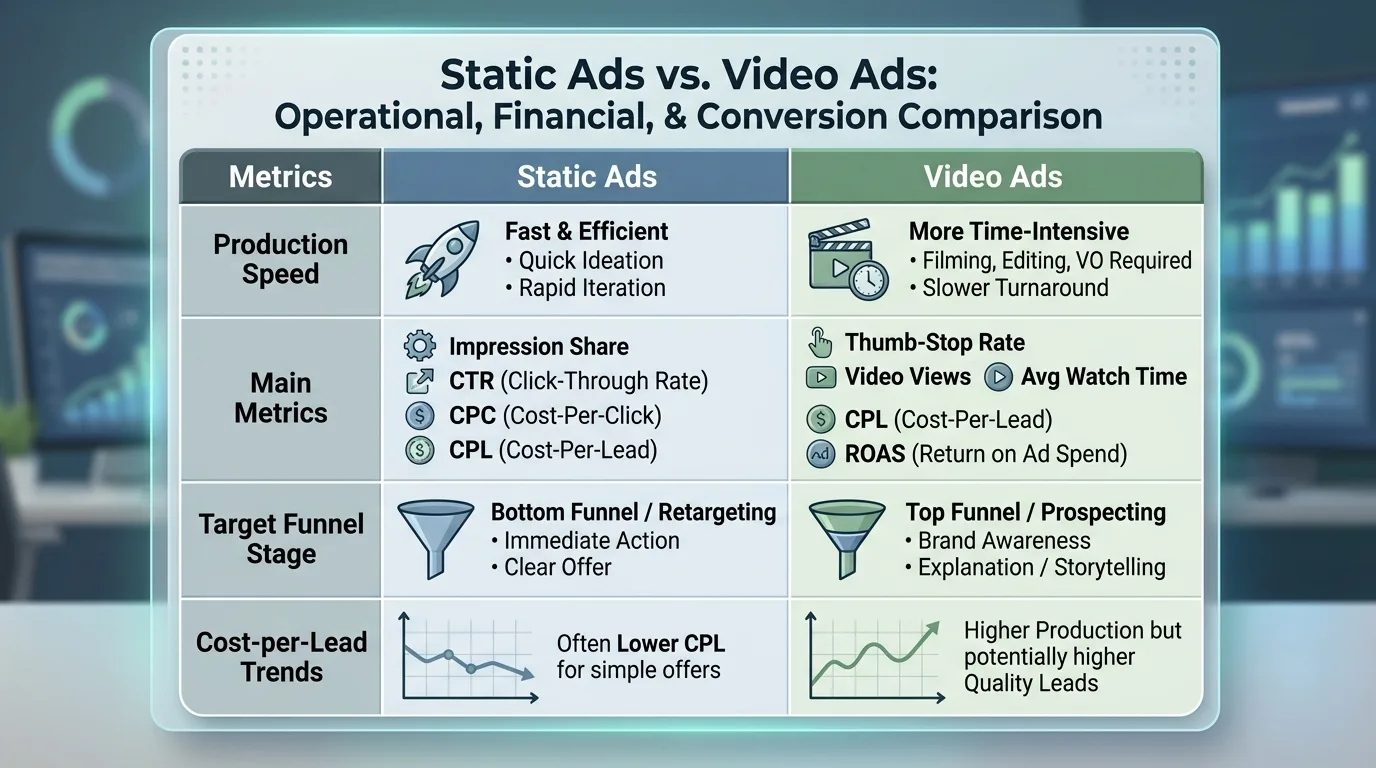
Treat format as a variable within a broader creative testing plan, not as a strategy by itself.
Where Static Ads Create an Advantage
Static creative is often underestimated because it looks simple. Operationally, simplicity is a competitive advantage. A team can produce multiple hooks, headlines, visual treatments, offers, proof points, and calls to action from one core concept without waiting on filming, editing, voiceover, or approvals.
That production speed creates more shots on goal. If a lead generation campaign needs to determine whether price, speed, social proof, or a pain point drives the best qualified volume, static ads make it possible to test those angles cleanly. When every test is a new video production, learning slows down and creative opinions start replacing data.
Static ads tend to work especially well when the value proposition is immediately understood. Think of a clear discount, a recognizable product, a direct quote, a strong before-and-after visual, or a benefit that can be stated in a few words. They can also be effective in retargeting, where the audience has already seen the brand and does not need a full introduction.
The trade-off is that static ads have less room to explain. If the offer is unfamiliar, the product has a long consideration cycle, or the buyer has meaningful objections, a single frame may not provide enough evidence to move someone forward. Trying to cram the entire sales argument into one image usually creates an unreadable ad rather than a high-converting one.
When Video Earns Its Production Cost
Video is worth the added production effort when seeing the message changes its meaning. A product demonstration, app walkthrough, creator testimonial, service explanation, or proof-based case study can establish understanding that a static image cannot deliver as quickly.
The first few seconds carry most of the burden. If the opening does not create recognition, curiosity, or a clear benefit, the rest of the edit will not matter. Many underperforming videos are not failing because they need better transitions or higher production value. They fail because the first frame does not communicate why the viewer should keep watching.
For performance teams, the useful question is not whether a video gets views. It is whether the video moves the business metric that matters. A high thumb-stop rate with weak landing-page conversion may mean the hook is entertaining but poorly qualified. Strong completed views with expensive acquisitions may indicate that the message is compelling but the offer or audience needs work.
Video also provides more components to test. The opening hook, creator, script, product demo, pacing, captions, proof, call to action, and length can all influence results. That flexibility is powerful, but it creates a measurement problem if the team changes everything at once. Version videos deliberately so performance data can point to a reason, not just a result.
Match the Format to the Job
A practical media plan does not assign static to one platform and video to another by default. It starts with the customer journey.
At the prospecting stage, video can introduce the problem, show the product, or make a new offer feel familiar. Static can test broad message angles at high velocity and find the claims that earn efficient clicks. Both are useful, and the mix should be driven by conversion data rather than a platform recommendation.
In mid-funnel campaigns, use formats that resolve the next objection. A customer testimonial video may reduce skepticism. A static comparison graphic may clarify price, features, or outcomes faster. For retargeting, direct response static ads often work because the audience already has context and needs a timely reason to act.
Channel mechanics matter as well. TikTok and short-form placements typically reward native-feeling motion and strong creator-led hooks. Meta can support both static and video at scale, particularly when the creative is designed for the placement instead of repurposed without adjustment. Google and native environments may favor clear visual claims and intent-aligned messaging over expensive storytelling. The platform is part of the decision, but it should not dictate the entire creative system.
Build a Fair Creative Test
The fastest way to get misleading results is to compare one polished video with one weak static image, then declare a format winner. Test concepts, not just assets.
Start with a defined hypothesis. For example: buyers who care about speed will respond better to a time-to-value claim than a discount. Build that claim into both a static execution and a video execution. Keep the audience, offer, landing page, optimization event, and spend conditions as consistent as possible. Now the team can see whether the message works and whether one format expresses it more effectively.
Measure performance in layers. CPM and thumb-stop rate tell you whether the ad earns attention. Click-through rate indicates whether the message creates intent. Landing-page conversion rate, cost per acquisition, qualified lead rate, revenue per visitor, and payback period tell you whether that attention is commercially useful.
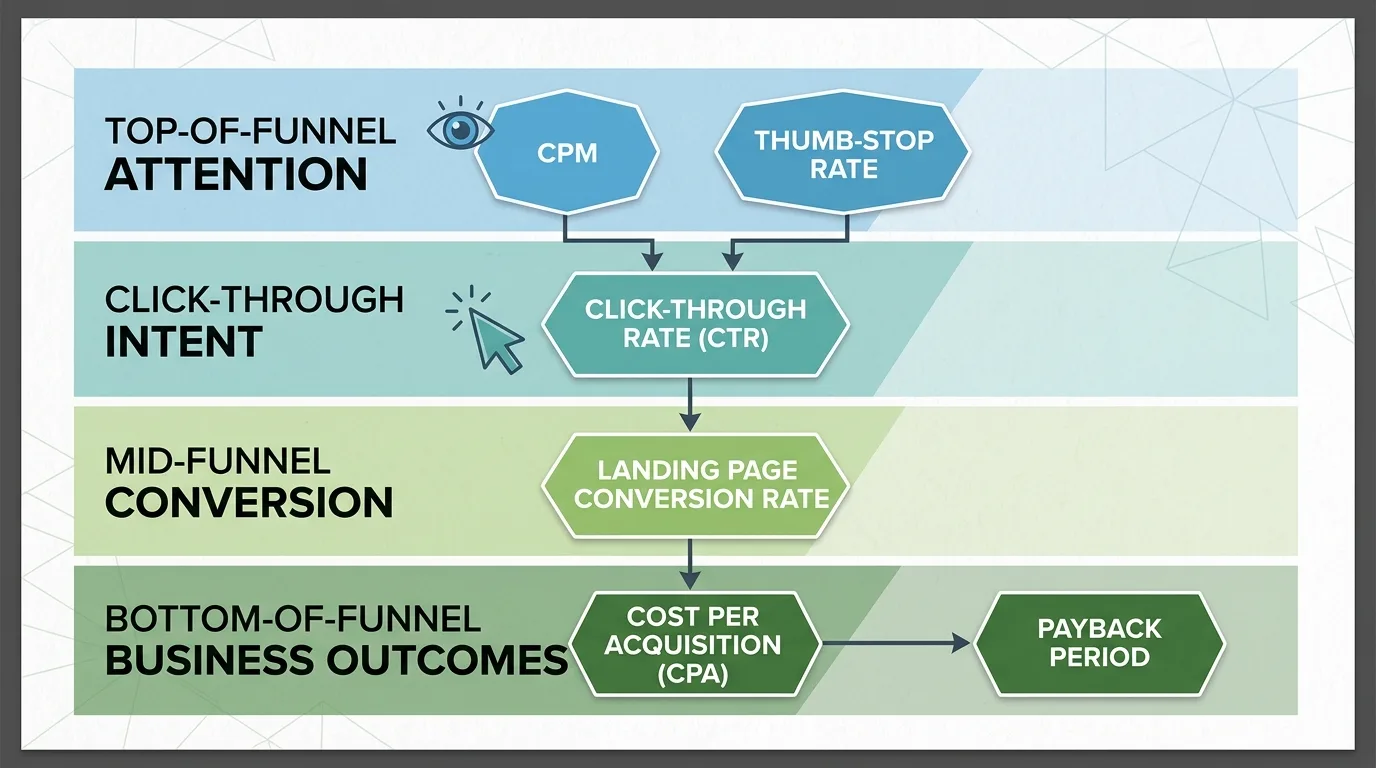
Do not kill an ad solely because its top-of-funnel metrics look average. A video with a modest click-through rate may pre-qualify users and produce stronger downstream conversion. Likewise, do not scale a static ad only because it has a cheap CPC if those clicks do not turn into revenue.
Set a minimum decision threshold before launch. The threshold should reflect your average order value, conversion rate, and expected acquisition cost, not a universal number. For lower-volume funnels, evaluate trends across a meaningful amount of spend and use lead quality or sales feedback to avoid making decisions on noise.
Creative Velocity Beats Format Loyalty
The real advantage comes from an operating system that keeps fresh creative entering the account while winners receive enough budget to prove themselves. That requires a connected workflow between creative production and media buying. When those functions operate separately, the creative team may optimize for aesthetics while the media team is left managing fatigue with too few usable variations.
Build modular creative systems. A winning static concept can become a video script, a creator brief, a carousel, and multiple placement-specific versions. A winning video hook can become a headline, a testimonial quote card, or a direct-response image. This turns every performance signal into a production input instead of a one-off result.
It also protects the account from fatigue. A winning format will eventually decline when the audience has seen it too often. The response is not to abandon the format. It is to refresh the hook, proof, visual treatment, offer framing, or audience-message match before efficiency collapses.
For large paid acquisition programs, centralized naming, consistent launch rules, and reporting that connects creative IDs to business outcomes are not administrative details. They are how a team learns quickly enough to scale. Conversion Collective approaches creative and media as one system for this reason: faster launches only matter when the resulting data is organized into clear next actions.
The Better Question to Ask
Instead of asking whether static or video ads are better, ask what the account needs to learn next. If you need to test five value propositions this week, static may provide the fastest answer. If the audience does not understand the product or trust the promise, video may be the more efficient path to qualified demand.
The strongest acquisition programs do not pick a side. They create enough volume, structure, and measurement discipline to let the market decide - then turn that decision into the next round of creative before the opportunity expires.