
A channel can look efficient in a weekly report and still be the wrong place to put the next $100,000. That is the operating question behind meta ads versus TikTok ads: not which platform is better in the abstract, but which one can produce profitable, repeatable acquisition for your offer, funnel, and creative capacity.
Meta and TikTok both reward strong creative, broad targeting, and fast feedback loops. The differences show up in user intent, creative shelf life, measurement reliability, and the systems required to turn an early winner into controlled scale. Teams that treat them as interchangeable usually end up with inconsistent creative testing, noisy attribution, and budget decisions made on incomplete signals.
Meta Ads Versus TikTok Ads: The Core Difference
Meta is generally the stronger conversion engine when a business needs to reach a broad adult audience, work across multiple funnel stages, and optimize toward a defined revenue event. Facebook and Instagram have mature delivery systems, deep audience behavior data, varied placements, and campaign structures built for ecommerce, lead generation, subscriptions, and app acquisition.
TikTok is a discovery engine first. It creates demand exceptionally well when the product can earn attention in-feed, the creative has a native point of view, and the advertiser can produce enough concepts to keep pace with the platform. Users are often less actively shopping than they are on Meta, which means TikTok can introduce an offer to people who would not have searched for or engaged with it elsewhere.
That distinction affects the job each channel performs. Meta often captures, converts, and retargets demand with more consistency. TikTok can expand the top of the funnel, find new pockets of demand, and drive efficient incremental volume. For many advertisers, the right answer is not choosing one platform. It is defining a different acquisition role for each and measuring that role accurately.
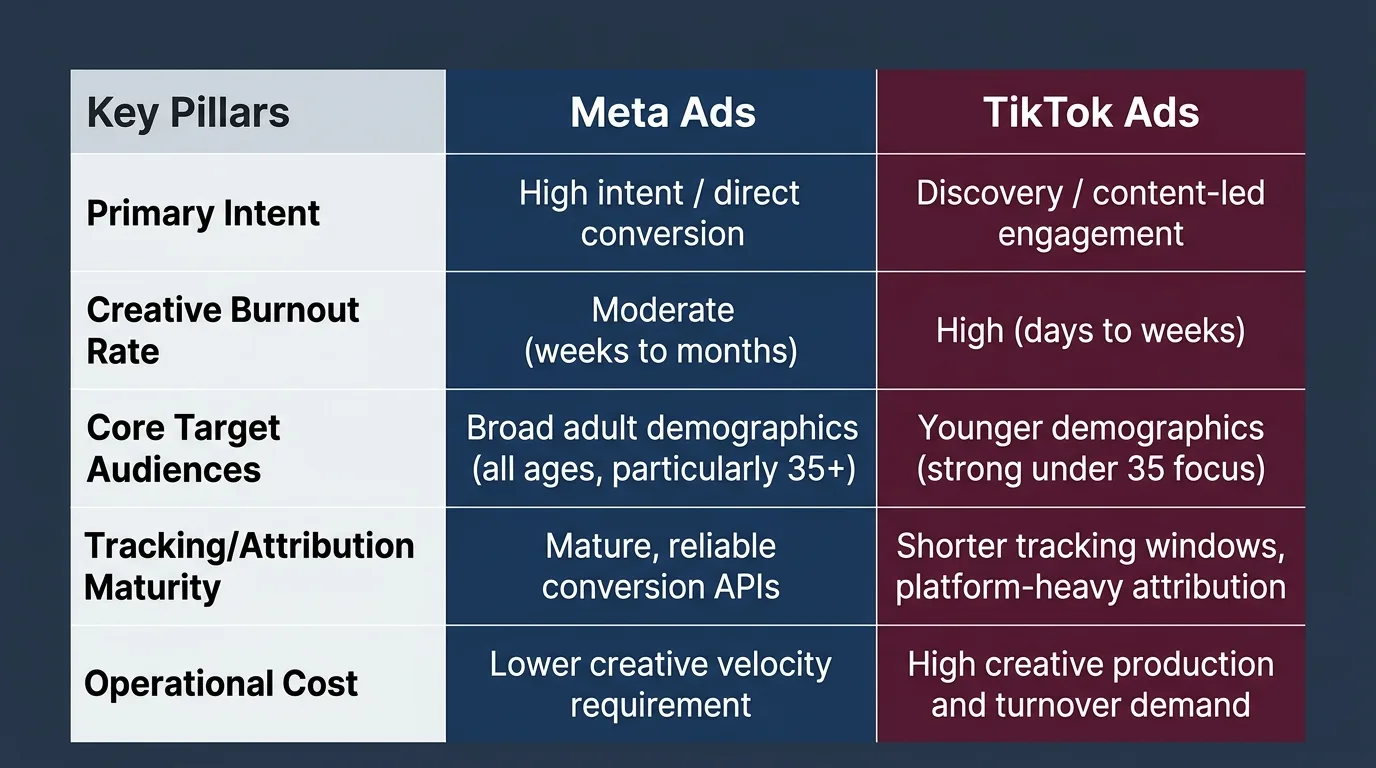
| Pillar | Meta Ads | TikTok Ads |
|---|---|---|
| Primary Intent | High intent / direct conversion | Discovery / content-led engagement |
| Creative Burnout Rate | Moderate (weeks to months) | High (days to weeks) |
| Core Target Audiences | Broad adult demographics (all ages, particularly 35+) | Younger demographics (strong under 35 focus) |
| Tracking/Attribution | Mature, reliable conversion APIs | Shorter tracking windows, platform-heavy attribution |
| Operational Cost | Lower creative velocity requirement | High creative production and turnover demand |
Where Meta Has the Operational Edge
Meta is usually easier to operationalize at meaningful spend because its campaign infrastructure supports a wider range of business models and buyer journeys. An ecommerce brand can run prospecting, catalog retargeting, creator-led video, statics, and offer-led ads within one integrated account structure. A lead generation business can optimize toward qualified leads, booked calls, or downstream sales events when the signal architecture is in place.
The platform also offers more room for creative formats. Static images, carousels, product demonstrations, founder videos, testimonials, comparison ads, and direct-response copy can all work. This matters because creative teams can test different angles without forcing every idea into the same short-form entertainment format.
Meta’s advantage becomes clearer when the purchase cycle is longer or the offer needs explanation. B2B lead generation, higher-ticket services, financial products, subscriptions with nuanced value propositions, and products aimed at buyers over 35 often find more dependable conversion volume there. That does not mean TikTok cannot work for these categories. It means Meta provides more ways to educate, qualify, and recover prospects before the final conversion.
There is a trade-off. Meta is highly competitive, especially in mature ecommerce and lead gen verticals. Strong account structure will not compensate for creative that looks like every other ad in the feed. Scaling on Meta requires a disciplined system for launching variations, isolating meaningful variables, identifying winners quickly, and refreshing fatigue before efficiency deteriorates.
Where TikTok Creates an Advantage
TikTok’s core strength is its ability to make a message feel less like an ad and more like content someone chose to watch. That gives advertisers access to attention that is difficult to buy through polished brand creative alone. A sharp product demonstration, unexpected proof point, customer story, objection-handling video, or creator-style hook can generate demand before a user has formed purchase intent.
For products with visual transformation, immediate utility, novelty, or a clear problem-solution story, this can be powerful. Beauty, wellness, consumer apps, ecommerce products, education offers, and certain subscription businesses can find lower-cost reach and substantial new-user volume when the creative is built for the feed rather than repurposed from Meta.
TikTok can also be valuable when Meta prospecting starts to saturate. If frequency rises, CPMs climb, and new creative is no longer opening new audiences, TikTok may provide an incremental growth lever. The goal is not to move budget because the platform is popular. The goal is to establish whether TikTok adds profitable conversions that would not have occurred through Meta alone.
The constraint is creative velocity. TikTok performance can be volatile, and concepts can burn out quickly. A single creator-style winner is not a channel strategy. It is an input. Teams need a pipeline of hooks, talent, formats, angles, offers, and iterations that can be launched while the original concept is still producing. Without that pipeline, performance often spikes and then disappears.
Creative Is the Real Platform Decision
Most channel comparisons spend too much time on targeting and not enough on production capacity. Both platforms increasingly rely on automation and broad audience delivery. The competitive advantage is less about finding a hidden targeting setting and more about supplying the algorithm with enough high-quality creative inputs.
On Meta, the best ads can be polished or deliberately simple, but they still need a clear job. A static may test a new promise. A testimonial may reduce trust friction. A product demo may show the mechanism. A direct offer may convert buyers who already understand the category. The creative system should make those hypotheses visible in reporting.
On TikTok, the first seconds carry more weight. Creative needs an immediate hook, a credible voice, and a reason to keep watching. It should feel native without becoming vague. Native does not mean avoiding a call to action or hiding the offer. It means earning attention before asking for the conversion.
The mistake is uploading the same assets to both platforms and calling it cross-platform testing. A winning Meta static can inspire a TikTok script, but it is rarely the final TikTok ad. A strong TikTok creator video can become a Meta asset, but it may need tighter editing, clearer product framing, and more direct conversion language. Reuse the insight. Adapt the execution.
Compare Economics Beyond Platform ROAS
Platform-reported return on ad spend is useful, but it is not a budget allocation system. Meta and TikTok can claim credit for the same conversion, particularly when both are active in a short buying journey. Last-click reporting can overvalue demand capture, while platform dashboards can overstate the role of upper-funnel exposure.
Evaluate each channel against the metric that matches the business model: contribution margin, qualified cost per lead, trial-to-paid rate, retained subscriber value, or payback period. Then assess performance by cohort and geography where possible. If TikTok acquires lower-cost customers who churn faster, its apparent CPA advantage may not be real. If Meta produces higher initial CPAs but stronger repeat purchase behavior, cutting it may damage long-term profit.
There is also an operational cost. TikTok may require more creator sourcing, editing, approvals, and concept turnover. Meta may require a deeper mix of assets across prospecting and retargeting. Include production throughput in the channel decision. Media buying and creative are one system, and a media plan that exceeds the creative team’s output capacity will eventually fail.
A Practical Budget Allocation Framework
Start with the channel that has the clearest historical path to profitable conversion. For many established advertisers, that is Meta. Protect that baseline before moving meaningful spend into a new platform.
Then give TikTok a real test budget, not a token amount too small to generate useful signal. Build a defined testing window, establish the event you will optimize toward, and launch multiple genuinely different creative concepts. Measure early indicators such as hook rate, hold rate, click-through rate, landing page conversion rate, and cost per acquisition, but do not make a scaling decision on engagement alone.
As TikTok produces winners, increase spend in controlled steps while monitoring blended economics. Watch whether total new-customer volume rises profitably or whether TikTok simply takes credit for customers Meta would have converted. The answer may require holdout testing, geographic experiments, or a close read of blended CAC trends rather than a single dashboard.
Conversion Collective approaches this work as an execution system: high-volume creative inputs, structured launch processes, centralized reporting, and clear decisions about what deserves more budget. The point is not to force every dollar through every platform. It is to find the combinations of channel, message, offer, and audience that can scale without creating waste.
The next budget decision should come with a simple standard: fund the channel that can absorb more spend while preserving the customer quality and margin your business needs. If Meta is doing that, keep pressing. If TikTok proves it can create incremental profitable demand, build the creative machine required to support it.