
A winning Meta ad can stall the moment it reaches TikTok. A high-intent Google campaign can look inefficient when it is judged against a prospecting campaign built to create demand. That is why cross platform media buying is not simply the act of running ads in more places. It is the operating system that connects creative, spend, measurement, and decision-making across every acquisition channel.
For growth teams, the challenge is rarely opening another ad account. The challenge is expanding reach without multiplying confusion, reporting delays, creative bottlenecks, and wasted spend. The right system creates more testing opportunities while keeping one clear view of what is producing profitable growth.
What Cross Platform Media Buying Actually Means
Cross platform media buying is the coordinated management of paid media across channels such as Meta, Google, TikTok, Taboola, and custom inventory sources. The goal is not to force every channel into the same campaign structure or judge them by one simplistic metric. Each platform has different user intent, creative behavior, attribution limits, auction dynamics, and scaling thresholds.
Google often captures demand that already exists. Meta and TikTok can create demand through interruption, storytelling, and repeated exposure. Native placements can reach audiences in a research mindset, while custom channels may offer distinct pockets of efficient traffic. A disciplined media program gives each channel a defined job, then measures its contribution to the larger acquisition engine.
That distinction matters. When teams treat channels as isolated vendors, they often duplicate audiences, recycle weak creative too long, and optimize toward platform-reported results that do not translate to business outcomes. When they treat channels as one system, they can identify where the incremental customer is coming from, where creative fatigue is forming, and where the next dollar has the highest chance of producing margin.
The Real Constraint Is Operational Control
Most paid acquisition programs do not fail because the team lacks channel knowledge. They fail because execution cannot keep pace with the market. Creative production is too slow. Testing plans are inconsistent. Naming conventions break. Reporting arrives after the opportunity has passed. Buyers spend their week managing campaign hygiene instead of making better allocation decisions.
Cross-platform growth increases this pressure. One new channel means more formats, more audience logic, more launch requirements, and more data to reconcile. Without a consistent operating model, expansion creates complexity faster than it creates revenue.
The answer is standardization where it helps and channel-specific judgment where it matters. Teams need common campaign taxonomy, budget rules, creative tracking, and reporting definitions. They also need the freedom to adjust landing page strategy, optimization events, audience structures, and creative angles for the mechanics of each platform.
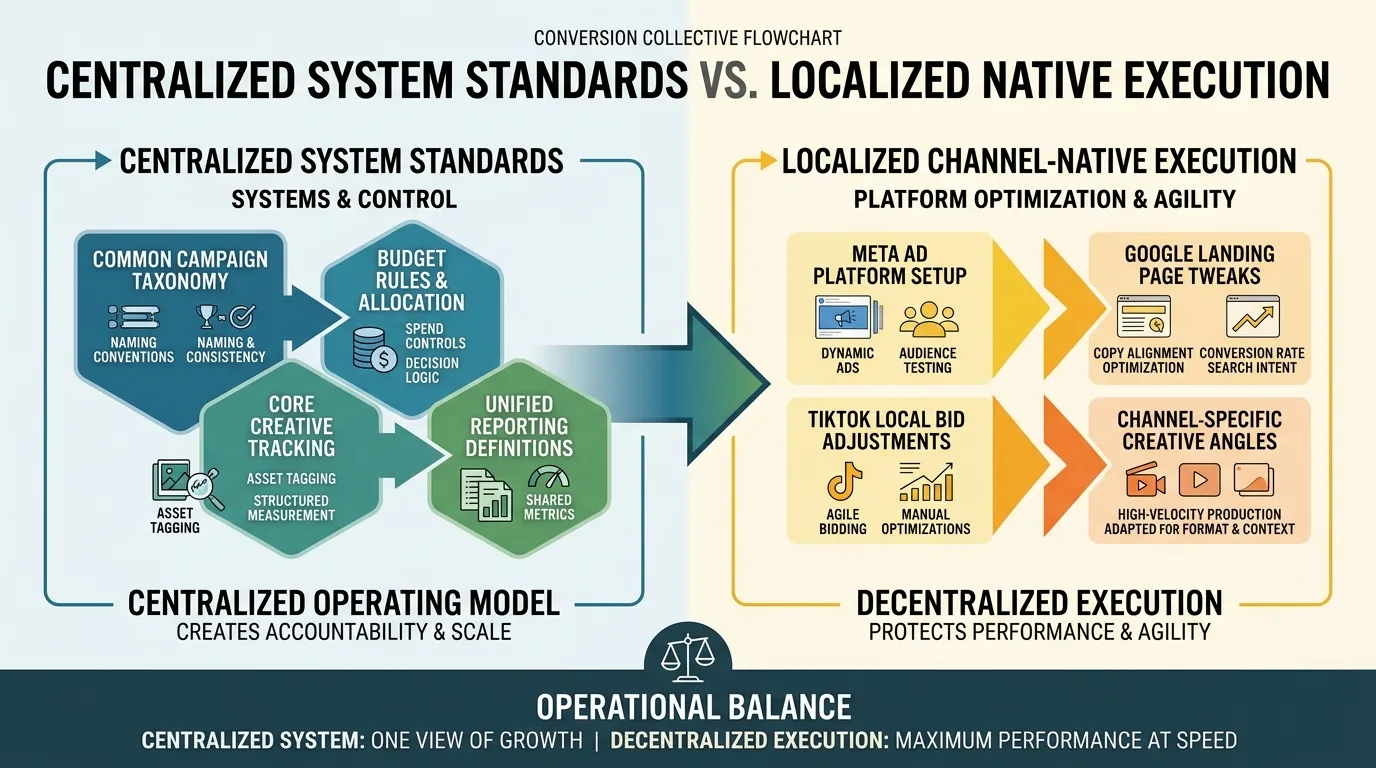
A useful rule is simple: centralize the system, not every decision. Centralized data and process create accountability. Platform-native execution protects performance.
Creative Is the Connection Between Channels
Media buying and creative are often managed as separate functions. That separation slows learning and produces generic assets that are repurposed without regard for placement, audience, or intent. It also obscures the strongest performance signal available: what the market is responding to right now.
Creative should be treated as a testing engine. A static ad, creator-style video, product demonstration, advertorial angle, testimonial, or offer-led message is not just a deliverable. It is a hypothesis about why a customer might act.
The same core insight can travel across platforms, but the execution should change. A strong TikTok hook may need faster pacing and native visual language. A Meta concept may need clearer proof points in the first frame. Search copy should align tightly with the problem the user is actively trying to solve. Native traffic may require more context before the click.
This does not mean creating from scratch for every placement. It means building a high-velocity creative process that develops concepts, adapts winners intelligently, and cuts underperformers before they consume more budget. The fastest-growing accounts usually have more than one winner because they are testing enough to find the next one before the current leader fatigues.
Measure Creative Beyond Click-Through Rate
Click-through rate is useful, but it is not a business model. An ad can earn cheap clicks by attracting curiosity rather than qualified buyers. Conversely, a lower-click-through-rate concept can produce stronger conversion rates, better lead quality, or higher subscription retention.
Track creative against the outcome that matters: contribution margin, qualified lead rate, first purchase profitability, trial-to-paid conversion, or predicted lifetime value. Then compare those outcomes by platform, audience, offer, and creative angle. This is how a team separates an attention winner from a revenue winner.
Build Measurement Around Decisions, Not Dashboards
A dashboard with dozens of charts can still leave a leadership team without an answer to the only question that matters: where should the next dollar go?
Strong reporting combines platform data with business data. Platform results are necessary for operational optimization, especially when making day-to-day decisions about bids, budgets, placements, and creative. But platform attribution has blind spots. It can over-credit the last ad interaction, miss cross-channel influence, and become less reliable as privacy rules change.
The solution is not to discard platform data. It is to put it in context. Use a clear source of truth for revenue or qualified conversions, maintain consistent tracking parameters, and evaluate performance across multiple windows. Watch blended customer acquisition cost, conversion volume, and margin alongside channel-level return.
For larger programs, incrementality tests and geo-based experiments can provide a clearer read on whether a channel is creating net-new demand or harvesting conversions that would have happened anyway. These tests take discipline and may not be practical for every budget level. But even smaller teams can improve decision quality by tracking holdout periods, monitoring branded search trends, and comparing spend changes against total business outcomes.
A Practical Operating Model for Cross-Platform Scale
The most effective programs run on a repeatable cadence. That cadence should make it easy to launch quickly, learn quickly, and move budget with confidence.
A Step-by-Step Operating Cadence for Scaling
- Establish clear economics: Define acceptable CAC, payback, or return targets before scaling.
- Assign channel roles: Align platforms (Meta, Google, TikTok, Taboola) to specific campaign intents.
- Create a testing backlog: Plan structured tests with measurable hypotheses rather than generic requests.
- Allocate budget by evidence: Protect exploration spend and shift capital based on performance.
- Review performance weekly: Meet to decide what is launched, scaled, or paused based on actual data.
Start with a single acquisition goal and economics that are understood by everyone involved. Define the acceptable customer acquisition cost, payback window, lead-quality threshold, or return target before scaling spend. If the target changes by product, market, or funnel stage, document those differences. Vague targets create vague optimization.
Next, assign each channel a role. Meta may be responsible for scaled prospecting and remarketing. Google may capture high-intent demand. TikTok may be used to find new audiences through creator-led testing. Taboola may support content-led acquisition. Channel roles can change as data develops, but starting with a purpose prevents duplicate effort.
Then create a testing backlog that connects creative ideas to measurable hypotheses. Instead of requesting “more ads,” define what is being tested: a new pain point, a different proof mechanism, a pricing objection, a customer segment, or a fresh offer. Launch enough variations to get signal, but avoid changing every variable at once. If the team cannot explain why an asset won, it cannot reliably scale the learning.
Budget allocation should follow evidence, not internal politics. Protect a portion of spend for exploration, move capital toward proven winners, and establish clear stop-loss rules for weak campaigns. The exact split depends on budget, creative volume, and business maturity. A company entering a new market needs more exploration than a mature account with reliable demand capture.
Finally, maintain a weekly performance review that produces decisions, not commentary. The meeting should answer which creative themes are winning, which channels are scaling efficiently, where efficiency is deteriorating, and what gets launched or paused next. If reporting does not change action, it is administrative overhead.
Common Mistakes That Inflate Spend
The first mistake is expanding platforms before the core execution engine is ready. More channels cannot compensate for weak creative throughput, unclear measurement, or a broken landing page experience. They only make those weaknesses more expensive.
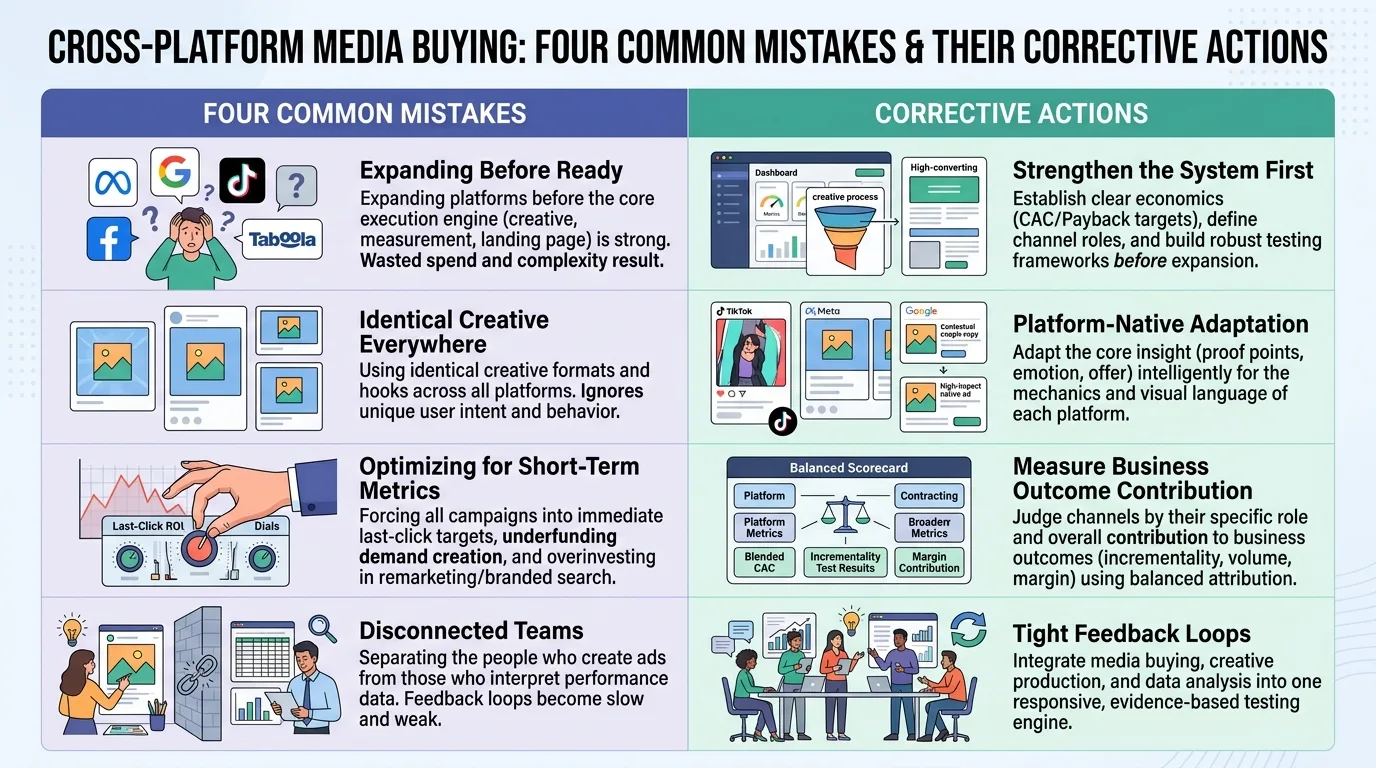
The second is using identical creative everywhere. Consistency of message is valuable. Identical formatting is usually not. Platform-native adaptation can materially change engagement, conversion quality, and spend efficiency.
The third is optimizing too aggressively for short-term platform metrics. If every campaign is forced to hit the same last-click return target immediately, teams often underfund demand creation and overinvest in remarketing or branded search. That may make channel dashboards look efficient while future growth slows.
The fourth is separating the people who make creative from the people who interpret performance. The feedback loop must be tight. Media buyers need to explain what audiences and messages are responding to. Creative teams need to turn that insight into new iterations at speed.
Scale Requires More Signal, Not More Noise
Profitable paid growth comes from a system that can process more information without losing clarity. The objective of cross platform media buying is not channel coverage for its own sake. It is the ability to find winners faster, fund them appropriately, and keep testing before performance plateaus.
Conversion Collective approaches this work as one integrated function: creative production, campaign execution, structured testing, and centralized performance insight. That model matters because the handoffs are where speed usually dies.
The next time a new platform looks like the answer, pressure-test the operating system first. If your team can launch, measure, learn, and reallocate quickly, additional channels become a controlled growth lever. If it cannot, the best investment may be fixing the system that turns spend into learning.