
A campaign can look profitable at 9:00 a.m., get scaled by noon, and reveal a very different story after refunds, delayed conversions, or missing browser events hit the data. That is the real business case behind server-side tracking vs pixels. This is not a technical debate for its own sake. It determines how confidently your team can test creative, optimize bids, cut losers, and move budget toward actual revenue.
For most performance teams, the answer is not to rip out pixels and declare victory with server-side tracking. Pixels and server-side events do different jobs. The winning setup is the one that gives ad platforms enough timely signal to optimize while giving your business a cleaner, more controllable measurement layer.
Server-Side Tracking vs Pixels: The Core Difference
A browser pixel is code that runs in the visitor’s browser. When someone lands on a page, views a product, submits a lead form, or purchases, the pixel sends an event to the advertising platform. Meta Pixel, Google tags, TikTok Pixel, and similar tools have powered paid acquisition for years because they are fast to deploy and directly connected to platform optimization.
Server-side tracking sends events from your server, backend, CRM, or cloud environment to the platform’s server. Instead of relying entirely on a browser to report that a purchase happened, your system can send a transaction event after it is confirmed in your order database or subscription platform.
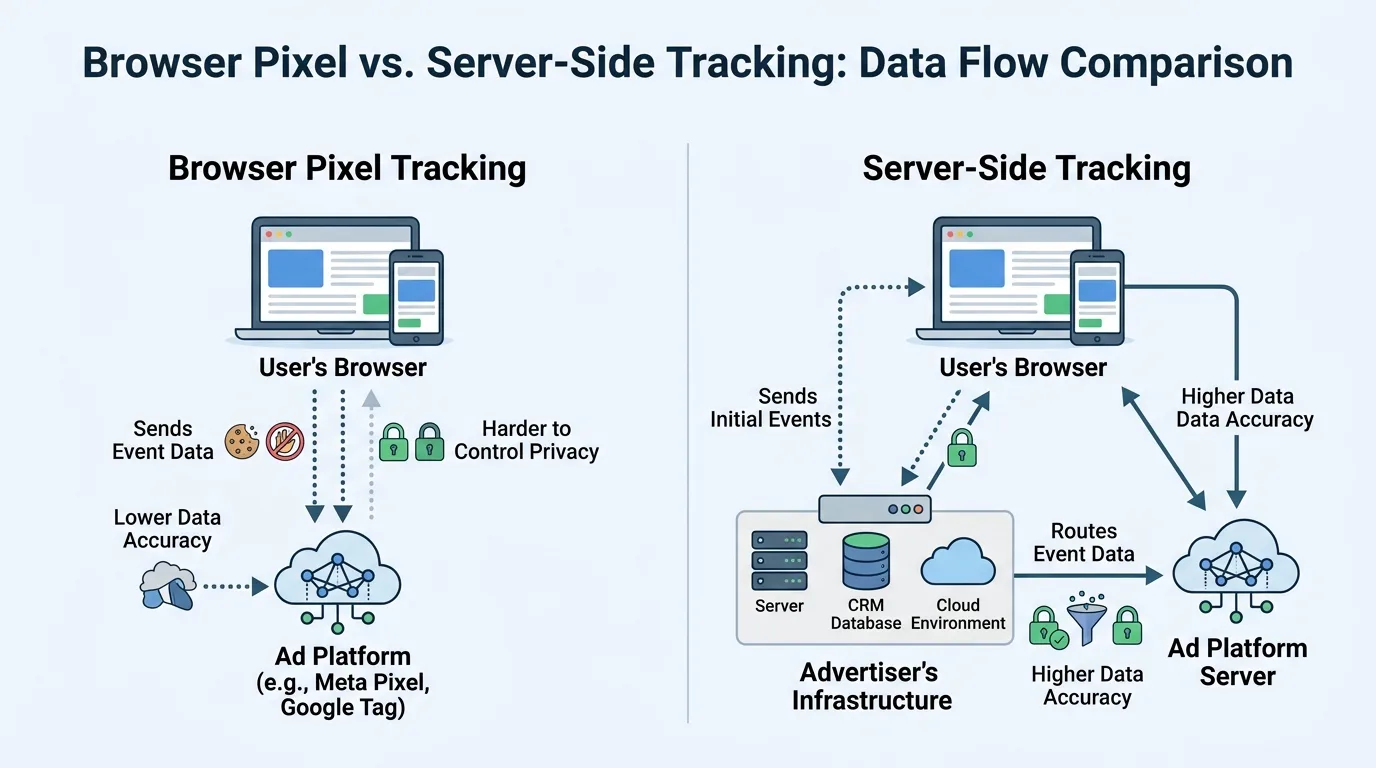
Pixel vs. Server-Side Tracking Comparison
| Dimension | Browser Pixels | Server-Side Tracking |
|---|---|---|
| Data Accuracy | Lower (susceptible to ad blockers, cookie limits, and network issues) | Higher (direct server-to-server connection, bypasses browser limits) |
| Implementation | Easy (simple script placement or tag manager setup) | Complex (requires API integration, developer resources, or cloud setups) |
| Latency | Near-instantaneous (real-time user action trigger) | Can be delayed (depending on backend processing and batching) |
| Privacy Compliance | Harder to control (browser sends data directly to third parties) | Better control (data can be filtered and anonymized before sending) |
The distinction matters because browsers are increasingly unreliable event reporters. Ad blockers, cookie restrictions, consent choices, browser privacy tools, slow page loads, and cross-device behavior all reduce the number of events a pixel can observe. Server-side tracking can recover part of that lost visibility because the event does not depend solely on client-side code firing successfully.
But server-side tracking is not a replacement for disciplined measurement. It is infrastructure. If the source data is wrong, event definitions are inconsistent, or deduplication is broken, sending more events only creates more confident-looking bad data.
Where Pixels Still Earn Their Place
Pixels remain useful because they capture immediate on-site behavior. Page views, landing page engagement, product views, add-to-carts, form starts, and button clicks are often easiest to collect in the browser. These signals help platforms understand user intent early in the funnel, especially when purchase volume is limited.
They are also fast to launch. A media team can deploy a campaign, validate that core events are firing, and start collecting optimization data without waiting for a complex backend integration. For a new offer, landing page test, or short-term campaign, that speed has real value.
The limitation is that browser events are not the same as business truth. A pixel may report a purchase before payment is fully processed. It cannot reliably account for cancellations, duplicate orders, rejected leads, chargebacks, or a sales team disqualifying a form fill two days later. If you optimize to that event without validation, the platform may find more of the wrong customers very efficiently.
That is why a pixel-only setup becomes less dependable as spend, funnel complexity, and sales-cycle length increase.
What Server-Side Tracking Improves
Server-side tracking improves control over what is sent, when it is sent, and how it is validated. A purchase can be triggered from an approved payment status rather than a thank-you-page load. A lead event can be enriched after CRM validation. A subscription event can reflect a successful first charge, not merely a trial signup.
For lead generation businesses, this is especially valuable. Sending every form fill back to an ad platform may optimize for low-intent submissions. Sending qualified leads, booked calls, issued policies, or funded accounts gives the algorithm a signal that is closer to revenue. The trade-off is delay. If the qualification event arrives days later and volume is low, platform learning can become slower and less stable.
For ecommerce and subscription brands, server-side events can improve purchase capture when browser signals are blocked or lost. They can also carry more useful data, such as order value, currency, product IDs, customer status, or subscription plan. That supports stronger value-based optimization, provided the fields are standardized and accurately mapped.
Server-side implementations also create a better audit trail. Your team can compare backend orders, analytics records, CRM outcomes, and platform-reported conversions instead of treating a single dashboard as the source of truth. When performance shifts, that visibility shortens the time between spotting a problem and fixing it.
The Trade-Offs Teams Underestimate
Server-side tracking adds operational complexity. You need event schemas, identity matching rules, consent handling, error monitoring, and a clear owner for maintenance. If creative, landing pages, checkout flows, and offers change frequently, tracking can break unless it is managed as part of the campaign launch process.
Deduplication is the most common failure point in a hybrid setup. If both the browser pixel and server send the same purchase event without a shared event ID, platforms may count it twice. Reported return on ad spend rises, budget scales, and the finance team eventually finds the gap. Every shared event needs a reliable deduplication strategy and regular checks against source-of-truth revenue.
Identity matching is another constraint. Server-side events typically perform best when they include approved identifiers such as hashed email, phone number, click IDs, or first-party cookies. If those fields are missing, malformed, or collected without appropriate consent, match quality falls. Better infrastructure cannot override privacy requirements or compensate for weak first-party data capture.
There is also a timing issue. Ad platforms need signals quickly. A fully validated revenue event may be more accurate but arrive too late to guide daily optimization. In many accounts, the right answer is a layered event strategy: use rapid on-site events for directional learning, then feed validated downstream events back to the platform for quality control and longer-term optimization.
Build a Measurement System, Not a Tracking Project
The best tracking architecture starts with the business outcome you are trying to scale. For an ecommerce brand, that may be profitable first purchases, not simply checkout completions. For a lead-gen program, it may be qualified leads or funded accounts. For an app, it may be retained users or subscriptions after a trial period.
Once that outcome is defined, work backward. Identify the earliest event that reliably predicts it, the final event that confirms it, and the lag between the two. This prevents a common mistake: optimizing campaigns toward a convenient event because it is easy to track rather than because it produces profit.
A practical setup usually includes browser pixels for immediate behavioral signals, server-side events for confirmed outcomes, and a reporting layer that reconciles platform data against backend performance. The exact mix depends on conversion volume. A high-volume ecommerce account can often optimize toward purchases quickly. A low-volume, high-consideration B2B funnel may need to optimize toward qualified form submissions or booked meetings while importing closed-won data to assess lead quality.
Your event taxonomy should stay simple. Define each event once, document its trigger, assign an owner, and keep naming consistent across Meta, Google, TikTok, Taboola, and internal reporting. When every channel uses a different definition of a lead or purchase, cross-platform optimization turns into a reporting exercise instead of a growth system.
How Tracking Changes Creative and Media Decisions
Good tracking does more than improve attribution. It improves testing velocity. When the team can trust event quality, it can identify whether a winning creative is generating real customers or merely cheap clicks and low-quality conversions.
That distinction matters when scaling. A bold claim, a discount-led hook, or an aggressive landing page can make a campaign look strong at the top of the funnel while attracting people who never convert into profitable customers. Server-side outcome data helps expose that gap sooner. It gives media buyers a better basis for deciding which ads deserve more spend and which apparent winners should be cut.
At Conversion Collective, this is the operating principle: creative volume only creates leverage when the measurement system can separate true winners from noisy signals. The goal is not more dashboards. It is faster, more accurate budget decisions.
The Practical Decision
If your current pixel data broadly matches backend sales and your funnel is simple, start by tightening event definitions, validating firing rules, and establishing regular reconciliation. You may not need an immediate server-side overhaul.
If browser-reported conversions are materially below backend outcomes, lead quality is invisible to ad platforms, privacy changes have weakened attribution, or teams are scaling based on unverified platform revenue, server-side tracking deserves priority. Start with the highest-value events, prove data quality, then expand. Trying to instrument every micro-action at once usually creates delay and confusion.
The strongest paid acquisition programs do not ask whether pixels or server-side tracking are better in isolation. They build a measurement system that moves quickly enough for media buying, accurately enough for finance, and cleanly enough for the team to scale with control.