
A paid media agency promises a 4x return on ad spend before it has audited your offer, margins, tracking, landing pages, or creative. That is not confidence. It is a red flag. Can agencies guarantee ROAS? Not honestly, at least not as a blanket promise that applies regardless of the business conditions behind the account.
A serious agency can guarantee process, execution standards, testing velocity, reporting discipline, and accountability. It can also put meaningful performance incentives behind its work. But a fixed ROAS outcome is affected by variables that sit both inside and outside the media account. The right question is not whether an agency will promise a number. It is whether it has the operating system to identify what is blocking that number and act on it quickly.
Can Agencies Guarantee ROAS? Only With Clear Limits
ROAS is simple on paper: revenue attributed to advertising divided by ad spend. In practice, it is an output of an entire acquisition system. Media buying matters, but so do product-market fit, pricing, conversion rate, average order value, retention, inventory, sales-team follow-up, attribution settings, seasonality, and competitor activity.
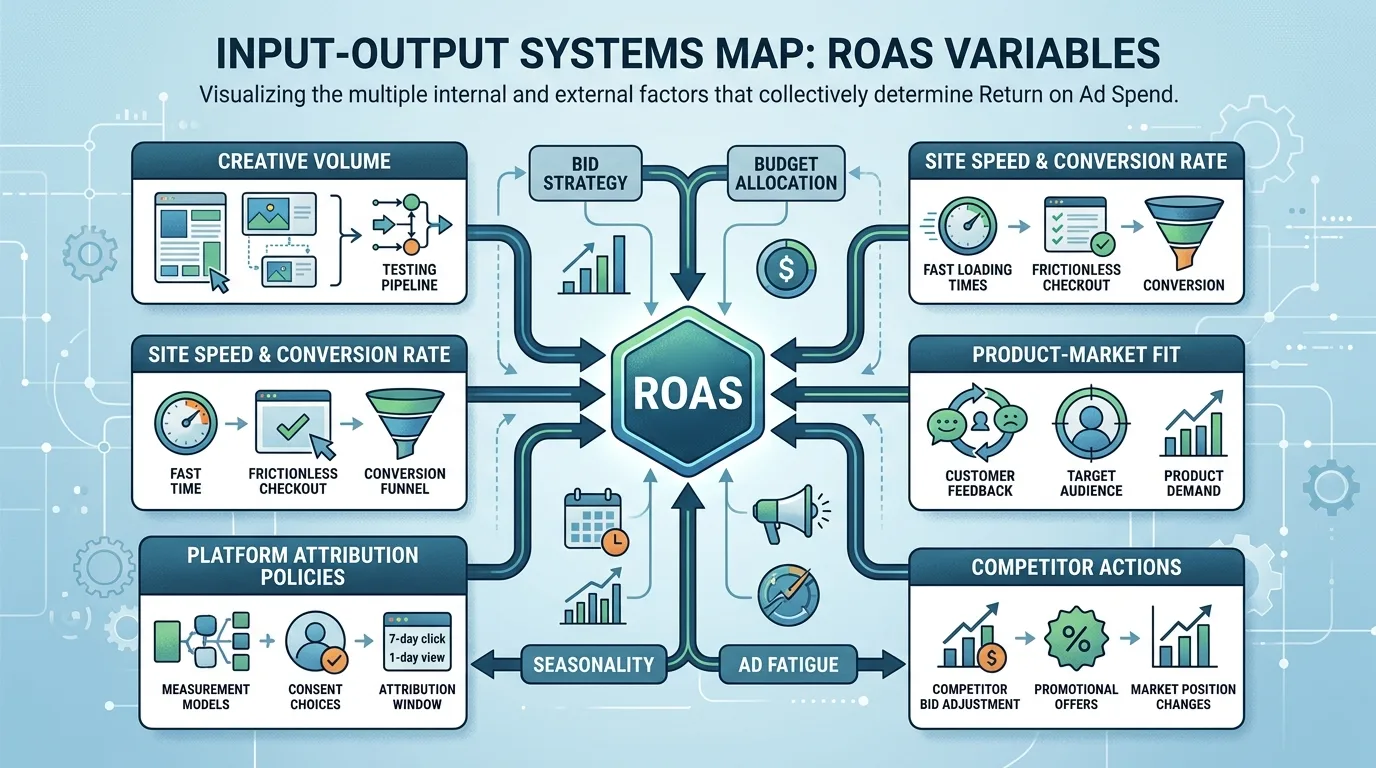
An agency that guarantees a 3x or 5x ROAS without defining these conditions is usually doing one of three things. It is using a narrow attribution window, excluding costs that should be included in the calculation, taking credit for branded demand it did not create, or setting expectations based on an unusually favorable past period.
There are situations where performance commitments can be reasonable. A mature account with stable conversion data, reliable tracking, proven creative angles, consistent inventory, and a defined measurement model creates a stronger basis for targets. Even then, the commitment should be structured around a range, a test period, channel-level economics, and shared responsibilities. It should not be a vague headline designed to close a contract.
For growth-stage businesses, the first 30 to 90 days may be about establishing a reliable testing baseline rather than forcing a top-line efficiency number. If the account has stale creative, weak landing pages, fragmented campaign structure, or broken attribution, promising a final ROAS before fixing those constraints is not performance marketing. It is wishful thinking.
What an Agency Can Actually Control
The best agency relationships are built around controllables. This is where execution separates a media partner from a dashboard watcher.
A capable agency can control five critical parts of the paid growth engine:
- Creative production and testing volume across concepts, formats, hooks, offers, and audiences.
- Campaign architecture, budget allocation, launch speed, and platform-specific optimization.
- Measurement hygiene, including event validation, reporting logic, attribution consistency, and visibility into spend and revenue.
- The speed at which losing ads, audiences, placements, and campaigns are cut before they create more waste.
- The speed at which winning signals are scaled, replicated, and translated across Meta, Google, TikTok, Taboola, and other relevant channels.
None of these guarantees a specific ROAS in isolation. Together, they dramatically improve the odds of profitable growth because they create more informed decisions at a faster pace.
Creative is often the most underestimated lever. Media buyers can optimize budgets all day, but they cannot out-target weak creative forever. A brand that launches three new ads per month will learn slowly. A brand that can test new hooks, visual treatments, claims, formats, and offers every week gives the account more opportunities to find a winner before spend gets trapped behind declining performance.
That is why creative and media should operate as one system. The media team sees where fatigue, rising CPMs, poor click-through rates, or weak conversion rates are emerging. The creative process turns those signals into the next test cycle. When those functions are separate, insight gets lost and iteration slows down.
The Variables That Make ROAS Unpredictable
A transparent agency will be direct about the variables it does not own. This is not an excuse to avoid accountability. It is the starting point for building an accountable working relationship.
Your offer has a major impact on performance. A strong product can still struggle if the entry offer is uncompetitive, the landing page creates friction, or shipping costs appear too late in the checkout flow. For lead generation, lead quality can deteriorate because of qualification criteria, sales response time, call handling, or follow-up cadence. For subscription brands, a high first-purchase ROAS can mask poor retention and weak lifetime value.
Platform conditions also change. Auction prices rise during promotional periods. Competitors change bids and offers. Algorithms shift delivery patterns. Tracking signals can weaken because of consent choices, browser limitations, app privacy changes, or implementation errors. No agency controls those conditions, but a disciplined one responds to them with better creative, smarter budget decisions, and clear communication.
Attribution is another source of false certainty. Platform-reported ROAS, blended ROAS, MER, first-click attribution, and last-click attribution can tell very different stories. None is universally correct. The appropriate model depends on your sales cycle, channel mix, repeat purchase behavior, and decision-making needs.
For example, a search campaign may appear highly efficient because it captures people already looking for the brand. A prospecting campaign may look weaker in-platform while contributing to future branded search, direct traffic, and customer growth. If an agency is judged only on a single platform’s attributed ROAS, it may optimize toward easy-to-claim conversions instead of incremental revenue.
Better Than a Guarantee: A Performance Agreement
If a fixed ROAS guarantee is the wrong standard, what should replace it? A performance agreement should make the economics, measurement, and responsibilities explicit before budgets scale.
Start with the business metric that actually matters. For ecommerce, that may be contribution margin after product costs, shipping, discounts, fees, and ad spend. For lead generation, it may be cost per qualified opportunity or cost per funded customer, not just cost per lead. For an app, it may be cost per activated user paired with a payback period. For subscriptions, it may be customer acquisition cost relative to projected lifetime value.
Then define the measurement source. Decide whether the team will use platform reporting, a third-party attribution platform, backend revenue, blended efficiency, or a combination. Establish the attribution window and reporting cadence. If the source of truth changes every time a result looks uncomfortable, no one can make sound decisions.
Next, set a baseline and a testing period. A credible partner should explain what it expects to learn during the first phase, what signals will trigger more investment, and what conditions would lead to a reset. This protects both sides from treating normal learning periods as failure or treating temporary spikes as proof that the system is solved.
Compensation can reinforce the right behavior. Flat retainers are simple, but they can disconnect agency economics from client outcomes. Spend-based fees can create an incentive to scale budget even when efficiency is deteriorating. A model that includes a reasonable operating fee and performance-based upside can better align incentives, provided the performance metric is transparent and cannot be manipulated.
At Conversion Collective, that alignment starts with a managed growth system built around creative volume, structured testing, centralized execution, and clear insight delivery. The point is not to manufacture a promise. It is to create the conditions for better decisions and profitable scaling.
How to Vet a ROAS Promise Before You Sign
When an agency says it can guarantee results, ask for the operational detail behind the claim. What exact ROAS definition will be used? Is revenue gross or net of refunds and discounts? Which channels and campaigns are included? What happens if tracking fails, inventory changes, or the client cannot approve creative on time?
Ask how the agency will generate enough creative variation to keep learning. Ask how frequently it reviews performance, how it determines a winning ad, and how quickly it cuts losing spend. Ask to see the reporting structure and the escalation process when performance moves in the wrong direction.
You should also ask what the agency needs from your team. High-performing accounts require fast approvals, accurate data, access to product insights, stable landing pages, and a willingness to test offers when the evidence supports it. An agency cannot be accountable for results while being denied the inputs required to produce them.
The answer you want is not, “Trust us, we guarantee 4x.” The answer you want is, “Here is the measurement model, here are the levers we control, here is how we test them, and here is how we will know whether scaling is profitable.”
A credible paid media partner does not sell certainty where none exists. It builds a system that makes performance visible, turns creative and media signals into action, and limits waste before it becomes expensive. That is the kind of accountability that compounds.