The wrong media buying model rarely fails because a team does not understand platform basics. It fails because creative arrives too slowly, decisions sit in meetings, reporting obscures the signal, or nobody owns the full path from ad concept to profitable scale. That is the real decision behind in house versus agency media buying.
For growth-stage businesses spending seriously across Meta, Google, TikTok, Taboola, and other channels, this is not a philosophical choice. It is an operating-model decision. The right answer depends on the volume of spend, the pace of creative testing, the complexity of your channel mix, and the internal capability required to turn performance data into action.
In-House Versus Agency Media Buying: What Actually Changes
An in-house team gives you proximity. The buyers are close to your product roadmap, your sales team, your customer feedback, and your internal data. They can hear a change in positioning on Monday and have campaigns live by Tuesday, assuming the creative and approvals process can keep up.
An agency gives you leverage. A strong partner brings specialized buyers, creative operators, platform knowledge, reporting infrastructure, and established launch processes without requiring you to recruit and manage every role yourself. That value is real only when the agency operates as an accountable extension of your growth function, not as a distant vendor sending monthly slides.
The difference is not simply control versus convenience. It is whether your organization can run a faster, more disciplined acquisition system internally than it can with outside support.
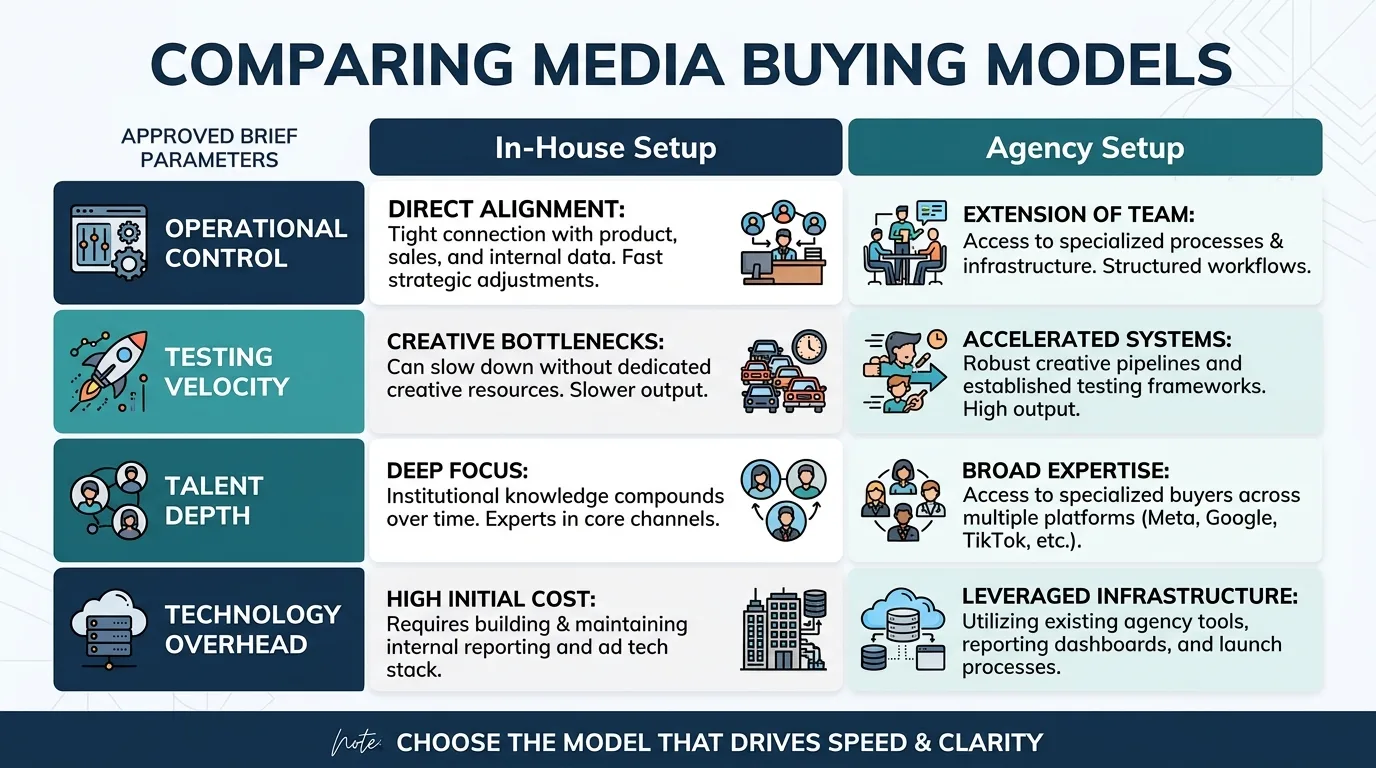
Comparison Matrix: In-House vs. Agency
| Parameter | In-House Media Buying | Agency Media Buying |
|---|---|---|
| Proximity | High; tight alignment with product & sales teams | Moderate; acts as an extension of your growth team |
| Scale & Cost | Requires massive scale to support full in-house team | Highly scalable; predictable headcount/execution costs |
| Testing Speed | Can bottle-neck without dedicated creative resources | Accelerated; robust systems and creative pipelines |
| Channel Depth | Often deep in 1-2 core platforms | Broad platform expertise across multiple paid channels |
When Building In-House Makes Sense
In-house media buying is often the right move when paid acquisition is central to the business and your company has enough scale to support a complete operating team. The key word is complete. One talented media buyer is not an in-house growth engine.
A functioning internal program typically needs buying expertise, creative strategy, designers and editors, analytics support, landing page ownership, and a decision-maker who can resolve trade-offs quickly. If those functions are fragmented across departments, the buyer may own the budget but not the inputs that determine performance.
The strongest case for in-house is a business with a mature product, deep first-party data, stable budgets, and a clear need for daily coordination between paid media and other internal teams. A subscription business with ongoing pricing tests, for example, may benefit from having acquisition, lifecycle, product, and data teams working from the same measurement framework.
In-house can also produce institutional knowledge that compounds over time. Buyers learn the nuances of your offers, audiences, compliance requirements, seasonality, sales cycle, and margin structure. That context can improve judgment, particularly in categories where generic playbooks fail.
But internal ownership does not automatically create speed. Hiring takes time. Senior buyers are expensive. Creative capacity is often underbuilt, and the team can become overly attached to familiar channels or legacy winners. When a small internal team is responsible for strategy, launching, analysis, reporting, and stakeholder management, testing velocity usually drops first.
When an Agency Produces Better Economics
An agency is most valuable when a business needs specialized execution before it can justify building every capability internally. This is common for companies that are scaling quickly, entering new channels, dealing with inconsistent creative output, or trying to impose order on an account structure that has grown messy.
The best agencies do not merely buy media at a lower headcount cost. They increase the number and quality of decisions a business can make each week. That means more creative concepts in market, cleaner campaign builds, faster budget shifts toward winners, and reporting that identifies what is working before spend is wasted.
This matters most in creative-led channels. On Meta and TikTok, media buying performance is tightly connected to creative throughput, message testing, and the ability to turn early signals into the next round of ads. If creative sits with a separate team that delivers a handful of assets each month, even an excellent buyer has limited room to improve results.
An integrated partner can connect these functions: develop new angles, produce static and video variations, launch structured tests, read performance at the right level, and scale proven concepts. The operating advantage is not a prettier creative deck. It is a shorter loop between insight and execution.
Agency economics are also attractive when channel expertise is uneven. A company may have a capable Meta buyer but lack real operational experience in Google, native, TikTok, or emerging paid channels. Building each specialty internally can be justified at high scale, but it is expensive and slow if the goal is simply to test where incremental growth exists.
The Risks on Both Sides
The risks of in-house media buying are usually visible in the org chart. A single buyer becomes a bottleneck. Creative requests accumulate. Reporting is manual. Platform knowledge is limited to what one or two people have seen. Leadership mistakes activity for a testing system because campaigns are launching, but no one can explain which creative variables or audience assumptions are driving lift.
The risks of agency media buying are usually visible in the workflow. The agency has too many accounts per buyer, creative production is detached from performance data, communication happens only in weekly calls, and reporting focuses on surface metrics without connecting spend to business outcomes. The client is then paying for execution but carrying the burden of direction and quality control.
Neither model works well when accountability is vague. Internal teams need authority over the inputs that affect results. Agencies need access to data, fast approvals, clear profitability targets, and direct feedback from the people closest to the customer.
Use Testing Velocity as the Decision Filter
If you need one filter for the in-house versus agency media buying decision, use testing velocity. Ask how many meaningful creative, audience, offer, landing page, and channel tests your organization can launch and learn from in a typical month.
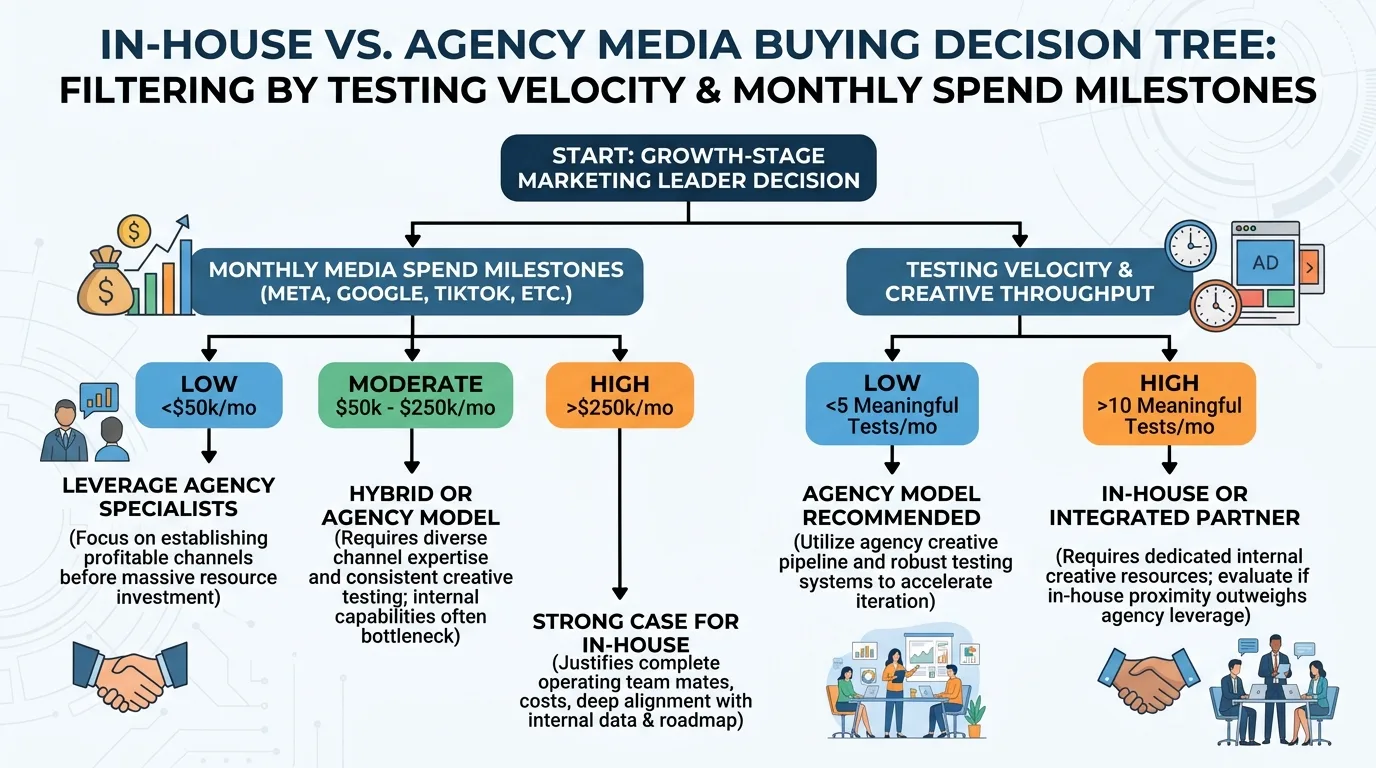
Do not count minor copy edits as tests. Count structured experiments with a clear hypothesis, sufficient spend, a defined success metric, and a decision that changes what happens next. If your team cannot run enough of those cycles to keep pace with creative fatigue and platform volatility, the model is underpowered.
A high-performing system also needs disciplined prioritization. More tests are not automatically better when account structure is chaotic or reporting cannot distinguish noise from signal. The goal is controlled volume: enough experimentation to find winners quickly, with enough process to understand why they won.
This is where a performance-focused agency can create an edge. Firms such as Conversion Collective are built around centralized campaign systems, rapid creative iteration, and cross-platform execution rather than treating media buying and creative as separate retainers. For a company without those systems internally, the practical choice may be to buy the operating model before trying to build it.
A Hybrid Model Is Often the Smartest Move
The choice does not have to be permanent or absolute. Many strong growth teams use a hybrid structure. Internal leaders own business strategy, offer direction, brand knowledge, first-party data, and executive alignment. An outside partner provides channel depth, creative production capacity, testing infrastructure, or support for new-market expansion.
This model works when responsibilities are explicit. The internal team should not be rewriting every campaign brief or second-guessing daily bid changes. The agency should not be guessing at margin targets, inventory constraints, or customer quality. Shared dashboards, weekly performance decisions, and defined approval windows prevent the relationship from becoming slow and political.
A hybrid approach is especially useful during transition periods. A company can retain an agency while hiring internal leadership, or keep an internal core team while using external specialists to launch a new channel. The goal is not to protect a preferred model. It is to avoid a gap in execution while the business grows.
Choose the Model That Produces Clearer Decisions
Do not choose in-house because it sounds more mature. Do not choose an agency because it seems easier to outsource a difficult problem. Choose the structure that gives your business the strongest combination of speed, insight, and accountability at its current stage.
If your internal team can consistently produce creative volume, launch clean tests, interpret results, and scale profitably across channels, invest in making that system stronger. If those capabilities are missing or overloaded, an agency with real performance infrastructure can close the gap faster than another round of disconnected hires.
Checklist: Are You Ready for In-House Media Buying?
Evaluate your internal capabilities before transitioning:
- Dedicated Growth Leader: Do you have an internal lead to align business strategy and brand guardrails?
- Creative Pipeline: Can your design team deliver a high volume of structured test concepts monthly?
- Multi-Channel Talent: Do you have experienced buyers for every active channel (Meta, Google, TikTok, etc.)?
- Advanced Attribution: Is there a clean reporting structure to separate performance signal from platform noise?
- Recruitment Capacity: Are you budgeted for the high salary costs of senior media buying specialists?
The useful question is not who has the media buying seat. It is who can turn the next performance signal into a better campaign before the opportunity disappears.