
A campaign can look unprofitable in-platform while still producing revenue. The reverse is also common: a dashboard reports efficient growth while finance sees margin compression and weak new-customer quality. To diagnose attribution gaps, do not start by debating which dashboard is right. Start by identifying where the customer journey, platform reporting, and business outcome stop matching.
Attribution is not a scoreboard. It is a decision system. If that system over-credits retargeting, misses upper-funnel demand creation, duplicates conversions across channels, or receives incomplete event data, your team will optimize toward the wrong winners. That means cutting creative that is creating demand, scaling campaigns that are harvesting it, and moving budget based on confidence you have not earned.
What an attribution gap actually looks like
An attribution gap is the difference between what a reporting system claims drove a result and what likely caused the result in the real business. Some gaps are expected. No attribution model can perfectly reconstruct every touchpoint across devices, browsers, walled gardens, and offline actions. The operational problem begins when the gap is large enough to change a budget, bidding, creative, or channel decision.
For a lead generation business, the gap may appear between reported platform leads and sales-qualified opportunities. For ecommerce, it may show up as strong tracked purchase ROAS but falling contribution margin or a lower percentage of new customers. For an app or subscription business, it may be a paid install that never becomes a retained user or paying subscriber.
The goal is not to find one perfect source of truth. The goal is to build a measurement system that is directionally reliable, consistent enough to compare decisions, and close enough to business outcomes that it protects profitable growth.
Diagnose attribution gaps before changing spend
When performance changes, teams often react inside the ad platform first. They pause ads, adjust bids, switch optimization events, or shift spend from one channel to another. That may be the right move, but only after confirming that the reported change is real.
Begin with a simple question: did the business outcome move in the same direction as the marketing metric? Compare platform-reported conversions with first-party orders, qualified leads, revenue, subscriptions, or pipeline for the same period. Use consistent date logic. A platform may report a conversion based on an ad interaction date, while your CRM records it based on form completion or close date. Those are different views of the same journey, not necessarily a tracking failure.
Then isolate whether the variance is new or structural. A stable 15% difference between platform revenue and backend revenue may be manageable if your team understands it and uses the same methodology every week. A sudden 40% divergence after a site release, consent-banner update, CRM change, pixel migration, or campaign restructure requires investigation before optimization.
Check the conversion event first
Most serious attribution problems begin with event quality. Confirm that the primary conversion fires once, fires on every intended path, and includes the data required to match it to an ad interaction. Test the highest-volume paths as a real user would: mobile and desktop, new visitor and returning visitor, paid landing page and direct navigation, form completion and checkout.
Look for duplicate purchase or lead events, especially when browser pixels, server-side tracking, tag managers, and confirmation-page scripts all send the same action. Deduplication failures can make a channel look like it is scaling efficiently when it is simply counting one conversion twice.
Also inspect event definitions. A lead event that fires on a button click is not equivalent to a completed application. A purchase event that includes taxes, shipping, refunds, or canceled orders may not match the revenue metric finance uses. Platforms can optimize only toward the signal they receive. Give them a weak signal and they will find more of it.
Validate identity and source capture
Attribution weakens when the customer cannot be reliably connected to the source that acquired them. UTMs, click IDs, landing-page parameters, CRM fields, and order records need a clear handoff. If a lead enters the CRM without campaign data, the issue may not be media performance. It may be a redirect stripping parameters, a form tool dropping hidden fields, or a sales workflow overwriting the original source.
Do not assume last-click source fields tell the full story. They are useful for operational reporting, but they naturally favor the final touchpoint. A branded search campaign, email click, affiliate referral, or retargeting ad may get credit for a customer initially generated by Meta, TikTok, Taboola, or a nonbrand search campaign.
This is where creative matters. A high-volume prospecting campaign may produce fewer directly attributed conversions while increasing branded search, direct traffic, and assisted conversion volume. If you judge every ad only by its final click, you will systematically underfund demand generation.
Reconcile time windows and conversion lag
A seven-day click attribution window, a 30-day analytics lookback, and a 45-day sales cycle will not produce matching numbers. They should not. The question is whether your reporting design accounts for the difference.
Build cohorts by acquisition date and measure how those cohorts mature. If a lead source typically closes over 21 days, evaluating it on day three will make it look worse than a source with faster but lower-quality conversions. Similarly, a subscription campaign may appear profitable at first purchase but fail on retention by month two.
This does not require slow reporting. Use early indicators for daily optimization, such as qualified lead rate, checkout completion, trial activation, or first-session engagement. Then use cohort revenue, retention, and margin to validate that the optimization signal predicts real value.
Find the gap by comparing four views
A practical attribution audit compares four reporting views over the same date range and conversion definition:
- Ad-platform reporting shows what each platform can observe and claim under its attribution rules.
- Web analytics shows onsite behavior, channel paths, and landing-page performance.
- First-party backend data shows orders, leads, revenue, refunds, qualification, and customer status.
- Finance or business reporting shows the outcome that actually matters: net revenue, contribution margin, pipeline value, or retained customers.
The comparison is not meant to force every number into alignment. It is meant to locate the break. If platform conversions rise but analytics sessions do not, investigate tracking or duplicate events. If analytics conversions rise but backend orders do not, inspect confirmation logic, payment failures, or form quality. If backend orders rise but finance revenue does not, look at refunds, discounts, fulfillment, or customer value.
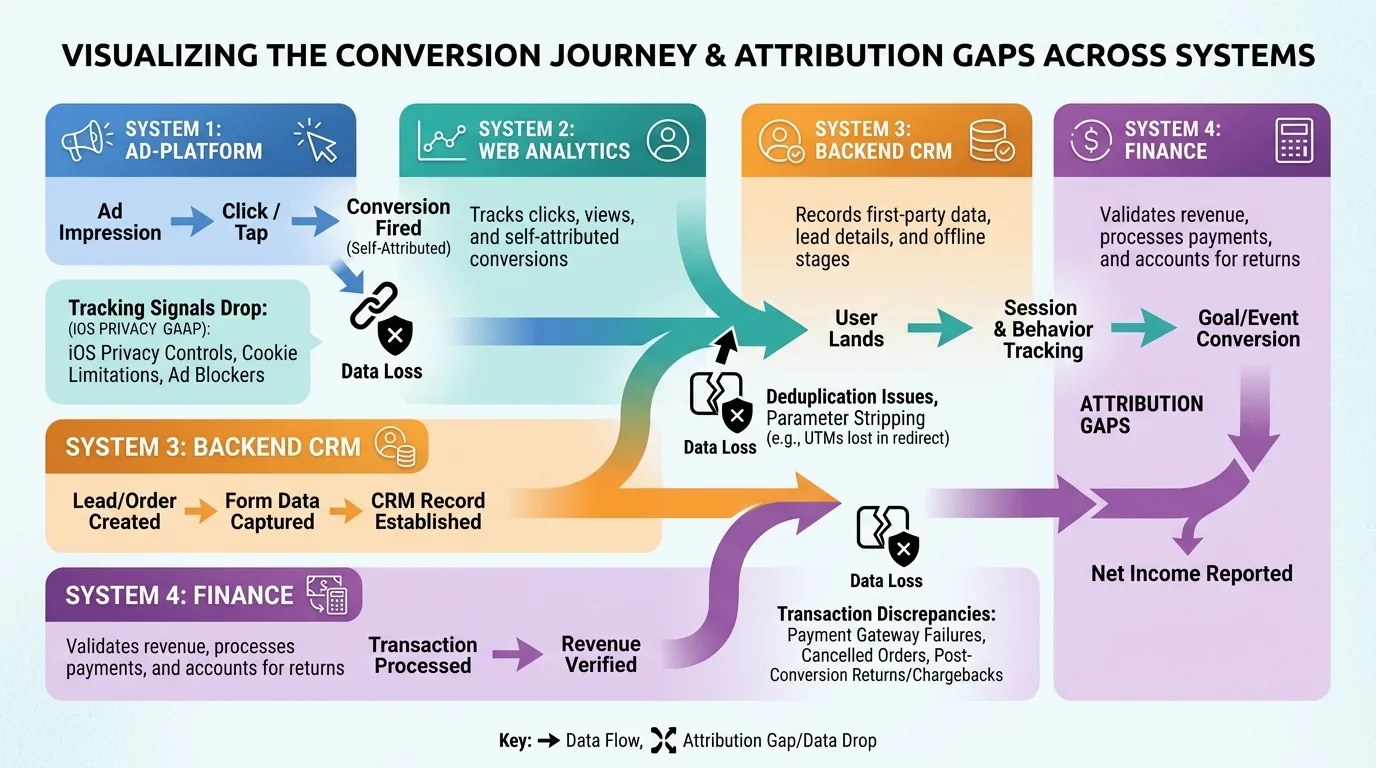
Identifying Discrepancies Across Reporting Views
| Reporting View | Primary Focus | Common Diagnostic Gaps |
|---|---|---|
| Ad-Platform | Self-attributed campaign conversions & ad interactions | Over-reported conversions due to overlap or lack of deduplication |
| Web Analytics | Session behavior, landing page arrivals, & traffic sources | Parameter stripping, cookie deletion, or attribution window differences |
| First-Party Backend | CRM records, physical order logs, & direct user actions | Integration delays, form failures, or system sync issues |
| Finance & Business | Verified net revenue, margins, chargebacks, & cash flow | Post-purchase returns, custom discounts, or variable date logic |
When all four views move together, you can act with more confidence. When they diverge, the divergence is the work. Treat it as an operating issue, not a reporting nuisance.
Separate tracking problems from channel overlap
Not every attribution gap is technical. Cross-channel overlap is a common source of inflated efficiency. Meta, Google, TikTok, and other platforms can each claim credit for the same customer because each observed a different eligible interaction. Adding their reported conversions together can overstate total acquisition.
Start with audience and campaign intent. Are prospecting campaigns excluding recent site visitors, purchasers, leads, app users, and CRM lists where appropriate? Are brand search and retargeting being evaluated separately from new-demand campaigns? Is one channel following another channel’s traffic spike and claiming conversions late in the path?
The answer depends on the business model. Aggressively excluding every existing visitor may reduce duplication but can also remove high-intent users from a channel that converts them efficiently. The right approach is controlled segmentation, clear reporting, and a willingness to measure incrementality where spend justifies it.
Incrementality tests do not need to be academic. Geographic holdouts, audience suppression tests, matched-market comparisons, and controlled budget reductions can reveal whether a channel is creating net-new outcomes or primarily capturing demand that would have converted anyway. Run them carefully, for long enough to account for conversion lag, and with a pre-agreed success metric.
Build an operating cadence that prevents blind spots
Attribution is not fixed by a one-time audit. Campaign structures change, creative volume increases, platforms update privacy rules, landing pages evolve, and tracking breaks quietly. The best defense is a recurring measurement cadence tied to how your team actually makes decisions.
Review event health weekly: volume, deduplication, match quality, parameter capture, and abnormal shifts by device or browser. Review channel efficiency weekly against qualified outcomes, not just reported conversions. Review cohort value monthly or on the timeline your business model requires. Any major site, CRM, checkout, or consent-management release should trigger a tracking QA before spend is allowed to scale.
This is where integrated creative and media operations matter. If creative production, campaign launches, and reporting live in separate workflows, nobody sees the full chain from message to conversion quality. A structured system makes it possible to identify which concepts generate qualified demand, launch follow-up tests quickly, and stop funding ads that only look good under a narrow attribution lens.
At Conversion Collective, that discipline means treating reporting as part of execution, not a retrospective deck. Fast testing only creates an advantage when the team can trust the feedback loop well enough to scale winners without scaling measurement errors.
The useful closing thought is simple: do not wait for attribution to become perfect. Make it reliable enough to expose the next wrong decision before it becomes expensive.