
When a paid acquisition program stalls, the problem is rarely a lack of ideas. More often, the team cannot turn those ideas into live, measurable ads quickly enough. Briefs sit in queues, design files get rebuilt by hand, naming conventions drift, and media buyers wait for assets while spend continues to flow toward aging creative.
Creative automation fixes that operational gap. It is not a button that produces better ads on demand. It is a system for converting approved inputs - angles, offers, formats, copy, visual components, and audience insights - into a high volume of launch-ready creative without losing control of quality or measurement.
For growth teams buying across Meta, Google, TikTok, Taboola, and other channels, that distinction matters. The goal is not more content for its own sake. The goal is faster testing velocity, clearer winners, and less wasted spend.
What Creative Automation Actually Means
Creative automation combines repeatable creative templates, structured asset libraries, production workflows, and campaign data. Instead of treating every ad as a one-off project, the team defines what can be standardized and where human judgment still needs to lead.
A simple example is a static ad program. The core design system may remain consistent: logo placement, fonts, legal language, image crops, CTA treatment, and platform-safe dimensions. Within that system, the team can test different hooks, headlines, offers, product images, testimonials, and audience-specific messages at speed.
The same principle applies to video, although the trade-offs are different. Automated versioning can produce multiple openings, captions, end cards, CTAs, and aspect ratios from an approved edit. It cannot replace the strategic work of finding a believable angle, a strong creator, or a concept that earns attention in the first two seconds.
That is why creative automation should be viewed as production infrastructure, not a creative strategy. It makes a strong strategy easier to execute at volume. It also makes weak strategy fail faster, which is still useful if the team is disciplined enough to act on the signal.
Why Creative Automation Changes Paid Media Performance
Creative and media buying are often managed as separate functions. The creative team ships assets on a schedule. The media team reacts to performance after launch. By the time a poor ad is identified, the next round of replacement creative may still be weeks away.
That operating model is too slow for competitive acquisition environments. Ad fatigue accelerates, auction conditions change, offers lose relevance, and platform delivery systems need a steady supply of differentiated inputs. A winning ad can carry spend for a period, but it will not carry growth forever.
Creative automation shortens the loop between insight and action. If a benefit-led hook is outperforming a feature-led hook, the team can build controlled variations around that signal. If a testimonial format is working on Meta but failing on TikTok, the production process can adapt format and pacing rather than blindly duplicating the asset.
The result is not just a higher output count. It is a more reliable learning system. Each launch should answer a question: Does a stronger offer improve conversion? Does this visual mechanism lower cost per acquisition? Does a new opening create better thumb-stop performance without hurting downstream quality?
When creative is organized around questions like these, teams stop confusing activity with progress.
The Operating System Behind Creative Automation
A scalable process starts before design or editing. It starts with a testing plan that connects business goals to specific creative variables. Without that structure, automated production can create hundreds of assets and very little insight.
Start With a Clear Test Matrix
A test matrix defines what is changing and what is staying constant. For example, a team might hold the offer and landing page steady while testing three angles: price relief, social proof, and speed of outcome. Within each angle, it may produce variants using different visuals or opening lines.
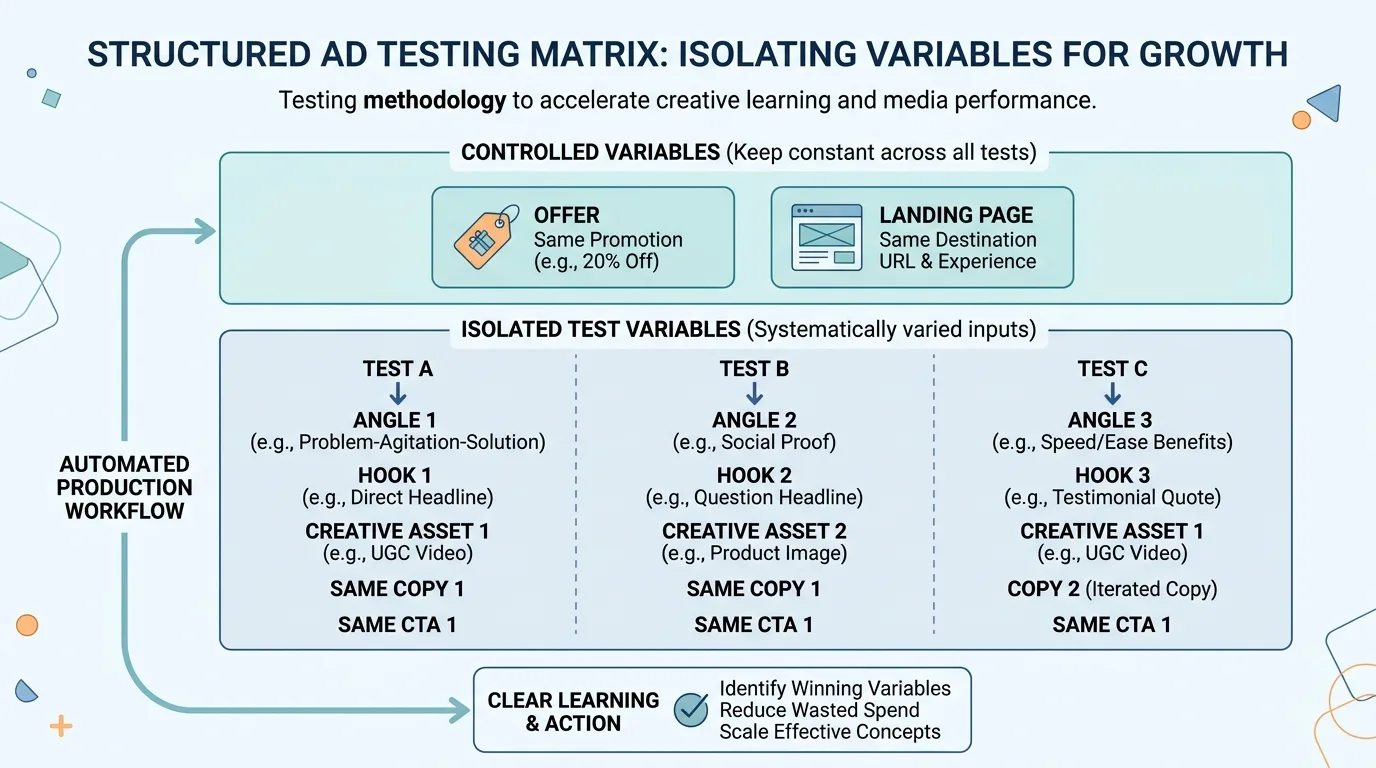
This approach protects interpretation. If every component changes at once, a winner may be impossible to explain. That makes it difficult to scale intelligently because the team does not know whether the result came from the headline, the creator, the offer, the format, or simple delivery variance.
Not every test needs laboratory-level control. Paid media has noise, and platforms do not distribute impressions perfectly. But the more spend a brand manages, the more costly vague learning becomes.
Build Reusable Creative Components
High-volume output depends on organized inputs. That includes approved brand elements, product imagery, UGC clips, motion treatments, copy blocks, disclaimers, CTAs, translations when needed, and platform-specific specifications.
The objective is not to make every ad look identical. It is to eliminate repetitive manual work that does not improve performance. Designers and editors should spend their time on concept quality, visual clarity, pacing, and persuasion - not recreating a footer or resizing the same asset for the tenth time.
A well-managed component library also reduces compliance risk. When required language, claims, pricing, and approved logos are governed centrally, fewer errors reach the platform or the customer.
Connect Asset Production to Campaign Structure
An ad is only useful when the media team can launch, find, and evaluate it. That requires consistent naming, campaign taxonomy, version tracking, and metadata that identifies the angle, format, offer, audience, and production date.
This is where many teams lose control. They can produce creative quickly, but their reporting cannot distinguish a new concept from a minor variation. The team sees a long list of asset names and has to reconstruct the story manually.
A stronger system makes creative data legible. Media buyers can see which concepts are live, where they are running, how much they have spent, and what performance pattern is emerging. That creates accountability on both sides: creative is tied to outcomes, and media decisions are tied to a documented testing plan.
Where Automation Helps Most - and Where It Does Not
Creative automation is especially valuable when a brand has recurring production needs across formats, audiences, products, offers, or markets. Ecommerce brands can version product-focused ads by category or promotion. Lead generation teams can test localized messages and vertical-specific proof points. App marketers can adapt successful concepts across device formats and lifecycle stages.
It is less useful when the team has not yet identified its message, has inconsistent source material, or is producing a small number of highly bespoke brand campaigns. In those cases, forcing a template can make the work look generic and reduce the very differentiation the brand needs.
The right balance depends on the acquisition model. A direct-response program with frequent creative fatigue may need dozens of new assets each week. A premium B2B program may need fewer assets, but stronger variations tied to specific buying objections. Automation should match the volume and complexity of the testing agenda, not become a production vanity metric.
There is also a quality risk. If an automated system makes it easy to create versions, teams may create insignificant versions: a new background color, a slightly different crop, a headline changed without a new claim. Those adjustments can matter occasionally, but they rarely replace genuine concept development.
The highest-performing programs separate meaningful creative bets from efficient adaptations. They invest human thinking in the former and use systems to accelerate the latter.
How to Measure Whether the System Is Working
Do not judge creative automation by the number of files produced. Measure whether it improves the economics and speed of the acquisition engine.
Useful operating metrics include time from approved brief to launch, the percentage of planned tests that actually reach the market, asset approval rates, and the number of usable learnings produced per testing cycle. Performance metrics should include cost per acquisition, conversion rate, qualified lead rate, revenue or margin contribution, and creative fatigue indicators such as declining CTR or rising frequency at stable conversion quality.
Context matters. A lower CPA is not automatically a win if lead quality collapses. A high-CTR ad is not useful if it attracts curiosity clicks that do not convert. Likewise, a creative concept may look weak in its first few days because delivery has not stabilized or because the test received too little spend.
The answer is not to wait forever. It is to establish decision rules before launch. Define the minimum spend, performance threshold, quality signal, and review window required to scale, iterate, or cut an asset. That removes emotional decision-making and gives the team a shared standard.
Make Creative Output a Growth Advantage
The brands that scale paid acquisition efficiently do not treat creative as a periodic deliverable. They treat it as a continuous input to media performance. They know what is live, what is being tested, what is winning, and what needs to be replaced next.
At Conversion Collective, that operational discipline is the point: creative volume only creates value when it is connected to structured testing, accurate launch execution, and clear performance insight. Faster production without those controls simply creates faster chaos.
Start by identifying the bottleneck in your current loop. If the issue is slow production, standardize the repeatable work. If the issue is unclear learning, tighten the test matrix and reporting taxonomy. If the issue is inconsistent launches, connect creative workflow directly to campaign operations. The next profitable winner is often not hiding in a bigger brainstorm. It is waiting behind a system that can get a good idea into market, read the result, and act before the opportunity passes.