
A Meta prospecting campaign looks unprofitable in-platform. Google branded search is reporting a strong return. Your blended revenue is growing anyway. The question is not which dashboard is lying. It is whether your team is using an attribution model built for the decisions it needs to make. The best ad attribution models do not create perfect certainty. They create a disciplined way to allocate budget, judge creative, and scale winners without giving credit to the wrong channel.
For performance teams, attribution is an operating system, not a reporting preference. A bad model can cause you to cut the campaign that created demand, overfund the channel that captured it, and misread which creative deserves more spend. A useful model acknowledges that customers move across devices, channels, and sessions, then gives operators a repeatable decision framework.
Why Attribution Breaks at Scale
Paid acquisition gets harder to measure as budgets, channels, and creative volume increase. A customer may first see a TikTok video, click a Meta retargeting ad two days later, search the brand on Google, and convert through email. Each platform has an incentive to claim as much of that conversion as its settings allow.
Privacy restrictions add another layer. Cookie loss, iOS consent choices, cross-device behavior, ad blockers, and delayed conversion events all create gaps. Platform reporting fills some of those gaps with modeled conversions. That can be useful for optimization, but it is not the same as a complete view of incremental business impact.
This is why a single number rarely settles the question. Platform data is best for fast, in-channel decisions. Analytics data is better for understanding the full customer path. Business-level metrics such as contribution margin, new-customer revenue, qualified leads, and cohort retention tell you whether the growth is worth buying in the first place.
The Best Ad Attribution Models, Explained
No attribution model is universally best. The right choice depends on your sales cycle, conversion volume, channel mix, and how quickly your team must act. The models below are most useful when their limitations are understood upfront.
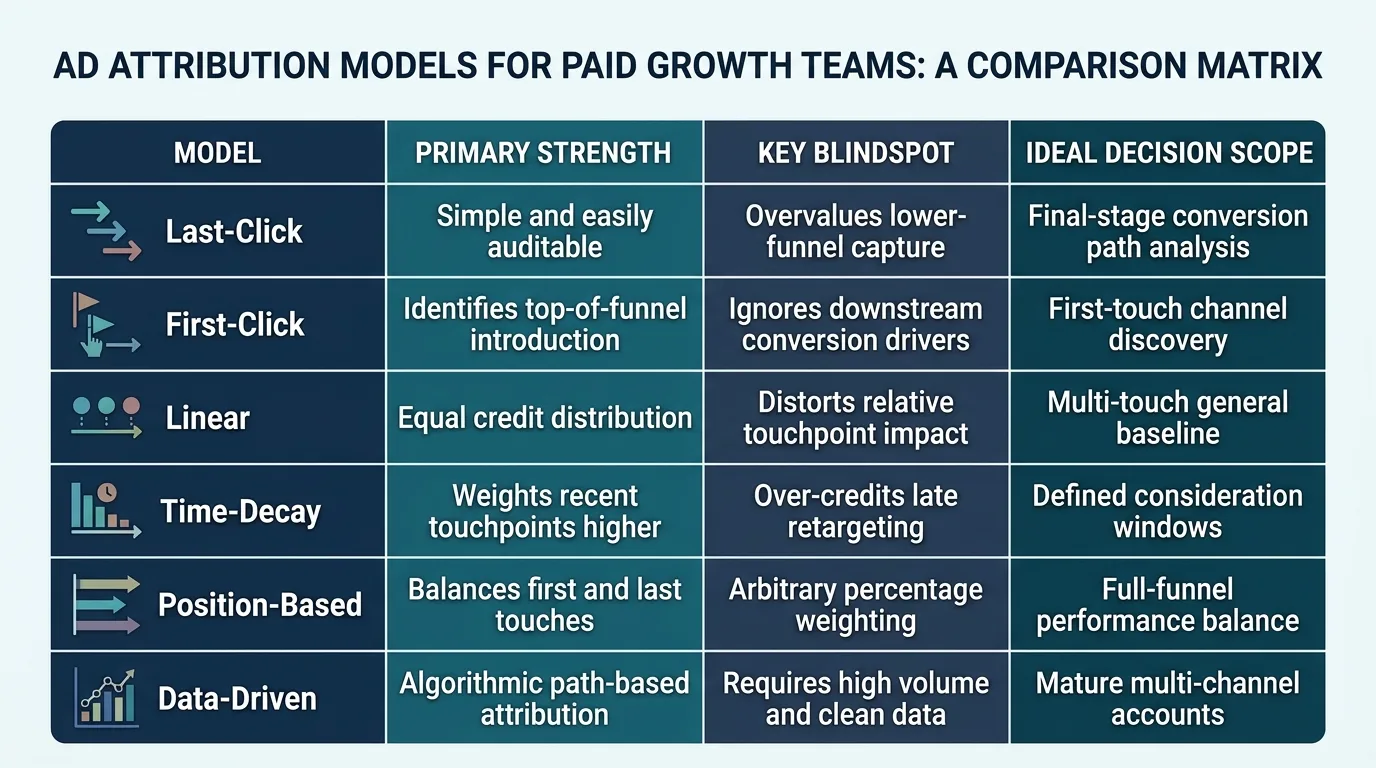
| Model | Primary Strength | Key Blindspot | Ideal Decision Scope |
|---|---|---|---|
| Last-Click | Simple and easily auditable | Overvalues lower-funnel capture | Final-stage conversion path analysis |
| First-Click | Identifies top-of-funnel introduction | Ignores downstream conversion drivers | First-touch channel discovery |
| Linear | Equal credit distribution | Distorts relative touchpoint impact | Multi-touch general baseline |
| Time-Decay | Weights recent touchpoints higher | Over-credits late retargeting | Defined consideration windows |
| Position-Based | Balances first and last touches | Arbitrary percentage weighting | Full-funnel performance balance |
| Data-Driven | Algorithmic path-based attribution | Requires high volume and clean data | Mature multi-channel accounts |
Last-click attribution
Last-click gives 100% of the conversion credit to the final tracked interaction before purchase or lead submission. It is simple, auditable, and widely available in web analytics.
Its weakness is structural: it overvalues demand capture. Branded search, retargeting, affiliates, and direct response email often appear strongest because they are closest to conversion. Meanwhile, top-of-funnel video, creator-style ads, native placements, and non-brand prospecting can look weak even when they are generating the audience that later converts.
Last-click still has a place. Use it to understand the final conversion path and to manage lower-funnel channels where intent is explicit. Do not use it alone to decide whether to cut prospecting.
First-click attribution
First-click assigns all credit to the first known interaction. It is useful for identifying which channels and ads introduce new customers to the brand. For teams testing broad audiences or scaling creative-led acquisition, that perspective can expose demand generation that last-click ignores.
The trade-off is that first-click gives no credit to the touchpoints that turned attention into action. It can make upper-funnel channels look more valuable than they truly are, especially when they generate cheap visits with low purchase intent. Treat it as an acquisition lens, not a full-funnel source of truth.
Linear attribution
Linear attribution splits credit evenly across every tracked touchpoint. It is a reasonable starting point for longer paths because it prevents the final click from taking all the credit.
But equal credit is rarely accurate. A five-second video view, an accidental click, a product-page revisit, and a high-intent branded search do not contribute equally. Linear models are fairer than last-click in theory, yet they can blur the signal operators need to make budget decisions.
Time-decay attribution
Time-decay assigns more credit to interactions that happen closer to conversion. This makes intuitive sense for businesses with a defined consideration window, such as subscription products, higher-ticket ecommerce, B2B lead generation, or app installs that require several sessions before activation.
The problem is the assumption behind it: closer does not always mean more influential. Retargeting frequently happens near conversion because it targets people who are already interested. Time decay can still over-credit the channel that arrived late and under-credit the creative that created initial demand.
Position-based attribution
Position-based models usually give the largest shares of credit to the first and last interaction, then distribute the remainder across the middle. This model recognizes that customer acquisition has two critical moments: creating awareness and closing the conversion.
For many growth teams, position-based attribution is more directionally useful than linear or time-decay models. It gives prospecting and conversion capture a seat at the table. Still, the weights are arbitrary. A standard 40-20-40 split may not reflect how your buyers actually decide.
Data-driven attribution
Data-driven attribution uses observed conversion paths to estimate the contribution of different touchpoints. In principle, it is the most sophisticated option because it moves beyond fixed rules and evaluates patterns in your own data.
In practice, it requires enough clean conversion volume, consistent tracking, and a stable enough media mix to produce credible results. It can also become a black box. If your team cannot explain why a channel receives more credit, it may be difficult to act on the output with confidence.
Data-driven attribution is strongest as a decision support layer for established accounts. It should not replace basic measurement hygiene, creative analysis, or business-level validation.
Choose a Model Based on the Decision
The mistake is searching for one model to govern every question. Different decisions require different views of performance.
For daily bid, budget, and audience management, use each platform’s attribution reporting with a consistent conversion event and attribution window. Platforms see more of their own click and view behavior than an external analytics tool. That makes in-platform reporting valuable for optimizing delivery, particularly when you are testing high volumes of ads.
For channel allocation, compare a multi-touch view with last-click and blended performance. If Meta reports strong revenue but analytics shows little last-click credit, do not dismiss Meta automatically. Look for supporting evidence: rising branded search, improving direct traffic, stronger new-customer rates, stable customer acquisition cost, and conversion lift during controlled spend changes.
For executive reporting, simplify. Focus on total spend, total revenue or qualified pipeline, new-customer acquisition cost, contribution margin, and payback period. Executives need to know whether the business is producing profitable growth, not whether one platform won a credit-assignment argument.
Build an Attribution System That Operators Can Use
Attribution improves when the underlying system is organized. Start with a consistent naming structure across platforms so campaigns, audiences, creative concepts, offers, and landing pages can be compared without manual cleanup. When hundreds of ads launch each month, loose naming conventions turn reporting into guesswork.
Next, separate creative performance from channel performance. A campaign can fail because the audience is wrong, the offer is weak, the landing page is slow, or the creative does not earn attention. If every result is rolled into one channel-level number, you lose the ability to identify the actual constraint.
Use a measurement hierarchy with four layers:
- Platform reporting for rapid optimization and creative testing.
- Analytics reporting for cross-channel paths and source validation.
- CRM or backend data for lead quality, approved revenue, refunds, and retention.
- Blended business metrics for the final budget decision.
The order matters. A platform can identify an ad worth scaling before backend data has fully matured. But backend outcomes must eventually validate that decision. For lead generation, optimize early on qualified leads rather than raw form fills whenever possible. For ecommerce, separate new-customer revenue from repeat purchases. For subscriptions and apps, track activation and early retention, not just the initial conversion.
Use Incrementality to Resolve the Hard Cases
When attribution systems disagree, incrementality is the tie-breaker. The question changes from “Who got credit?” to “What would have happened if we had not spent this budget?”
You do not need a research department to start learning. Run controlled tests when practical: reduce spend in a geography, hold out a defined audience, pause a campaign with clear guardrails, or compare matched markets. Watch blended outcomes, not just the platform dashboard.
These tests are especially valuable for retargeting, branded search, and high-frequency prospecting. Those channels can look excellent in attribution while mostly harvesting conversions that would have happened anyway. A carefully controlled reduction may reveal that some spend is incremental and some is simply claiming existing demand.
Avoid making broad conclusions from one short test. Seasonality, inventory, promotions, creative fatigue, and competitor activity can distort results. Repeat tests, document assumptions, and make budget shifts in measured increments.
What Good Attribution Looks Like in Practice
A high-functioning attribution program does not chase a mythical single source of truth. It creates alignment between reporting speed and financial reality. Media buyers can identify a winning creative quickly. Growth leaders can see how channels work together. Finance can verify that acquisition spend produces profitable customers rather than inflated dashboard revenue.
The best ad attribution models are the ones your team can apply consistently, challenge intelligently, and validate against real business outcomes. Build the system around the decisions that move spend, keep the rules visible, and let incrementality settle the arguments that dashboards cannot.