
A paid acquisition program does not fail because a dashboard loses a few rows. It fails when the team keeps making budget decisions as if the data is complete. Cookie deprecation strategies are therefore not an analytics cleanup project. They are an operating plan for preserving signal, maintaining testing velocity, and protecting profitable growth when attribution becomes less deterministic.
For growth teams spending across Meta, Google, TikTok, Taboola, and other channels, the goal is not to recreate the old tracking environment. That is neither realistic nor necessary. The goal is to build a measurement system that can make good decisions with imperfect, privacy-compliant data.
Why Cookie Deprecation Changes Paid Media Operations
Third-party cookie restrictions are only one part of a larger shift. Browser-level privacy controls, consent requirements, device fragmentation, mobile operating-system restrictions, and platform modeling all reduce the amount of directly observable user-level behavior available to advertisers.
The immediate impact is familiar: fewer attributed conversions, shorter or less reliable user paths, audience pools that behave differently, and discrepancies between platforms, analytics tools, and backend revenue. The more serious impact is operational. Teams may over-credit retargeting, under-credit prospecting, cut campaigns that are producing incremental value, or allow weak campaigns to survive because a platform is claiming conversions it did not create.
This does not mean platform reporting is useless. It means it should no longer be the sole authority on where to scale. Each source answers a different question. Platform reporting helps optimize delivery. Backend data shows business outcomes. Incrementality testing identifies what spend actually caused. A growth team needs all three.
Policy timelines and browser behavior will continue to change. Build around that uncertainty rather than waiting for a final industry announcement. The teams that win will have cleaner event design, faster creative testing, and tighter budget controls than competitors still debating attribution windows.
Cookie Deprecation Strategies Start With First-Party Data
First-party data is information collected through a direct relationship with your customer or prospect: lead forms, purchases, subscriptions, account creation, product activity, email engagement, and qualified sales outcomes. It is not simply a bigger email list. Its value comes from accuracy, consent, and the ability to connect media activity to business value.
Start by auditing the events that matter commercially. For an ecommerce brand, that may include new-customer purchases, contribution margin, repeat orders, and refund rate. For lead generation, it is usually not the form fill. It is contact rate, qualification, sales acceptance, booked appointments, and funded or closed revenue. For subscription and app businesses, activation, trial conversion, retention, and payback matter more than installs or low-intent trials.
Then make sure those events can be passed back to advertising platforms through approved server-side or offline conversion processes where applicable. The purpose is not to force platforms to take credit for every sale. It is to give their optimization systems better feedback than a brittle browser pixel can provide.
Event quality matters as much as event volume. A lead event that fires reliably but represents low-quality submissions can train an algorithm to find more low-quality submissions at scale. When the sales cycle allows it, feed qualified downstream events back into the system. There is often a trade-off: deeper events are more valuable but occur less often. Use the deepest event that still provides enough volume for the platform and campaign structure to learn.
Consent must be built into this process. Your legal and technical teams should define what data can be collected, stored, and activated, and under what permissions. Performance teams should not treat consent management as someone else’s problem. If consent rates fall or implementation changes, optimization inputs change with them.
Fix Measurement Before You Change Budget Strategy
A fragmented measurement stack creates false confidence. If the media team sees one number in-platform, the analytics team sees another, and finance sees a third, no one can make a clean scaling decision.
Establish a measurement hierarchy before performance becomes disputed. For daily optimization, use platform signals and campaign-level trends. For weekly operating decisions, reconcile spend, conversions, and revenue against a centralized reporting view. For major allocation decisions, use business-level efficiency metrics and controlled tests.
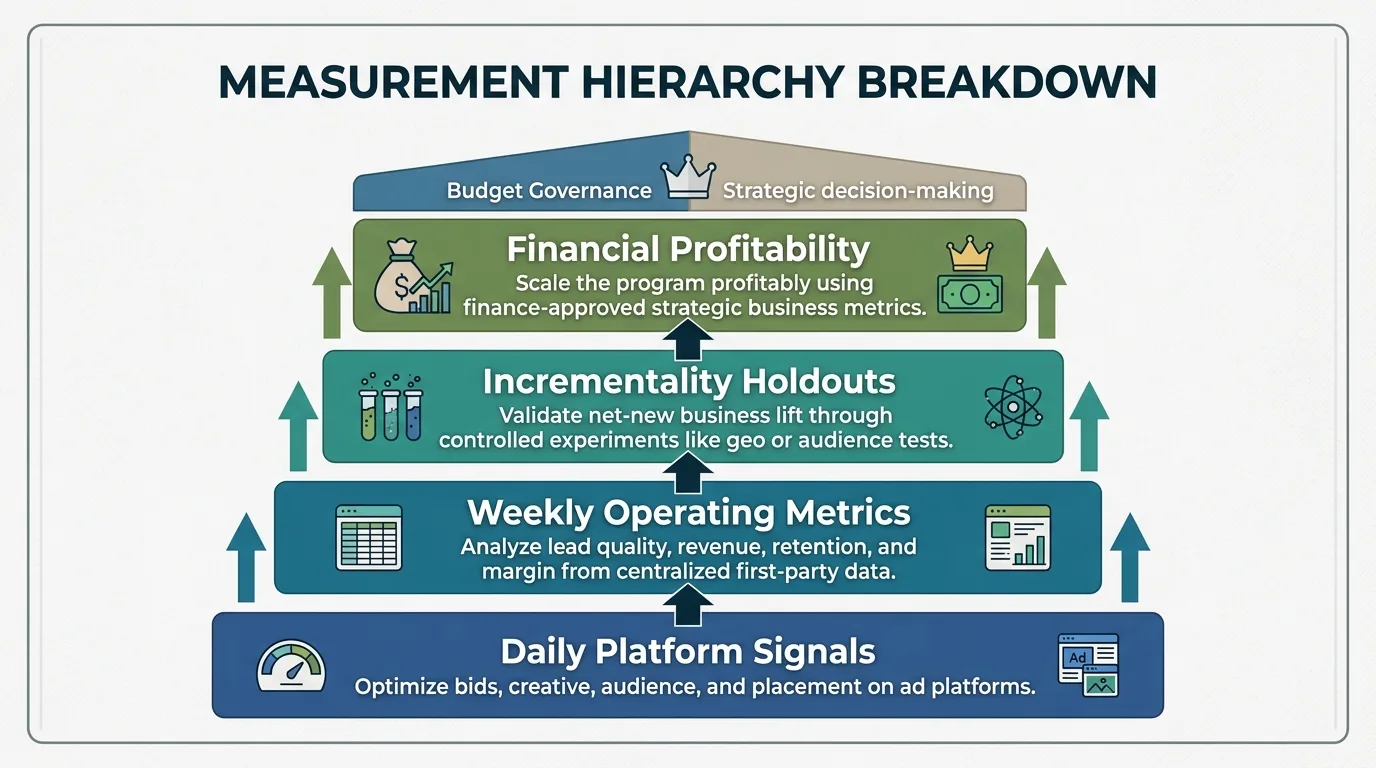
Measurement Hierarchy Breakdown
| Level | Focus | Primary Decision Type |
|---|---|---|
| Platform Reporting | Bids, creative, audience, placements | Daily optimization |
| First-Party Reporting | Lead quality, revenue, retention, margin | Weekly operating decisions |
| Incrementality Tests | Net-new business validation | Major allocation decisions |
| Finance Metrics | Profitable program scaling | Strategic budget governance |
A practical hierarchy might look like this:
- Platform reporting guides bid, creative, audience, placement, and campaign decisions.
- First-party reporting determines whether lead quality, revenue, retention, and margin are holding.
- Incrementality tests and geo or audience holdouts validate whether increased spend produces net-new business.
- Finance-approved metrics determine whether the program is actually scaling profitably.
Do not expect these systems to match exactly. They measure different things under different rules. The standard should be directional consistency and decision usefulness, not perfect numerical alignment.
This is also the moment to clean up tracking governance. Define event names, ownership, conversion windows, source-of-truth rules, and QA procedures. Keep a changelog for site releases, offer changes, tracking updates, and major campaign launches. When conversion rates move, your team should be able to separate a real market shift from a broken event or landing-page deployment quickly.
Shift From Attribution Certainty to Incremental Evidence
Last-click attribution made budget allocation look cleaner than it really was. A person can see a video ad, search the brand later, click a remarketing ad, and convert through an email sequence. Assigning 100% of the value to one final interaction is convenient, but it is rarely a full explanation.
Cookie loss makes this limitation harder to ignore. The answer is not to abandon attribution. It is to pair it with incrementality evidence.
Run controlled tests where the business can tolerate them. Geo tests can compare matched regions with different media exposure. Audience holdouts can measure whether suppressing a segment changes outcomes. Conversion lift studies can help assess platform impact. Budget pulse tests, where spend is deliberately increased or decreased for a defined period, can reveal whether total revenue moves in proportion.
No single test is perfect. A geo test can be distorted by local demand differences. Holdouts may be difficult when audiences are small. Budget tests can collide with seasonality or promotions. Use multiple methods over time instead of waiting for one definitive experiment.
The key question is simple: if this campaign disappeared, what would happen to total qualified leads, new customers, or contribution margin? That is the decision standard that matters when attribution reports disagree.
Creative Becomes a More Valuable Signal Source
As targeting signals become less precise, creative carries more of the burden of finding and qualifying demand. A strong creative system does not just produce ads. It generates structured evidence about customer motivations, objections, awareness levels, offers, and channel fit.
Treat each creative test as a hypothesis. One concept may test price sensitivity. Another may test urgency, product proof, a specific use case, expert authority, or a friction point in the buying process. Tag those variables consistently, then connect them to downstream outcomes. A high click-through rate with weak qualified conversion is not a winner. It is a clue that the message attracts the wrong intent.
This is where scale matters. Testing a few ads per month produces slow, noisy learning. High-velocity creative production gives media buyers enough inputs to identify patterns before performance decays. But volume without a system creates chaos. Standardize naming, briefing, approval, launch, and reporting so the team can isolate what changed and why.
At Conversion Collective, creative and media are treated as one operating system for this reason. Media buyers need fast access to new angles when performance shifts, while creative teams need downstream quality data to avoid optimizing for superficial engagement.
Build Resilience Channel by Channel
Cookie deprecation does not affect every platform, audience, or business model equally. Search can retain strong intent signals even when user-level paths are less visible. Social platforms may rely more heavily on modeled conversions and server-side feedback. Native and programmatic environments may require closer scrutiny of audience assumptions and post-click quality. Email, SMS, direct traffic, and organic demand can also appear to improve when paid attribution becomes less complete.
Avoid the temptation to solve uncertainty by spreading budget everywhere. Channel diversification works when each channel has a clear job, measurement approach, and creative plan. It fails when teams add channels simply because one dashboard has become less trustworthy.
Assign each channel a role: demand capture, demand creation, retargeting, reactivation, or testing. Set the right success metric for that role, then evaluate it against business-level results. A prospecting channel should not be judged by the same last-click efficiency target as branded search or high-intent remarketing.
The Operating Cadence That Keeps Spend Accountable
The practical response to degraded tracking is a tighter operating cadence, not more reporting theater. Review daily for anomalies, pacing, broken events, and clear creative fatigue. Review weekly for quality trends, spend allocation, and new test results. Review monthly for blended acquisition efficiency, retention signals, incrementality findings, and channel roles.
Keep decision logs. When a campaign is scaled, paused, or restructured, record the reason, the expected result, and the metric that will validate the decision. This creates institutional memory and prevents teams from relitigating the same assumptions every quarter.
Cookie deprecation will make some decisions less comfortable because the old certainty was often overstated. The answer is disciplined execution: better first-party signals, faster creative learning, controlled experiments, and a reporting system tied to real business outcomes. Build that system now, and your acquisition engine can keep scaling even when the dashboard gets less flattering.