
A campaign can hit its CPA target and still waste money. That happens when the conversions credited to ads would have occurred anyway through organic demand, direct traffic, email, branded search, or another channel. To calculate incremental lift, you need to measure the conversions your paid activity actually caused, not just the conversions an ad platform claimed.
For growth teams spending serious budget across Meta, Google, TikTok, Taboola, and other channels, this distinction changes how you allocate spend. Incrementality tells you whether scaling is creating new demand or simply paying for demand you already owned.
What Incremental Lift Actually Measures
Incremental lift is the additional outcome produced by a marketing intervention compared with what would have happened without it. The outcome may be purchases, qualified leads, subscriptions, installs, revenue, or profit.
Platform attribution answers a different question: which touchpoint received credit under that platform’s attribution rules? Those rules can be useful for daily optimization, but they are not proof of causation. A seven-day click, one-day view attribution model may report strong performance while counting customers who were already on their way to convert.
Incrementality creates a counterfactual: what would this audience, geography, customer segment, or time period have done without the campaign? Because no one can observe both realities at once, the job is to build a credible control group that represents the untreated outcome.
The Formula to Calculate Incremental Lift
At its simplest, calculate incremental lift by comparing the conversion rate of an exposed test group with the conversion rate of a comparable control group:
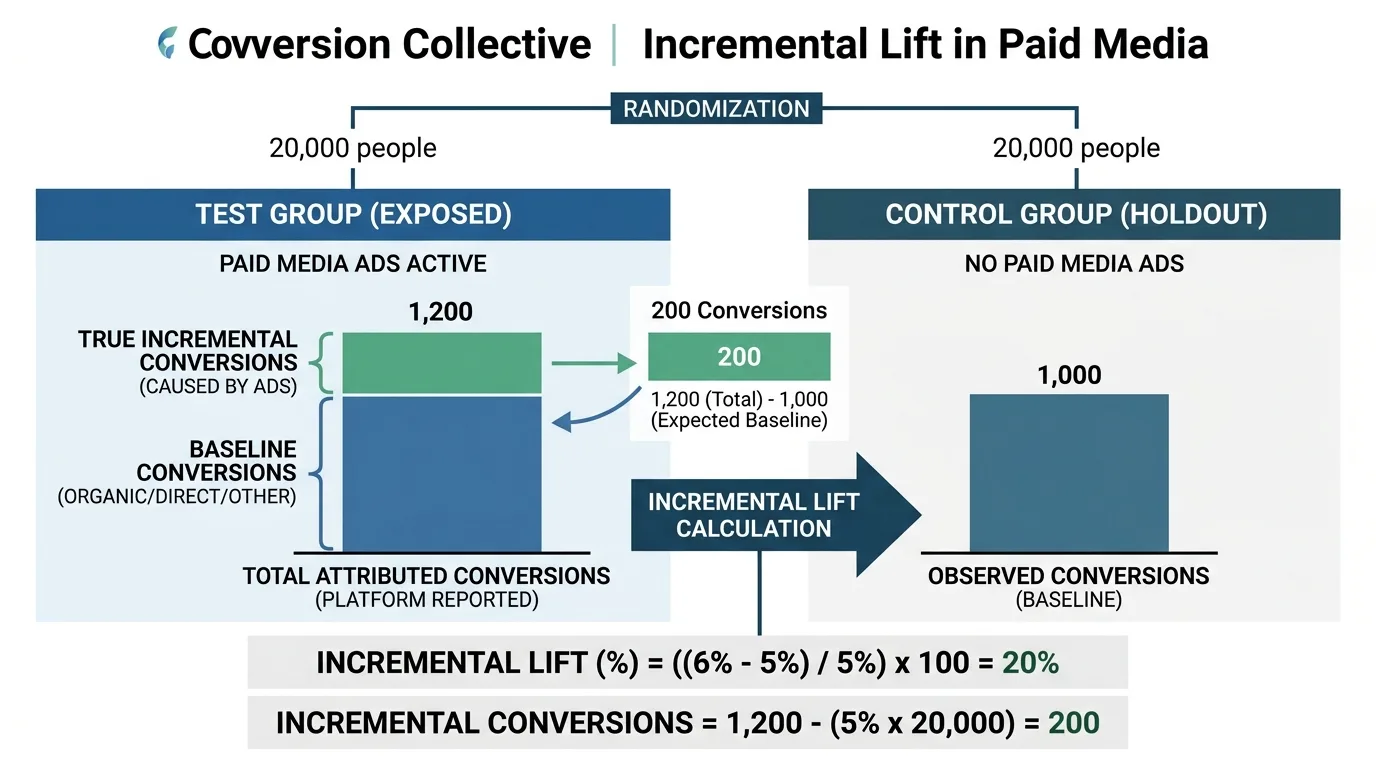
Incremental lift (%) = ((Test conversion rate - Control conversion rate) / Control conversion rate) x 100
Suppose a holdout test produces the following result:
- Test group: 1,200 purchases from 20,000 people, or a 6% conversion rate
- Control group: 1,000 purchases from 20,000 people, or a 5% conversion rate
The incremental lift is ((6% - 5%) / 5%) x 100 = 20%.
That means the campaign increased conversion rate by 20% relative to the baseline. It does not mean that 20% of all recorded conversions were incremental. For that, calculate the incremental conversion count:
Incremental conversions = Test conversions - (Control conversion rate x Test group size)
In this example, the expected baseline conversions in the test group were 5% x 20,000 = 1,000. The campaign generated 1,200 conversions, so it drove 200 incremental purchases.
If spend was $10,000, incremental CPA is $10,000 / 200, or $50. That is the number that should influence budget decisions, not the platform-reported CPA based on all 1,200 attributed purchases.
Start With the Business Decision, Not the Test Format
The best measurement design depends on the decision at stake. A team deciding whether to maintain brand search coverage needs a different test from a team determining whether TikTok prospecting generates profitable new customers.
Define the intervention first. Be specific about what is changing: total channel spend, a campaign type, a creative concept, a bidding strategy, or the presence of ads in selected markets. Then define the primary success metric. Revenue and contribution profit are usually stronger decision metrics than leads or purchases alone, particularly when lead quality and repeat purchase behavior vary.
Next, set the threshold that makes a result actionable. A channel may create positive lift but still fail to clear your required incremental CPA or payback period. Incrementality is not a trophy metric. It is an input for deciding where the next dollar should go.
Choose a Test Design That Matches Your Operating Reality
User-Level Holdout Tests
A user-level holdout randomly withholds a portion of an eligible audience from advertising while the rest can receive ads. Because assignment happens at the individual level, this is often the cleanest approach when a platform or your customer data infrastructure supports it.
Use a true randomized holdout where possible. The test and control groups should have the same eligibility rules, duration, and measurement window. The only intended difference is ad exposure.
This approach works well for retargeting, CRM audiences, and conversion campaigns with enough volume. Its main trade-off is operational: withholding users can reduce short-term attributed results, and small holdouts may not generate enough data for a confident read.
Geo Holdout Tests
Geo testing splits markets into test and control groups. You may increase spend in selected designated market areas while maintaining or reducing spend in comparable markets. It is valuable when user-level experimentation is unavailable or when you need to measure the combined impact of multiple platforms.
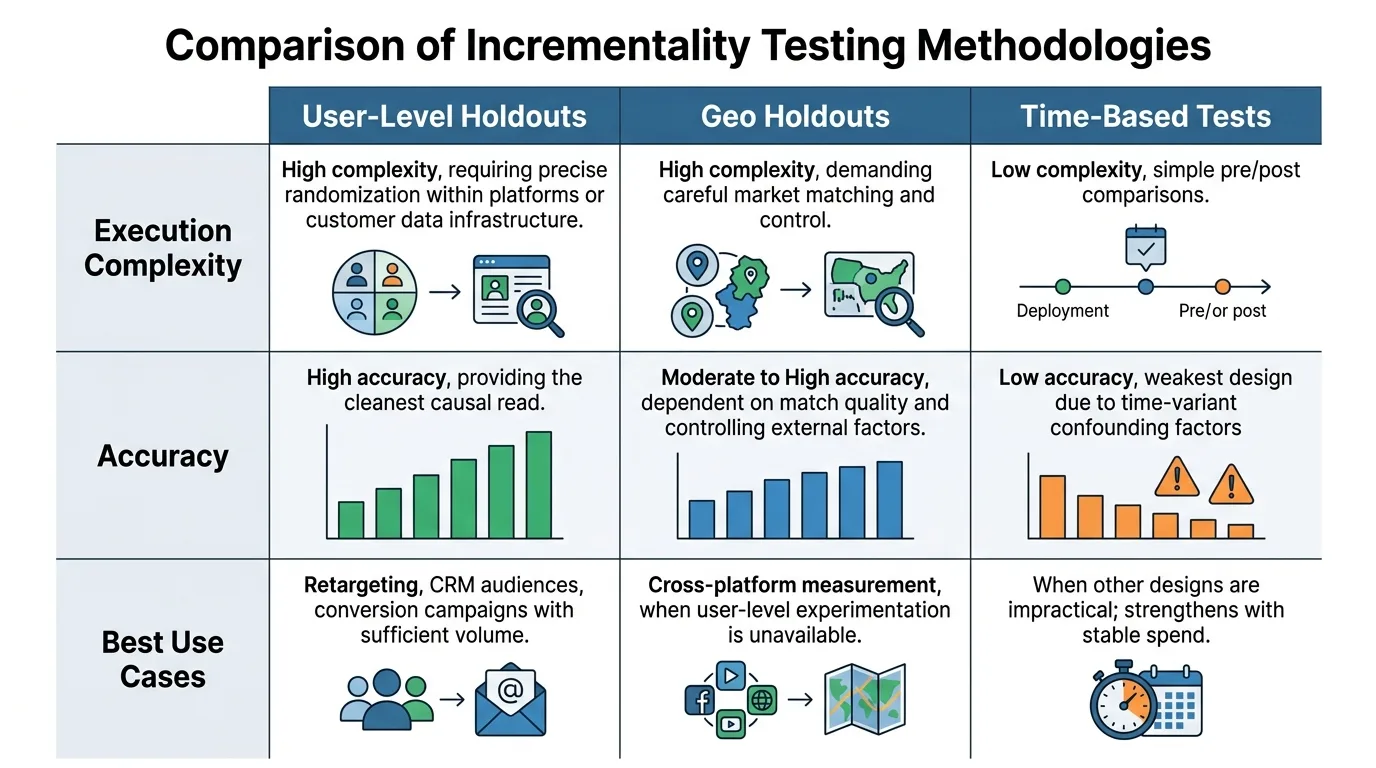
The hard part is matching markets correctly. A high-income coastal market and a lower-cost rural market are not interchangeable controls simply because their populations look similar. Match on historical conversion volume, seasonality, product mix, pricing, and media behavior. Use a pre-test period to validate that the markets move similarly before the intervention.
Geo tests also require careful execution. National TV, PR, affiliate activity, promotions, inventory constraints, and regional sales efforts can contaminate results. The design is only as good as your ability to control or account for these factors.
Time-Based Tests
Time-based tests compare results before and after a media change. They are easy to launch but generally weaker because demand changes over time. A promotion, holiday period, competitor outage, product launch, or algorithm shift can look like media lift.
Use time-based measurement when it is the only practical option, but avoid treating it as definitive causal proof. Strengthen the design with multiple comparison series, stable spend outside the tested variable, and enough historical data to account for normal volatility.
Protect the Test From the Errors That Distort Results
Incrementality testing fails most often through execution discipline, not math. The control group must remain unexposed as much as possible. If control users see ads through another campaign, device, or platform, the measured lift will be understated.
Creative consistency matters too. Do not simultaneously change landing pages, offers, pricing, and media strategy unless the purpose is to evaluate the entire package. If several variables move at once, you may learn that performance changed without knowing why.
Keep attribution windows and conversion definitions consistent across test and control. Count outcomes from first-party systems whenever possible, then reconcile them against platform reporting rather than allowing each platform to define success independently.
Finally, do not stop a test because early results look favorable. Short windows are vulnerable to random variation and day-of-week patterns. Decide the minimum duration and sample size before launch. If conversion volume is low, the honest answer may be that the test needs more time, more markets, or a larger treatment difference.
Read the Result Alongside Efficiency and Scale
A positive lift result is only the first layer. The next question is whether the lift is profitable at meaningful spend.
Calculate incremental revenue by multiplying incremental conversions by average realized revenue per conversion. For ecommerce, use net revenue after discounts, refunds, and cancellations where possible. For lead generation, use downstream CRM outcomes, not form fills. For subscriptions, account for trial-to-paid conversion and retention behavior.
Then compare incremental profit with ad spend and variable costs. A campaign can show an attractive incremental CPA but still fail if it brings low-value customers or consumes operational capacity that could be deployed elsewhere.
Also examine marginal lift. The first $20,000 in spend may produce efficient new demand, while the next $20,000 mostly reaches people who would have converted anyway. This is why a single test result should not become a permanent budget rule. Re-test as spend, creative, audiences, and market conditions change.
Turn Lift Into Better Media Decisions
Use platform reporting for fast in-platform decisions: pausing weak ads, identifying creative patterns, managing frequency, and finding scalable audience pockets. Use incrementality tests to validate the bigger allocation decisions: whether a channel deserves more budget, whether branded search is defensive or accretive, whether retargeting is oversaturated, and which prospecting programs are creating net-new customers.
That operating rhythm keeps speed and accountability in the same system. At Conversion Collective, the objective is not to create a perfect-looking dashboard. It is to run enough disciplined testing that creative production, media buying, and budget allocation move toward profitable growth.
The practical standard is simple: if you cannot explain what changed in the control group, what changed in the test group, and what the additional conversions were worth, you do not yet have a reliable scaling signal. Build the test, protect the control, and let incremental profit determine where the next budget increase goes.